
Success Stories: Real-World Examples of Australian Businesses with Offshore Teams
- Offshore staffing
- Remote teams
- Australian business
- Payroll outsourcing
- Case studies

Australian offshore staffing success stories show that remote teams produce reliable results when specialist talent is supported by documented workflows, clear ownership, approval controls and ongoing management. The strongest examples involve more than moving tasks overseas. They redesign delivery so Australian businesses gain capacity without losing accountability, compliance oversight or service quality.
Introduction
Australian businesses do not need another collection of vague offshore team testimonials claiming that remote hiring saves time and money. They need to see what changed operationally, how the work was transferred and which controls made the result sustainable.
The case studies below come from Remotee's direct delivery experience. Client names are withheld for confidentiality, but the challenges, interventions and outcomes are real. They show why predictable delivery matters more than adding headcount.
Remotee delivery evidence
| Evidence from Remotee's work | Recorded result | Source |
|---|---|---|
| Recruitment agency payroll implementation | Discovery, implementation and live delivery completed within 2 weeks | Remotee client delivery data supplied for this article |
| Non-billable partner time released per pay cycle | 6-10 hours across recruitment agency engagements | Remotee data from 15 implementations in 2026 |
| Ongoing approval requirement in the featured recruitment case | Approval of one email each fortnight | Remotee client delivery data supplied for this article |
Key takeaways
- Offshore staffing succeeds when workflows and ownership are designed before tasks are transferred.
- Australian businesses remote teams support can cover specialist, compliance-sensitive functions, not merely basic administration.
- Remote payroll can release substantial partner capacity when approvals, exceptions and responsibilities are clearly defined.
- Cost reduction is only one outcome. Better controls, greater continuity and clearer accountability often matter more.
- A credible case study separates observed results from estimates and avoids unsupported savings claims.
- Payroll is a business-critical trust function and should be operated as one.
Summary table
| Example | Initial problem | Delivery change | Observed outcome |
|---|---|---|---|
| Recruitment agency | Founders were spending time on payroll and accounting instead of business development and operations | A specialist team, customised payroll workflow and fortnightly approval checkpoint were installed | Payroll administration and queries moved away from the founders, releasing non-billable partner time |
| Hospitality recruitment and labour hire company | Internal staff and external accountants were duplicating payroll work at substantial expense | Payroll ownership was consolidated, the pay cycle changed and award requirements were reviewed | Lower payroll operating costs, less duplicated work and stronger compliance processes |
| Structured offshore delivery model | A business adds people without defining how work should move | Roles are wrapped in documented processes, controls, reporting and escalation paths | Capacity becomes more predictable and less dependent on individual memory |
What these offshore staffing success stories actually prove
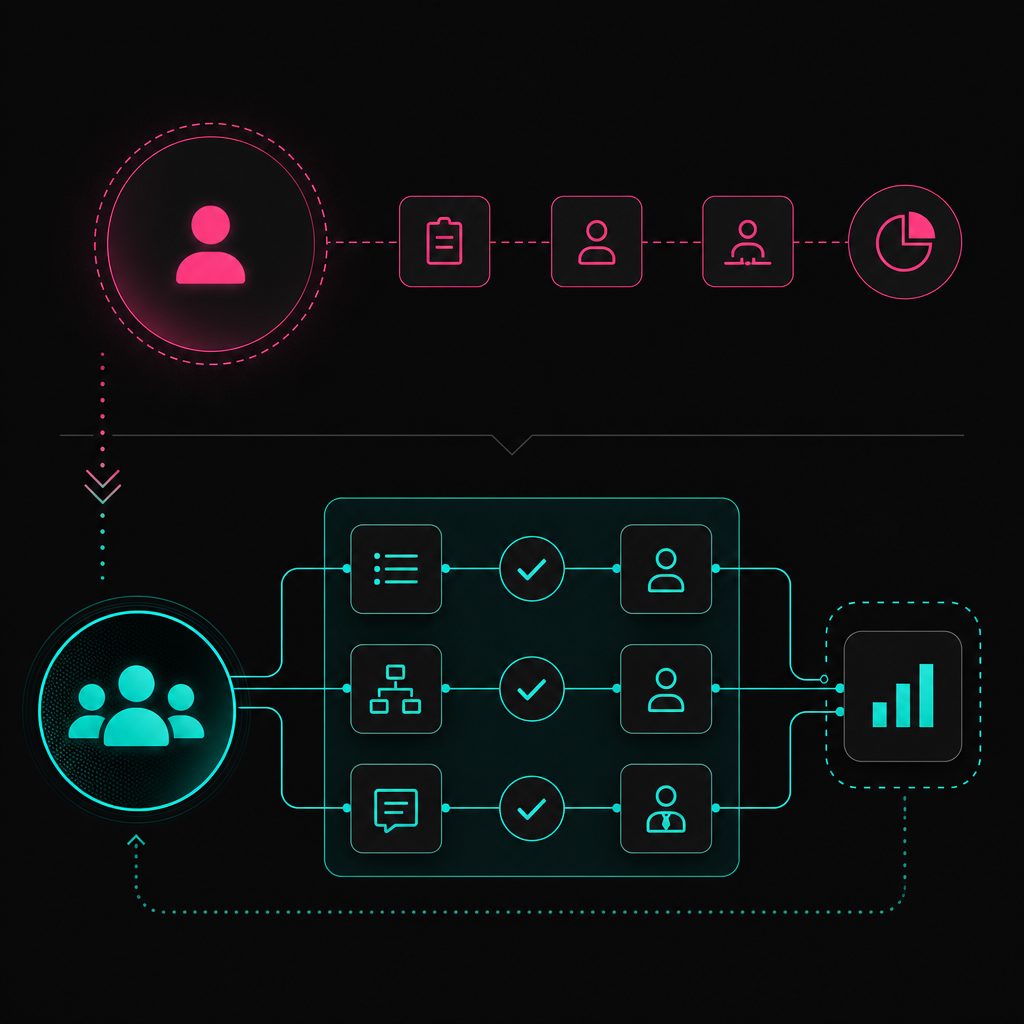
These offshore staffing success stories prove that the decisive factor is not where a team member sits. It is whether the business has defined the work, assigned ownership and installed reliable controls. Offshore talent can expand capacity, but only a functioning delivery system turns that capacity into consistent business performance.
Most offshore staffing content focuses on labour cost, hiring speed and access to a larger talent pool. Those benefits may influence the decision, but they do not explain why some remote teams work while others create more management pressure.
The difference is operational design. A reliable model answers practical questions before delivery begins:
- Which tasks belong to the offshore specialist?
- What information must be available before work starts?
- Who can approve a pay run, adjustment or exception?
- How are urgent issues escalated?
- What evidence shows that each step was completed?
- Who owns the process if a key person is unavailable?
Without these answers, a business has transferred activity rather than responsibility. The owner or local manager still carries the mental load. They remain the person remembering deadlines, finding missing information and checking whether work happened.
That is why Remotee's position is direct: the difference between a capacity gap and a capacity crisis is usually a delivery structure problem, not a talent problem.
This also addresses a common myth about quality. Local proximity does not automatically create accountability. A local employee working from an undocumented process can introduce as much risk as any remote worker. Quality comes from role clarity, specialist capability, review controls and visible performance.
The human side matters as well. Offshore specialists need context, access to decision-makers and a clear place within the operating rhythm. Treating remote staff as an anonymous task queue weakens judgement and ownership. Treating them as accountable specialists, with defined boundaries and support, produces a stronger working relationship.
Case study: releasing recruitment founders from payroll operations
A recruitment agency's founders wanted to concentrate on new business development and operational execution, but payroll and accounting work kept pulling them back into administration. Building and managing another internal function did not offer an attractive commercial return, so Remotee designed a specialist payroll delivery system around the agency's existing software and processes.
The challenge
Recruitment agency payroll carries operational complexity. Timesheets, worker queries, superannuation, leave, PAYG withholding, reporting and payment approvals must align. Labour hire arrangements can add award and allowance considerations. The work is deadline-driven, while errors are immediately visible to workers.
The founders did not merely need another person to enter data. They needed the function to operate without depending on their daily attention.
This distinction is important. Hiring an offshore payroll assistant without redesigning the workflow could have shifted data entry while leaving the founders responsible for checking inputs, chasing missing timesheets and resolving every exception. That would reduce tasks without removing ownership.
The intervention
Remotee completed discovery and implementation within 2 weeks, based on the author's supplied client delivery data. The work included understanding the agency's payroll cycle, software, information flows, approval requirements and recurring queries.
A customised payroll system and team were then installed. Responsibility covered payroll processing, superannuation, compliance activities, tax-related payroll administration, inbound worker queries and timesheet questions.
The control point for the founders became deliberately narrow. Rather than participating throughout the pay cycle, they approved one email each fortnight. The specialist team managed the process around that approval.
This is what predictable delivery looks like in practice. The founders retained authority without remaining trapped in execution.
The outcome
Remotee's records across 15 recruitment agency implementations in 2026 show a reduction of 6-10 hours in non-billable partner time per pay cycle. This is Remotee's own book-of-business data, not a general market benchmark.
The featured agency also reduced the founders' ongoing payroll involvement to approving one email each fortnight. Payroll processing, queries, timesheet issues, superannuation and compliance administration were handled by the delivery team.
The result should not be reduced to an hourly saving. The more valuable change was that founder attention became available for recruitment, client development and operational decisions. Those are functions where founder judgement creates more value than routine payroll administration.
The operational testimonial
No verbatim client quote has been supplied for publication, so it would be wrong to manufacture one. The strongest testimonial is the operating result itself: after implementation, the founders' recurring payroll obligation was approval of one email each fortnight while the specialist team managed the function around them.
That is more useful than a generic statement about being satisfied. It tells another business exactly what changed.
Case study: consolidating payroll for a hospitality labour hire company
A hospitality recruitment and labour hire company had internal employees and external accountants involved in payroll. The arrangement created high operating costs, duplicated responsibility and heavy weekly workloads. Remotee consolidated the function under a specialist team, changed the payroll rhythm and introduced a clearer compliance-focused operating model.
The challenge
Hospitality labour hire payroll can involve different classifications, award conditions, allowances and working patterns. The company had several parties touching the process, but more involvement did not create clearer accountability.
This is a common structural problem. Internal staff may gather timesheets, managers may answer exceptions, accountants may review calculations and owners may approve payments. Each party sees part of the process, while no single team owns delivery from input to resolution.
The weekly payroll cycle also concentrated workload. Every cycle required the same collection, calculation, checking, reporting and query-handling activities.
The intervention
Remotee's specialist team completed discovery and presented a system that replaced the fragmented arrangement. Payroll work previously handled by internal resources and external accountants was consolidated into one managed delivery function.
The business also moved from weekly to fortnightly payroll. That decision was not made simply to halve administrative events. A pay-cycle change must consider employment obligations, worker communication, contracts, awards and cash flow. The value came from redesigning the process around a viable cycle rather than changing frequency in isolation.
During implementation, the team identified multiple industry award requirements that had not been fully recognised in the previous arrangement. The new process incorporated those considerations into recurring payroll controls.
Fair Work Ombudsman guidance confirms that employers must keep required employee records and issue compliant pay slips. Its information on pay slips explains the employer's obligations. Outsourcing processing does not outsource legal accountability, so the operating model must preserve Australian oversight and reliable records.
The outcome
The company reduced payroll-related operating expenditure by removing duplicated internal and external involvement from the payroll workflow. It also reduced payroll processing costs after moving from weekly to fortnightly delivery.
No dollar figure has been supplied, so one should not be implied. The verifiable outcomes were structural:
- Internal payroll workload was removed from the previous roles.
- External accountant involvement in routine payroll was removed.
- Payroll frequency moved from weekly to fortnightly.
- Responsibility shifted to one specialist delivery team.
- Compliance processes improved after previously unrecognised award requirements were identified.
This case shows why offshore staffing should not be judged only by wage comparisons. The larger opportunity was process consolidation. The business replaced overlapping effort with clear ownership.
Why structured remote teams outperform isolated offshore hires

Structured remote teams outperform isolated hires because the delivery model defines how work enters, moves through and leaves the function. A capable person cannot compensate indefinitely for unclear inputs, changing expectations or missing approvals. Documentation, controls and management cadence make quality repeatable instead of dependent on individual effort.
Most providers compete on cost, speed or CV volume. Remotee competes on reliability. That means designing the operating environment around the role rather than sending a CV and leaving the client to work out delivery.
Document the workflow before expanding headcount
A process does not need to become a massive procedure manual. It does need to identify triggers, required inputs, task owners, approval points, evidence and escalation rules.
For payroll, the trigger may be the timesheet cut-off. Inputs include approved hours, leave, allowances and employee changes. The output is not merely a calculated pay run. It includes approval evidence, reporting, employee records, Single Touch Payroll activity and query resolution.
The Australian Taxation Office's Single Touch Payroll guidance explains the reporting framework employers must follow. These obligations should appear inside the workflow, not sit in a separate compliance folder nobody consults.
Give one team end-to-end ownership
Shared work is not the same as shared accountability. When several people each own a small piece, the business owner often becomes the unofficial process manager.
End-to-end ownership gives one delivery team responsibility for moving the work forward. Local leaders still approve material decisions, but they do not need to coordinate every hand-off.
Your payroll should not depend on one busy admin person remembering everything. It should also not depend on a founder acting as the connection between unrelated providers.
Build security into normal operations
Offshore staffing can involve access to personal and commercially sensitive information. That requires deliberate access controls, secure authentication, device standards and clear rules for handling data.
The Office of the Australian Information Commissioner's guidance on cross-border disclosure of personal information is particularly relevant when personal information may be disclosed overseas. Businesses should obtain advice about how the Privacy Act applies to their circumstances.
The Australian Signals Directorate's Essential Eight also provides a recognised baseline for cyber security controls. Not every control will be implemented identically in every business, but offshore access should never rely on informal password sharing or unmanaged devices.
Manage specialists as part of the business
Good remote delivery still requires leadership. Offshore staff need clear priorities, feedback and context about why the work matters. They should know what they can decide, when they must escalate and how performance is reviewed.
This is not micromanagement. It is operational clarity. The goal is to give specialists enough structure to act confidently without waiting for instructions on every routine matter.
How the Accountee Payroll Process turns hiring into delivery
The Accountee Payroll Process converts a payroll staffing requirement into a managed operating function. It begins with discovery, transfers ownership through a controlled transition, establishes full payroll processing and continues with active management. Each phase reduces ambiguity, protects approval authority and makes recurring delivery visible to the Australian business.
Phase 1: Payroll Discovery and Setup
The team reviews the current payroll process, pay cycles, staff types, award considerations, systems, approvals and reporting requirements. The output is a clear operating model rather than a loose list of tasks.
Discovery also exposes hidden dependencies. A manager may hold information in an inbox. An administrator may remember an allowance rule without documenting it. An external accountant may be checking an issue that everyone assumes belongs to somebody else.
Phase 2: Payroll Transition
The transition covers system access, templates, pay-run calendars, employee data, timesheet flows and approval checkpoints. Work is moved deliberately, with responsibilities confirmed before the previous arrangement is removed.
This phase matters because abrupt hand-offs create gaps. A proper transition shows which information has moved, which access is active and how the next live cycle will be controlled.
Phase 3: Full Payroll Processing
The specialist team manages timesheet review, pay calculations, leave, allowances, deductions, Single Touch Payroll, superannuation, payroll reporting and pay-run preparation.
Specialist payroll accountants, not generalist bookkeepers. Payroll done properly. Not squeezed in between tax returns.
That position is not a criticism of bookkeeping. It recognises that payroll is deadline-driven, employee-facing and exposed to changing awards, records and reporting obligations. Payroll is too important to be "mostly right".
Phase 4: Ongoing Payroll Management
The final phase covers recurring delivery, issue resolution, compliance support, reporting and account management. The process is not considered complete when the first pay run succeeds.
Ongoing management is where reliability is maintained. Exceptions are reviewed, process changes are documented and performance problems are addressed before they become habitual.
The most useful success metric is owner dependence
The offshore staffing industry pays too much attention to headcount and hourly cost. A better question is whether the business can deliver without the owner coordinating routine work. If an offshore hire is inexpensive but still requires constant prompting, checking and escalation, the underlying capacity problem remains unresolved.
This is Remotee's non-consensus position: adding headcount without adding a system is how scaling creates chaos.
Consider two hypothetical businesses that hire equally capable offshore payroll specialists. In the first, approvals arrive inconsistently, award decisions live in emails and exceptions go straight to the owner. In the second, cut-offs are defined, inputs have owners, approvals follow a calendar and exceptions have an escalation path.
The talent may be identical. The outcome will not be.
That is why Remotee measures success through operational evidence such as:
- Founder and partner involvement required per pay cycle.
- Work completed by the agreed deadline.
- Exceptions resolved through the defined escalation path.
- Queries handled without unnecessary hand-offs.
- Approvals completed at the correct control point.
- Documented coverage when a team member is unavailable.
This perspective also changes how businesses assess case studies offshore staff providers publish. A useful case study should explain the initial process, the intervention and the observable operating result. Unsupported percentages, anonymous praise and broad cost claims do not establish reliability.
The Australian Competition and Consumer Commission states that businesses must not make false or misleading claims. Offshore team testimonials should therefore distinguish client evidence, provider data and hypothetical examples clearly.
The aim is predictable delivery, not just headcount. That is how an owner moves from Doer to Strategist without losing control of a business-critical function.
How to assess whether an offshore success story applies to your business
An offshore case study is relevant when its operating conditions resemble yours, not merely because the featured company shares your industry. Compare workflow complexity, compliance exposure, management capacity, systems and approval requirements. Then determine whether the provider solved the underlying delivery problem or only supplied another person.
Start by asking for detail. What tasks moved? Who owned implementation? What stayed with the Australian business? How were access and approvals controlled? What happened when data was late or incorrect?
Review the evidence with the same discipline you would apply to any operational supplier. Remotee's published case studies can help you examine the relationship between the initial problem, delivery system and result.
Be cautious when a story relies entirely on wage savings. Labour cost can be relevant, but a lower hourly rate cannot compensate for rework, missed deadlines, weak controls or management overhead.
For payroll, also confirm that the team understands Australian obligations. Fair Work's record-keeping guidance and modern awards information are useful starting points. Specialist advice may still be required for a business's specific workforce arrangements.
Discover your own offshore staffing success story
A successful offshore team should give your business controlled capacity, not another group of people to supervise. Remotee starts with the work, responsibilities and compliance environment before building the team around them. The result is a delivery function designed to operate reliably as the business grows.
If payroll, administration or another specialist process remains dependent on founders and overloaded internal staff, the first step is not automatically recruitment. It is identifying where ownership, documentation and controls are missing.
Contact Remotee to discuss the function you need to stabilise, the capacity you want to release and the operating system required around the role.
References
These references cover the Australian payroll, workplace, privacy, security and advertising obligations discussed in this article. They are primary guidance from recognised Australian regulators and government bodies. Requirements can change, so businesses should confirm the current guidance and obtain professional advice where their workforce arrangements or data handling create additional complexity.
- Fair Work Ombudsman: Pay slips
- Fair Work Ombudsman: Record-keeping
- Fair Work Ombudsman: Awards
- Australian Taxation Office: Single Touch Payroll
- Office of the Australian Information Commissioner: APP 8 and cross-border disclosure
- Australian Signals Directorate: Essential Eight
FAQ_SCHEMA_JSON
FREQUENTLY ASKED QUESTIONS
Common questions
What results can Australian businesses expect from offshore staffing?
- Australian businesses can expect additional specialist capacity, reduced internal administration and clearer process ownership when offshore roles are properly structured. Results depend on workflow quality, management and role suitability. Remotee's recruitment agency data recorded 6-10 hours less non-billable partner time per pay cycle across 15 implementations in 2026.
How quickly can an offshore team become operational?
- Timing depends on role complexity, system access, documentation, recruitment and compliance requirements. In the recruitment payroll case featured here, Remotee completed discovery and implementation within 2 weeks. That is a specific client result, not a universal implementation promise.
Are offshore staffing case studies verifiable?
- A credible case study should identify the starting problem, intervention, observed outcome and source of any figures. Confidentiality may prevent the client's name from being published, but the provider should still explain what changed. Avoid relying on unsupported savings percentages or testimonials without operational detail.
Is payroll safe to manage through an offshore team?
- Payroll can be managed safely offshore when access, privacy, approvals, documentation and Australian compliance oversight are properly designed. Outsourcing does not remove the employer's obligations. Specialist delivery may be safer than an overloaded internal process, but each business must assess its legal and security requirements.
Which roles are best suited to offshore staffing?
- Roles with repeatable workflows, digital inputs, measurable outputs and clear escalation paths are usually strong candidates. Examples include payroll processing, accounting support, administration, customer support and recruitment operations. Highly ambiguous roles can also work, but they require stronger management and decision frameworks.
How should Australian businesses manage privacy with offshore staff?
- Businesses should map what personal information offshore staff can access, apply appropriate technical controls and review whether cross-border disclosure rules apply. Access should follow job requirements rather than convenience. The OAIC's Australian Privacy Principles guidance and professional legal advice can help clarify obligations.

Jon Kelly
Founder, Remotee
Jon helps Australian businesses build compliance-led offshore teams that scale without the burnout. NDIS, accounting, mortgage broking, recruitment and digital marketing.
KEEP READING
Related posts
benefits of offshore staffing Australia
Benefits of Offshore Staffing for Australian Businesses: Beyond Cost Savings
The benefits of offshore staffing for Australian businesses extend well beyond lower employment costs. A well-structured offshore team can expand specialist cap…
14 August 2026 · 18 min read
Offshore staffing service inclusions
Offshore staffing service inclusions
An offshore staffing service should include workforce planning, candidate sourcing, screening, compliant employment, payroll, onboarding, technology setup, secu…
31 August 2026 · 20 min read
offshore project management staff Australia
Offshore Project Management Staffing for Australian Businesses
Offshore project management staffing gives Australian businesses access to dedicated project coordinators, PMO analysts and project managers without building ev…
23 August 2026 · 19 min read
READY TO SCALE WITHOUT THE BURNOUT?
Build a compliance-led offshore team in 3–4 weeks.
Tell us about your current bottleneck and we'll show you what a Remotee placement would look like for your operation.
Or get our playbooks emailed to you instead.