
The Role of AI in Offshore Staffing: Enhancing Efficiency and Selection
- AI offshore staffing
- offshore recruitment
- remote teams
- AI recruitment
- business process automation

AI offshore staffing in Australia combines artificial intelligence with structured remote hiring to improve sourcing, screening, onboarding and routine delivery. AI can reduce administration and expose workflow problems, but it should not make unchecked employment decisions. The strongest model combines specialist offshore staff, documented processes, Australian oversight and accountable human judgement.
Artificial intelligence is changing how Australian businesses build and manage offshore teams. The opportunity is not simply faster recruitment. Used properly, AI can improve candidate matching, standardise recurring work and give managers earlier visibility of delivery risks.
However, adding AI to an undocumented process usually automates confusion. This guide explains where AI belongs, where human judgement remains essential and how to build an offshore operating model that produces predictable delivery.
Key takeaways
- AI can accelerate talent sourcing, initial screening, interview scheduling and candidate communication.
- Recruitment decisions still require accountable human review, particularly where automated tools may reproduce historical bias.
- Automating offshore processes works best after ownership, inputs, approvals and exceptions have been documented.
- Performance oversight should focus on outcomes, quality and service levels, not invasive activity surveillance.
- Australian businesses remain responsible for privacy, workplace compliance and information security when work is performed offshore.
- The commercial goal is predictable delivery, not simply lower headcount costs.
Summary table
| Area | Useful AI application | Human responsibility | Main risk |
|---|---|---|---|
| Talent sourcing | Search, skills matching and shortlist support | Define role outcomes and validate experience | Poor criteria produce irrelevant candidates |
| Candidate screening | Application summaries and structured comparisons | Review evidence and make employment decisions | Bias, false negatives and opaque scoring |
| Interview scheduling | Calendar coordination and reminders | Handle exceptions and candidate relationships | Impersonal communication |
| Onboarding | Knowledge retrieval, checklists and training support | Confirm access, understanding and accountability | Incorrect or outdated instructions |
| Offshore operations | Drafting, classification and routine task routing | Approve outputs and manage exceptions | Errors scaling across a workflow |
| Performance oversight | Quality trends, queue analysis and exception alerts | Coach staff and interpret context | Surveillance and misleading productivity signals |
| Compliance | Document checks and deadline reminders | Obtain specialist advice and approve regulated work | Treating AI output as professional advice |
Remotee implementation data, 2026
| Result | Recorded scope | Source |
|---|---|---|
| 6-10 hours less non-billable partner time per pay cycle | Recruitment agency payroll implementations | Remotee's own data from 15 implementations in 2026 |
| 15 implementations | Recruitment agency clients | Remotee's own 2026 implementation data |
| 100% compliance result | Supplied implementation records | Remotee's own 2026 business data |
What AI actually changes in offshore staffing
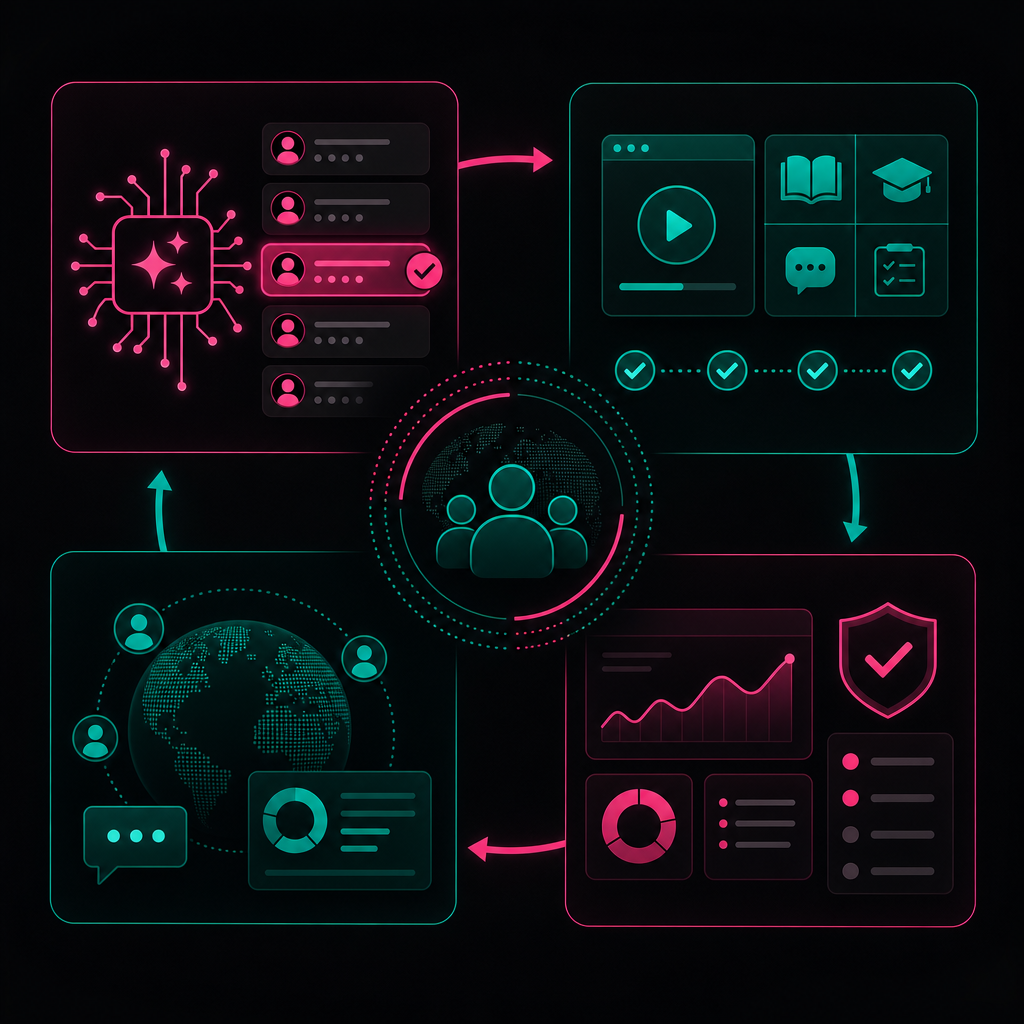
AI changes the speed and consistency with which offshore work can be searched, classified, drafted, checked and routed. It does not remove the need for capable people or sound management. Its practical value comes from reducing repetitive decisions while making exceptions visible to the person responsible for the final outcome.
Traditional offshore staffing often begins with a position description and a request for CVs. That approach treats hiring as the whole solution. It is not. A suitable employee can still fail when the role lacks documented inputs, ownership, approval points or a clear definition of done.
AI can support four connected layers:
- Selection: finding and comparing people against defined role requirements.
- Enablement: helping new team members locate procedures, templates and approved answers.
- Execution: drafting, classifying, reconciling or routing repeatable work.
- Oversight: identifying unusual results, missed service levels and queues requiring attention.
The important distinction is between assistance and accountability. An AI tool might summarise a candidate's CV, but a manager remains responsible for deciding whether the evidence supports progression. It might flag a payroll discrepancy, but an authorised specialist must investigate and approve the pay run.
This is why artificial intelligence remote hiring needs an operating system around it. The role, workflow and decision rights must be designed before software is selected.
How AI supports offshore talent sourcing and selection
AI powered recruitment offshore can help recruiters search larger candidate pools, identify relevant skills and produce consistent application summaries. It is most reliable when it supports a structured selection process. It becomes risky when employers allow an unexplained score to determine who receives an interview or employment opportunity.
Talent sourcing
Recruiters can use AI-assisted search to connect role requirements with different descriptions of the same capability. A payroll specialist might describe experience through awards, STP, superannuation, timesheets or a specific payroll platform. Semantic search can recognise those relationships more effectively than a basic keyword filter.
That does not excuse a vague brief. Before sourcing starts, define:
- the outcomes owned by the role
- essential technical capabilities
- systems the employee will use
- decisions the employee may make independently
- matters requiring Australian approval
- expected evidence of past work
- communication and working-hour requirements.
AI cannot reliably infer a business owner's unstated expectations. A poor role definition merely produces a faster pile of weak matches.
Candidate screening
AI can summarise CVs, compare applications against a documented rubric and prepare structured interview questions. Those are support functions, not final decisions.
Recruiters should test every screening criterion for job relevance. Employment gaps, writing style, school names or similarity to previous successful employees can become proxies for characteristics unrelated to capability. The Australian Human Rights Commission's Human Rights and Technology Final Report recommends stronger accountability for high-impact automated decisions, a principle directly relevant to recruitment.
A defensible screening workflow should record:
- which information the tool assessed
- the criteria supplied to it
- which version of the model or service was used
- who reviewed the output
- why the candidate progressed or did not progress
- how a candidate can request human consideration.
Scheduling and candidate communication
Scheduling is a lower-risk use case. AI assistants can compare calendars, account for time zones, send reminders and answer approved process questions. This removes coordination work without delegating a consequential employment decision.
Candidate communication still needs restraint. Applicants should know when they are interacting with automated systems. Sensitive personal information should not be pasted into an unapproved public tool. Messages also require a human escalation path when a candidate raises a contractual, accessibility or personal issue.
A warning from Amazon's abandoned recruitment tool
Amazon's experimental recruiting system became a widely cited example of historical bias entering an automated process. Reuters reported in 2018 that the company abandoned the tool after it showed bias against women. The system had learnt patterns from historical CV data rather than discovering a neutral definition of merit.
The lesson is not that all recruitment AI is unusable. The lesson is that past hiring behaviour is not an objective ground truth. Australian employers need job-relevant criteria, representative testing, documented human review and a way to challenge results.
Where AI improves offshore operations

AI improves offshore operations when it is applied to stable, repeatable work with known inputs and review rules. Strong examples include document classification, first-draft preparation, knowledge retrieval, queue routing and exception detection. It should not independently handle sensitive, regulated or financially material decisions without an authorised reviewer.
Knowledge retrieval and onboarding
An approved AI knowledge assistant can help offshore staff find procedures, templates and policy answers without searching across multiple folders. This can shorten the path to an answer, but only if its source material is controlled.
Every operational knowledge base should have:
- named document owners
- review dates
- version control
- access restrictions
- links back to source documents
- instructions for unresolved or conflicting answers.
Retrieval must not be confused with truth. If the source procedure is obsolete, AI will make the obsolete answer easier to find.
Routine drafting and classification
Offshore teams often process high volumes of emails, forms, invoices, candidate notes or customer requests. AI can classify each item, extract relevant fields and prepare a draft response. Staff then validate the output and manage exceptions.
This works because the system narrows the employee's attention to the part requiring judgement. It does not simply replace one task with another hidden checking burden.
A useful workflow separates work into three lanes:
- Straight-through work: low-risk items meeting predefined conditions.
- Human review: outputs requiring verification before release.
- Escalation: unusual, sensitive or high-value matters needing an authorised decision-maker.
Process automation and hand-offs
Automating offshore processes can connect forms, project systems, shared inboxes and reporting tools. AI may read an inbound request, identify its category, create the task and assign it to the correct specialist.
The hand-off rules matter more than the model. Each automated step needs an owner, failure notification and recovery procedure. Otherwise, a failed integration can leave work invisible between systems.
Payroll shows where the boundary belongs
Payroll contains repetitive processing, but it is a business-critical trust function. AI can help identify unusual timesheets, classify queries, retrieve award information for specialist review and draft internal explanations. It should not independently interpret an award, alter employee entitlements or approve a pay run.
Our position is direct: payroll is too important to be "mostly right". Specialist payroll accountants, not generalist bookkeepers, should own the controlled process. AI supports those specialists. It does not carry their accountability.
How to monitor performance without creating surveillance
AI should help managers evaluate completed work, queue health, quality and service commitments. It should not reduce offshore employees to keyboard activity, screenshots or presence indicators. Activity data is a weak substitute for clear outcomes and can encourage visible busyness rather than accurate, useful delivery.
Good operational measurement starts with the workflow. Managers can monitor:
- work received, completed and awaiting clarification
- turnaround against an agreed service level
- rework and recurring error categories
- exceptions requiring Australian approval
- customer or internal stakeholder feedback
- overdue dependencies outside the employee's control.
AI can summarise these signals and highlight patterns. A rising queue might indicate insufficient capacity, but it could also reflect poor briefs, unavailable approvers or a broken integration. Managers must investigate the cause before judging the employee.
Avoid covert monitoring. Tell workers what information is collected, why it is needed, who can access it and how long it is retained. Access should be proportionate to the business purpose. The Office of the Australian Information Commissioner advises organisations to assess privacy risks before using commercially available AI products and not to enter personal information into tools without proper controls.
The management question should be, "Is the system producing the required outcome?" It should not be, "Did the offshore employee appear active every minute?"
Privacy, bias and compliance risks for Australian businesses

Australian businesses remain accountable for personal information, employment decisions and regulated outputs when AI or offshore workers are involved. Sending work overseas does not send responsibility overseas. Organisations need approved tools, data minimisation, access controls, human review, incident procedures and contracts that reflect how information is actually handled.
Privacy and cross-border handling
Recruitment records can include contact information, employment history, identification documents, salary expectations and interview notes. Operational teams may also access customer, employee or financial information.
Before adopting a tool, document:
- what data enters the system
- where it is stored and processed
- whether prompts or files train the provider's models
- which subprocessors can access the information
- retention and deletion settings
- access logging and authentication controls
- the process for investigating a suspected breach.
The OAIC's guidance on commercially available AI products recommends privacy impact assessments where proposed uses may significantly affect individuals. That assessment should cover the full workflow, not just the AI interface.
Bias and explainability
Bias can enter through historical data, selection criteria, labels or the way results are interpreted. A polished summary may also hide uncertainty or missing evidence.
For recruitment, do not ask a model to determine whether someone is a "culture fit". Define observable requirements instead. These might include producing a reconciliation, explaining an escalation or demonstrating how they would manage a conflicting deadline.
Human review must be meaningful. A manager who automatically accepts the system's recommendation is not providing an effective safeguard.
Security and confidential information
Consumer AI accounts are not an appropriate destination for unrestricted client files. Businesses should maintain an approved-tool register and define permitted data classes. Sensitive workflows may require enterprise agreements, restricted retention, single sign-on and role-based access.
The NIST AI Risk Management Framework provides a useful structure through governance, mapping, measurement and management. ISO/IEC 42001 also specifies requirements for an AI management system. Neither replaces Australian legal advice, but both help turn broad intentions into operational controls.
Workplace and payroll obligations
AI-generated payroll or workplace guidance should be checked against authoritative Australian sources and qualified advice. Fair Work record-keeping requirements still apply regardless of whether calculations or documents are prepared with automation.
Your payroll should not depend on one busy admin person remembering everything. It should also not depend on a model producing an answer that nobody verifies. Compliance-first payroll, every pay run, requires named ownership and evidence of review.
A practical implementation model for AI offshore staffing
Implement AI offshore staffing by choosing one defined workflow, documenting its current state and identifying a narrow assistance point. Establish a baseline, test with non-sensitive data and keep human approval in place. Expand only after the business can demonstrate reliable outputs, controlled access and a clear recovery process.
Step 1: Define the business outcome
Do not begin with, "Where can we use AI?" Begin with the operational problem. Examples include slow CV triage, repetitive inbox classification, inconsistent onboarding answers or delayed exception reporting.
Name the outcome, process owner and affected people. If nobody owns the current workflow, automation will not fix the accountability gap.
Step 2: Map the work before choosing a tool
Document the trigger, required inputs, normal steps, decisions, exceptions, approvals and final output. Mark where personal, confidential or regulated information appears.
This map reveals whether the problem is suitable for AI. A stable classification task may be. A constantly changing process dependent on undocumented expert judgement probably is not.
Step 3: Assign risk and decision boundaries
Classify each use case according to consequence. Calendar coordination is not equivalent to rejecting an applicant or approving payroll.
Specify what AI may draft, recommend or execute. Then specify what requires human review. The reviewer needs enough time, authority and source evidence to challenge the output.
Step 4: Test against real scenarios
Build a test set containing common cases, edge cases and deliberately ambiguous examples. Check accuracy, missing information, inappropriate confidence and differential treatment of candidate groups.
Do not test only ideal examples. Operational reliability is demonstrated by how the workflow handles uncertainty and failure.
Step 5: Train the offshore team
Training should cover the process, not just software features. Staff need to know permitted data, validation steps, escalation triggers and what to do when the tool is unavailable.
An employee should never be penalised for escalating an uncertain AI output under the agreed procedure. Otherwise, the business quietly encourages unsafe automation.
Step 6: Review and improve
Audit a sample of outputs, examine recurring corrections and update procedures when systems or obligations change. Retire use cases that create more checking than they remove.
The objective is not maximum AI usage. It is dependable work with less avoidable administration.
How to evaluate whether AI is working
AI is working when it improves a defined business outcome without increasing unmanaged risk, rework or employee frustration. Measure the workflow before and after implementation. Time saved matters, but so do accuracy, exception volume, service consistency, candidate experience and the amount of management intervention still required.
Useful measures include:
- elapsed time from request to completed outcome
- manager handling time
- percentage of outputs requiring correction
- recurring error types
- volume and age of unresolved exceptions
- candidate or stakeholder complaints
- privacy or security incidents
- staff confidence in the escalation process.
Do not rely on software-generated "productivity" scores without understanding their assumptions. A faster first draft has little value when specialists spend longer repairing it. Likewise, more shortlisted candidates do not improve recruitment if unsuitable people consume additional interview time.
Run a controlled pilot where possible. Keep the original process available, define acceptance criteria and nominate someone with authority to stop the trial. Review quality by work category because aggregate results can conceal serious failures in uncommon cases.
The delivery system matters more than the AI tool
The difference between a capacity gap and a capacity crisis is usually a delivery structure problem, not a talent problem. My non-consensus view is that businesses should systemise the work before pursuing sophisticated AI. Clear ownership and controlled hand-offs create more value than another tool attached to operational disorder.
This is the gap most discussions of AI offshore staffing miss. They compare software features or recruitment speed while assuming the underlying business process is fit for purpose.
Remotee's focus is predictable delivery, not just headcount. The aim is to move business owners from Doer to Strategist by placing specialist offshore capability inside a documented, compliance-aware operating system.
Our payroll work provides practical evidence. In one recruitment agency, the founders wanted to focus on business development and operational execution rather than payroll and accounting. Hiring and managing additional in-house resources did not offer a suitable commercial return.
We completed discovery, configured the payroll system and installed the delivery team. The process went live within two weeks. The founders now approve one email each fortnight, while the team handles payroll, superannuation, tax, compliance, timesheets and inbound queries.
Across 15 recruitment agency implementations in 2026, Remotee's own data records a reduction of 6-10 hours in non-billable partner time per pay cycle. That result came from redesigning delivery, not merely adding a person or switching on AI.
A second hospitality recruitment and labour hire business had several internal staff and external accountants involved in weekly payroll. We mapped the process, moved payroll to a fortnightly cycle and installed a specialist team to handle delivery. This reduced operating and payroll administration costs while identifying industry award requirements that the existing arrangement had missed.
These cases establish the right sequence for AI:
- discover the current process
- define the operating model
- transition ownership and information flows
- deliver through specialist staff
- add automation where it removes repeatable work safely.
This sequence is reflected in The Accountee Payroll Process: Payroll Discovery and Setup, Payroll Transition, Full Payroll Processing, then Ongoing Payroll Management. AI may support each phase, but the control structure comes first.
Payroll done properly. Not squeezed in between tax returns. The same principle applies to recruitment, customer operations and administration. Technology supports reliable specialists. It does not compensate for absent ownership.
What comes next for AI-enabled offshore teams
AI-enabled offshore roles will increasingly combine specialist judgement with workflow supervision, validation and exception management. The strongest employees will not simply complete tasks faster. They will understand the process, recognise weak outputs, protect sensitive information and explain when an automated recommendation should not be followed.
Role descriptions will need to change accordingly. Businesses should specify AI responsibilities, approved systems and human decision boundaries rather than adding a generic requirement to be "comfortable with AI".
Recruitment will also place greater emphasis on work samples. Candidates can be asked to inspect an AI-generated output, identify unsupported assumptions and explain an escalation. This tests judgement more effectively than asking which tools they have used.
Managers will need stronger process skills. They must define outcomes, maintain source material and distinguish employee performance from system failure. Offshore workers should participate in that design because they see recurring exceptions that senior managers often miss.
The future is not AI versus offshore talent. It is well-designed human and software collaboration versus uncontrolled work. Australian businesses that understand that distinction will build more reliable teams.
Build an AI offshore staffing strategy around reliable delivery
AI can improve selection and offshore operations, but only when the surrounding delivery system is ready. Remotee helps Australian businesses define specialist roles, document workflows and install accountable offshore support. To assess where AI and remote capability fit your operation, contact Remotee and start with the process that matters most.
References
These sources provide recognised guidance on AI governance, privacy, human rights, management controls, workplace records and recruitment bias. They should be read alongside current professional advice relevant to the organisation's industry, employment arrangements, data and intended AI use.
- Office of the Australian Information Commissioner, Guidance on privacy and the use of commercially available AI products
- Australian Human Rights Commission, Human Rights and Technology Final Report
- Australian Government Department of Industry, Science and Resources, Australia's AI Ethics Principles
- National Institute of Standards and Technology, AI Risk Management Framework
- ISO, ISO/IEC 42001 Artificial intelligence management systems
- Reuters, Amazon scraps secret AI recruiting tool that showed bias against women
FREQUENTLY ASKED QUESTIONS
Common questions
What is AI offshore staffing?
- AI offshore staffing combines remote specialists with artificial intelligence tools that support recruitment, onboarding, execution and oversight. Australian managers retain accountability for employment and business decisions.
Can AI select offshore candidates automatically?
- AI can assist with sourcing and screening, but it should not make unchecked selection decisions. Employers need job-relevant criteria, bias testing, documented human review and an accountable final decision-maker.
Which offshore processes are suitable for AI automation?
- Stable, repetitive and lower-risk processes are the best starting point, including scheduling, inbox classification, document extraction, draft preparation and knowledge retrieval. Regulated or sensitive decisions require human oversight.
Is offshore recruitment with AI legal in Australia?
- AI recruitment is subject to existing Australian privacy, discrimination, employment and record-keeping obligations. Employers should assess each use case and obtain advice appropriate to their circumstances.
How should an Australian business protect data used by offshore AI teams?
- Businesses should use approved tools, minimise data, apply role-based access, enable strong authentication and check storage, retention, model-training and subprocessor terms. Staff also need clear incident and escalation procedures.
Will AI replace offshore staff?
- AI may replace parts of repetitive tasks, but businesses still need people to validate outputs, handle exceptions, communicate with stakeholders and remain accountable for delivery.
How can we measure the return from AI offshore staffing?
- Compare workflow handling time, turnaround, rework, exceptions, service quality and management intervention before and after implementation. Include privacy, security and employee impacts in the assessment.

Jon Kelly
Founder, Remotee
Jon helps Australian businesses build compliance-led offshore teams that scale without the burnout. NDIS, accounting, mortgage broking, recruitment and digital marketing.
KEEP READING
Related posts
cybersecurity offshore staff Australia
Cybersecurity Best Practices for Offshore Teams in Australian Businesses
Australian businesses can secure offshore staff by combining least-privilege access, managed devices, multi-factor authentication, encryption, documented workfl…
12 August 2026 · 18 min read
hire offshore staff
How to Hire Dedicated Offshore Staff Quickly and Compliantly
Australian businesses face a persistent problem in 2026: finding skilled talent locally is expensive and slow. HR managers and business owners spend months adve…
6 July 2026 · 17 min read
offshore staff leasing
Long-Term Offshore Staff Leasing: Building Dedicated Teams in Australia
The difference between a capacity gap and a capacity crisis is usually a delivery structure problem, not a talent problem. Australian business owners frequently…
5 July 2026 · 18 min read
READY TO SCALE WITHOUT THE BURNOUT?
Build a compliance-led offshore team in 3–4 weeks.
Tell us about your current bottleneck and we'll show you what a Remotee placement would look like for your operation.
Or get our playbooks emailed to you instead.