
Long-Term Offshore Staff Leasing: Building Dedicated Teams in Australia
- offshore staff leasing
- employer of record
- offshore staffing solutions
- Australian businesses
- remote teams
The difference between a capacity gap and a capacity crisis is usually a delivery structure problem, not a talent problem. Australian business owners frequently hit a wall where local hiring becomes commercially unviable. You need experienced accountants, payroll officers, and administrative staff, but the local market demands $90,000 to $120,000 plus superannuation, taxes, and office space. You hire slowly, or you do not hire at all. Growth stalls.
Offshore staff leasing provides a structural fix to this problem. Instead of engaging faceless business process outsourcing centres or project-based freelancers, you build a dedicated, long-term team. These are your employees. They adopt your brand, follow your standard operating procedures, and integrate into your culture. The strategic advantage is that you are accessing highly educated professionals in tier-one cities across the Philippines at a fraction of the local cost.
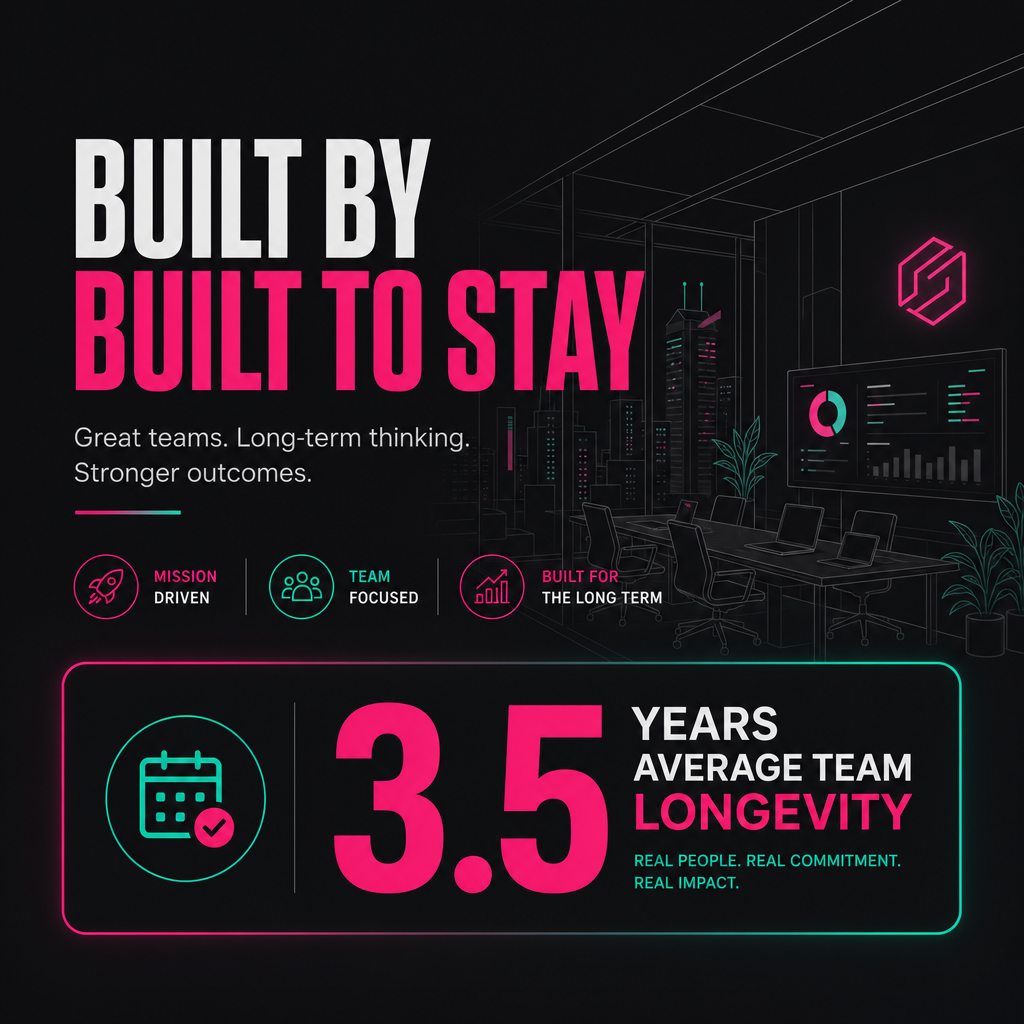
At Remotee, our focus is on predictable delivery, not just headcount. We install compliance-baked operating systems around specialist roles sourced from the Philippines. If you want to move from being the Doer to the Strategist, you need a reliable team wrapped in a solid delivery system. This guide details the legal framework, the Employer of Record model, and the exact methodology for building offshore teams that last. Our internal data shows that when businesses implement our delivery frameworks, their offshore staff retention averages 3.5 years. That is the kind of stability that actually changes a business.
Key Takeaways
- Dedicated Teams versus Outsourcing: Offshore staff leasing gives you dedicated personnel who work exclusively for your business, unlike traditional outsourcing where your work is processed in a shared pool.
- Australian Tax Compliance: Properly structured offshore leasing arrangements rely on the Employer of Record model, legally bypassing Australian Payroll Tax, GST on labour, and compulsory superannuation guarantees.
- Asset and IP Security: Data security in the Philippines requires stringent hardware controls, dedicated internet protocols, and physical security measures in monitored offices, not just software restrictions.
- Process Precedes Talent: Adding headcount without adding system creates chaos. Long-term success relies on documented workflows, clear ownership, and repeatable processes.
- Real Business Outcomes: Established Australian enterprises can save up to 70 percent on labour costs while building centralised support hubs for functions like payroll, administration, and loan processing.
Summary Table: Offshore Staff Leasing versus Traditional Outsourcing
| Feature | Offshore Staff Leasing (Dedicated Model) | Traditional Outsourcing (Project-Based) |
|---|---|---|
| Worker Commitment | Works exclusively for your business. | Handles multiple clients and shared tasks concurrently. |
| Management and Control | You direct their daily workflows and priorities. | The vendor manages the workflow and KPIs. |
| Knowledge Retention | High. Institutional knowledge stays inside your business. | Low. High staff turnover at the vendor leads to repeated training. |
| Pricing Structure | Flat monthly leasing fee per employee. | Variable hourly rates or per-ticket pricing. |
| Integration | Deep integration into your internal tools and culture. | Treated as an external vendor or third-party supplier. |
| Best Suited For | Long-term capacity, specialist roles, repeatable processes. | One-off projects, seasonal overflow, highly specialised tasks. |
The Mechanics of Offshore Staff Leasing
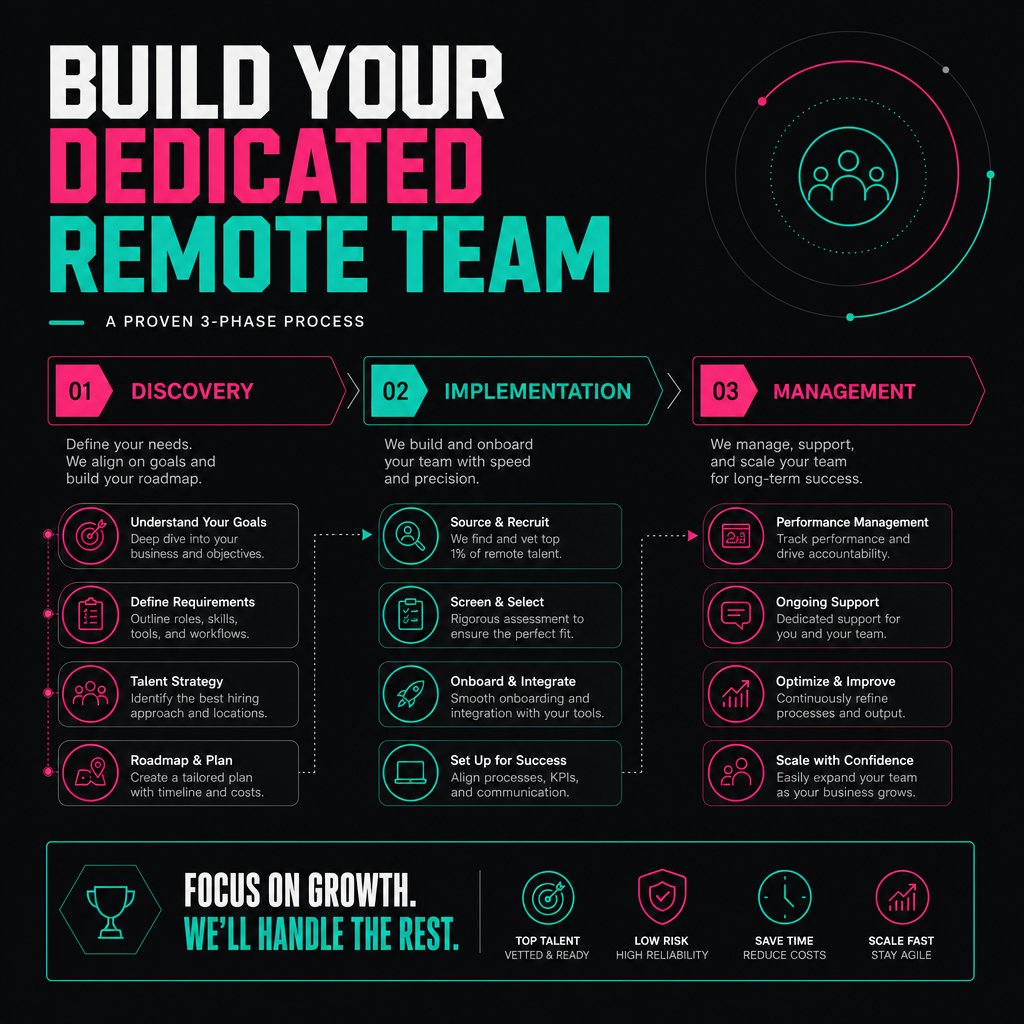
Building an offshore team requires more than browsing a catalogue of resumes. The process demands rigorous discovery, precise implementation, and a clear understanding of how to manage remote workers across different time zones. We approach this by ensuring the infrastructure is installed before the talent arrives.
When Australian enterprises engage Remotee, the first step is always a deep dive into existing workflows. We need to know exactly what the offshore staff will do, how they will do it, and who they will report to. This is why documented workflows matter. If you offshore a chaotic process, you simply get chaos in a different time zone.
Our internal data across 15 implementations completed in 2026 demonstrates the value of this preparation. By installing structured delivery systems, we consistently achieve a reduction in non-billable partner time of 6-10 hours per pay cycle. We maintain a 100 percent compliance rate. This does not happen by accident. It happens because specialist roles are wrapped in a rigid operating model.
Consider the experience of an Australian hospitality recruitment and labour hire company we partnered with recently. They had multiple people in-house as well as external accountants managing their payroll at great expense. Because they processed payroll weekly, the workload was relentless and prone to errors. Our intervention involved a complete discovery phase. We presented a system that eliminated their internal staff and external accountants, moved payroll to a fortnightly cycle, and allowed our specialist team to take over the function plug and play.
The outcome was significant. They achieved a reduction in operating expenditure and payroll costs, and a marked improvement in compliance. Before the engagement, they were unaware of multiple industry award requirements that exposed them to heavy penalties. We brought structure, controls, deadlines, and a compliance focus every cycle. Specialist payroll accountants, not generalist bookkeepers, delivered the result.
The Legal Framework: Australian Taxation and Superannuation Exemptions
A major hesitation for Australian business owners is the perceived legal complexity of hiring offshore staff. The Australian Taxation Office (ATO) has clear guidelines regarding foreign workers, and navigating these correctly is what separates a compliant offshore strategy from a costly legal headache.
When you engage offshore staff leasing through an Employer of Record, the legal relationship is clear. The Employer of Record is a foreign entity registered in the Philippines. They employ the local staff. You, the Australian business, enter into a business-to-business service agreement with that foreign entity. This structure triggers specific exemptions under Australian law.
First, consider the Superannuation Guarantee. Under the Superannuation Guarantee (Administration) Act 1992, Australian employers must pay superannuation for eligible employees. However, the legislation includes a specific exemption for employees working outside of Australia. If an employee performs their duties entirely outside Australia for an employer that is not an Australian resident entity, the superannuation guarantee charge does not apply. Because the Employer of Record in the Philippines directly employs the staff, you are not liable for the 11.5 percent superannuation guarantee in 2026.
Next, consider Payroll Tax. State-based payroll tax in Australia applies to wages paid by an employer. Since the Australian business is not the legal employer of the offshore staff, and the payments are made to a foreign service provider for services rendered offshore, these payments do not constitute wages under state payroll tax legislation. This legally minimises your payroll tax liability.
Finally, Goods and Services Tax (GST). The supply of labour offshore is generally an export of services under the GST legislation. Because the work is performed outside Australia and the effective use or enjoyment of the service occurs outside Australia, the service provider in the Philippines does not charge GST. You are engaging a foreign service provider, not hiring domestic employees, which legally bypasses the 10 percent GST on domestic labour. This legal framework is a real, immediate lever for improving operating margins.
Understanding the Employer of Record Model
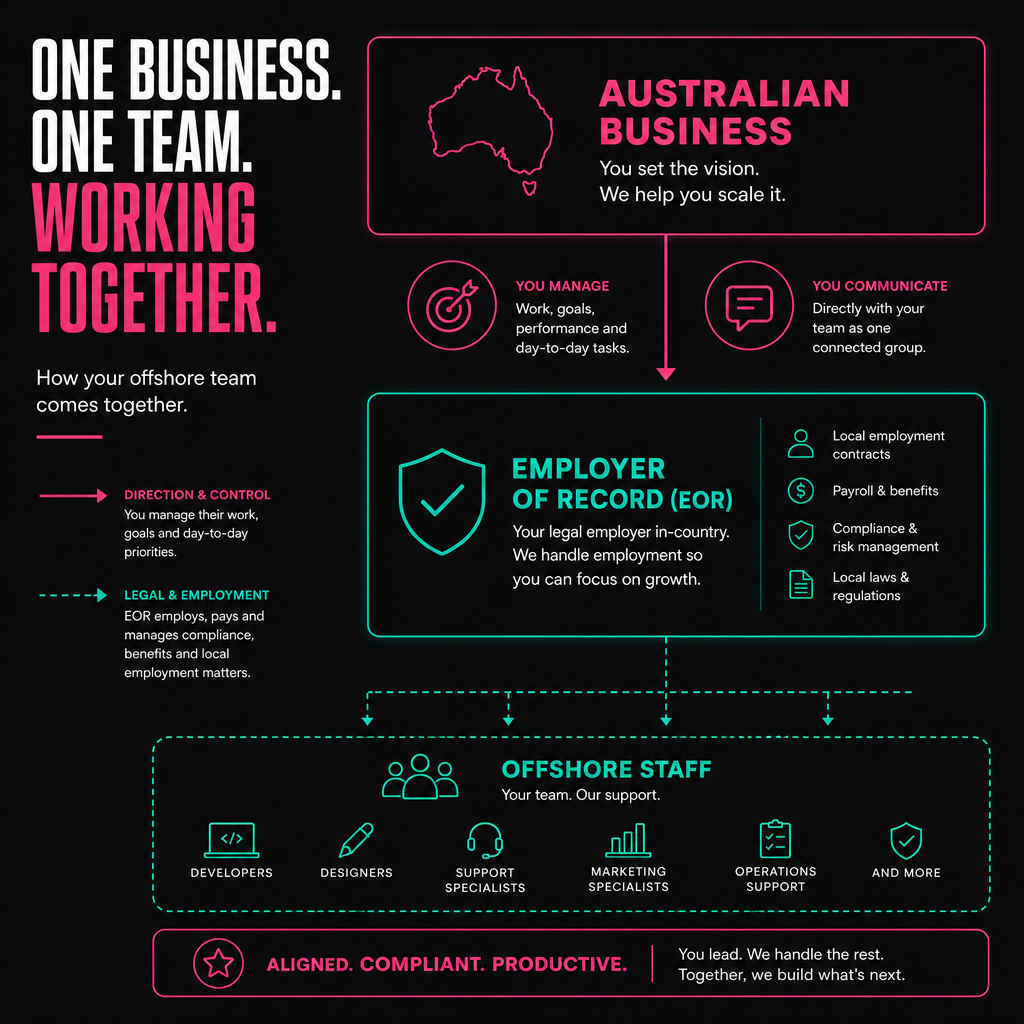
The Employer of Record model is the backbone of compliant offshore staff leasing. Many businesses confuse staff leasing with independent contracting or gig work. This confusion leads to severe compliance issues. An independent contractor arrangement in the Philippines often leaves the Australian business exposed to claims of illegal dismissal, unpaid statutory benefits, and tax evasion under Philippine labour laws.
The Employer of Record model legally eliminates this risk. The Employer of Record assumes total legal responsibility for the worker. They handle local payroll, statutory contributions, taxation, and adherence to local labour codes. In the Philippines, this means managing the Social Security System (SSS), Philippine Health Insurance Corporation (PhilHealth), and the Home Development Mutual Fund (Pag-IBIG).
When you lease staff through this model, you retain total operational control. You tell the staff what to do, how to do it, and when it needs to be finished. The Employer of Record simply handles the complex administrative and legal scaffolding that keeps you compliant. This division of labour allows you to focus on business growth and operational execution rather than getting bogged down in the intricacies of Philippine employment law.
At Remotee, our delivery system integrates directly with the Employer of Record model. We ensure that the contractual agreements protect your business while giving you the flexibility to scale your team up or down as market conditions change.
Asset Management and Data Security in the Philippines
Data security is the paramount concern for Australian enterprises outsourcing administrative, financial, or client-facing roles. The Philippines has matured significantly in its data protection capabilities, largely driven by the Data Privacy Act of 2012. This legislation established the National Privacy Commission and mandated strict requirements for the handling, processing, and storage of personal data.
However, legal compliance at a national level does not automatically guarantee security at the workstation level. Real data security in an offshore environment requires stringent physical and digital asset management protocols. We enforce strict rules that go beyond basic software restrictions.
Effective asset management involves comprehensive control over the physical environment. Staff operate from highly monitored offices. We prohibit the use of personal devices for work tasks. Every workstation features dedicated internet protocols to isolate traffic and prevent unauthorised access. Furthermore, the physical office layout prevents the use of unauthorised hardware. Prohibited items include mobile phones, personal USB drives, cameras, and even paper and pens at the desk level. These physical barriers prevent the unauthorised extraction of sensitive client data.
Digital security layers must be equally aggressive. This includes strict identity and access management, mandatory virtual private networks, endpoint encryption, and the principle of least privilege across all software environments. When these physical and digital systems are combined, the risk profile of your offshore team drops significantly. You build a secure, controlled environment that protects your intellectual property and your client data.
Offshore Staff Leasing versus Hiring Locally: The Real Difference
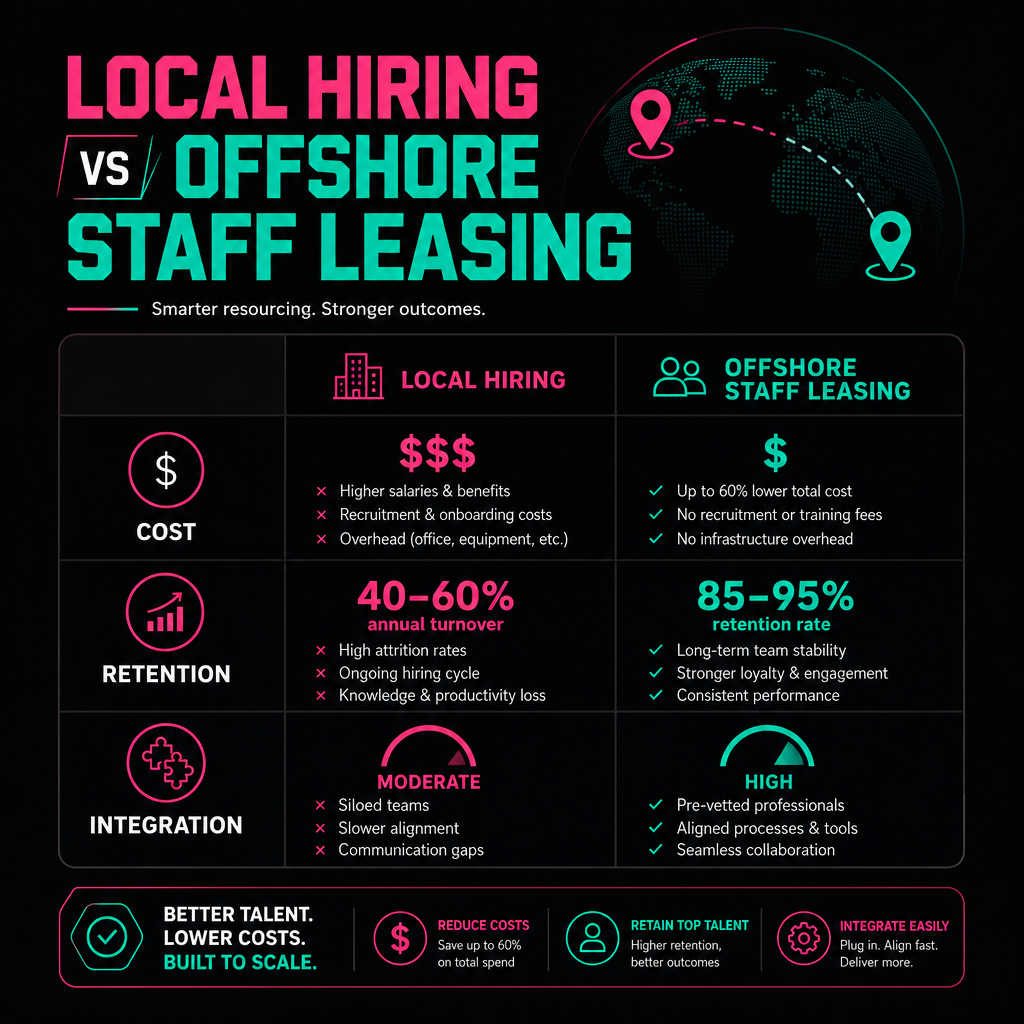
Australian businesses considering their growth strategies must weigh the real differences between local hiring and offshore staff leasing. The local hiring market in 2026 remains fiercely competitive. The Australian Bureau of Statistics consistently reports tight labour markets in professional services. Securing local talent requires substantial financial investment and extensive recruitment timelines.
The cost difference is stark. Hiring a mid-level accountant locally can cost between $90,000 and $110,000 AUD per year, plus superannuation, payroll tax, workers compensation, and office overheads. The total cost of employment often exceeds $120,000 AUD. Through offshore staff leasing, a highly qualified and experienced accountant in the Philippines costs between $1,500 and $2,500 USD per month. Even when factoring in the Employer of Record management fees, the total annual cost rarely exceeds $40,000 AUD.
Beyond cost, the difference in retention and dedication alters how a business operates. Local job markets suffer from high turnover. Employees frequently jump between companies for marginal salary increases. Offshore staff, when treated with respect and integrated into a stable company culture, demonstrate exceptional loyalty. As noted, our clients experience an average team longevity of 3.5 years. This retention builds deep institutional knowledge. It allows you to hand over complex, repeatable processes without constantly retraining new staff.
Case Study 1: Centralising Support for a Gym Franchise
A rapidly expanding gym franchise across the east coast of Australia faced a common operational bottleneck. Their local franchise owners spent too much time on administration, member queries, and billing issues. The central office was overwhelmed. They needed a centralised support hub, but local customer service and administrative staff were too expensive to justify for routine queries.
We built them a dedicated offshore team in Manila. The team consisted of three customer service representatives, one billing specialist, and a team leader. We started by documenting the exact workflows for member onboarding, cancellation requests, and billing dispute resolution. The franchise needed a delivery system, not just headcount.
Using the Employer of Record model, we legally established the team without creating a local entity in the Philippines. We installed strict asset management controls because the team handled sensitive financial and health data. Within four weeks, the centralised offshore hub was fully operational. Local franchise owners forwarded their queries to a shared portal. The offshore team resolved them within agreed service level agreements.
The gym franchise reduced their administrative overhead by 65 percent compared to local hiring projections. More importantly, the standardised processes meant that every franchise owner received consistent, reliable support. The offshore team became an integrated extension of their brand, operating entirely within their systems and reporting structures.
Case Study 2: Long-Term Processing Team for a Mortgage Broker
An independent mortgage brokerage in Sydney struggled to scale. The directors wanted to focus on new business development and client relationships. Instead, they spent their days processing loan applications, chasing documentation, and liaising with banks. They needed a long-term processing team to take the heavy administrative load.
We implemented an offshore staff leasing strategy. We placed a dedicated loan processing assistant and a compliance checker in the Philippines. The key to success here was not the talent acquisition, but the process engineering. We mapped out the entire loan application journey, from initial client contact to final settlement.
We faced a specific challenge regarding trust and sensitivity. Mortgage processing involves highly confidential financial data. The business owner was understandably nervous about offshore access. We mitigated this through layered digital security. The offshore staff accessed the brokerage system through a secure, read-only portal that prevented downloading or printing. We established strict approval checkpoints. The offshore team prepared the files, but local directors retained final sign-off.
The intervention allowed the directors to reclaim their time. The offshore team managed the data entry, document collection, and initial compliance reviews. The brokerage increased its loan settlement volume by 40 percent within six months without adding a single local administrative role. The dedicated offshore staff understood the intricate workflows of the business, proving that remote hiring only creates value when wrapped in a delivery system.
Integrating Proprietary Frameworks for Delivery Success
Talent quality matters, but quality alone is not enough. To achieve predictable delivery, Australian businesses need installed frameworks. At Remotee, we apply proprietary methodologies depending on the specific function we are offshoring.
For established Australian businesses looking to focus on business growth and not accounting operations, we install The Accountee Payroll Process. Payroll is too important to be mostly right. We treat it as a business-critical trust function. The framework operates in four distinct phases.
Phase 1 is Payroll Discovery and Setup. We review the current payroll process, pay cycles, staff types, award considerations, systems, approvals, and reporting requirements to build a clear payroll operating model. Phase 2 is Payroll Transition. We take over the payroll function from the client, including required access, templates, payrun calendars, employee data, timesheet flows, and approval checkpoints.
Phase 3 is Full Payroll Processing. Our team processes payroll end to end. This includes timesheet review, pay calculations, leave, allowances, deductions, Single Touch Payroll (STP), superannuation, payroll reporting, and payrun preparation. Phase 4 is Ongoing Payroll Management. We provide ongoing payroll delivery, issue resolution, compliance support, reporting, and account management to ensure payroll runs accurately, on time, and with minimal internal admin.
This framework is highly effective. We recently partnered with a recruitment agency where the founders wanted to focus on new business development and operational execution, not payroll and accounting. Hiring in-house and managing those resources was not deemed to be a good return on investment, commercially or efficiently. We executed a full discovery and implementation within two weeks. We were live and managing payroll. The outcome was highly specific: the founders now approve one email once per fortnight. Our team manages all payroll, super, compliance, and tax. All inbound queries and timesheet queries come to us, resulting in our clients focusing on what they do best, recruitment.
Most people say payroll should stay in-house because it is too sensitive to outsource. Our position is the exact opposite. Payroll is often safer when it is outsourced to specialists. Most payroll risk comes from internal overload, manual checks, rushed payruns, and people wearing too many hats. A specialist payroll team brings structure, controls, deadlines, and compliance focus every cycle. We process payroll like it matters because to your staff, it does.
The Economics of Offshore Staff Leasing
Understanding the pricing structure is vital for Australian business owners mapping out their commercial strategy. Transparent, predictable pricing allows for accurate cash flow forecasting. When you engage in offshore staff leasing, the pricing typically consists of two distinct components.
The first component is the gross salary of the offshore employee. This is dictated by the local market rates in the Philippines. Roles requiring niche technical skills or extensive experience command higher salaries, while standard administrative roles remain highly cost-effective. The second component is the leasing fee, or the Employer of Record management fee. This fee covers the legal employment risk, local tax compliance, statutory benefits, office infrastructure, and physical security measures.
This structure provides immense value. Instead of dealing with variable costs associated with local turnover, recruitment fees, and underutilisation, you pay a flat monthly rate. You know exactly what your team costs. This flat structure moves your business from variable, unpredictable overheads to fixed, manageable operating expenses. For specific details on how we structure our pricing, you can review our transparent pricing models.
Moving from Doer to Strategist
The ultimate goal of offshore staff leasing is to free up the business owner and key local personnel. When you are trapped in the day-to-day execution, you cannot strategise. You cannot build relationships. You cannot identify new market opportunities. You are a Doer, not a Strategist.
Building a dedicated offshore team facilitates this change. By offloading repeatable, documented processes to highly capable staff in the Philippines, you reclaim your time. You shift your focus to high-level business growth. This requires trusting the system you have built. It requires documented workflows, clear ownership, and repeatable processes. When you wrap your offshore team in a delivery system, you achieve predictable delivery.
Australian businesses that succeed with offshore staffing do not treat it as a cheap alternative to local hiring. They treat it as a strategic lever. They understand that accessing a global talent pool allows them to scale faster, operate leaner, and outmanoeuvre competitors who remain constrained by local hiring bottlenecks.
If you are ready to install compliance-baked operating systems around specialist roles, and move from doing the work to directing it, we are ready to help. The process begins with a thorough review of your current workflows to identify exactly where a dedicated offshore team will drive the highest value. Contact our team to begin the discovery phase.
References
- Australian Taxation Office. Superannuation Guarantee Ruling SGR 2008/1: Pays or provides superannuation contributions for employees who are working temporarily in Australia or working outside Australia.
- Australian Bureau of Statistics. Labour Force, Australia.
- National Privacy Commission (Philippines). Data Privacy Act of 2012 and Implementing Rules and Regulations.
- Fair Work Ombudsman. Hiring employees and contractors.
FREQUENTLY ASKED QUESTIONS
Common questions
What is offshore staff leasing?
- Offshore staff leasing is a model where an Australian business hires dedicated, full-time employees in another country, typically the Philippines, through a local Employer of Record. The staff work exclusively for the Australian business but are legally employed by the local provider, which handles all local taxes, compliance, and statutory benefits.
How does offshore staff leasing differ from traditional outsourcing?
- Traditional outsourcing usually involves paying a vendor to complete a specific project or handle a high volume of transactional tasks using shared resources. Offshore staff leasing involves hiring specific individuals who work only for your business. You control their daily tasks and workflows, allowing for deep integration into your company culture and processes.
Do I need to pay Australian superannuation for offshore staff?
- No. Under the Superannuation Guarantee (Administration) Act 1992, the superannuation guarantee does not apply to employees who perform all of their work outside of Australia for a non-resident employer. Because the Employer of Record in the Philippines directly employs the staff, Australian businesses are exempt from paying the superannuation guarantee.
Is my business data secure with an offshore team?
- Yes, provided you use the right asset management protocols. Effective security requires stringent physical controls such as monitored offices and prohibited personal devices, along with digital controls like secure VPNs, endpoint encryption, and restricted user access based on the principle of least privilege.
How long does it take to build an offshore team?
- The timeline depends on the complexity of the roles and the readiness of your internal workflows. Generally, once the workflows are documented and the delivery system is installed, you can have fully integrated offshore staff operating within four to eight weeks. The initial discovery and implementation phase is critical to long-term success.
What roles are best suited for offshore staff leasing?
- Roles that involve repeatable processes, heavy administration, and specialist technical skills are ideal. This includes accounting, payroll processing, loan processing, customer service, information technology support, and digital marketing. Any role that can be clearly documented and performed remotely is a strong candidate.

Jon Kelly
Founder, Remotee
Jon helps Australian businesses build compliance-led offshore teams that scale without the burnout. NDIS, accounting, mortgage broking, recruitment and digital marketing.
KEEP READING
Related posts
offshore staff leasing
Offshore Staff Leasing in Australia: How the Employer of Record (EOR) Model Works
Australian businesses face a well-documented skills shortage. Finding local talent is difficult, expensive, and slow. To bridge this gap, many organisations loo…
27 June 2026 · 15 min read
offshore staff leasing
Offshore Staff Leasing in Australia: How It Works, Costs and When to Use It in 2026
Hiring locally is expensive and slow. Project outsourcing hands control to someone else. And building an offshore team from scratch in a foreign jurisdiction is…
7 June 2026 · 26 min read
AI offshore staffing Australia
The Role of AI in Offshore Staffing: Enhancing Efficiency and Selection
AI offshore staffing in Australia combines artificial intelligence with structured remote hiring to improve sourcing, screening, onboarding and routine delivery…
25 August 2026 · 19 min read
READY TO SCALE WITHOUT THE BURNOUT?
Build a compliance-led offshore team in 3–4 weeks.
Tell us about your current bottleneck and we'll show you what a Remotee placement would look like for your operation.
Or get our playbooks emailed to you instead.