
Offshore Staff Leasing in Australia: How the Employer of Record (EOR) Model Works
- offshore staff leasing
- employer of record australia
- offshore eor services
- offshore staffing solutions
- offshore employment compliance

Australian businesses face a well-documented skills shortage. Finding local talent is difficult, expensive, and slow. To bridge this gap, many organisations look overseas to hire offshore staff. The goal is simple: access a global talent pool, reduce operational costs, and scale quickly. However, the execution is rarely simple. Setting up a foreign entity, understanding local labour laws, and managing international payroll introduces significant risk.
This is where offshore staff leasing comes in. More specifically, this is why Australian companies are turning to the Employer of Record (EOR) model. An EOR allows you to legally hire workers in another country without needing to establish your own legal entity in that country. The EOR becomes the legal employer for tax and compliance purposes, while you retain day-to-day control of the worker.
But here is the hard truth that most providers will not tell you. Adding headcount without adding system is how scaling creates chaos. The difference between a capacity gap and a capacity crisis is usually a delivery structure problem, not a talent problem. Remotee competes on reliability and predictable delivery, not just resumes. In this guide, I will break down exactly how offshore staff leasing works in Australia, how the EOR model mitigates your legal risk, and why payroll and compliance must be the foundation of your offshore strategy.
Key Takeaways
- Risk Mitigation: The EOR model absorbs the legal and compliance risks associated with international hiring, protecting your Australian business from foreign employment liabilities.
- Strict Compliance: Offshore employment compliance involves complex tax, superannuation, and local labour law requirements. An EOR navigates these seamlessly.
- Rapid Deployment: Using offshore EOR services reduces hiring timelines by up to 40% compared to establishing a foreign entity.
- Process Over Headcount: Reliable offshore staffing solutions require documented workflows, clear ownership, and repeatable processes to succeed.
- Payroll as a Trust Function: Accurate payroll is business-critical. Specialist payroll accountants ensure your offshore and local staff are paid correctly, every cycle.
Traditional Offshore Hiring vs EOR Staff Leasing
When you decide to build an offshore team, you generally have two paths. You can set up your own foreign entity and hire directly, or you can use an Employer of Record. The difference in cost, liability, and speed is massive.
| Feature | Traditional Direct Hire (Own Entity) | EOR Staff Leasing Model |
|---|---|---|
| Setup Time | 3-6 months (entity registration, local approvals) | 1-2 weeks (onboarding through existing EOR infrastructure) |
| Upfront Cost | High ($10,000 - $30,000+ in legal and registration fees) | Low (One-off setup fee per employee) |
| Legal Liability | High (You assume all local employment and compliance risk) | Low (EOR assumes legal employment risk) |
| Payroll & Tax | Handled internally or via expensive local accountants | Included in EOR service (managed by local specialists) |
| Ongoing Admin | Heavy (Local HR, compliance updates, tax filing) | Light (Single monthly invoice to the Australian business) |
| Flexibility | Rigid (Hard to scale down quickly) | Agile (Easy to scale headcount up or down) |
The EOR Legal and Compliance Framework in Australia
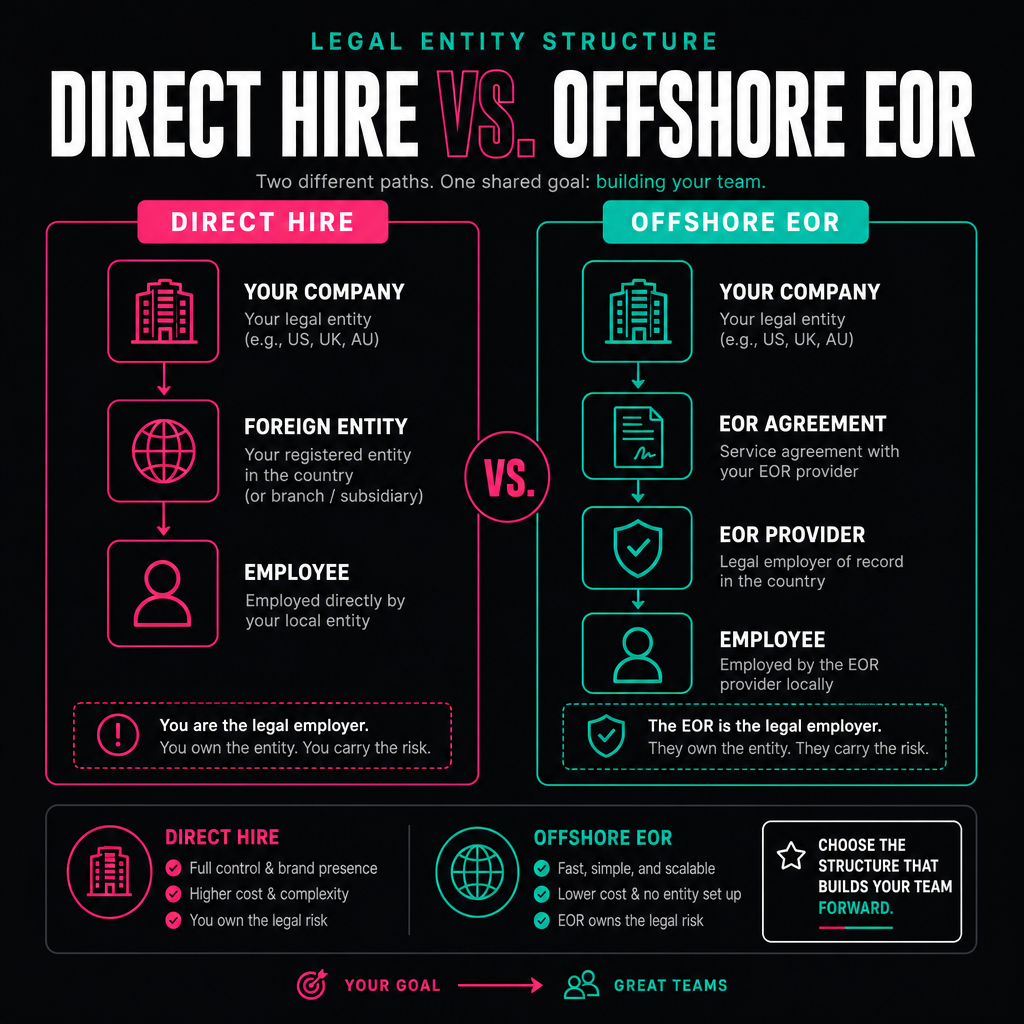
Offshore employment compliance is not a topic you can afford to treat lightly. The Australian Taxation Office (ATO) and the Fair Work Ombudsman impose strict rules on how businesses classify and manage workers. When you hire offshore, you layer foreign labour laws on top of these domestic obligations.
What is an Employer of Record?
An Employer of Record is a third-party organisation that takes on the legal responsibilities of being an employer. When you engage offshore EOR services, the EOR signs the local employment contract with your offshore worker. The EOR handles local tax withholding, statutory benefits, pension or superannuation equivalents, and adherence to local working time directives.
You, the Australian business, direct the daily work. You set the hours, assign the tasks, and manage performance. The EOR manages the legal and administrative framework. This clean separation of duties is what makes offshore staff leasing so effective.
The Risks of Misclassification
A major risk for Australian businesses hiring offshore is worker misclassification. If you hire an offshore contractor but treat them like an employee, you may trigger a permanent establishment risk or breach local labour laws. Penalties for non-compliance can be severe, ranging from back-pay for unpaid benefits to heavy fines.
The EOR model eliminates this risk. Because the offshore worker is legally employed by the EOR entity in their home country, they receive all mandated local benefits. There is no ambiguity about their employment status. This structure provides total compliance peace of mind.
The Payroll Compliance Danger of In-House Management
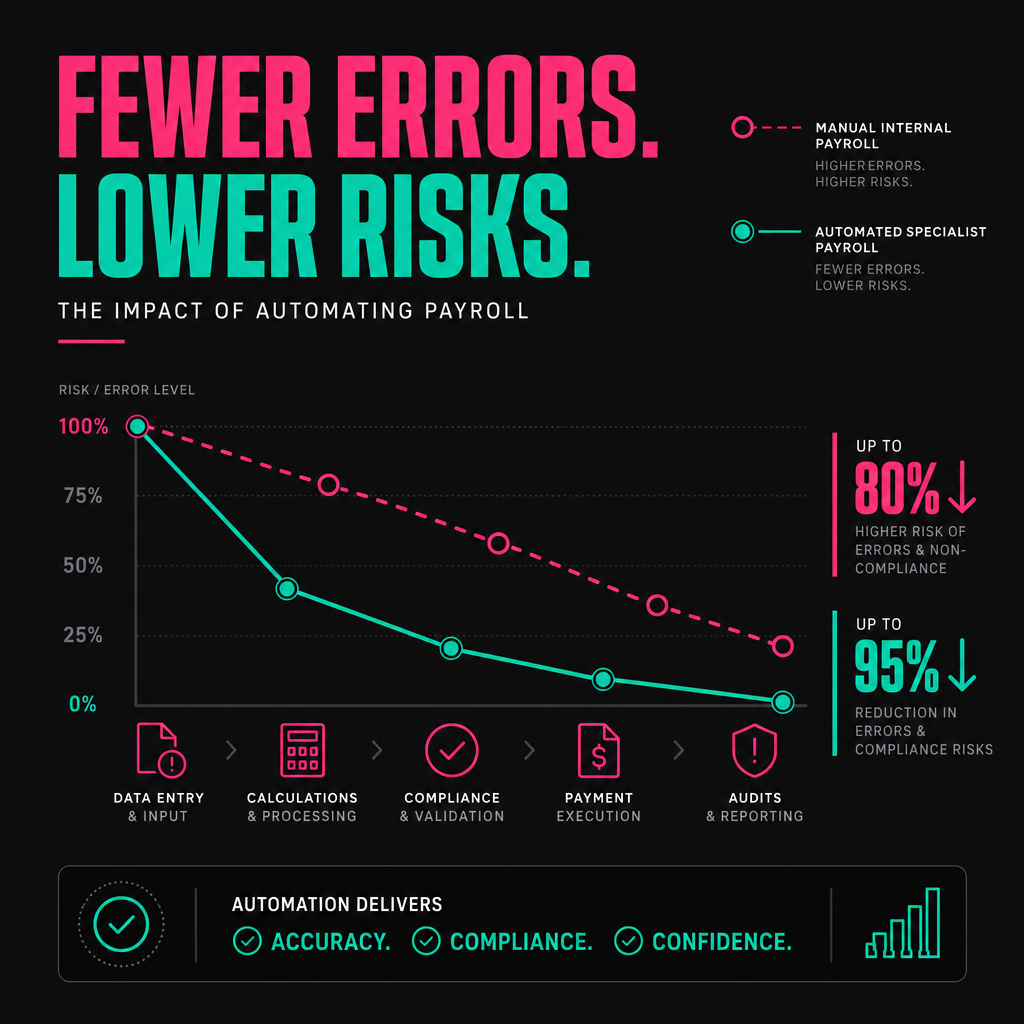
Most business owners think payroll is just an admin function. They are wrong. Payroll is a business-critical trust function. When payroll is wrong, staff confidence drops quickly. Accurate, on-time payroll protects culture, cash flow, compliance, and the employer brand.
There is a common objection I hear from business owners. They say, "Payroll should stay in-house because it is too sensitive to outsource." My position is the opposite. Payroll is often safer when it is outsourced to specialists. Most payroll risk comes from internal overload, manual checks, rushed payruns and people wearing too many hats. A specialist payroll team brings structure, controls, deadlines and compliance focus every cycle.
The Accountee Payroll Process in Action
To illustrate this, I want to share a real example from our book of business in 2026. We worked with a hospitality recruitment and labour hire company that had multiple people in-house as well as external accountants managing their payroll at great expense. They were processing payroll weekly, which created mass workloads and constant bottlenecks.
Our expert team came in, completed a discovery phase, and presented a system that eliminated their reliance on internal staff and external accountants. We moved their payroll to fortnightly and our team picked up the entire function. It was a plug-and-play solution.
The outcome was a significant reduction in opex staffing costs and external accounting fees. More importantly, there was a marked improvement in compliance. They were completely unaware of multiple industry award requirements they were getting wrong. We achieved 100% compliance and reduced our clients' non-billable partner time by 6-10 hours per pay cycle across 15 implementations in 2026. This is the power of specialist delivery. As we say around here, STP, super, leave, PAYG and reporting should be handled by people who live in payroll.
How We Execute the Transition
We use a proprietary framework to transition payroll and employment compliance safely. We call it The Accountee Payroll Process.
- Phase 1 - Payroll Discovery & Setup: We review the client's current payroll process, pay cycles, staff types, award considerations, systems, approvals, and reporting requirements to build a clear payroll operating model.
- Phase 2 - Payroll Transition: We take over the payroll function from the client. This includes required access, templates, payrun calendars, employee data, timesheet flows, and approval checkpoints.
- Phase 3 - Full Payroll Processing: Accountee processes payroll end-to-end. We handle timesheet review, pay calculations, leave, allowances, deductions, STP, superannuation, payroll reporting, and payrun preparation.
- Phase 4 - Ongoing Payroll Management: We provide ongoing payroll delivery, issue resolution, compliance support, reporting, and account management to ensure payroll runs accurately, on time, and with minimal internal admin.
If you want to understand the foundational steps of our approach, review our process.
Step-by-Step EOR Onboarding Process
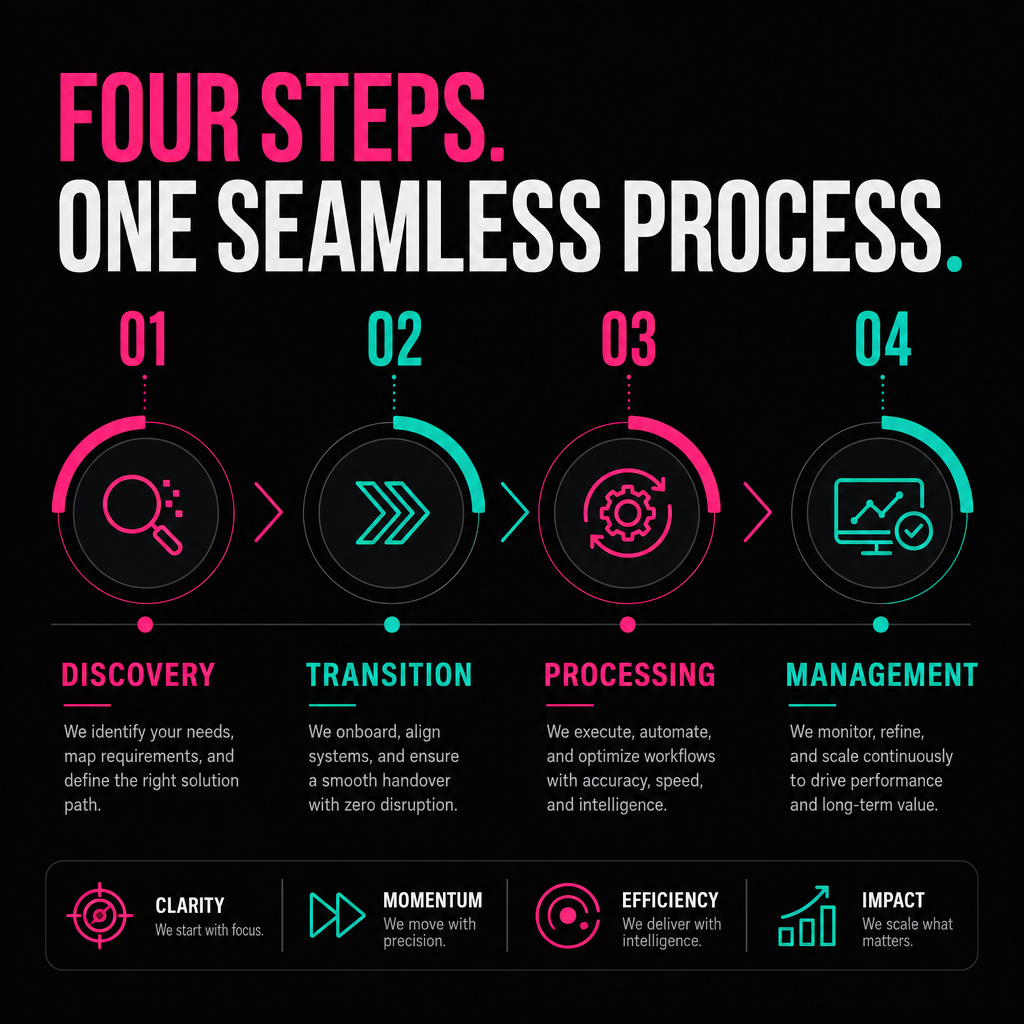
Once the compliance and payroll framework is established, onboarding the offshore staff is straightforward. We do not throw resumes at a problem. We install a delivery system. Here is how we execute offshore staff leasing to ensure you get predictable delivery, not just headcount.
Phase 1: Discovery and Role Definition
The difference between a successful offshore hire and a costly failure happens before the job ad is even written. We sit down with you to define the outcomes expected from the role. We document the workflows, identify the software stack required, and establish clear ownership of tasks. If you need a payroll specialist, we find a payroll specialist. Not jack-of-all-trades accounting. Specialist payroll delivery.
Phase 2: Talent Acquisition
Once the role is defined, we tap into our talent network in the Philippines. We source candidates who have the exact technical skills required. We shortlist based on ability to execute the documented workflows, not just years of experience.
Phase 3: EOR Engagement and Contracting
When you select a candidate, the EOR steps in. We handle the local employment contract, ensuring it meets all local labour laws and statutory requirements. You never have to worry about navigating foreign legal systems.
Phase 4: Systems Integration and Onboarding
Your new offshore staff member is integrated into your business. We manage the IT setup, access controls, and communication tools. We also facilitate compliance training to ensure they understand Australian standards relevant to their role, such as privacy laws and data security protocols.
Real Outcomes: Moving from Doer to Strategist
Business owners get trapped in the day-to-day. They become the bottleneck. The goal of our offshore staffing solutions is to move you from Doer to Strategist. We do this by installing compliance-baked operating systems around specialist roles sourced from the Philippines.
Consider another client example from our recent work. A recruitment agency where the founders wanted to focus on new business development and operational execution. They were bogged down in payroll and accounting. Hiring in-house and managing those resources was not deemed to be a good ROI, commercially or efficiently.
We installed a payroll system and team customised to their business and the software they use. We executed a full discovery and implementation within 2 weeks. We were live and managing payroll.
The outcome? Approval of one email once per fortnight. Our team manages all payroll, super, compliance, and tax. All inbound queries and timesheet queries come to us. The result is our clients focusing on what they do best: recruitment. This is what happens when you combine offshore staff leasing with rigorous process engineering. You get compliance-first payroll, every pay run. Payroll done properly. Not squeezed in between tax returns.
Calculating the ROI of Offshore EOR Services
Understanding the cost structure of offshore staff leasing requires looking beyond hourly rates. You must calculate the total cost of ownership, including compliance risks, management overheads, and software.
Direct Cost Savings
The primary driver for most Australian businesses is the direct labour cost arbitrage. Hiring highly skilled professionals in the Philippines through an EOR model is significantly more cost-effective than hiring locally in Sydney, Melbourne, or Brisbane. Wages are lower, but the quality of talent remains exceptionally high.
Indirect Cost Savings
The indirect savings are where the real value lies. By using offshore EOR services, you avoid:
- Setting up a foreign corporate entity.
- Hiring local HR and legal staff in a foreign country.
- Paying for expensive international accounting firms to manage foreign tax filings.
- Absorbing the cost of local compliance failures.
Productivity Gains
When you partner with a firm that installs delivery systems, you gain productivity. As seen in our case studies, reducing non-billable partner time by 6-10 hours per pay cycle is standard. That is 6-10 hours you can redirect to revenue-generating activities. Your payroll should not depend on one busy admin person remembering everything. We process payroll like it matters, because to your staff, it does.
Common Pitfalls in Offshore Employment
Many businesses attempt to manage offshore staff independently. They use generic job boards, pay workers via PayPal, and ignore local employment laws. This approach is a ticking time bomb. Here are the common pitfalls we help businesses avoid:
1. Ignoring Local Labour Laws
If you hire an offshore worker directly, you must comply with their local labour laws regarding minimum wage, overtime, mandated benefits, and termination procedures. An EOR navigates this for you, ensuring you avoid payroll fines before they become expensive lessons.
2. Poor Workflow Documentation
As I stated earlier, the difference between a capacity gap and a capacity crisis is a delivery structure problem. If you hire offshore staff but do not document your workflows, the arrangement will fail. Clear ownership and repeatable processes are non-negotiable.
3. Currency and Payment Risks
Fluctuating exchange rates can complicate offshore payments. The EOR model standardises this. You pay a single predictable invoice in AUD, and the EOR handles the currency conversion and local payout.
Why Australian Businesses Choose Remotee
At Remotee, we do not compete on resumes. We compete on reliability. We know that adding headcount without adding system is how scaling creates chaos. Our goal is predictable delivery, not just headcount.
When you partner with us for offshore staff leasing, you get access to specialist talent in the Philippines wrapped in a robust Australian-compliant delivery system. We use specialist payroll accountants, not generalist bookkeepers. We handle STP, super, leave, PAYG and reporting. We take the friction out of scaling your team.
If you are tired of internal overload and ready to build a reliable offshore team, we are ready to help. Contact us today to begin your discovery phase. Reach out via our contact page to speak with our team.
References
- Australian Taxation Office (ATO): Guidelines on Single Touch Payroll (STP) and employer obligations.
- Fair Work Ombudsman: Best practice advice on hiring employees and managing independent contractors in Australia.
- International Labour Organization (ILO): Standards and fundamental principles of rights at work for international employment.
- Australian Bureau of Statistics (ABS): Labour force data reflecting the tight Australian skills market and the need for alternative staffing models.
FREQUENTLY ASKED QUESTIONS
Common questions
What is offshore staff leasing?
- Offshore staff leasing is a model where an Australian business hires workers located in another country, typically through an Employer of Record (EOR). The EOR acts as the legal employer, managing local tax, compliance, and payroll, while the Australian business directs the daily work.
How does an Employer of Record work in Australia?
- An Employer of Record allows an Australian company to legally employ staff overseas without setting up a foreign entity. The EOR handles local employment contracts, statutory benefits, and tax compliance, absorbing the legal risk for the Australian business.
How much does it cost to use offshore EOR services?
- The cost depends on the role's seniority and the local market rates in the offshore country. Generally, offshore EOR services involve a manageable monthly fee per employee that covers payroll, tax administration, and compliance management. This is significantly cheaper than setting up a foreign entity.
What legal protections does an EOR provide?
- An EOR protects your Australian business from foreign employment liabilities. This includes misclassification risks, non-compliance with local labour laws, and errors in tax filings. The EOR ensures all statutory requirements are met.
How long does it take to onboard offshore staff?
- Onboarding through an EOR is fast. While setting up a foreign entity can take months, offshore staff leasing through an EOR can take as little as 1-2 weeks from selection to the first day of work. Our transition process can be completed in 2 weeks.
Can I manage the payroll of my offshore staff myself?
- You can, but it is high risk. Managing foreign payroll requires intimate knowledge of local tax laws, benefits, and currency regulations. Most payroll risk comes from internal overload and rushed payruns. Outsourcing to a specialist EOR ensures accuracy and compliance.
What roles are best suited for offshore staffing solutions?
- Roles that involve highly repeatable processes are best suited for offshore staffing. This includes payroll specialists, accounting functions, administrative support, digital marketing, and IT development. Success depends on clear documentation of workflows.
How does Remotee ensure compliance?
- Remotee builds compliance into the core of our operations. We utilise The Accountee Payroll Process to ensure every aspect of payroll, tax, and local employment law is handled accurately. We focus on getting it right every pay cycle so you can focus on business growth.

Jon Kelly
Founder, Remotee
Jon helps Australian businesses build compliance-led offshore teams that scale without the burnout. NDIS, accounting, mortgage broking, recruitment and digital marketing.
KEEP READING
Related posts
offshore staff leasing
Long-Term Offshore Staff Leasing: Building Dedicated Teams in Australia
The difference between a capacity gap and a capacity crisis is usually a delivery structure problem, not a talent problem. Australian business owners frequently…
5 July 2026 · 18 min read
offshore staff retention
Strategies for High Employee Retention with Offshore Staff
Offshore staff retention improves when employers combine competitive local wages, meaningful benefits, visible career paths, consistent management and genuine t…
21 July 2026 · 20 min read
reduce labour costs offshore
Proven Strategies to Reduce Labour Costs with Offshore Staff in Australia
Australian business owners and CFOs are facing unrelenting margin pressure. Local wage growth is climbing, onshore overheads are inflexible, and the cost of doi…
11 July 2026 · 14 min read
READY TO SCALE WITHOUT THE BURNOUT?
Build a compliance-led offshore team in 3–4 weeks.
Tell us about your current bottleneck and we'll show you what a Remotee placement would look like for your operation.
Or get our playbooks emailed to you instead.