
Offshore Staff Leasing vs Offshore Staffing: Which Model Suits Your Australian Business in 2026?
- offshore staff leasing
- offshore staffing
- staff leasing Australia
- offshore staffing models
- offshore leasing vs outsourcing
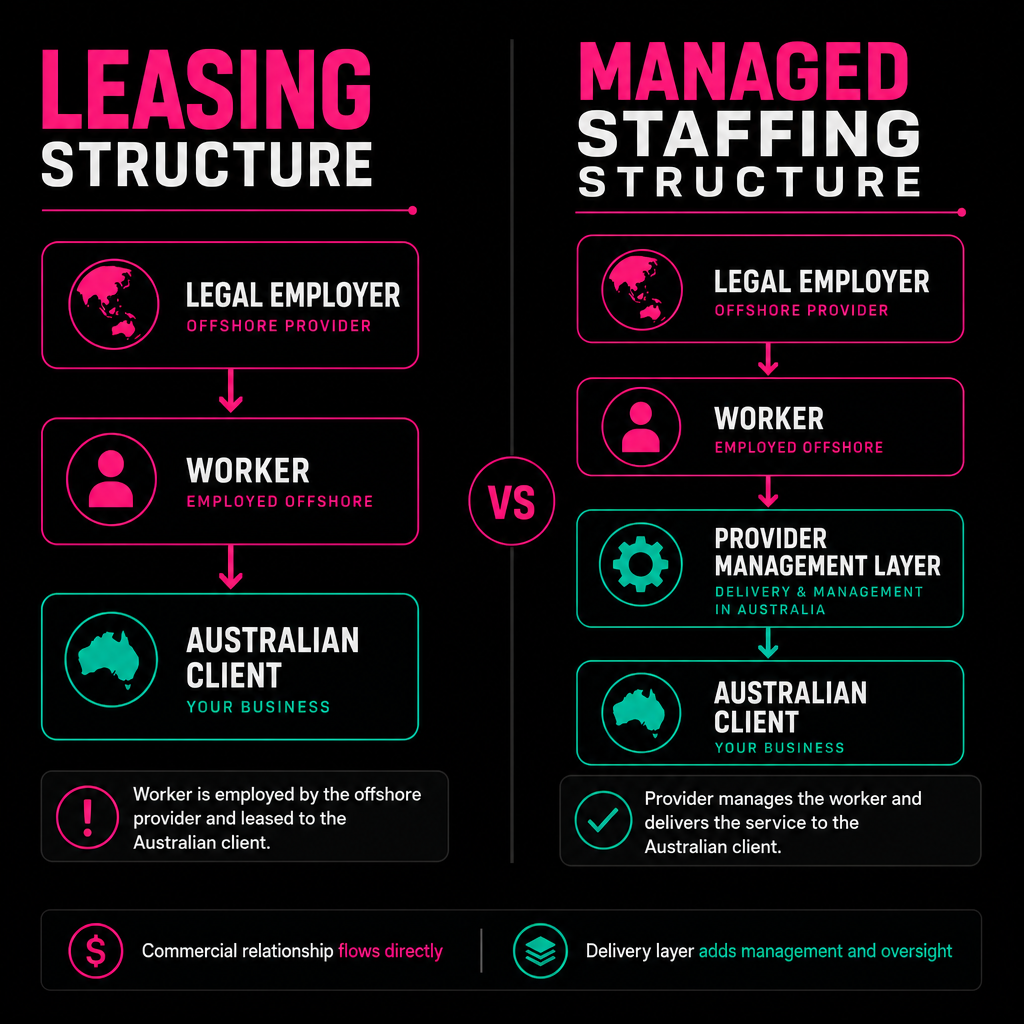
Every week, I talk to Australian business owners who signed up for an offshore arrangement and ended up with something they did not expect. Not bad staff, necessarily. Bad structure. They thought they were getting a managed solution and ended up with a compliance headache. Or they thought they were getting cost savings and discovered they were carrying full legal employer liability for people they had never met.
The root cause, almost every time, is that the buyer did not understand which offshore model they had actually purchased. Offshore staff leasing and offshore staffing are not interchangeable terms. They describe fundamentally different commercial and legal arrangements, and choosing the wrong one for your situation is an expensive mistake to unpick.
This article breaks down both models clearly: what each one means in practice, who carries the legal employer obligations, how the cost structures compare, and which model actually suits your business depending on what you need to achieve. If you are at the point of shortlisting offshore partners, or reviewing an arrangement that is not working, this is the framework you need.
Key Takeaways
- Offshore staff leasing places the legal employment relationship with the offshore provider. The Australian business directs the work but does not employ the worker.
- Offshore staffing is a broader term that can describe leasing, managed services, or direct hire. Without clarity on the legal structure, you cannot assess your compliance exposure.
- Cost is not the only variable that matters. Control, IP protection, data handling, and speed to hire are all affected by which model you choose.
- Philippine labour law applies to offshore workers regardless of which Australian business is directing their work. The question is who is accountable for compliance.
- Leasing suits businesses that want direct control over output without the HR and legal overhead of direct employment. Managed staffing suits businesses that want a full delivery system around the headcount.
- The right model depends on your internal capacity, your compliance risk appetite, and whether you have the documented workflows to support self-directed offshore staff.
Summary Table: Offshore Staff Leasing vs Offshore Staffing Models
| Factor | Offshore Staff Leasing | Managed Offshore Staffing | Direct Offshore Hire |
|---|---|---|---|
| Legal employer | Offshore provider | Offshore provider (managed) | Australian business (via PEO/EOR) |
| Cost structure | Monthly seat fee + management margin | Monthly service fee (all-in) | Setup cost + direct salary + employer costs |
| Control over staff | High (client directs daily work) | Shared (provider manages delivery) | High (full employer control) |
| Compliance responsibility | Primarily provider | Primarily provider | Primarily Australian business |
| Speed to hire | 2-4 weeks typical | 2-6 weeks typical | 6-12 weeks typical |
| IP and data risk | Medium (requires clear contractual terms) | Medium-low (provider has governance in place) | Low (direct contractual relationship) |
| Best for | Businesses with strong internal systems needing extra capacity | Businesses needing turnkey delivery without internal management overhead | Businesses with legal/HR infrastructure and long-term headcount certainty |
| Flexibility | High (scale up/down with notice period) | Medium (contractual minimums apply) | Low (direct employment obligations apply) |
What Offshore Staff Leasing Actually Means
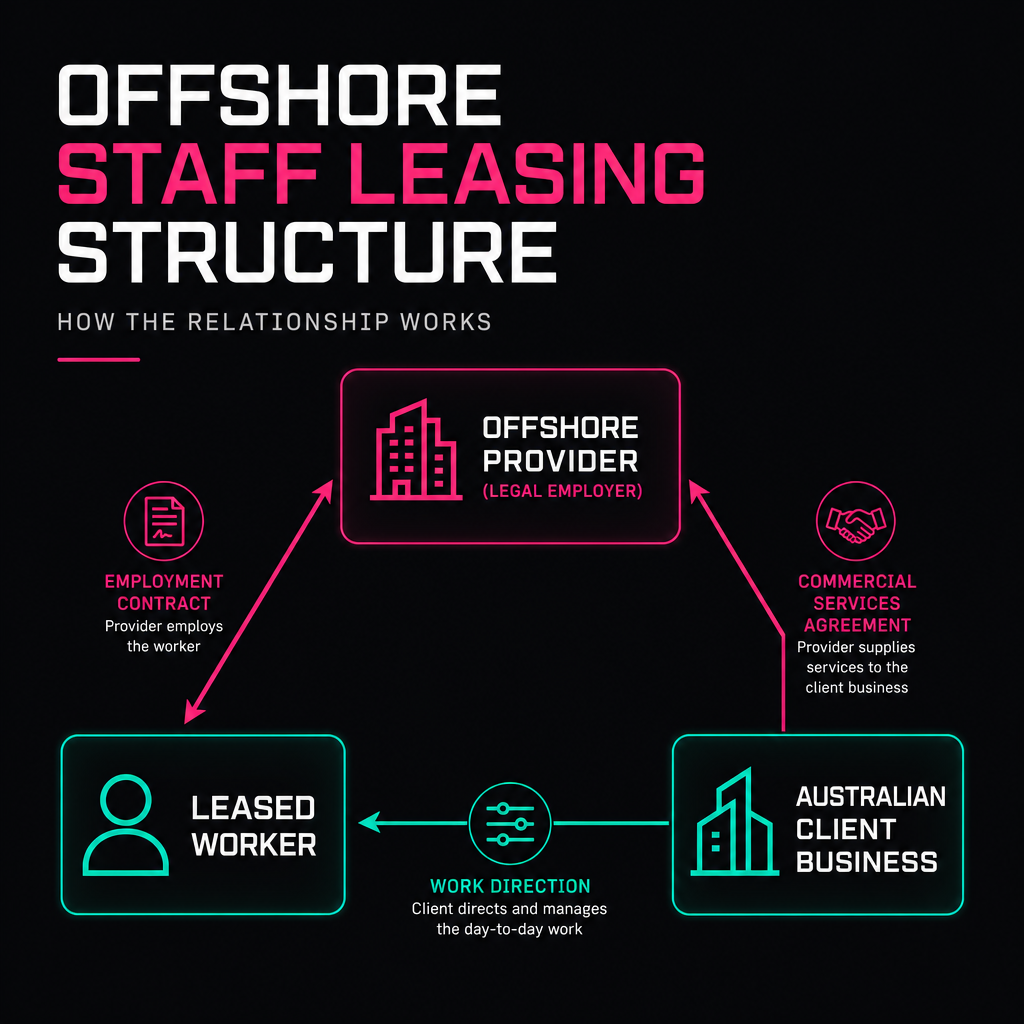
The term "offshore staff leasing" has a precise legal meaning that most sales collateral glosses over. In a staff leasing arrangement, the provider (the offshore company, typically registered in the Philippines) holds the employment contract with the worker. The Australian client business enters into a separate commercial agreement with the provider to access that worker's time and output.
The worker turns up to work for you, follows your direction, uses your tools, and produces output for your business. But on paper, they are employed by the provider, not by you. The provider handles their payroll, their statutory contributions, their leave entitlements, and their compliance with local labour law.
In the Philippines, this structure is regulated under the Department of Labor and Employment (DOLE) and the Philippine Overseas Employment Administration (POEA). Legitimate offshore staff leasing companies hold a DOLE licence to operate as a legitimate contractor or leasing entity. If your provider does not hold the appropriate DOLE authorisation, the legal structure collapses and the liability question becomes very uncomfortable very quickly.
For Australian businesses, the key implication is this: you are not the employer. You are the client. That distinction matters enormously when it comes to Fair Work obligations, workers' compensation, superannuation, and tax. Your offshore provider carries those obligations for the Philippine workers. You carry the obligation to ensure your commercial agreement with the provider is sound.
This is not a loophole. It is a legitimate, well-established commercial structure. Australia's Fair Work Act 1994 does not directly govern offshore workers employed by a foreign entity. The worker's employment rights are protected by Philippine law. Your commercial obligations are defined by your contract with the provider. Done properly, this is clean. Done carelessly, it creates gaps.
The Difference Between Leasing and Labour Hire in Australia
It is worth drawing a distinction here because Australian businesses are familiar with labour hire, and they sometimes conflate it with offshore staff leasing. In Australia, labour hire is regulated at a state level. Victoria, Queensland, and South Australia all require labour hire providers to hold a licence. The Australian Competition and Consumer Commission (ACCC) has also examined labour hire practices as part of its broader focus on supply chain transparency.
Offshore staff leasing sits outside this domestic labour hire framework because the employment relationship is governed by Philippine law and the worker is not physically present in Australia. However, if you bring an offshore worker onshore for any period, the regulatory picture changes significantly. If that scenario is on your roadmap, get specific legal advice before you proceed.
How Offshore Staff Leasing Differs from Managed Offshore Staffing and Direct Hiring
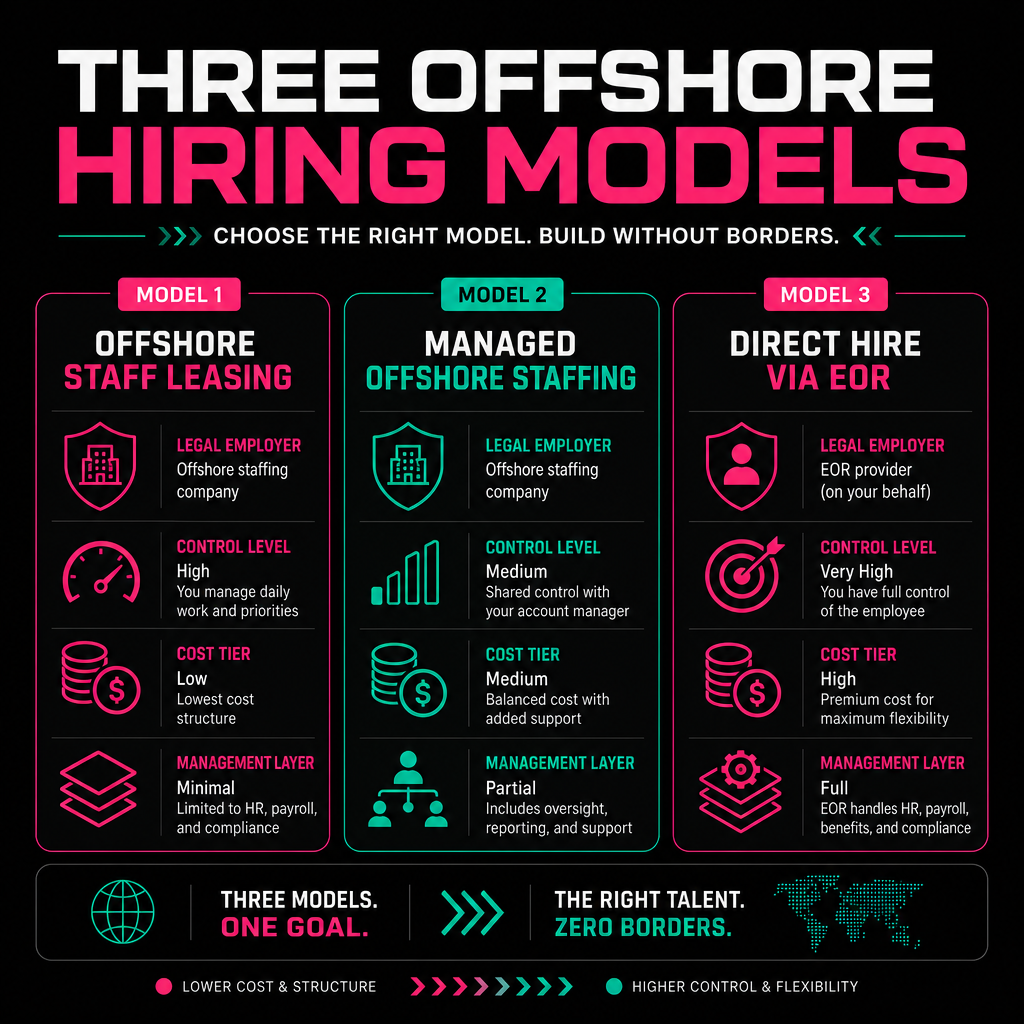
Three models dominate the offshore market for Australian businesses. They look similar from the outside. They behave very differently under pressure.
Model 1: Offshore Staff Leasing
As described above, the provider holds the employment relationship and leases access to the worker. The Australian client directs the daily work. The client typically sets the KPIs, assigns the tasks, manages the schedule, and is responsible for integrating the worker into their own systems and workflows.
This is the model that gives you the most control. It is also the model that demands the most from you internally. If you do not have documented workflows, clear task ownership, and a consistent management cadence, a leased offshore worker will drift. Not because they are not capable. Because the delivery system is not there to support them.
That belief sits at the core of how I approach offshore staffing: talent quality matters, but quality alone is not enough. The real problem in most businesses is not headcount. It is the absence of documented workflows, clear ownership, and repeatable processes. The difference between a capacity gap and a capacity crisis is usually a delivery structure problem, not a talent problem.
Model 2: Managed Offshore Staffing
In a managed staffing model, the provider does more than supply the worker. They wrap a delivery system around the placement. This typically includes team leader oversight, output reporting, quality control, performance management, and escalation pathways.
The Australian client still directs the work at a strategic level but is not responsible for the day-to-day management of the offshore worker's activity. The provider holds that accountability.
This model suits businesses that do not have the internal infrastructure to manage offshore staff directly. It costs more than a pure leasing arrangement because you are paying for the provider's management layer. But for many Australian SMEs, that extra cost is justified by the reduction in management overhead on the Australian side.
At Remotee, our offshore staffing approach is built around this principle. We do not just fill seats. We install a delivery structure around each placement so that the output is predictable, not just the headcount.
Model 3: Direct Offshore Hire via Employer of Record (EOR)
Some businesses want the employment relationship to be more direct but do not want to establish a foreign legal entity. An Employer of Record (EOR) is a third party that employs the worker on your behalf under local law, while you direct the work. You pay the EOR a fee that covers the worker's salary, employer contributions, and the EOR's margin.
This model gives you more control over the employment terms and can feel more like a direct hire. The downside is cost and flexibility. EOR arrangements typically carry higher per-head costs and less flexibility to scale down quickly because you are closer to the employment relationship, even if you are not technically the employer.
For Australian businesses that need long-term, specialist offshore roles and have the internal HR capacity to manage them, EOR can work well. For businesses that are still testing whether offshore works for them, it is often the wrong starting point.
See our breakdown of how our process works if you want to understand how we structure initial engagements before any headcount decision is made.
Cost Structure Comparison: What You Actually Pay in 2026
Cost is the most common reason Australian businesses explore offshore models. It is also the area where the most confusion exists, because the headline number rarely tells the full story.
Offshore Staff Leasing: Cost Structure
In a typical offshore staff leasing arrangement for a Philippines-based worker, the Australian client pays a monthly seat fee. In 2026, this typically ranges from approximately $1,800 to $3,500 AUD per month for a full-time equivalent, depending on the role, the seniority level, and the provider's structure.
That seat fee covers the worker's salary, the provider's employer-side statutory contributions under Philippine law (SSS, PhilHealth, Pag-IBIG), and the provider's margin. It does not usually include the cost of equipment, software licences, or specialised tools, which may be billed separately or included depending on the contract.
When you compare this to a comparable full-time Australian hire, the difference is substantial. An accounts payable officer or bookkeeper in a major Australian city commands $65,000 to $80,000 AUD per year in base salary, plus superannuation (currently 11.5% of ordinary time earnings under the Superannuation Guarantee), plus leave entitlements, plus workers' compensation. The total employment cost easily reaches $85,000 to $100,000 AUD annually before you factor in office space, equipment, and recruitment fees.
The equivalent offshore leased role at $2,500 AUD per month is $30,000 AUD per year. That is a 60-70% cost reduction on a comparable role, and it includes the provider's compliance and management overhead.
Managed Offshore Staffing: Cost Structure
Managed offshore staffing carries a higher monthly fee because you are buying more than the worker's time. You are buying the provider's management layer. Expect to pay $2,500 to $4,500 AUD per month for a managed placement, depending on the complexity of the role and the service level agreement.
For many businesses, this premium is worth it. If your internal management time is worth $100 to $200 per hour, and managing an unstructured offshore worker costs you five to ten hours per month in rework, escalation, and performance management, the cost of the managed model pays for itself quickly.
Hidden Costs to Account For
Whichever model you choose, account for these costs before you compare providers on price alone:
- Onboarding time (your team's time, not just the provider's)
- Tool and system access provisioning
- Knowledge transfer and documentation
- Redundancy or transition costs if the model does not work
- Legal review of the commercial agreement
Our transparent pricing page covers what is included in each Remotee engagement so you can run a real comparison.
Compliance and Legal Employer Obligations: Who Carries the Risk?
This is the section most offshore providers would rather you did not read carefully. Compliance is where the wrong offshore model creates the most damage, and it is almost always damage that surfaces slowly, not immediately.
Philippine Labour Law Obligations
Offshore workers employed by a Philippines-based leasing company are protected by the Philippine Labor Code. This means they are entitled to statutory minimum wages (which vary by region), 13th month pay, contributions to SSS, PhilHealth, and Pag-IBIG, and statutory leave entitlements.
In a legitimate staff leasing arrangement, the provider carries these obligations. The Australian client does not contribute to Philippine statutory requirements directly. But the Australian client needs to verify that their provider is meeting these obligations. If the provider is underpaying workers, cutting corners on statutory contributions, or misclassifying employees as independent contractors to reduce their cost base, the arrangement is not compliant. And while the legal liability sits with the provider, the reputational exposure sits with you.
Ask your provider directly: are your workers employed or engaged as contractors under Philippine law? If they cannot answer that question clearly, that is your answer.
Australian Obligations: What Applies and What Does Not
Fair Work Australia does not govern the employment of workers physically based offshore and employed by a foreign entity. Your offshore leased staff are not covered by the National Employment Standards, Modern Awards, or the Superannuation Guarantee as it applies to Australian employees.
However, your obligations as an Australian business do not disappear entirely. Depending on how your offshore arrangement is structured:
- If you are making payments directly to individual offshore workers (not via a provider entity), the ATO may view those workers as employees for PAYG withholding purposes. Get a private ruling if this is your structure.
- Privacy obligations under the Privacy Act 1988 (Cth) apply to how you share Australian customer data with offshore staff. If your leased staff are handling personal information of Australian individuals, your Privacy Policy must disclose cross-border disclosure and you must take reasonable steps to ensure the offshore recipient handles it consistently with Australian privacy principles.
- If your business is subject to industry-specific regulation (financial services, health, legal), check whether your regulator has specific requirements around offshore processing of client data.
Our compliance and training framework is built specifically to address these Australian-side obligations so your offshore arrangement does not create domestic regulatory risk.
Control, IP, and Data Security Trade-offs
Control and compliance pull in opposite directions in offshore arrangements. The more control you want over an offshore worker, the more the arrangement starts to look like employment. The more the arrangement looks like employment, the more compliance obligations follow.
This is not a reason to avoid offshore staffing. It is a reason to structure it carefully.
Intellectual Property
In an offshore staff leasing arrangement, the IP created by the leased worker belongs to you (the Australian client) by default if the commercial agreement says so. Make sure it does. A well-drafted service agreement should include:
- A clear IP assignment clause confirming that all work product created by the leased worker vests in the client
- A confidentiality clause covering both the worker and the provider
- Specific provisions around software code, creative assets, data, and proprietary processes if relevant to your business
Do not assume the provider's standard contract addresses this adequately. Have a solicitor review it before you sign.
Data Security
Offshore workers typically access your systems remotely. This means your data security posture needs to account for access from a foreign jurisdiction. Practical steps include:
- Role-based access controls (offshore workers access only what they need)
- Multi-factor authentication on all systems they can access
- VPN requirements where appropriate
- Clear data handling protocols, documented and acknowledged in writing by the provider and the worker
- Audit trails on sensitive data access
The Office of the Australian Information Commissioner (OAIC) has published guidance on cross-border data flows and the accountability principle under the Privacy Act. If your offshore workers are touching personal information of Australian residents, read that guidance and build your controls accordingly.
The Control Spectrum
Leasing gives you more day-to-day control over the worker's activity. That control comes with a trade-off: if the worker underperforms, you are managing it. If integration fails, you own that failure. Managed staffing gives you less direct control but more accountability sitting with the provider. For businesses without strong internal systems, managed staffing usually produces better outcomes even at a higher cost per head.
Real Examples: What This Looks Like in Practice
Case Study 1: Recruitment Agency, Payroll and Compliance Team
I worked with a recruitment agency where the founders were clear about what they wanted to focus on: new business development and operational execution. What they were not willing to do was keep spending time and money on payroll administration.
They had been managing payroll in-house, and it was consuming non-billable partner time that should have been generating revenue. They came to us looking for a leased offshore payroll resource. What they actually needed was a delivery system, not just a body.
We ran a full discovery process, mapped their pay cycles, award considerations, system access requirements, and approval workflows. Within two weeks, we were live and managing their payroll end-to-end. The outcome: one email approval per fortnight. Our team handles all payroll processing, superannuation, STP, compliance checks, and timesheet queries. The founders are not involved in payroll at all unless something genuinely requires their decision.
Across our recruitment agency clients in 2026, we have seen a consistent reduction of 6-10 hours per pay cycle in non-billable partner time. That is time that goes directly back into the work that actually grows the business.
This is not a leasing-only model. It is a managed staffing model with a structured delivery system built around the offshore resource. That distinction is why it works.
Case Study 2: Hospitality Labour Hire Company, Payroll Consolidation
A hospitality recruitment and labour hire company came to us with a different problem. They had multiple in-house staff and external accountants managing payroll at significant cost. They were also running payroll weekly, which was creating a constant administrative burden across the business.
They had looked at offshore staff leasing as a cost-cutting measure. But when we did the discovery, it became clear that the real issue was not the cost of the people doing payroll. It was the structure of the payroll function itself.
We eliminated the in-house payroll staff and the external accountant arrangement, moved payroll to a fortnightly cycle, and had our offshore specialist team take over the entire function. Plug and play.
The outcomes: meaningful reduction in operating expenditure on payroll staff, reduced payroll processing costs from the cycle change, and a significant improvement in compliance. The previous arrangement had missed multiple Modern Award obligations they were not aware of. Our team identified and corrected these before they became a Fair Work issue. That last point is not a small thing. Award non-compliance can trigger back-pay obligations, penalties, and reputational damage. Avoiding payroll fines before they become expensive lessons is exactly the kind of value a properly structured offshore payroll team delivers.
What These Examples Have in Common
Neither of these businesses needed more staff. They needed better structure around the staff function. Offshore staffing, whether leasing or managed, only delivers on its promise when the delivery system is built first. Headcount without system is how scaling creates chaos.
You can see more client outcomes on our case studies page.
When Offshore Staff Leasing Suits You vs When Managed Staffing Is Better
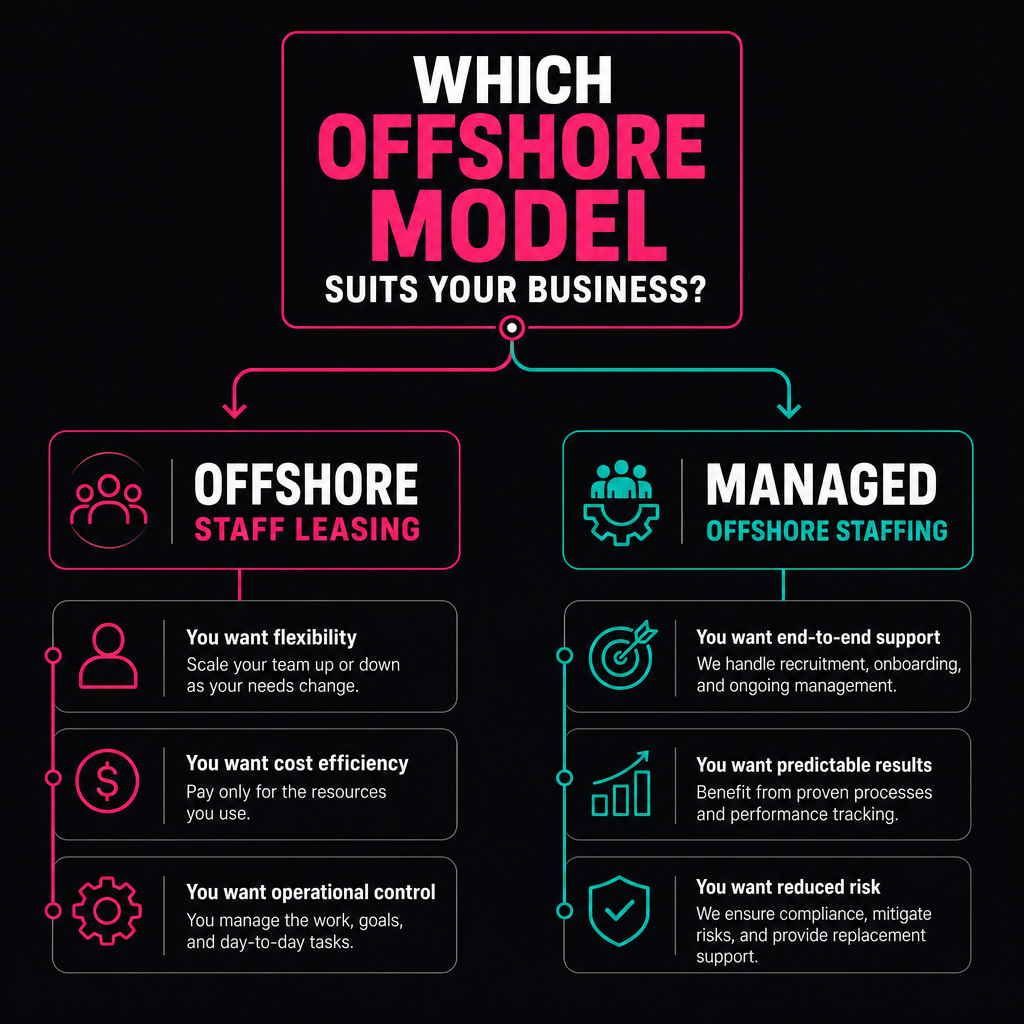
This is the question most Australian businesses need answered before they engage any offshore provider. Here is a direct framework.
Choose Offshore Staff Leasing When:
- You have documented workflows that an offshore worker can follow with minimal guidance
- You have an internal manager who has capacity to direct the offshore worker daily
- The role is well-defined and the output is easy to measure
- You want maximum cost efficiency and are prepared to take on the management responsibility
- You have already used offshore staffing before and know what to expect
- You have reviewed the commercial agreement and are comfortable with the IP and data provisions
Choose Managed Offshore Staffing When:
- You need offshore capacity but do not have internal bandwidth to manage it
- Your workflows are not fully documented yet
- The role involves multiple stakeholders or complex integration with Australian-side systems
- You want the provider to be accountable for output quality, not just attendance
- You are new to offshore staffing and want a lower-risk entry point
- Compliance, particularly around data and industry regulation, is a significant concern
Choose Direct Hire via EOR When:
- The role is long-term and strategically important enough to justify the higher cost
- You want more direct contractual control over the employment terms
- You have internal HR capacity to manage an employment-style relationship offshore
- You are considering eventually bringing the worker onshore or transitioning to a foreign subsidiary
The Question I Always Ask Clients First
Before we talk about which offshore model suits a business, I ask one question: what does this person's Monday morning look like? If the client cannot answer that question specifically, they are not ready to lease offshore staff. They need the managed model first, and the leasing model later once the structure is in place.
Roles Australian Businesses Offshore in 2026
Offshore staffing is no longer limited to data entry and customer service. The range of roles Australian businesses are offshoring in 2026 spans most white-collar functions.
Higher-frequency offshore roles we see:
- Bookkeeping and accounts payable/receivable
- Payroll processing and administration
- Recruitment support and talent sourcing
- Digital marketing and content creation
- Software development and QA testing
- Virtual assistance and executive support
- Customer support (voice, chat, email)
- Data analysis and reporting
- Graphic design and video editing
- HR administration and onboarding support
The roles that work best offshore are roles where the output is clearly defined, the process is repeatable, and the tools are accessible remotely. Roles that require physical presence, real-time relationship management, or local regulatory expertise are typically not suitable for offshoring without significant structural support.
The Decision Framework: A Step-by-Step Approach for Australian Businesses
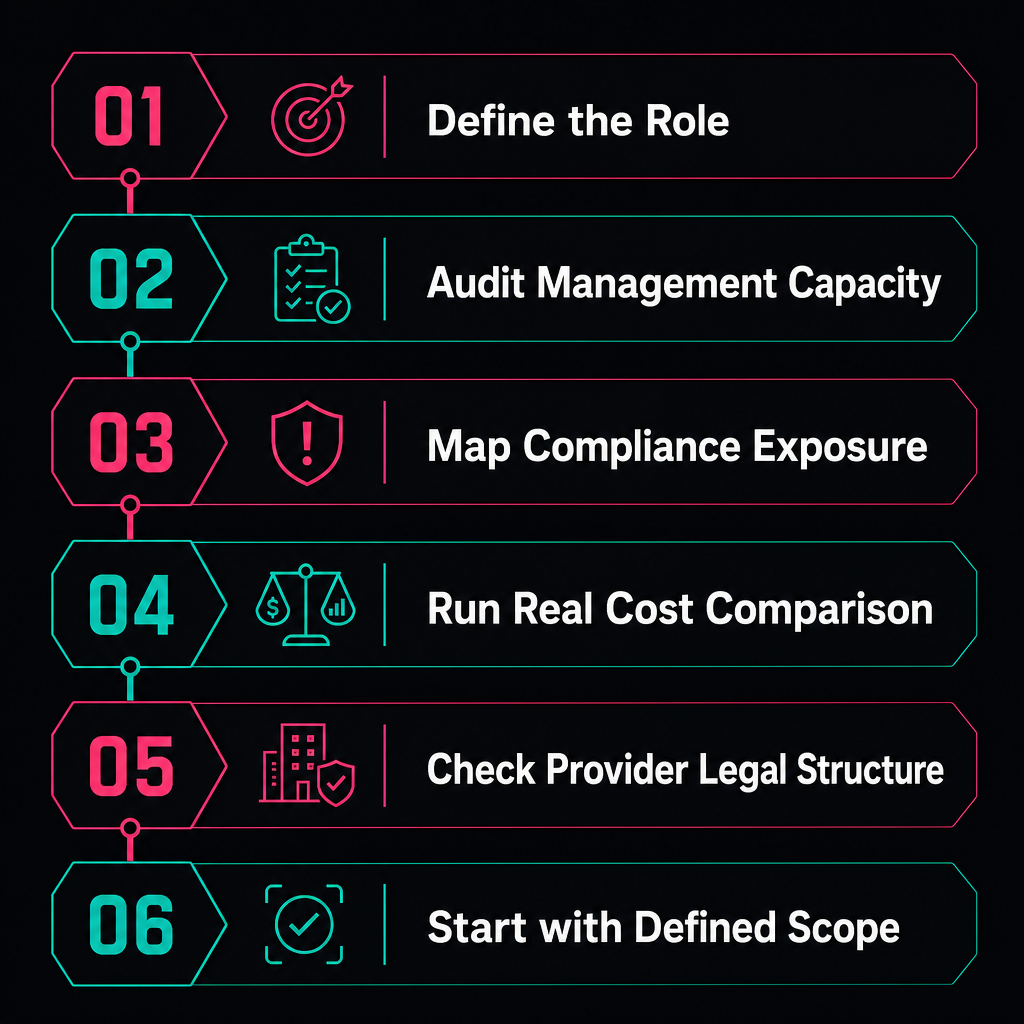
If you are working through this decision right now, use this framework before you talk to any provider.
Step 1: Define the role precisely. What does this person do on a typical day? What tools do they use? What outputs do they produce? If you cannot answer these questions, you are not ready to hire, offshore or otherwise.
Step 2: Audit your internal management capacity. Who in your business will direct this person's daily work? How much time can they dedicate to that? If the answer is less than two to three hours per week, you need the managed model.
Step 3: Map your compliance exposure. Does the role involve Australian customer data? Are you in a regulated industry? Do you have contracts with clients that restrict offshore processing? Get these questions answered before you sign anything.
Step 4: Run the real cost comparison. Compare like for like. An offshore leased worker at $2,500 per month versus an Australian hire at $85,000 per year is a $55,000 annual saving. But if that $55,000 saving costs you $20,000 in management overhead and rework, your real saving is $35,000. That may still be worth it. Know the real number.
Step 5: Check the provider's legal structure. Does your provider hold DOLE authorisation? Can they produce evidence of Philippine statutory compliance for their workers? Is the IP assignment in the contract clear and complete? Do not skip this step.
Step 6: Start with a defined scope. The most successful offshore engagements we see start with one role, one process, and a 90-day success metric. Avoid the temptation to offshore everything at once. Build the model, prove it works, then scale.
If you want a tailored recommendation based on your specific situation, contact us and we will walk through this framework with you directly.
References
-
Department of Labor and Employment (DOLE), Philippines. "Rules Implementing Articles 106 to 109 of the Labor Code of the Philippines." DOLE Department Order No. 18-A. https://www.dole.gov.ph
-
Office of the Australian Information Commissioner (OAIC). "Australian Privacy Principles Guidelines: APP 8 Cross-border disclosure of personal information." https://www.oaic.gov.au/privacy/australian-privacy-principles/australian-privacy-principles-guidelines/chapter-8-app-8-cross-border-disclosure-of-personal-information
-
Fair Work Ombudsman. "Independent contractors." https://www.fairwork.gov.au/find-help-for/independent-contractors
-
Australian Taxation Office. "Superannuation guarantee: Overview." https://www.ato.gov.au/businesses-and-organisations/super-for-employers/paying-super-contributions/superannuation-guarantee
-
Australian Competition and Consumer Commission (ACCC). "Labour hire licensing in Australia." https://www.accc.gov.au
-
Australian Bureau of Statistics. "Employee Earnings and Hours, Australia." https://www.abs.gov.au/statistics/labour/earnings-and-work-hours/employee-earnings-and-hours-australia
FREQUENTLY ASKED QUESTIONS
Common questions
Is offshore staff leasing legal in Australia?
- Yes. Offshore staff leasing is a legitimate commercial arrangement. The offshore provider holds the employment contract with the worker under the law of the country where the worker is based, typically the Philippines. The Australian business enters a commercial services agreement with the provider. Fair Work Australia does not govern this employment relationship because the worker is not employed in Australia. However, Australian businesses still have obligations under the Privacy Act 1988 (Cth) regarding cross-border data flows, and industry-specific regulations may apply depending on the nature of the work.
Who employs leased offshore staff?
- In a staff leasing arrangement, the offshore provider employs the worker. The provider handles the employment contract, statutory contributions, payroll, leave entitlements, and compliance with local labour law. In the Philippines, this means compliance with DOLE, SSS, PhilHealth, Pag-IBIG, and 13th month pay obligations. The Australian client directs the work but is not the legal employer.
What is the difference between offshore staff leasing and outsourcing?
- Outsourcing typically means contracting a third party to deliver a defined outcome or service. You pay for the output, not the person. Offshore staff leasing means you are paying for dedicated worker capacity. The worker works exclusively or primarily for your business, follows your direction, and integrates into your systems and workflows. The distinction matters for control, IP, and cost structure.
Who is responsible for compliance if an offshore worker is underpaid or mistreated?
- The legal employer, the offshore provider, carries the primary compliance obligation under Philippine labour law. However, Australian businesses sourcing offshore labour should conduct due diligence on their provider to confirm that statutory obligations are being met. Reputational risk is real even when legal liability sits with the provider. Ask your provider to confirm their DOLE registration status and provide evidence of statutory contribution compliance.
How does the Privacy Act 1988 (Cth) apply to offshore staff?
- The Privacy Act 1988 (Cth) applies to how Australian businesses handle personal information of Australian residents, including when that information is accessed or processed by offshore staff. Under Australian Privacy Principle 8, if you disclose personal information to an overseas recipient, you must take reasonable steps to ensure the recipient handles it consistently with the Australian Privacy Principles. Your privacy policy should disclose cross-border disclosure, and your offshore provider should be bound by appropriate data handling obligations in your commercial agreement.
How do offshore staff leasing costs compare to Australian hiring in 2026?
- A full-time offshore leased worker in the Philippines typically costs between $1,800 and $3,500 AUD per month depending on role and seniority. A comparable full-time Australian hire for an administrative or professional services role costs $65,000 to $100,000 AUD per year when you include base salary, superannuation at 11.5%, leave entitlements, and on-costs. The offshore model typically delivers a 55-70% cost reduction on a comparable role.
How quickly can I have an offshore leased staff member in place?
- In a standard offshore staff leasing arrangement, expect a 2-4 week timeline from engagement to the worker being active. This covers the recruitment or matching process, onboarding, system access provisioning, and handover. Managed staffing arrangements may take 2-6 weeks depending on the complexity of the role and the delivery structure being built around it. Direct EOR arrangements typically take 6-12 weeks due to the additional contractual and compliance steps involved.
What happens if the offshore worker does not perform?
- This depends on the model. In a staff leasing arrangement, the Australian client typically has the right to request a replacement worker, but the performance management process sits with the provider. In a managed staffing arrangement, the provider is responsible for performance management and output quality, and the Australian client has contractual recourse if SLAs are not met. In a direct EOR arrangement, the Australian client has more control but also carries more responsibility for the performance management process.

Jon Kelly
Founder, Remotee
Jon helps Australian businesses build compliance-led offshore teams that scale without the burnout. NDIS, accounting, mortgage broking, recruitment and digital marketing.
KEEP READING
Related posts
transparent provider pricing comparison
Offshore Staffing Pricing Transparency: How to Compare Provider Quotes Without Getting Caught Out
Transparent provider pricing comparison means evaluating offshore staffing quotes against total cost of engagement, not headline hourly rate. A genuine quote it…
13 September 2026 · 17 min read
managed staffing versus freelancer platforms
Managed Offshore Staffing vs Freelancer Platforms: Which Model Actually Delivers for Australian Businesses?
Managed offshore staffing suits ongoing, business-critical work because it wraps talent in documented workflows, compliance and a replacement guarantee. Freelan…
12 September 2026 · 15 min read
offshore staffing company comparison criteria
Offshore Staffing Company Comparison Criteria: How Australian Businesses Should Evaluate Providers
Direct Answer: The criteria that actually predict offshore staffing outcomes are the employment and compliance model, documented delivery workflows, supervision…
11 September 2026 · 16 min read
READY TO SCALE WITHOUT THE BURNOUT?
Build a compliance-led offshore team in 3–4 weeks.
Tell us about your current bottleneck and we'll show you what a Remotee placement would look like for your operation.
Or get our playbooks emailed to you instead.