
Which Roles Are Best Suited to Offshore Staffing? A Guide for Australian Businesses in 2026
- offshore staffing
- offshore roles
- Australian business
- remote hiring
- outsourcing
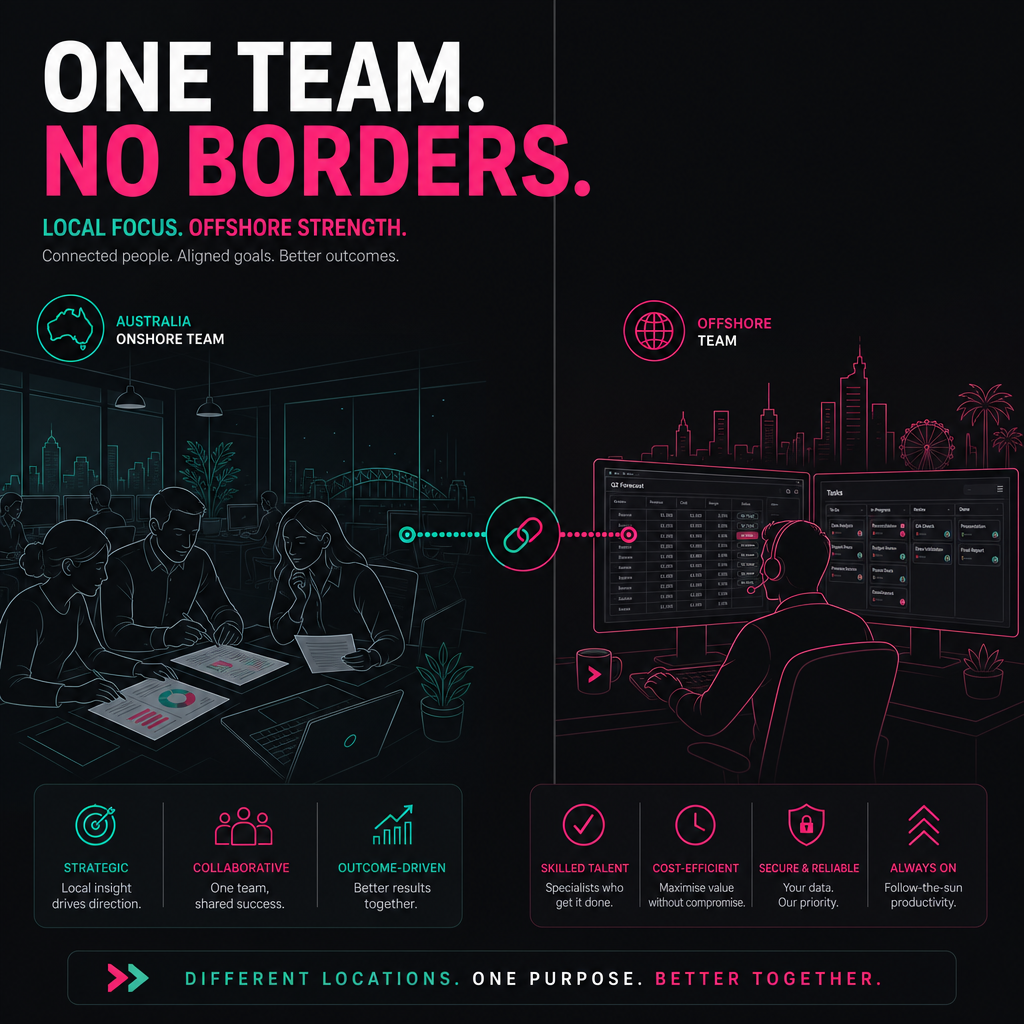
The most expensive offshore staffing mistake I see Australian business owners make is not hiring the wrong person. It is offshoring the wrong role. They start with their most complex, most client-sensitive, most undocumented function and then wonder why it falls apart. The role was never set up to succeed offshore. The problem was not the offshore talent. It was the decision about what to offshore first.
In 2026, offshore staffing is no longer a cost-cutting experiment for early adopters. It is a structural decision for any Australian business that wants to stay competitive. Labour costs in Australia continue to climb, the national minimum wage sits above $24 per hour, and skilled roles in finance, technology and marketing regularly command $80,000-$120,000 AUD annually. Offshore staffing through a partner like Remotee can reduce that cost by 50-70% without reducing quality, provided you are offshoring the right roles.
This guide gives you a practical, no-fluff framework for identifying which roles are genuinely suited to offshore staffing, which ones should stay local, and how to think about splitting a hybrid role between both. I will back every recommendation with logic, real examples from businesses I have worked with, and Australian market context. By the end, you will know exactly where to start.
Key Takeaways
- The single biggest predictor of offshore staffing success is process maturity, not role complexity. A well-documented simple role beats an undocumented complex one every time.
- Roles with clear inputs, measurable outputs, and low real-time customer-facing risk are highest suitability for offshoring.
- High-suitability offshore roles include bookkeeping, data entry, scheduling, digital marketing execution, IT support and software development.
- Roles requiring local regulatory judgement, physical presence, or high-stakes client relationship management are better kept onshore, at least initially.
- Many roles are not purely onshore or offshore. Splitting tasks within a role between a local lead and an offshore executor is often the most efficient model.
- Readiness matters as much as role type. Before hiring offshore, audit your documentation, software access and approval workflows.
Summary Table: Offshore Staffing Role Suitability at a Glance
| Role Category | Offshore Suitability | Typical Complexity | Supervision Needs | Customer-Facing Risk |
|---|---|---|---|---|
| Data Entry and Processing | Very High | Low | Low | Very Low |
| Bookkeeping and Accounts Payable | High | Medium | Low-Medium | Low |
| Scheduling and Admin Support | High | Low-Medium | Low | Low |
| Digital Marketing Execution | High | Medium | Medium | Low |
| IT Support (Tier 1-2) | High | Medium | Low | Low-Medium |
| Software Development | High | High | Medium | Low |
| Customer Service (non-complex) | Medium-High | Medium | Medium | Medium |
| Payroll Processing | Medium-High | Medium-High | Medium | Medium |
| Graphic Design | High | Medium | Low | Low |
| Senior Finance or CFO Advisory | Low | Very High | High | High |
| Legal and Compliance Advice | Very Low | Very High | High | Very High |
| Senior Sales (relationship-driven) | Low | High | High | High |
| C-Suite Leadership | Very Low | Very High | High | Very High |
The Role-Suitability Framework: Four Questions Before You Offshore Anything
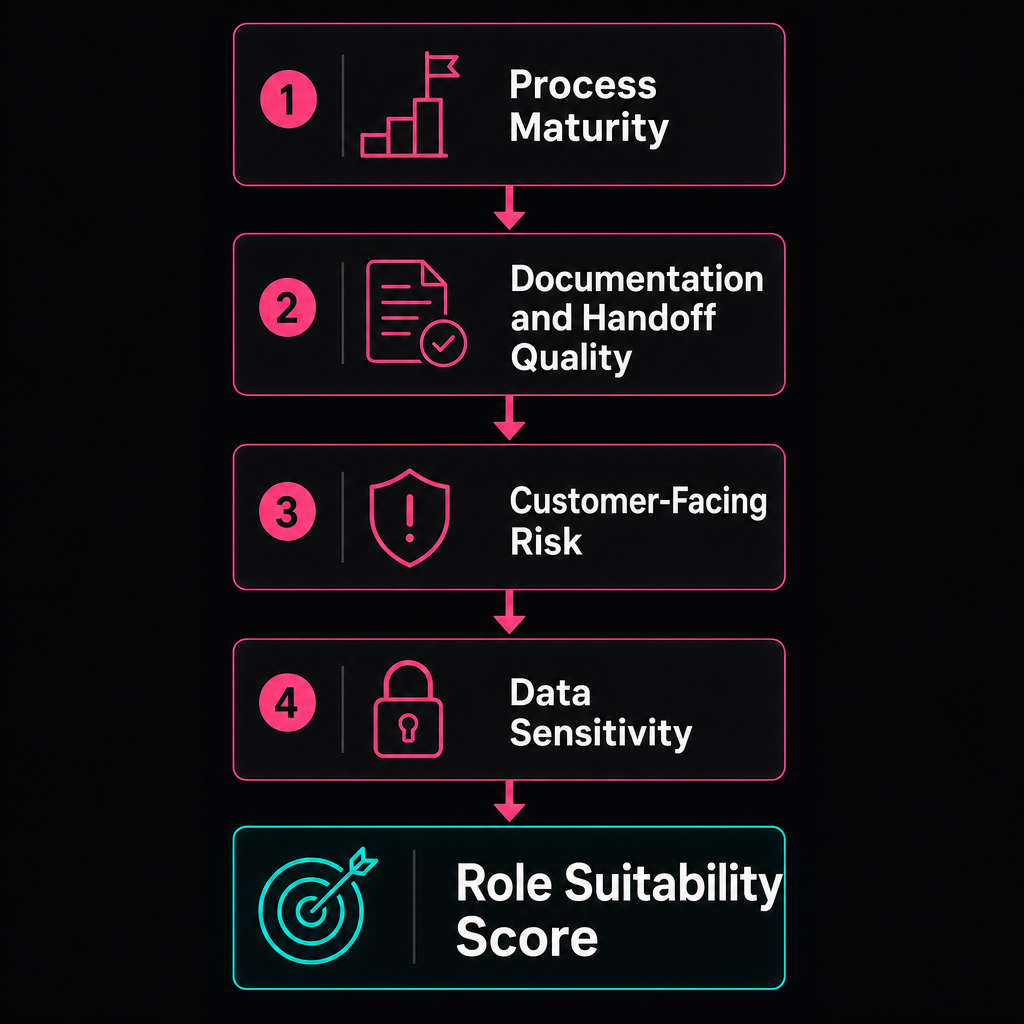
Before I recommend a specific role list, I want to give you a framework you can apply to any function in your business. I call it the four-filter test. Run every role through these four questions before you make a hiring decision.
Filter 1: Process Maturity
Can you hand someone a documented process and have them execute it with fewer than three clarifying questions? If the answer is no, that is not an offshore staffing problem. That is a documentation problem you need to solve first.
I have seen businesses try to offshore a customer service function where every query was handled differently depending on who picked it up. There was no script, no escalation path, no decision tree. The offshore hire could not succeed because no local hire could either. The chaos was invisible until someone new had to navigate it.
High process maturity means: written SOPs exist, they are current, and someone has tested them with a new team member recently. If your last process document was written in 2021 and has not been touched since, it does not count.
Filter 2: Documentation and Handoff Quality
Related to process maturity but distinct. Even if a process is mature, can you hand it off clearly? This means access to the right software, defined approval chains, and clear ownership of exceptions.
For bookkeeping as an example, this means your chart of accounts is clean, your bank feeds are connected, your approval workflow for bills is defined, and someone local owns the exceptions. Without that, even an excellent offshore bookkeeper will spend half their time chasing basic context.
Filter 3: Customer-Facing Risk
How much reputational or relationship damage could a single error cause? A data entry mistake in an internal spreadsheet is recoverable. A billing error sent to your top three clients is a different conversation.
This does not mean customer-facing roles cannot be offshored. It means you need to think carefully about what decisions the offshore person is authorised to make independently, and what requires local sign-off. The risk is manageable with the right guardrails. It is not manageable if you treat it as someone else's problem.
Filter 4: Data Sensitivity
Does the role require access to personally identifiable information, financial records, or commercially sensitive data? This is relevant under the Australian Privacy Act 1988, and Australian businesses handling personal information of Australian residents are bound by those obligations regardless of where the work is performed.
This does not disqualify a role from being offshored. It means you need a data handling agreement, clear access controls, and a provider who takes compliance seriously. At Remotee, compliance is built into the operating model, not bolted on as an afterthought.
High-Suitability Offshore Staffing Roles: Where to Start
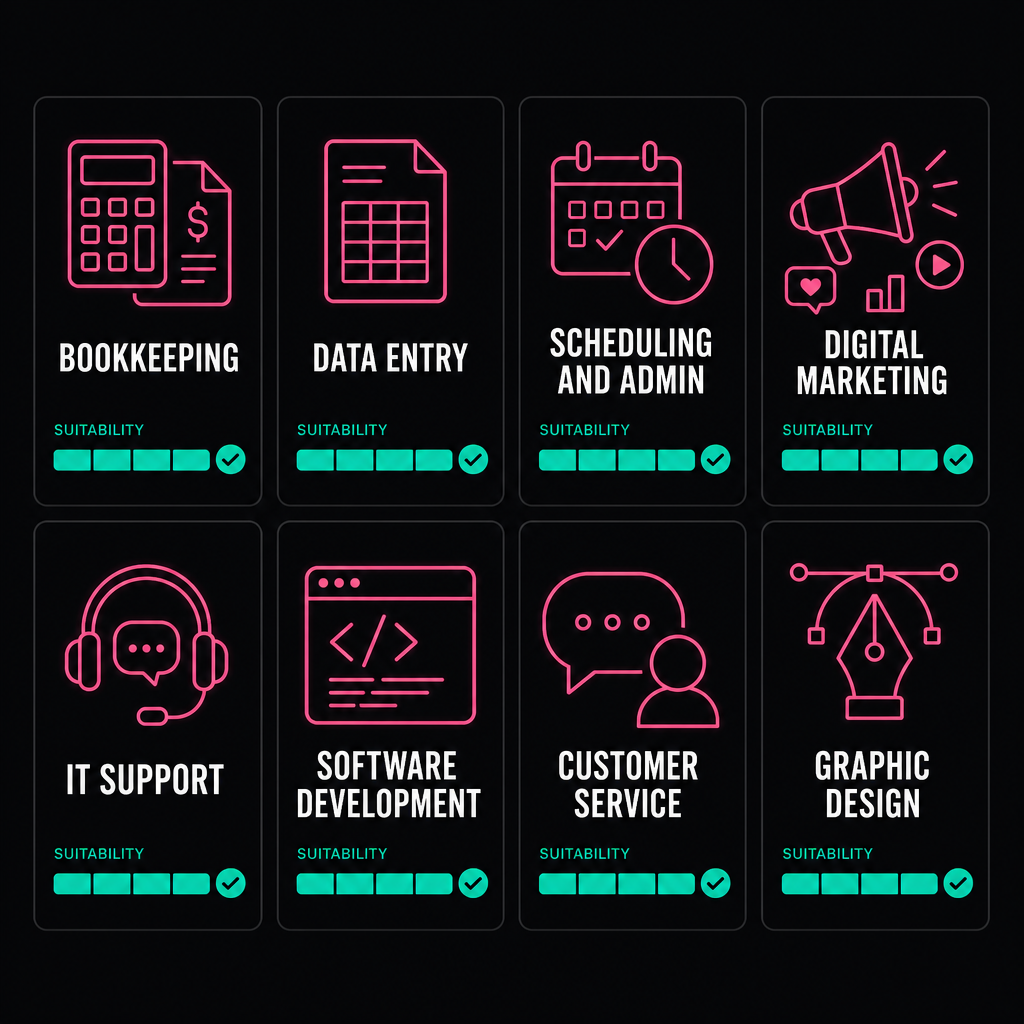
These are the roles where offshore staffing consistently delivers strong outcomes for Australian businesses. Each one scores well across all four filters when set up correctly.
Bookkeeping and Accounts Payable
This is one of the most proven offshore functions for Australian businesses. A skilled offshore bookkeeper working in Xero, MYOB or QuickBooks, reconciling accounts, processing invoices and preparing BAS-ready reports, can typically be hired for 40-60% less than the equivalent local hire.
The Australian bookkeeping market is tight. A mid-level local bookkeeper costs $55,000-$75,000 AUD per year, and in Sydney or Melbourne you are often competing with accounting firms for the same talent. Offshore, through the right partner, you can access equivalent technical skill at a fraction of that.
I worked with a recruitment agency whose founders wanted to focus on new business development, not payroll and accounting. Managing those functions in-house was not delivering good commercial ROI and it was pulling the partners away from billable work. We installed an offshore payroll and bookkeeping team customised to their software stack, completed full discovery and were live within two weeks. The outcome: one email approval per fortnight, and the offshore team manages all payroll, super, compliance and tax. Inbound timesheet queries, payroll reconciliation, all of it handled. The founders got back 6-10 hours per pay cycle that they now put into winning new clients.
Bookkeeping is one of those roles where the quality of the delivery system matters as much as the talent. An offshore bookkeeper inside a structured onboarding and compliance framework is safer than a local part-timer who is rushing a payrun between tax returns.
Data Entry and Processing
High volume, low ambiguity, easy to audit. Data entry is the textbook offshore role and for good reason. Whether it is entering invoices, updating CRM records, migrating product catalogues, or processing forms, the work is repeatable, measurable and easy to quality-check.
Australian businesses in retail, logistics, healthcare administration and property regularly use offshore data processing teams to handle volume that would otherwise require multiple full-time local hires. The cost difference is significant. A local data entry operator at award wage costs around $45,000-$50,000 AUD per year. Offshore, you can often staff two people with equivalent output for the same budget.
Scheduling, Administration and Executive Assistance
Calendar management, travel bookings, inbox triage, preparing meeting notes, chasing approvals, managing supplier correspondence. These tasks are time-intensive for founders and senior managers, but they do not require local presence or deep local knowledge in most cases.
A well-briefed offshore executive assistant can handle a significant portion of a founder's administrative load. The key is a clear communication protocol: which messages require same-day response, which can be batched, what the assistant is authorised to send independently. Get that documented and the model works well.
For Australian businesses where the owner is the bottleneck, an offshore EA is often the highest-leverage first hire. It costs less than $3,000 AUD per month in many cases, and it frees up 10-15 hours per week of the owner's time.
Digital Marketing Execution
Content creation, social media scheduling, SEO reporting, Google Ads monitoring, email campaign builds, graphic design, video editing. These are all execution-layer tasks that sit below strategy.
The distinction matters. Offshore digital marketing hires work best when a local strategist owns the direction and the offshore team executes against a brief. Campaign strategy, brand positioning, and client-facing pitch work tend to stay onshore. Execution, production and reporting move offshore efficiently.
Australian digital marketing agencies and in-house marketing teams have been using this model for years. A local senior marketing manager sets the quarterly plan, an offshore team of two or three handles production. The output increases substantially without a proportional increase in cost.
IT Support: Tier 1 and Tier 2 Helpdesk
Password resets, software troubleshooting, user onboarding, ticket triage, basic network monitoring. These are well-defined, process-driven tasks where offshore teams perform consistently when backed by a good knowledge base.
For Australian businesses running on Microsoft 365, Google Workspace or common SaaS stacks, offshore IT support is a proven model. Many managed service providers (MSPs) in Australia have run hybrid local-offshore support models for years. Time zone overlap with the Philippines covers Australian business hours, which removes one of the common objections to this model.
Software Development and QA Testing
Development talent in Australia is expensive and competitive. A mid-level software developer in Sydney or Melbourne commands $100,000-$130,000 AUD per year. Offshore development teams in the Philippines, with the right structure and oversight, can deliver at 40-60% of that cost.
QA testing is particularly well-suited to offshoring because it is process-driven, repetitive and measurable. Test case execution, regression testing, bug logging and documentation are tasks where offshore teams consistently deliver strong results.
For product development, the model that works best is a local product owner or technical lead who owns the architecture and stakeholder communication, with an offshore development team executing within a defined sprint structure. Without that local technical ownership, offshore development projects tend to drift.
Customer Service: Non-Complex Inbound
This one has more nuance than the others. Non-complex, process-driven customer service with clear scripts and escalation paths can be handled offshore effectively. Order status queries, basic product questions, appointment confirmations, returns processing.
Complex, judgment-intensive customer issues where the representative needs to negotiate, make exceptions, or manage an escalating situation are better handled locally or by a senior local team member, at least until the offshore team has built enough context to handle them.
For Australian e-commerce businesses, offshoring Tier 1 customer service while keeping complaint handling and escalations local is a common and effective model. The key is a clearly defined escalation protocol so offshore staff know exactly when to hand over.
Roles That Should Stay Local (For Now)
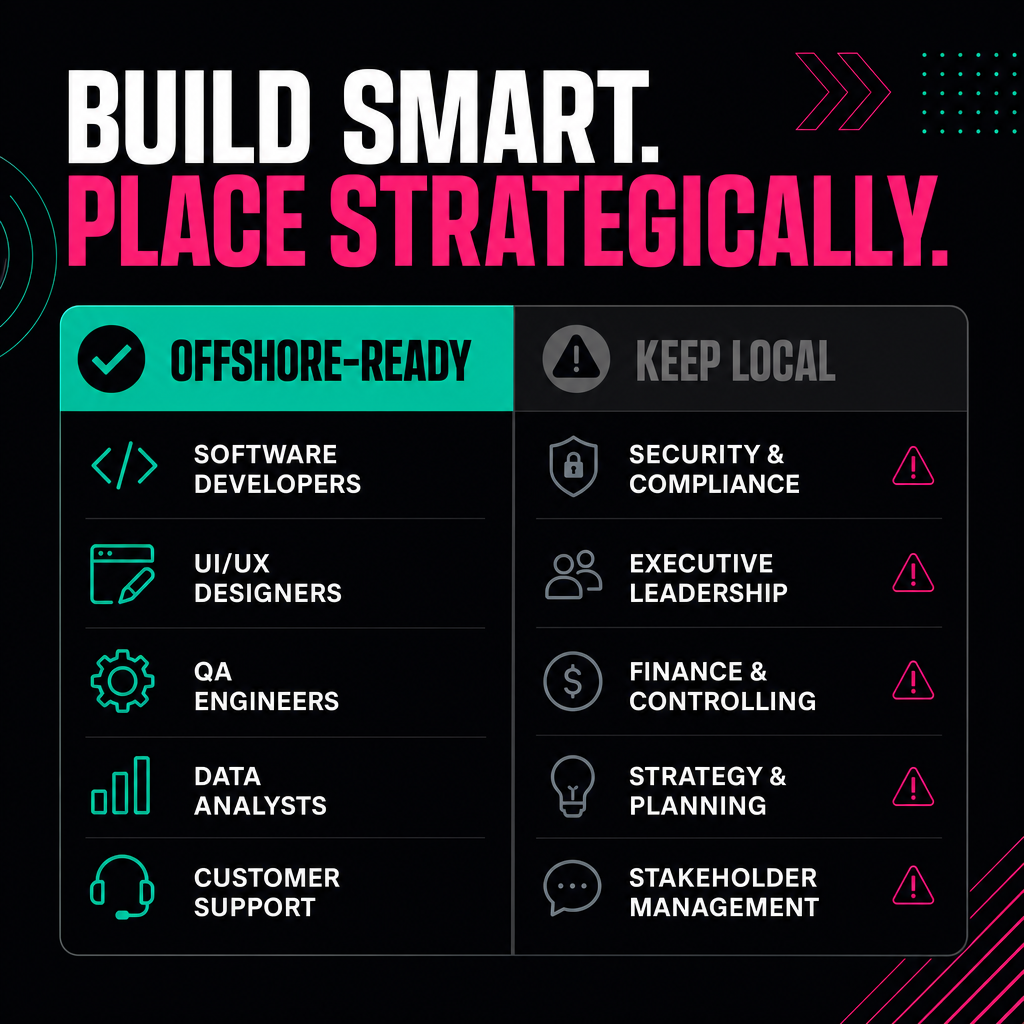
Not every role is suitable for offshoring, and being honest about that is part of building a model that works.
Senior Sales and Business Development
Relationship-driven B2B sales in the Australian market requires local presence, cultural fluency and often face-to-face contact. An offshore hire can support a local sales person by handling CRM updates, research, proposal formatting and follow-up sequencing. But the relationship ownership and the close stay onshore.
Legal, Regulatory and Compliance Advisory
Anything requiring Australian legal qualifications, ASIC obligations, ATO correspondence or Australian Consumer Law advice stays local. This is not about trust in offshore talent. It is about regulated professional obligations that require Australian registration and accountability.
C-Suite and Strategic Leadership
The roles that set direction, manage culture, represent the business to investors or major clients, and make consequential decisions about the organisation's future. These are not roles you can document into a repeatable process. They require judgement, presence and deep organisational context.
Roles With Unresolved Process Chaos
Any role where the current local holder could not explain what they do on a random Tuesday afternoon is not ready to offshore. This is the most underappreciated point. Offshore staffing does not fix process chaos. It amplifies what already exists. If the role is disorganised locally, it will be more disorganised offshore.
Fix the process first. Then offshore the execution.
How to Split a Role Between Local and Offshore
One of the most practical but under-discussed models is the role split. Most real-world functions are not 100% offshore-suitable or 100% local-only. They have components that fall cleanly on each side.
Take a finance manager role in a mid-sized Australian business. The full role might include: strategic financial analysis and board reporting (local), cashflow forecasting and scenario modelling (local), accounts payable processing (offshore), bank reconciliation (offshore), payroll processing (offshore, with local approval), month-end close management (split: offshore prepares, local reviews and signs off).
A hospitality recruitment and labour hire business I worked with had multiple in-house staff plus external accountants managing their payroll at significant cost. They processed payroll weekly, creating a mass workload and high error risk. We came in, completed discovery, and presented a system that removed all internal payroll staff and external accountants from the process, moved payroll to fortnightly, and handed the entire function to our offshore team to run end-to-end. The outcome: a meaningful reduction in operational staff costs, lower payroll processing costs from the fortnightly shift, and improved compliance because the previous team had not been tracking several industry award requirements correctly. The local team now approves one report. That is their entire payroll involvement.
The role split model works well for finance, marketing, operations and customer service. Map the tasks within a role against the four-filter framework, identify which tasks score high on all four, move those offshore, and keep the rest local.
To explore which specific services this model covers, see the full list of Remotee offshore staffing services.
Assessing Your Business's Readiness Before You Hire Offshore
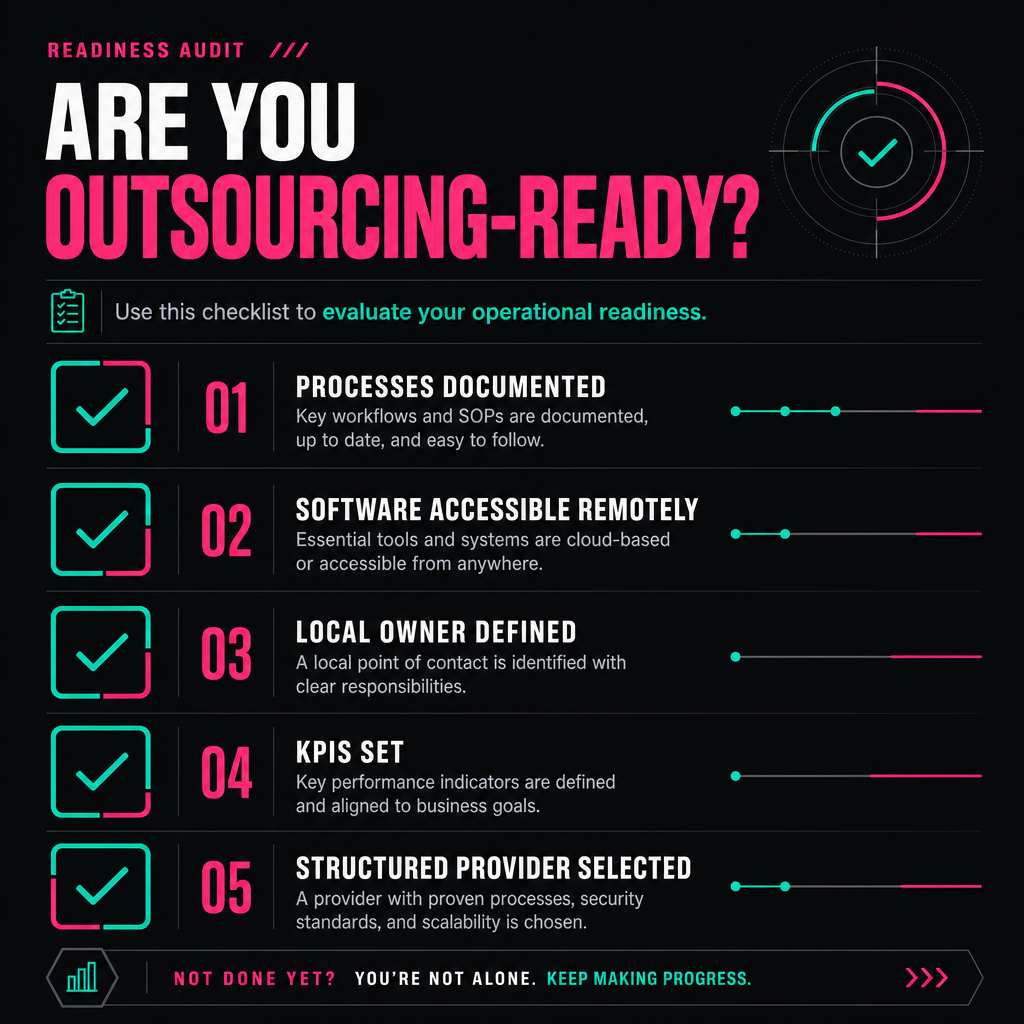
Role suitability is one half of the equation. Business readiness is the other. I have seen roles that were genuinely well-suited to offshoring fail because the business was not ready to support an offshore hire.
Here is a practical readiness checklist before you bring on your first offshore team member.
1. Your Processes Are Documented
Not in someone's head. Not in a 2019 folder that no one has opened since. Written, current, tested SOPs that a new hire can follow on day one. If you cannot produce a process document for the role within a week, you are not ready to hire for it offshore.
2. Your Software Stack Is Accessible Remotely
Cloud-based tools: Xero, HubSpot, Asana, Google Workspace, Slack, Zendesk, and similar platforms are all designed for distributed teams. If your critical systems still require VPN access to an on-premise server or physical presence in the office, that is a constraint you need to resolve before you hire.
3. You Have a Local Owner for the Function
Every offshore role needs a local owner. Not a micromanager. An owner. Someone who sets priorities, reviews output, handles exceptions and is accountable for the function's performance. Without a local owner, the offshore hire has no compass.
4. You Have Defined Outputs and KPIs
What does good look like for this role? How will you know in week two, month two, that the hire is performing? If your answer is "I'll know it when I see it", that is a red flag. Offshore roles need measurable output targets: number of invoices processed, tickets resolved, posts published, records updated per week.
5. You Are Hiring Through a Provider That Includes Structure, Not Just Resumes
This is where provider choice matters enormously. Some offshore staffing agencies hand you a CV and a start date. Others build the delivery structure around the hire, including onboarding, compliance, communication protocols and ongoing performance management.
Adding headcount without adding system is how scaling creates chaos. The value of a structured offshore staffing provider is not just the talent. It is the operating model that surrounds the talent.
If you are ready to assess which roles make sense for your specific business, speak with the Remotee team and we will map it out with you.
Real Case Studies: What Role-Matched Offshore Staffing Looks Like in Practice
Case Study 1: Recruitment Agency, Payroll and Accounts Function
A recruitment agency with strong growth ambitions had their founders spending significant time on payroll and accounting. Hiring in-house was not delivering good ROI commercially or operationally. They were managing the function reactively rather than systematically.
We installed an offshore payroll and bookkeeping team customised to their existing software and pay cycle. Discovery and implementation took two weeks. The offshore team now handles all payroll processing, superannuation, compliance and tax obligations. Inbound queries from staff, timesheet discrepancies and reporting are all managed offshore. The founders' involvement: approval of one email, once per fortnight.
Across fifteen similar implementations in 2026, we have seen founders and senior partners recover 6-10 hours per pay cycle. Hours that go back into business development, client work, or frankly, not working on a Sunday night catching up on payroll.
Case Study 2: Hospitality Labour Hire, Payroll Complexity and Cost Reduction
A hospitality recruitment and labour hire business was running payroll weekly across a large, variable workforce. Multiple internal staff and external accountants were involved, the cost was high, and compliance gaps were emerging because the team managing payroll was not specialised.
We moved the entire payroll function offshore, shifted the cycle to fortnightly, and built a compliant operating model that accounted for the relevant industry award requirements the previous team had missed. The outcome was a reduction in operational staff costs, a reduction in payroll processing costs from the cycle change, and a meaningful improvement in compliance accuracy.
Payroll is too important to be "mostly right". When it is wrong, it affects staff trust, cash flow and your compliance obligations under the Fair Work Act. Getting specialist payroll people running the function, rather than a generalist admin person squeezing it in between other tasks, changes the risk profile completely.
Australian Wage Context: Why the Numbers Make Sense in 2026
Understanding the financial case for offshore staffing requires looking at the current Australian labour market honestly.
The Fair Work Commission's annual wage review has pushed the national minimum wage above $24 per hour in 2026. Add superannuation at 11.5%, workers compensation, leave loading, and the true cost of a full-time local employee at minimum wage exceeds $60,000 AUD per year. For skilled roles, that baseline rises substantially.
Offshore staffing through a structured provider typically costs $1,500-$3,500 AUD per month depending on the role and level of experience. For a full-time equivalent, that is $18,000-$42,000 AUD per year, all-inclusive. The savings on a single bookkeeper or admin hire can fund two or three offshore roles.
This is not about paying people less for its own sake. It is about accessing a labour market where the cost of living, and therefore the cost of labour, is structurally different, while delivering equivalent or better output through a well-managed system. The businesses seeing the best results are the ones treating offshore staff as valued team members inside a clear operating structure, not as cheap labour to exploit.
To understand the full cost model, see Remotee's pricing for transparent role-by-role breakdowns.
Which Industries Are Seeing the Strongest Results?
Offshore staffing is not sector-specific, but some industries in Australia have moved faster than others. Recruitment and HR, professional services, e-commerce, property and construction, digital agencies and healthcare administration are all segments where offshore staffing is now embedded in normal operating models.
For a breakdown by industry, the Remotee industries page covers the specific roles and structures that work best in each sector.
A Note on Senior and Specialised Offshore Roles
A question I get often: can you offshore a senior role? The short answer is yes, with the right setup.
Senior developers, senior SEO strategists, experienced finance analysts, and team leads are all available offshore at a fraction of the local cost. The Philippines in particular has a strong pipeline of degree-qualified professionals with experience in Australian business contexts.
The qualification to "yes" is that senior offshore roles need more onboarding investment, more clearly defined scope, and a strong local executive sponsor who is genuinely engaged in the hire's success. A senior offshore hire left to figure out the business on their own will underperform. A senior offshore hire inside a structured operating model will often outperform the local equivalent at less than half the cost.
Getting Started: Your First Three Offshore Roles
If you are starting from zero and trying to decide where to begin, here is my practical recommendation.
Start with one role that scores high on all four filters: process maturity, documentation quality, low customer-facing risk, and manageable data sensitivity. Data entry, bookkeeping and scheduling administration are the most common starting points for a reason. They deliver quick wins, build your team's confidence in the offshore model, and give you a template for the roles that follow.
Do not start with your most complex function. Do not start with a role that has no documented process. And do not try to offshore three roles simultaneously on your first attempt. One role, done well, teaches you everything you need to scale the model.
When you are ready to map this out for your specific business, contact the Remotee team here. We will assess your current functions, identify where offshore staffing fits, and build the delivery structure around it.
References
- Fair Work Commission, Annual Wage Review 2025-26, https://www.fwc.gov.au/hearings-decisions/major-cases/annual-wage-review
- Australian Bureau of Statistics, Labour Force Australia, https://www.abs.gov.au/statistics/labour/employment-and-unemployment/labour-force-australia
- Office of the Australian Information Commissioner, Privacy Act 1988 and Australian Privacy Principles, https://www.oaic.gov.au/privacy/the-privacy-act
- Fair Work Ombudsman, Pay and Conditions, https://www.fairwork.gov.au/pay-and-wages
FREQUENTLY ASKED QUESTIONS
Common questions
Which roles should never be offshored?
- Roles requiring Australian professional registration (legal, financial advice, certain healthcare roles), roles with no documented process, and C-suite leadership roles where strategic judgement and local stakeholder relationships are the core deliverable. Any role where the current local holder cannot clearly explain what they do is also not ready to be offshored, regardless of the function.
Can I offshore a senior role, not just junior admin work?
- Yes. Senior developers, finance analysts, digital marketing strategists, SEO leads and team managers are all available offshore. The Philippines has a strong pipeline of degree-qualified, experienced professionals. Senior offshore roles require structured onboarding and a clear local sponsor, but the cost difference can be substantial, often $50,000-$80,000 AUD per year or more compared to a local equivalent.
How do I know if a role is ready to be offshored?
- Run it through four filters: Is the process documented? Can the work be handed off clearly with defined inputs and outputs? Is the customer-facing risk low or manageable? Is data sensitivity addressed through proper controls? If yes across all four, the role is a strong candidate. If the process is not documented, that needs to be fixed first.
What is the typical cost saving from offshoring a role in Australia?
- For most skilled roles, Australian businesses see 50-70% cost savings compared to an equivalent local hire when all employment costs are included, such as superannuation, leave loading, workers compensation and overhead. A local bookkeeper costing $65,000 AUD per year all-in can often be replaced with an equally skilled offshore hire at $22,000-$30,000 AUD per year through a structured provider.
Do Australian Privacy Act obligations apply to offshore staff handling Australian data?
- Yes. The Australian Privacy Act 1988 requires Australian businesses to ensure personal information about Australian residents is protected regardless of where processing occurs. You need a data handling agreement with your offshore provider, clear access controls, and a provider who understands these obligations. This is a manageable compliance requirement, not a reason to avoid offshoring.
How long does it take to get an offshore hire productive?
- For high-suitability roles with documented processes, most offshore hires are contributing meaningfully within two to four weeks. The speed depends on documentation quality, software access setup, and the quality of the first two weeks of onboarding. Businesses that invest in structured onboarding see much faster ramp times.
Is offshore staffing only viable for large businesses?
- No. Some of the strongest results come from businesses with 5-20 local staff. At that size, a single offshore hire in bookkeeping or admin can materially change the founder's week. You do not need scale to benefit. You need a documented role, a local owner and the right provider.
What is the difference between offshore staffing and outsourcing?
- Offshore staffing means hiring a dedicated person or team who works exclusively for your business, following your processes, inside your systems, as an extension of your team. Outsourcing means contracting a third-party provider to deliver a service outcome, where the provider manages their own team and processes. For roles requiring integration with your operations and culture, offshore staffing is usually the stronger model.

Jon Kelly
Founder, Remotee
Jon helps Australian businesses build compliance-led offshore teams that scale without the burnout. NDIS, accounting, mortgage broking, recruitment and digital marketing.
KEEP READING
Related posts
offshore staffing cost
How Much Does Offshore Staffing Cost in Australia? A 2026 Breakdown of Savings and Pricing
Key Stats: Australian employers pay an average of 20-30% on top of base salary in statutory on-costs (superannuation, payroll tax, WorkCover, leave loading). A…
20 June 2026 · 26 min read
offshore staffing Philippines
Offshore Staffing in the Philippines: Why Australian Businesses Choose It and How to Get Started in 2026
The Philippines ranks first globally for English proficiency among non-native speaking nations in Asia, according to the EF English Proficiency Index. That sing…
12 June 2026 · 22 min read
offshore staffing company comparison criteria
Offshore Staffing Company Comparison Criteria: How Australian Businesses Should Evaluate Providers
Direct Answer: The criteria that actually predict offshore staffing outcomes are the employment and compliance model, documented delivery workflows, supervision…
11 September 2026 · 16 min read
READY TO SCALE WITHOUT THE BURNOUT?
Build a compliance-led offshore team in 3–4 weeks.
Tell us about your current bottleneck and we'll show you what a Remotee placement would look like for your operation.
Or get our playbooks emailed to you instead.