
How Much Does Offshore Staffing Cost in Australia? A 2026 Breakdown of Savings and Pricing
- offshore staffing
- offshore staffing cost
- Philippines outsourcing
- Australian business
- remote hiring
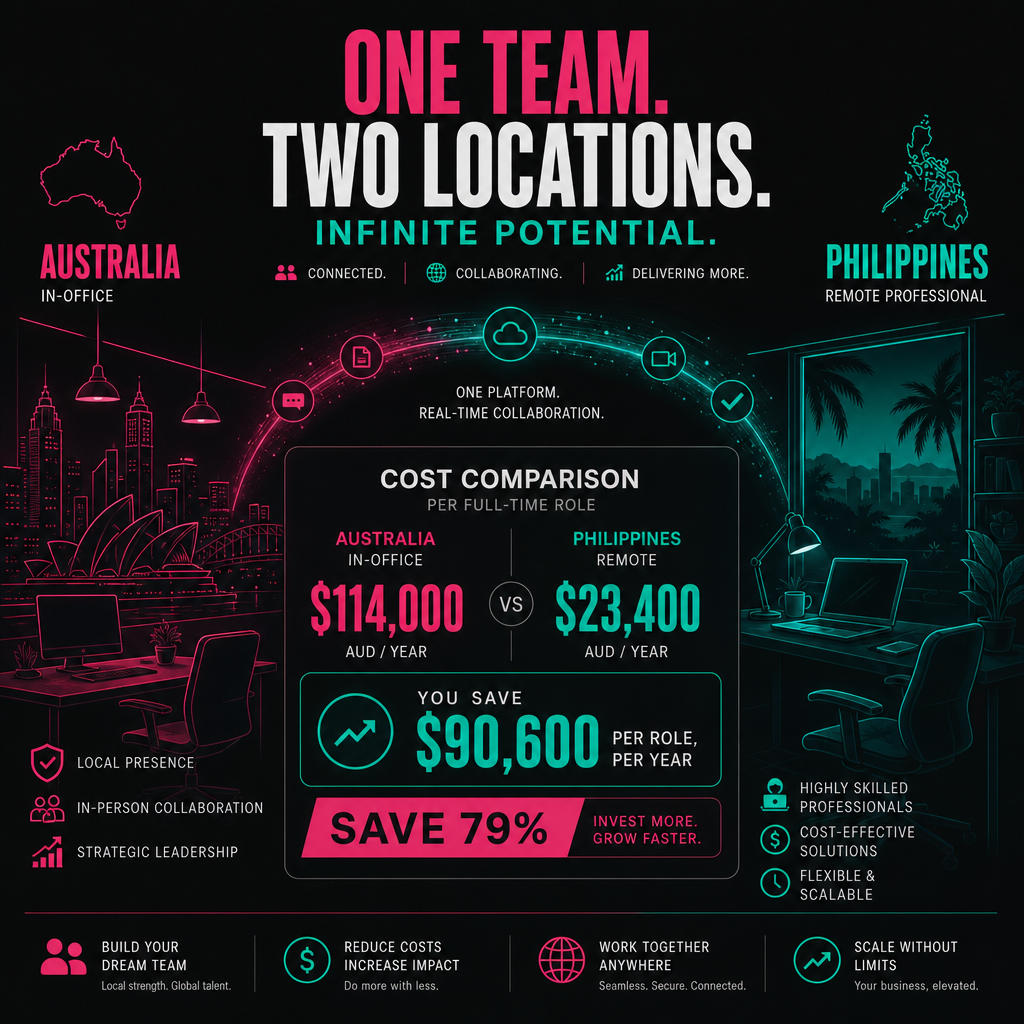
Key Stats: Australian employers pay an average of 20-30% on top of base salary in statutory on-costs (superannuation, payroll tax, WorkCover, leave loading). A fully-loaded offshore role typically lands at 40-60% of the equivalent Australian total employment cost. Specialist retention at 12 months through Remotee's managed model: 95%+.
Cost is the first question every Australian SME asks before exploring offshore staffing. It makes sense. Before you commit to restructuring how your business delivers work, you want to know whether the numbers actually stack up. The honest answer is that the real figure is more nuanced than any headline hourly rate suggests, and the 70% savings claims you see on some providers' websites are doing Australian business owners a disservice.
The total cost of an offshore hire depends on the role, the delivery model, the level of operational support wrapped around the placement, and whether you're comparing it fairly against the true cost of your local hire, not just their base salary. Most business owners I talk to are comparing an offshore monthly fee against a local base wage. That is not an apples-to-apples comparison, and it skews both the savings figure and the risk assessment.
In this breakdown, I'll walk through what actually drives offshore staffing cost in 2026, how it compares to fully-loaded Australian employment across common roles, what hidden costs to budget for, and what realistic savings look like when you run the numbers honestly. I'll also share what I've seen work inside real businesses and where the model breaks down when it's treated as a cost play rather than a capability decision.
Key Takeaways
- The real comparison is offshore total cost vs Australian total cost of employment, not offshore fee vs Australian base salary.
- Australian employers avoid superannuation (11.5% in 2026), payroll tax, WorkCover premiums, leave loading, and public holiday obligations when hiring offshore through a managed provider.
- Fully-loaded offshore staffing for common roles in the Philippines typically costs $2,500-$5,500 AUD per month depending on the role, seniority, and delivery model.
- Realistic, honest savings ranges sit at 40-60% of equivalent Australian employment cost, not the 70%+ figures that circulate in marketing materials.
- The hidden costs (technology, training, management time, onboarding) are real and must be budgeted. A managed model with systems built in reduces but does not eliminate these costs.
- Savings are only sustainable when the offshore role is wrapped in a documented delivery structure. Without that, inconsistent output erodes the financial case faster than any salary comparison can justify.
Summary: Local vs Offshore Fully-Loaded Monthly Cost by Role (2026)
| Role | AUS Base Salary (Annual) | AUS Total Employment Cost (Monthly) | Offshore Monthly (Managed) | Est. Monthly Saving | Saving (%) |
|---|---|---|---|---|---|
| Admin / Virtual Assistant | $60,000 | $6,800 | $2,800 | $4,000 | ~59% |
| Accounting Support (Bookkeeper / BAS) | $75,000 | $8,500 | $3,500 | $5,000 | ~59% |
| Customer Service Representative | $58,000 | $6,600 | $2,600 | $4,000 | ~61% |
| IT Support (Tier 1-2) | $85,000 | $9,600 | $4,500 | $5,100 | ~53% |
| Digital Marketing Coordinator | $72,000 | $8,200 | $3,800 | $4,400 | ~54% |
| Mortgage Broking Support | $70,000 | $7,900 | $3,400 | $4,500 | ~57% |
Notes: AUS total employment cost includes base salary, superannuation at 11.5%, payroll tax (approx. 4.85% for NSW employers above threshold), WorkCover premium, annual leave loading, and allowance for sick leave. Offshore monthly figures reflect a fully-managed model inclusive of salary, employer contributions in the Philippines, HR support, equipment, and account management. Figures are indicative estimates for 2026 and will vary by state, industry, and individual role requirements.
What Drives Offshore Staffing Cost?
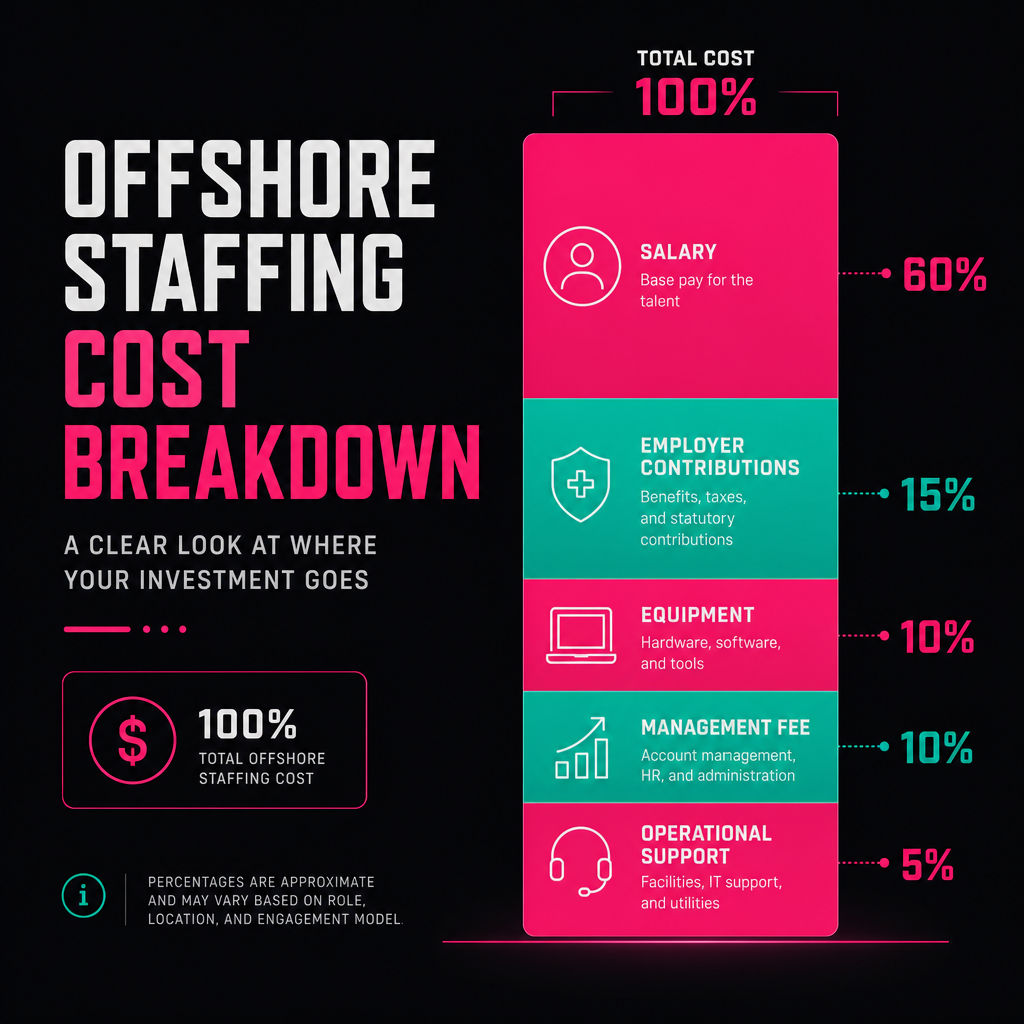
Offshore staffing cost is not a single number. It is a stack of components, and understanding what sits inside each layer is the only way to make a decision you won't regret six months in.
The Salary Component
The most visible part of the cost is the salary paid to the offshore specialist. In the Philippines, which is the primary market for Australian businesses hiring English-speaking, degree-qualified remote staff, monthly salaries for skilled roles in 2026 sit broadly in the following ranges:
- Virtual Assistant or general admin: PHP 25,000-40,000 per month (approximately $700-$1,100 AUD)
- Accounting support, bookkeeping, or BAS preparation: PHP 40,000-65,000 per month (approximately $1,100-$1,800 AUD)
- Customer service representative: PHP 25,000-45,000 per month (approximately $700-$1,250 AUD)
- IT support (Tier 1-2 helpdesk): PHP 45,000-80,000 per month (approximately $1,250-$2,200 AUD)
- Digital marketing coordinator: PHP 40,000-70,000 per month (approximately $1,100-$1,950 AUD)
These are base salary ranges only. They are competitive in the Philippine market and attract qualified candidates. They are not rock-bottom rates, and providers who quote significantly below these benchmarks are either placing underqualified candidates or operating in a race to the bottom that costs you more in rework and turnover than you save on the monthly fee.
The Philippine Overseas Employment Administration and Department of Labor and Employment set minimum wage standards, and reputable providers are required to meet these. Providers sourcing from top-tier talent pools, as Remotee does, typically pay above minimum to attract candidates in the top 1% of their field.
Employer On-Costs in the Philippines
Philippine employers are required to make statutory contributions on behalf of their employees. These include Social Security System (SSS), PhilHealth (national health insurance), and Pag-IBIG (housing fund contributions). In a managed offshore model, these contributions are handled by the provider, but they are built into your monthly fee. A transparent provider will show you what portion of your fee covers these obligations.
These contributions are substantially lower than Australian statutory on-costs, which is one of the core financial drivers of the model. But they are not zero, and any provider who does not account for them is either absorbing them (unlikely) or not paying them (a compliance risk for you if the arrangement is ever scrutinised).
The Agency or Management Fee
In a managed model, the provider charges a fee above the specialist's salary and employer contributions. This fee covers:
- Recruitment, headhunting, and skills testing
- HR administration and employment contracts
- Equipment provision (laptop, headset, secure internet)
- Account management and performance oversight
- IT security and data access controls
- Payroll processing and compliance in the Philippines
- Ongoing support if a replacement is required
At Remotee, this is also where the operational layer sits. The offshore staffing services we wrap around every placement include the SOP library, the workflow documentation, and the account management structure that moves you from Doer to Strategist. That is not a marketing phrase. It is a structural component of the service that directly affects whether your offshore hire delivers consistent, reviewable outcomes.
Management fees across the industry typically sit at 20-40% above the all-in salary cost. Some providers charge a flat monthly fee inclusive of everything. Others itemise salary separately from their management fee. Either structure can work. What matters is that you understand exactly what the total monthly cost is and what it includes.
What Australian Employers Actually Pay Locally
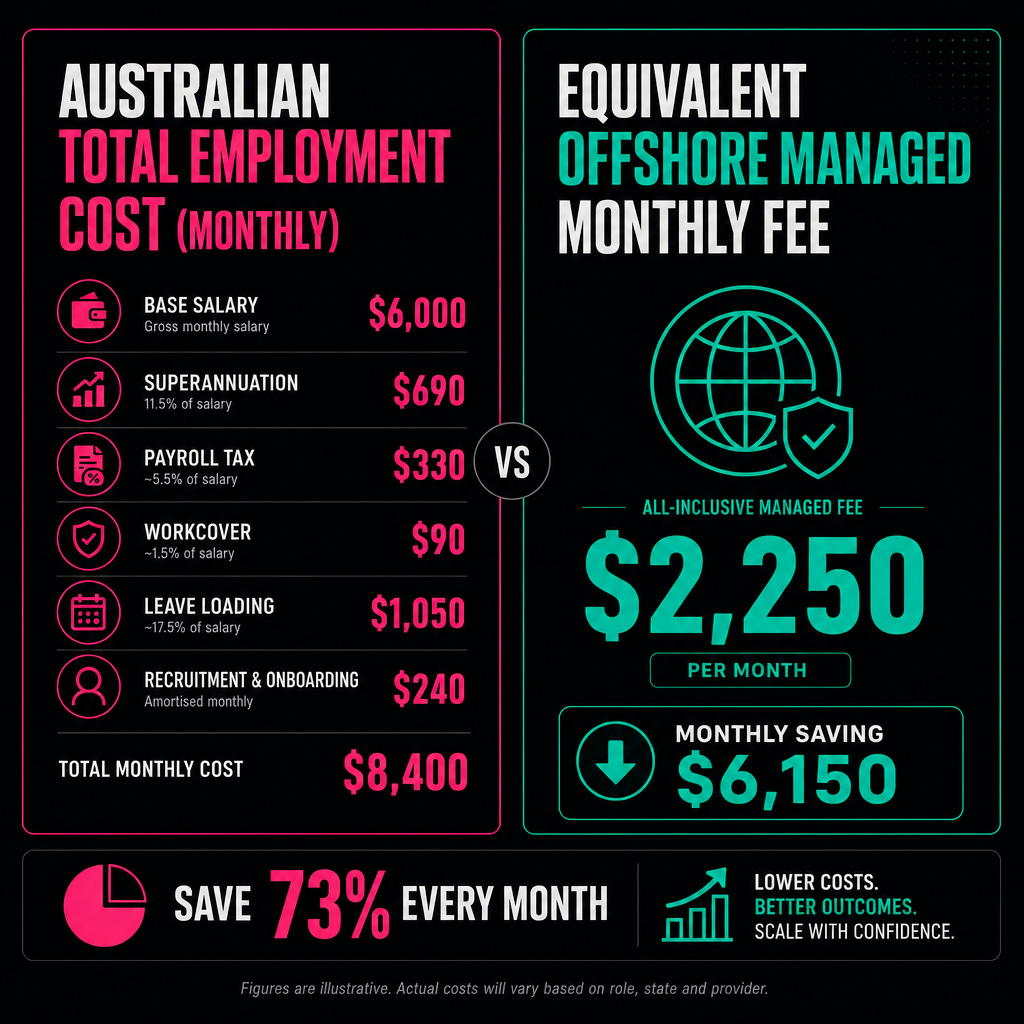
This is where most cost comparisons go wrong. Business owners look at an offshore monthly fee and compare it to a local base salary. That comparison understates the true cost of local employment by a significant margin.
Here is what a fully-loaded Australian hire actually costs in 2026, using a customer service role paying $58,000 base as the example:
Base salary: $58,000 per year ($4,833/month)
Superannuation (11.5% from 1 July 2024, legislated to rise to 12% by 2025): $6,670 per year ($556/month)
Payroll tax: This varies by state and only applies above threshold, but NSW employers above the $1.2M threshold pay 5.45%, Queensland 4.75%, Victoria 4.85%. For a business above threshold, this adds roughly $3,000-$3,200 per year per employee ($250-$267/month).
WorkCover / workers compensation premium: Varies by industry and claims history, but a typical premium sits between 1-3% of wages. For this role, that is $580-$1,740 per year ($48-$145/month).
Annual leave loading: 17.5% on top of four weeks leave, adding approximately $980 per year ($82/month).
Sick leave provision: Ten days per year under the National Employment Standards, typically costing $2,230 per year in paid absence ($186/month).
Recruitment cost (amortised): A single local hire for this type of role typically costs $5,000-$12,000 through an agency or $2,000-$4,000 through direct advertising and internal time. Amortised over a 24-month tenure, that is $100-$500 per month.
Total monthly cost of local employment: Approximately $6,000-$6,600 for this role.
Compared to an equivalent offshore managed monthly fee of $2,500-$2,800, the saving is $3,200-$4,100 per month, or roughly $38,000-$49,000 per year. That is a meaningful number for a small or mid-sized business. It is not 70% savings. It is 50-60% savings calculated honestly, and that is still a very strong financial case.
The Fair Work Act 2009 and the National Employment Standards set out the full range of entitlements Australian employees hold. The ATO's guidance on superannuation obligations and payroll tax obligations are worth reviewing if you have not recently audited your true employment cost per head.
Managed vs Direct Hire: The Cost Structure Difference
There are two broad ways to hire offshore staff for your Australian business. Each has a different cost structure and a different risk profile.
Direct Hire (DIY Offshore Hiring)
In a direct model, you find the candidate yourself (through platforms like OnlineJobs.ph or equivalent), pay them directly as an independent contractor, and manage the employment relationship yourself. The monthly outlay is lower because you are paying salary only, with no agency margin.
For a bookkeeper, this might look like PHP 45,000 per month direct, versus $3,500 AUD per month through a managed provider. On the surface, that looks like a significant saving.
But the direct model carries costs that rarely appear in the comparison:
- Recruitment time. Screening, testing, and interviewing candidates yourself can consume 20-40 hours of internal time for a skilled role. At your effective hourly rate as a business owner, that has a real cost.
- Contractor vs employee risk. Classifying a Filipino worker as an independent contractor when they work exclusively for you, follow your processes, and use your systems creates misclassification risk under Philippine labour law. Reputable providers hold the employment risk.
- Equipment and security. You are responsible for providing or specifying the work setup. A managed provider typically includes this in the fee.
- No replacement guarantee. If your direct hire resigns or underperforms, the cost of finding and onboarding a replacement falls on you again.
- No operational support. There is no account manager helping you document processes, resolve issues, or structure the role for consistent output.
For businesses at an early exploration stage, direct hiring can be a legitimate starting point. But for established Australian businesses with repeatable operations who want a long-term capability layer, the managed model consistently produces better commercial outcomes because the delivery structure is built in.
Managed Provider Model
In a managed model, the provider employs the specialist (or engages them compliantly in the Philippines), handles all HR and payroll administration, provides equipment, and charges you a monthly fee. This fee is your total cost. There is no hidden employer liability sitting underneath.
The additional component in a quality managed model is the operational layer: the SOP library, the delivery cadence, the account management, and the frameworks that turn a new hire into a reliable contributor within the first 21 days rather than the first six months.
This is where Remotee's approach differs from most providers. Most compete on cost, speed, or the quality of resumes they can supply. We compete on reliability. Talent quality matters enormously, but quality alone does not produce consistent outcomes. Without documented workflows, checkpoints, and a review cadence, even strong hires produce inconsistent results as volume grows and the business changes around them. Check the pricing page for a transparent breakdown of what is included in each tier.
Hidden Costs to Budget For
I want to be direct about something that some providers gloss over. Even in a well-structured managed model, there are real costs beyond the monthly fee that business owners need to budget for. Ignoring these does not make them go away. It just means you discover them after the decision is made.
Technology and Software Access
Your offshore specialist needs access to your existing software stack. For most businesses, that means additional user licences for your CRM, accounting software, project management tool, communication platform, and any industry-specific applications. Depending on your existing licensing arrangements, this can add $50-$400 AUD per month per person.
If you are using software with per-seat pricing (Xero, HubSpot, Monday.com, for example), the offshore headcount adds to your licence cost in exactly the same way a local hire would.
Onboarding and Training Time
Even with an SOP library provided by the managed service, your offshore specialist needs time to learn your specific business, your clients, your tone, and your workflows. Budget for 4-8 hours of internal team time in the first two weeks, reducing to a regular check-in rhythm after that. This is not a criticism of the model. It is a reality of any new hire, local or offshore.
The businesses I work with that get the fastest time-to-productive results are the ones that treat the onboarding period as an investment in clarity rather than a drain. Documented processes and clear expectations are not bureaucracy. They are what makes delegation reliable.
Management Time and Cadence
An offshore specialist is not a set-and-forget arrangement. A weekly check-in (20-30 minutes), a review of output against agreed standards, and a structured feedback loop are what keep quality consistent over time. In Remotee's model, the account manager supports this cadence, but the business owner or team lead still needs to participate. Budget two to three hours per month of your own time for oversight and direction, especially in the first 90 days.
Currency Fluctuation
If your contract is priced in AUD (as it should be through a reputable managed provider), this is not your risk. The provider manages the currency exposure. If you are paying a contractor directly in Philippine Peso or USD, your monthly cost will move with the exchange rate. In a direct hire arrangement, this is an ongoing cost variable that is easy to underestimate across a 12-24 month period.
What Realistic Savings Look Like: Two Case Studies
Case Study 1: Digital Marketing Agency
I worked with a founder running a digital marketing agency who was the approval bottleneck for almost every piece of routine work. Tasks lived across the inbox, Slack, and memory. Rework occurred constantly because expectations were unclear and handoffs were verbal.
We placed a marketing coordinator offshore at a fully-managed monthly cost of $3,600 AUD. The equivalent local role, loaded with super, payroll tax, leave, and recruitment cost amortised over 24 months, would have cost $8,400 per month. The gross saving was $4,800 per month.
But that number only held because we installed the delivery structure alongside the hire. We built a delegation map that defined who owned approvals at each stage. We created an SOP pack covering every repeatable task, including exception handling for the edge cases that typically cause the most rework. We introduced a quality checkpoint checklist and a weekly scorecard.
The outcome was not just cost savings. Handoffs became faster because approvals had clear owners. Rework dropped because expectations were documented, not assumed. And the founder moved from being the person doing the work to the person reviewing outcomes. That shift is where the real commercial value sits. The saving on salary is the entry ticket. The reclaimed strategic time is the return.
Over 12 months, the financial saving was $57,600 AUD. The operational improvement, measured in reduced rework cycles and faster client delivery, was harder to put a precise number on but was visible in client retention and throughput.
Case Study 2: Accounting Firm
An accounting firm came to us with a familiar problem. Sensitive compliance steps were blocking delegation. Prep work was consuming the internal team's time, and approvals were inconsistent and slow. Partners were spending 50-60% of their time on tasks that could be handled by a well-supported specialist at a fraction of the cost.
We installed a control model structured by workflow risk. Prep work was delegated to an offshore accounting specialist placed at $3,500 AUD per month (fully managed). Sensitive approvals were retained internally. We introduced evidence capture at checkpoints so every decision had an audit trail.
Across Remotee's accounting clients, we consistently see a 35-50% reduction in non-billable partner time. In this firm, the reclaimed partner hours were redirected to client-facing advisory work, which produced additional revenue that far exceeded the monthly offshore cost. The placement-to-operational timeline was 21 days.
The fully-loaded saving on the offshore role versus a local hire was approximately $4,800 per month. Over 12 months, that is $57,600. But the advisory revenue generated from reclaimed partner time made the true ROI multiple orders of magnitude higher.
Testimonial: "Before Remotee, I was doing work that I knew I shouldn't be doing. Prep work, data entry, chasing documents. Now that's handled consistently, and I can actually focus on the clients who need my advice. The systems they put in place made the difference. It wasn't just a hire, it was a whole operating structure." Managing Director, boutique accounting firm, Queensland.
The Philippines as the Benchmark Market

The Philippines is the primary offshore talent market for Australian businesses, and for good reason. English is an official language, the education system produces large numbers of degree-qualified professionals each year, and the cultural alignment with Australian business norms is meaningfully closer than other low-cost markets.
The Philippine Statistics Authority reports a national literacy rate above 98%, and the country's tertiary education system produces over 500,000 graduates annually across business, technology, accounting, and communication disciplines. Metro Manila, Cebu, and Davao are the primary talent hubs, each with a mature outsourcing industry and deep familiarity with Australian business standards.
In 2026, the minimum wage in Metro Manila sits at approximately PHP 610 per day for non-agricultural workers. Skilled professionals in the roles relevant to Australian businesses earn well above this, typically PHP 35,000-80,000 per month depending on the discipline and experience level. These are market-competitive rates in the Philippine context, and they represent the salaries paid by reputable providers sourcing from the top of the talent pool.
Providers who advertise rates that would imply salaries significantly below these benchmarks are either sourcing from lower-skilled cohorts, misrepresenting what is included, or paying wages that will produce high turnover. High turnover in an offshore role is expensive. Recruitment, onboarding, and productivity ramp-up costs for a replacement hire can easily consume three to four months of the savings you made on the monthly fee.
Remotee's 95%+ specialist retention rate at 12 months is a direct result of paying above-market rates for top-tier talent and wrapping those specialists in a delivery structure that makes their work meaningful and measurable. Retention is not a soft metric. It is a hard financial advantage.
ROI Timeline: When Do the Savings Actually Land?
This is a question most providers avoid answering directly. I'll give you a straight answer.
Month 1: Net cost is typically higher than the ongoing rate because of setup, onboarding, and the productivity ramp-up period. Budget for 60-70% of full productive output in the first month. In Remotee's model, the placement-to-operational timeline is 21 days, which compresses this ramp-up significantly.
Months 2-3: Output reaches 80-90% of full capacity as the specialist learns your systems, your clients, and your standards. Weekly scorecard reviews during this period surface any gaps before they become habits.
Month 4 onwards: Full productive output. The monthly saving versus local employment is realised in full. For most roles, this sits at $3,500-$5,000 AUD per month depending on the role and the local equivalent cost.
Break-even on setup costs: Setup costs (any one-off recruitment or onboarding investment) are typically recovered within 6-8 weeks of full productive output, given the monthly saving differential.
12-month financial picture: Across common roles, a business replacing one local hire with an offshore specialist in a managed model will typically save $42,000-$60,000 AUD over a 12-month period, net of the managed monthly fee, technology costs, and internal time investment.
For businesses adding headcount rather than replacing an existing role, the ROI calculation looks different but is often stronger. If you are growing and the choice is between hiring locally or hiring offshore, the offshore option frees capital for other growth investments while delivering equivalent or, in a well-structured model, superior output consistency.
Use the agency capacity calculator to model what this looks like for your specific business, including the roles you are considering and your current local employment cost.
Why the Cheapest Option Usually Costs the Most
This is a point I feel strongly about, because I've seen the consequences of businesses choosing the lowest-priced provider and then spending 12 months unpicking the results.
The offshore staffing market has providers at every price point. At the low end, you'll find high-volume models that prioritise speed of placement over quality of match and provide no operational support. The specialist placed through these models may be technically qualified, but without a delivery structure around them, output quality varies with mood, workload, and the clarity of instructions they receive on any given day.
That is not a talent problem. It is a delivery structure problem. And it is almost always the delivery structure problem, not the talent, that causes offshore arrangements to underperform.
Systems over heroics is how I would summarise the principle. Quality is designed, not discovered. A cheap placement with no operating system costs you more in management time, rework, and eventual replacement than a slightly higher monthly fee for a specialist who arrives with documented workflows, clear checkpoints, and a review cadence already established.
For a deeper comparison of what the true numbers look like across different models, see the offshore vs local hiring cost comparison which runs through several role-specific scenarios in more detail.
The Remotee Method: How This Works in Practice
For established Australian businesses with repeatable operations who want a long-term capability layer rather than a quick hire, Remotee's delivery follows a structured four-phase process.
Phase 1: Discovery and Mapping. We audit your existing workflows and map your complete software ecosystem to build an operational blueprint. This is where we identify what can be delegated, what the risk profile of each task is, and where the delivery structure needs to be built before the hire occurs.
Phase 2: The Specialist Match. We headhunt from the top 1% of Philippine talent with rigorous technical testing against Australian industry standards. For accounting roles, that means testing against Australian tax and compliance knowledge, not just general bookkeeping competency. For customer service roles, we assess written and verbal English against Australian business communication standards.
Phase 3: Operational Integration. The specialist is delivered alongside a library of industry-specific SOPs with compliance baked in, not bolted on. The first 21 days include structured onboarding against real deliverables, with quality checkpoints validating output before the specialist operates independently.
Phase 4: Strategic Mentorship. Ongoing support from a dedicated Australian account manager who reviews performance, supports process improvements, and helps you move from being the person executing work to the person directing strategy.
The financial cost of this model is transparent. You can review the pricing structure to understand what each tier includes and how the monthly fee is structured. If you want to explore what this looks like for your specific situation, the right starting point is a conversation: contact Remotee to discuss your roles and requirements.
What to Do Before You Decide
Before you commit to any offshore staffing arrangement, there are three things worth doing.
First, calculate your real local employment cost. Use the on-cost categories I've outlined above and work out what each role you're considering actually costs to employ locally in your state. The ATO's guidance on superannuation and the Fair Work Commission's pay scales are reliable starting points. Most business owners discover their true employment cost is 20-35% higher than the base salary figure they think of.
Second, define what done looks like for the role. The single biggest predictor of success with an offshore hire is clarity about what good output looks like. Before any conversation with a provider, write down the top five tasks the role will own, the output standard for each, and how you'll know each week whether the role is performing. If you can't define this, the hire will underperform regardless of who provides it.
Third, choose the right model for your business stage. If you're early-stage and experimental, a direct hire may suit you while you figure out what you need. If you're established, growing, and want the role to function reliably without consuming your management time, a managed model with operational support is almost always the right commercial decision.
References
- Australian Taxation Office. Super for employers. ATO, 2026. https://www.ato.gov.au/businesses-and-organisations/super-for-employers
- Fair Work Commission. National Minimum Wage Order 2024-25. Fair Work Commission, 2024. https://www.fwc.gov.au
- Australian Bureau of Statistics. Employee Earnings and Hours, Australia. ABS, 2024. https://www.abs.gov.au/statistics/labour/earnings-and-work-hours
- Philippine Statistics Authority. Labor Force Survey, 2025. PSA Philippines. https://psa.gov.ph
- Department of Employment and Workplace Relations. Payroll tax rates and thresholds by state and territory. DEWR, 2026. https://business.gov.au
FREQUENTLY ASKED QUESTIONS
Common questions
Is offshore staffing actually cheaper than hiring locally in Australia?
- Yes, materially so, but the comparison needs to be fair. Offshore staffing is cheaper than the total cost of equivalent local employment, which includes base salary, superannuation (11.5% in 2026), payroll tax (where applicable), WorkCover premiums, leave loading, and recruitment costs. Comparing an offshore monthly fee to total local employment cost shows a realistic saving of 40-60% for most roles.
What is included in a typical offshore staffing monthly fee?
- In a managed model, the monthly fee typically covers the specialist's salary, Philippine employer contributions (SSS, PhilHealth, Pag-IBIG), HR and payroll administration, equipment (laptop, headset, secure internet), account management, and replacement support. A full-service provider will also include operational support such as SOP library access, workflow documentation, onboarding support, and dedicated account management.
Are there setup fees for offshore staffing?
- This varies by provider. Some charge a one-off placement or setup fee on top of the first monthly payment. Others build recruitment costs into the ongoing monthly fee. The key question to ask any provider is whether there is a separate recruitment fee, and what happens to that fee if the placement does not work out within the first 90 days.
What is a realistic savings percentage for offshore staffing?
- Realistically, 40-60% compared to the total cost of equivalent local employment. The higher figures of 70%+ that circulate in marketing materials are usually based on comparing offshore salary only to Australian base salary, without loading either figure correctly. For most roles, the monthly saving sits at $3,500-$5,500 AUD, compounding to $42,000-$66,000 per year.
What are the hidden costs of offshore staffing I should know about?
- The most common hidden costs are: additional software licence seats for the offshore specialist, internal time spent on onboarding in the first two to four weeks, management time for weekly check-ins and output reviews, and in a direct hire arrangement, currency fluctuation risk. In a managed model with a strong account management structure, the management overhead is substantially reduced but never zero.
Is there a minimum commitment period for offshore staffing?
- Most reputable managed providers require a minimum three to six month commitment. This is reasonable given the investment in recruiting, testing, and onboarding a specialist for your business. Be cautious of providers offering month-to-month arrangements with no commitment from either side, as this usually signals a high-volume, low-quality model where retention is not a priority.
How quickly can an offshore specialist be productive in my business?
- In a well-structured managed model, placement-to-operational takes around 21 days, with full productive output typically landing by week six to eight. Businesses that invest in clear SOP documentation and a structured onboarding plan consistently reach full productivity faster.
Does offshore staffing work for compliance-sensitive roles like accounting or NDIS support?
- Yes, when the delivery structure is built correctly. Compliance is a reason to be more deliberate about how you structure offshore staffing, not a reason to avoid it. The key is separating what can be delegated (prep work, data entry, document management) from what must be retained internally (final approvals, client sign-offs, professional certifications). When compliance steps are documented in SOPs from the start, offshore specialists in accounting, NDIS, and mortgage broking can operate within clear boundaries with full audit-ready visibility.

Jon Kelly
Founder, Remotee
Jon helps Australian businesses build compliance-led offshore teams that scale without the burnout. NDIS, accounting, mortgage broking, recruitment and digital marketing.
KEEP READING
Related posts
offshore staffing Philippines
Offshore Staffing in the Philippines: Why Australian Businesses Choose It and How to Get Started in 2026
The Philippines ranks first globally for English proficiency among non-native speaking nations in Asia, according to the EF English Proficiency Index. That sing…
12 June 2026 · 22 min read
offshore staffing roles
Which Roles Are Best Suited to Offshore Staffing? A Guide for Australian Businesses in 2026
The most expensive offshore staffing mistake I see Australian business owners make is not hiring the wrong person. It is offshoring the wrong role. They start w…
23 June 2026 · 23 min read
offshore staffing company comparison criteria
Offshore Staffing Company Comparison Criteria: How Australian Businesses Should Evaluate Providers
Direct Answer: The criteria that actually predict offshore staffing outcomes are the employment and compliance model, documented delivery workflows, supervision…
11 September 2026 · 16 min read
READY TO SCALE WITHOUT THE BURNOUT?
Build a compliance-led offshore team in 3–4 weeks.
Tell us about your current bottleneck and we'll show you what a Remotee placement would look like for your operation.
Or get our playbooks emailed to you instead.