
Offshore Staffing in Australia: How It Really Works for Local Businesses in 2026
- offshore staffing
- offshore team management
- offshore staffing australia
- SME growth
- remote hiring
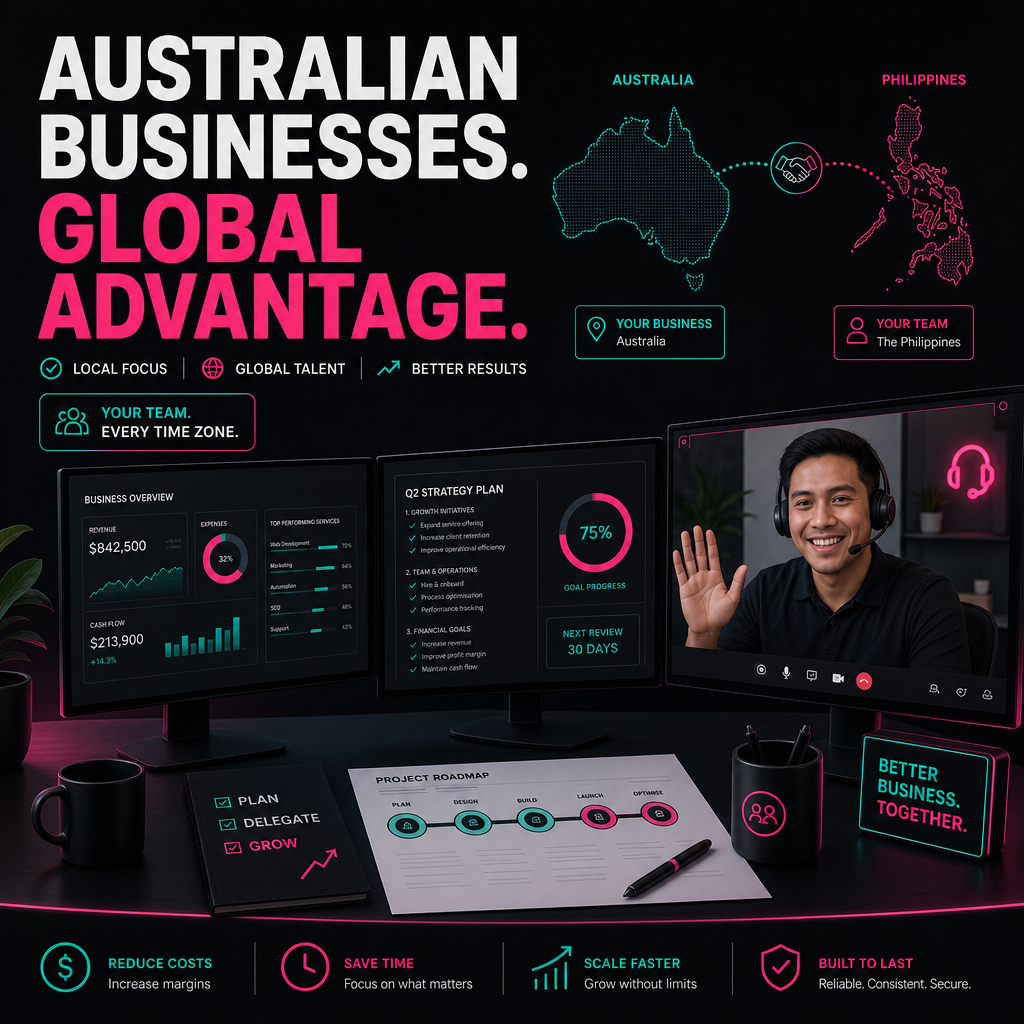
At a glance: Remotee clients reduce non-billable partner time by 35-50%. Offshore specialists are operational within 21 days. Specialist retention sits above 95% at 12 months.
Most Australian business owners come to offshore staffing with one of two mindsets. Either they expect a silver bullet that cuts their wage bill overnight, or they are quietly convinced it will not work for a business like theirs. Both assumptions tend to land them in the same place: months of hesitation, followed by a half-baked attempt that confirms every fear they started with.
The reality is neither catastrophic nor miraculous. Offshore staffing, when it is set up correctly, is one of the most effective ways an Australian SME can build capacity without the overhead of a full local hire. When it is set up badly, you end up with a remote person doing unclear work, a founder back in the weeds, and a story about why "offshore doesn't work for us." The difference between those two outcomes is almost never about the talent. It is almost always a delivery structure problem.
This guide walks you through what offshore staffing actually is, how it works step by step, what it costs in the Australian context, and the compliance and quality considerations that matter most. If you are an accounting firm, NDIS provider, mortgage broking business, or growing SME thinking seriously about building an offshore team, this is the most useful thing you will read on the topic.
Key Takeaways
- Offshore staffing is not the same as outsourcing a project to a freelancer. A dedicated offshore team member works exclusively for your business, integrated into your operations.
- The single biggest reason offshore hiring fails is the absence of documented workflows and clear ownership, not the quality of the person hired.
- Australian businesses can access specialist talent from the Philippines at 40-70% below the equivalent local hire cost, with no sacrifice in technical capability when the recruitment process is rigorous.
- Compliance is manageable. The Fair Work Act does not apply to offshore workers employed under Philippine law, but Australian data privacy obligations and contractual protections still require careful attention.
- Time zones between Australia and the Philippines are narrow (1-3 hours depending on state), which makes real-time collaboration straightforward compared to nearshore options in Europe or the Americas.
- Getting started correctly means scoping the role before recruiting for it. Most failures begin with hiring first and designing the role second.
Summary Table: Offshore Staffing vs Local Hiring vs Freelancers
| Factor | Offshore Staffing (Dedicated) | Local Hire | Freelancer |
|---|---|---|---|
| Cost (monthly, AUD) | $2,500 - $5,500 | $6,000 - $12,000+ | Variable, often higher per hour |
| Control | High, works to your SOPs, your hours | High | Low, sets own terms |
| Compliance handled by | Staffing provider (local employment law) | You (Fair Work Act) | You (contractor obligations) |
| Scalability | High, add roles without new entity | Moderate, recruitment overhead | Moderate, availability constrained |
| Onboarding time | 21-30 days (with provider support) | 4-12 weeks | 1-2 weeks |
| Retention | 95%+ at 12 months (Remotee data) | Variable | Very low |
| Quality consistency | System-dependent | Person-dependent | Project-dependent |
| IP and data control | Contractual, NDA, system access rules | Strongest | Weakest |
What Offshore Staffing Actually Is
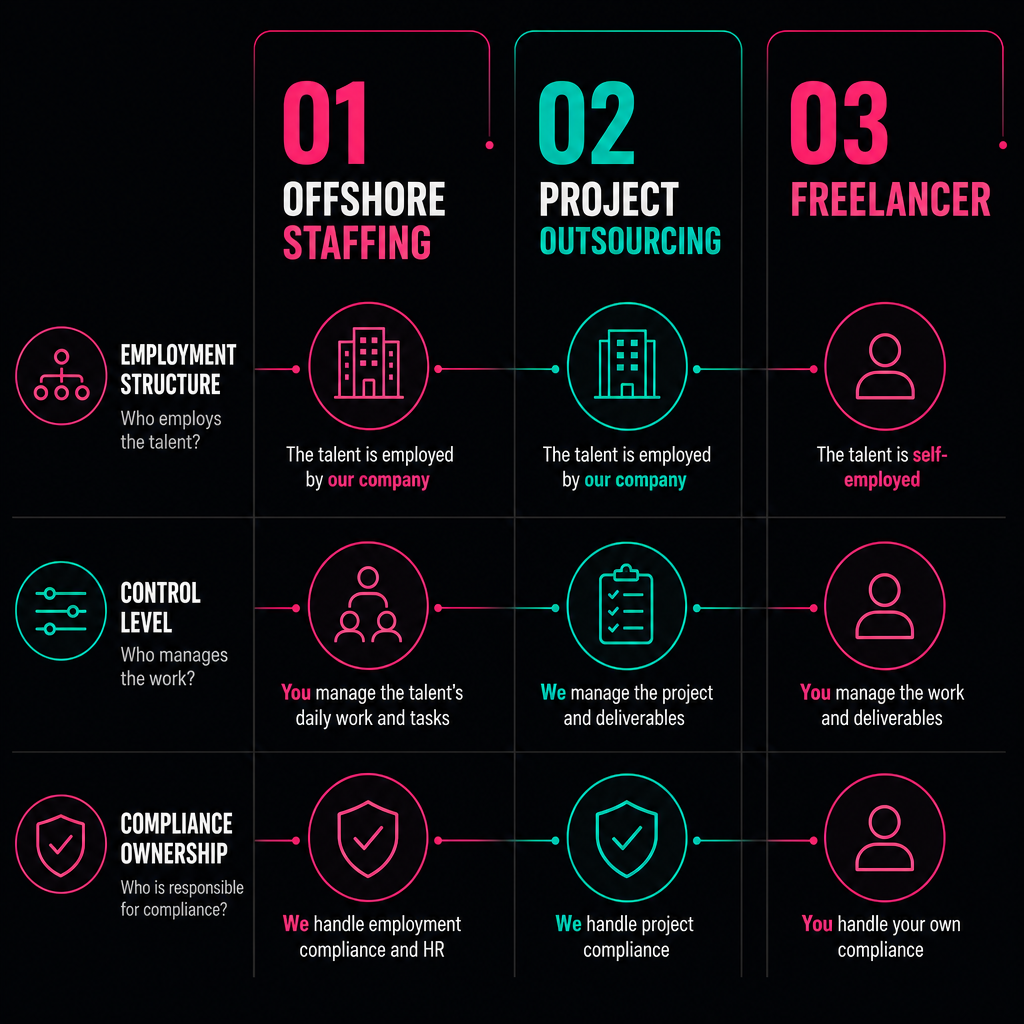
Offshore staffing means hiring a full-time (or part-time) specialist who works exclusively for your business, but is based in another country and employed under that country's employment law. In the Australian context, that almost always means the Philippines.
This is meaningfully different from two things that are often confused with it.
The first is project outsourcing. When you engage a digital agency in Vietnam to build your website, you are buying a deliverable. You do not manage the people, set their hours, or integrate them into your team. That is outsourcing. Offshore staffing is the opposite: you are adding a person to your team who happens to be located offshore.
The second is a freelancer marketplace hire. Platforms like Upwork or OnlineJobs.ph let you hire individuals directly, but the compliance burden (contractor vs employee status, payroll obligations, redundancy exposure) lands on you, and there is no infrastructure around the hire. If the person resigns, you start again from scratch.
With a managed offshore staffing provider, the employment contract sits with the provider's Philippine entity. They handle payroll, statutory contributions (SSS, PhilHealth, Pag-IBIG), government compliance, and HR administration. You direct the work. You own the outcomes. You do not own the employment relationship.
That structure is important for two reasons. First, it removes significant legal complexity for the Australian business. Second, it means the provider has skin in the game when it comes to retention, because the specialist is their employee.
The Dedicated-Team Model vs Project Outsourcing: Why the Distinction Matters
I see this confusion regularly. A business owner will describe a bad experience with "offshore staffing" that, when unpacked, was actually a project outsourced to a call centre or a freelancer who worked for six other clients simultaneously. The experiences are genuinely incomparable.
A dedicated offshore team member:
- Works the hours you set (typically aligned to Australian business hours)
- Uses your systems, your communication tools, your processes
- Attends your team meetings
- Reports to your internal team leaders or, through the provider, to a dedicated account manager
- Builds institutional knowledge of your business over time
This is what makes offshore staffing a long-term capability layer, not a short-term cost fix. The person who joins your accounting firm as a prep specialist in month one is a fundamentally different asset to your business in month twelve, because they know your clients, your software, your preferences, and your exceptions.
How Offshore Staffing Works: Step by Step
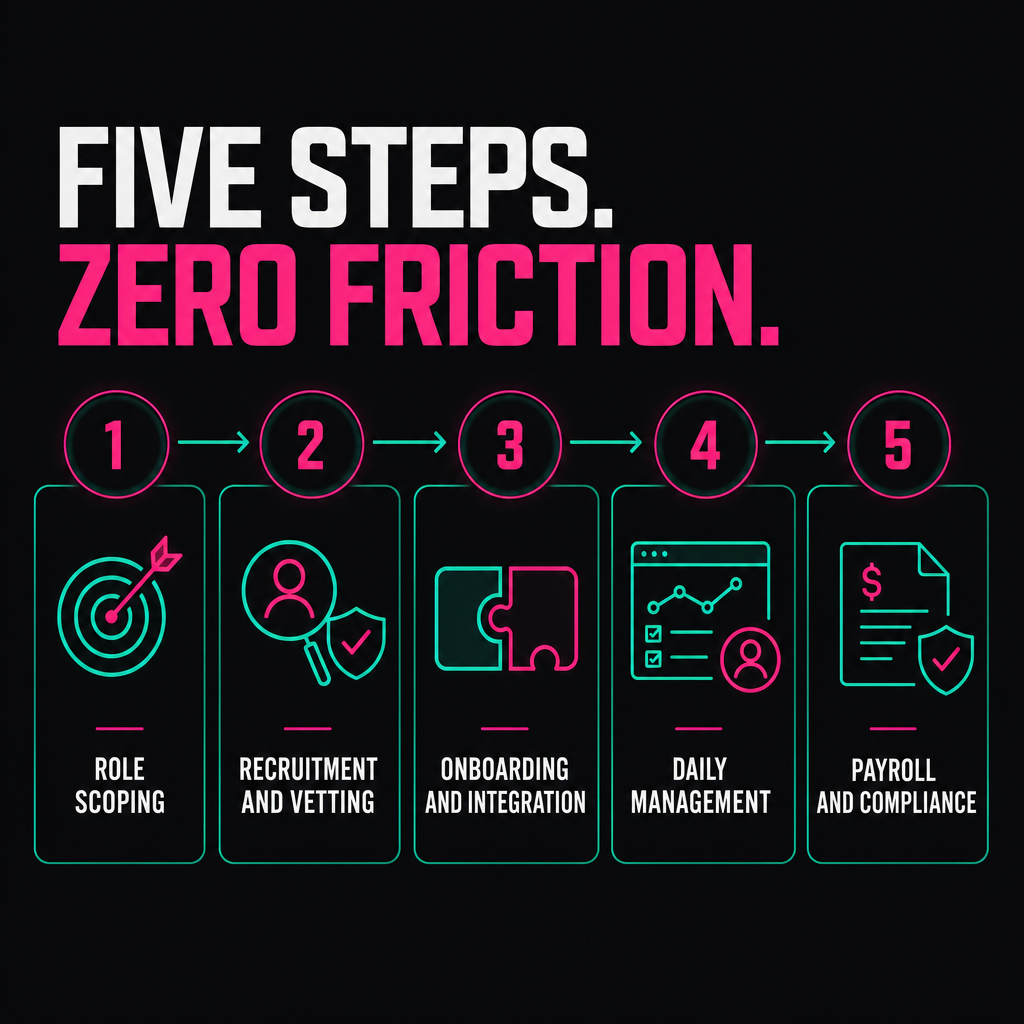
The process varies by provider, but a well-run engagement follows a clear sequence. Here is how it works at the end that matters: from first conversation to a specialist producing reliable output for your business.
Step 1: Role Scoping and Workflow Audit
Before anyone is recruited, the role needs to be defined. Not in a job-ad sense, but in an operational sense. What work will this person do? What tools will they use? What does a good week look like? What are the edge cases and who handles them?
Most businesses skip this step because it feels like admin. It is not. It is the foundation of everything. If you cannot describe what done looks like, you cannot train for it, measure it, or hold anyone accountable for it.
At Remotee, this is Phase 1 of The Remotee Method. We audit your existing workflows and map your software ecosystem before we recruit anyone. The output is an operational blueprint: a clear picture of what the role produces, what it depends on, and where the risks sit.
Step 2: Recruitment and Technical Vetting
Once the role is scoped, recruitment begins. In the Philippine talent market, the volume of applicants is high, but the gap between average and exceptional is significant. Rigorous testing matters.
For accounting roles, that means testing in the specific software your firm uses (Xero, MYOB, Karbon, HandiSoft) and against Australian accounting standards, not generic bookkeeping tasks. For NDIS administration, it means familiarity with NDIS Price Guide categories, participant plan management, and documentation standards. For mortgage broking support, it means competency in CRM platforms, loan application preparation, and broker compliance workflows.
The recruitment process should surface not just technical ability but communication quality, attention to detail, and the capacity to follow documented processes consistently. The top 1% of Philippine talent is genuinely world-class. Finding them requires more than posting a job ad.
Step 3: Onboarding and System Integration
Onboarding an offshore specialist is not the same as onboarding a local hire. You are setting up remote system access, establishing communication rhythms, running compliance and confidentiality inductions, and delivering role-specific training, all without the benefit of physical proximity.
This is where a strong SOP library becomes critical. Training tied to real outputs, with early deliverables reviewed against defined checkpoints, is the only way to validate that the person is ready to operate independently. Without this, you default to hope-based management, which is expensive.
The goal of onboarding is not to get the specialist "started." It is to get them to a point where their output is predictable and reviewable. That distinction changes how you design the first 30 days entirely.
For most roles, a well-structured onboarding takes three to four weeks. At Remotee, accounting specialists are typically operational within 21 days.
Step 4: Daily Management and Accountability
Once the specialist is running, the management model matters. Offshore does not mean out of sight, out of mind. The most effective offshore teams operate with clear daily and weekly rhythms: task ownership is explicit, output is measured against defined outcomes, and issues are resolved through process updates rather than repeated correction.
This is what I mean by systems over heroics. If your offshore specialist makes an error and your response is to correct it manually and move on, you have solved nothing. If your response is to identify the gap in the SOP, update it, and validate that the fix holds, you have improved a system. Over time, that compounds.
A weekly cadence with a scorecard review is the minimum viable accountability structure. It does not need to be a long meeting. It needs to be a consistent one.
Step 5: Payroll and Compliance Handled by the Provider
This is one of the clearest practical advantages of managed offshore staffing over a direct hire. The provider's Philippine entity handles:
- Employment contracts under Philippine labour law
- Mandatory contributions (SSS, PhilHealth, Pag-IBIG)
- 13th month pay obligations
- Tax withholding and BIR compliance
- HR administration, leave management, and disciplinary processes
For the Australian business, this means your monthly cost is a single management fee. No superannuation. No WorkCover. No payroll tax exposure. No unfair dismissal risk under the Fair Work Act.
That last point is not a trivial one. Australian unfair dismissal provisions are among the more stringent in the developed world. The ability to manage a specialist's performance through the provider's HR structure, rather than directly under Australian employment law, removes a significant risk for small business owners.
Who Offshore Staffing Suits: Australian Industry Context
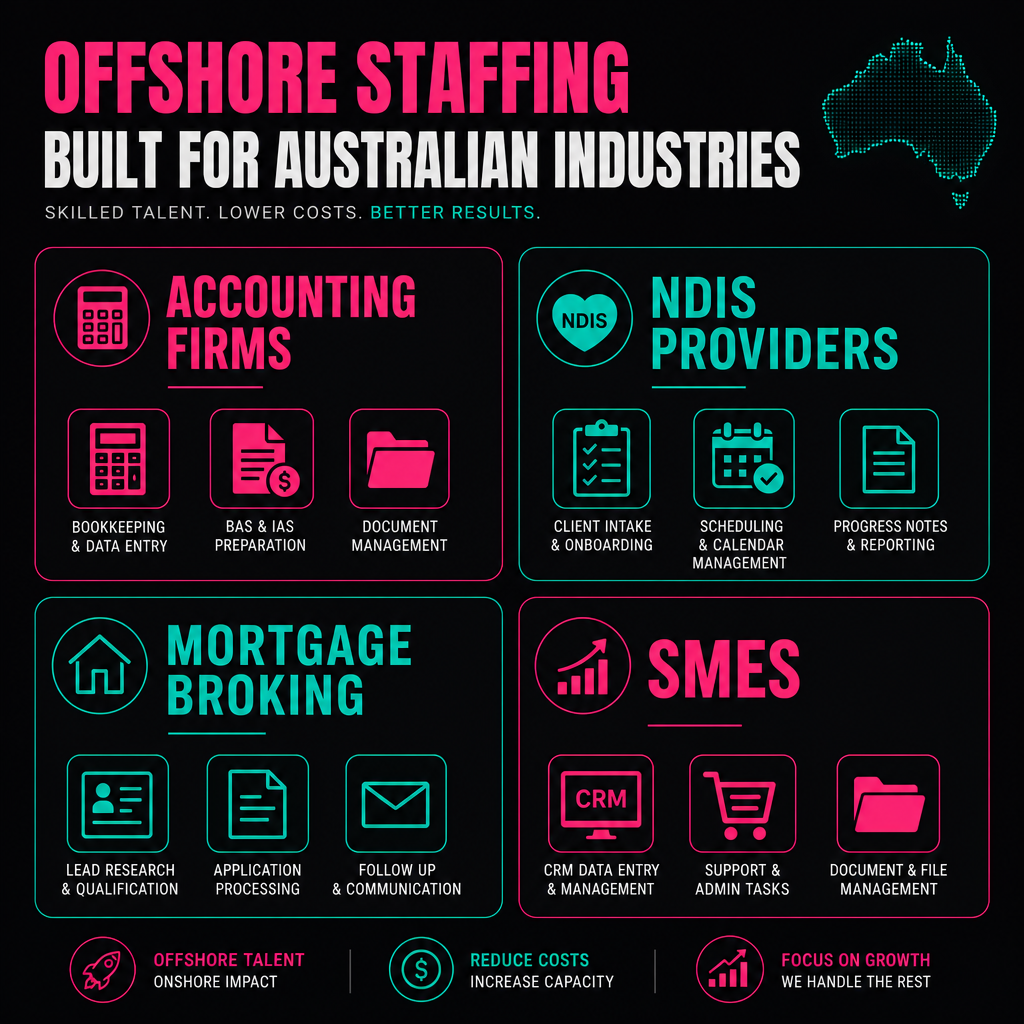
Offshore staffing is not universally applicable. It works best for businesses with repeatable, process-driven work that does not require physical presence. In the Australian market, four industries stand out.
Accounting Firms
This is the clearest fit in the Australian professional services market. The prep work in an accounting firm, tax return preparation, workpaper assembly, BAS preparation, bookkeeping, and client onboarding documentation, is exactly the kind of high-volume, process-defined work that offshore specialists handle well.
I have seen this pattern consistently across accounting clients. Partners are spending 60% or more of their time on work that a trained offshore specialist could handle at a fraction of the cost. The fix is not hiring another accountant. It is installing the right support structure around the senior team so their time goes where it actually creates value.
One accounting firm I worked with had a specific bottleneck: sensitive workflow steps were blocking delegation because there was no documented model for what could be handed off and what had to stay with the partner. We built a control model by workflow risk, delegated the prep work, retained approvals internally, and introduced evidence capture at checkpoints. The internal team reclaimed their time on prep work, sensitive approvals stayed controlled, and there was a cleaner audit trail for every decision. That is what compliance baked in, not bolted on actually looks like in practice.
Across Remotee's accounting client base, non-billable partner time has dropped by 35-50% following offshore specialist placement. That is not a marginal gain. That is a material change to how a firm operates.
NDIS Providers
The NDIS sector has significant documentation and administration overhead. Support coordination, plan management, participant intake, progress notes, and compliance reporting all generate substantial back-office volume. That volume scales with participant numbers, which creates a real capacity problem as providers grow.
I have worked with an NDIS provider where documentation was incomplete, exception handling was ad hoc, and quality checks were inconsistent. The compliance risk was accumulating silently. We installed an SOP pack with compliance steps and exception handling built in, an approval owner map with escalation triggers, and a monthly quality review with versioned SOP updates. The outcome was more consistent compliance execution, fewer repeated issues because problems fed back into an improvements log, and vastly better reviewability if an NDIS Quality and Safeguards Commission audit were to occur.
For NDIS providers, offshore staffing for administration and documentation support is not a cost play. It is a compliance play.
Mortgage Broking Businesses
Mortgage broking has a high volume of client-facing communication and back-office coordination: loan application preparation, lender follow-up, document collection, CRM updates, and settlement tracking. Much of it is time-sensitive and repetitive.
I have worked with broking businesses where client updates were inconsistent, requests were not reliably captured, and delivery felt reactive rather than controlled. Installing intake templates, prioritisation rules, and a communication cadence reduced missed requests and created a smoother delivery rhythm. Across Remotee's broking clients, time-to-settle has reduced by 30% where offshore support has been paired with a structured process.
For a mortgage broking firm where the broker's time is worth several hundred dollars an hour, reclaiming even five hours per week from administrative coordination is a significant return.
SMEs in Digital Marketing, E-Commerce, and Professional Services
Beyond those three verticals, any SME with a founder who is the bottleneck for routine work is a candidate for offshore staffing. The specific pattern I see most often: tasks live across inbox, chat, and memory; rework happens because expectations are unclear; and the founder cannot step back because no one else knows how things are supposed to work.
This is not a headcount problem. It is a delivery structure problem. Adding an offshore specialist without addressing the structure makes it worse, not better. Adding an offshore specialist with a proper delegation map, SOP pack, and quality checkpoint process makes the whole operation more reliable.
What Does Offshore Staffing Cost in Australia?
Cost is always the first question. Here is an honest answer.
For a full-time dedicated offshore specialist based in the Philippines, the all-in cost to an Australian business through a managed provider typically sits between $2,500 and $5,500 per month. That figure includes the specialist's salary, the provider's management fee, HR administration, and compliance handling.
The equivalent local hire for the same role (a skilled accounts administrator, for example, or an NDIS support coordinator) would cost $6,000 to $10,000 per month once you factor in salary, superannuation at 11.5%, payroll tax (where applicable), WorkCover, leave loading, and the overhead of HR management.
The saving is real, and it is significant. But it is not the primary reason to do this.
The primary reason is capacity. An offshore specialist adds productive hours to your operation that you cannot add locally without a full employment commitment. For a business that needs 20 hours of structured admin support per week, a local part-time hire is expensive, difficult to retain, and limited in scalability. An offshore specialist who works those hours in a structured way, supported by SOPs and a provider's HR infrastructure, is a fundamentally different proposition.
For transparent pricing on Remotee's offshore staffing services, see the Remotee pricing page.
Fair Work, Data Security, and Compliance Considerations
Two concerns come up in almost every conversation with Australian business owners: legal exposure and data security. Both are legitimate, and both are manageable.
Does the Fair Work Act Apply?
No. Offshore workers employed under Philippine law by a Philippine entity are not covered by the Australian Fair Work Act 2009. They are not entitled to the National Minimum Wage, the National Employment Standards, or unfair dismissal protections under Australian law.
This does not mean anything goes. The specialist is employed under Philippine labour law, which includes minimum wage protections, mandatory benefits, and disciplinary procedures. A reputable provider will comply with all of this. And the Australian business's contractual relationship is with the provider, not directly with the specialist, which matters for liability.
If you are ever unsure about the structure of a specific arrangement, the Fair Work Ombudsman's guidance on labour hire and contractor arrangements is a useful reference point.
Data Privacy and the Australian Privacy Act
This is the more important compliance consideration for most Australian businesses. If your offshore specialist accesses personal information about Australian individuals (client names, financial data, health information, or loan applications), the Privacy Act 1988 and the Australian Privacy Principles apply to you as the Australian entity.
This means:
- You need contractual protections with your provider covering data handling obligations.
- Access to client data should be role-limited and logged.
- Data should not be stored on personal devices or local drives outside your controlled systems.
- You should have a clear process for revoking access when a specialist's engagement ends.
For regulated industries (financial services, NDIS, health), there are additional requirements. Mortgage broking businesses operating under an Australian Credit Licence need to ensure their data handling practices are consistent with ASIC's expectations. NDIS providers are subject to the NDIS Quality and Safeguards Commission's standards, which include requirements for handling participant information.
At Remotee, compliance is not an afterthought. Our compliance training framework is industry-specific and built into the onboarding process, not delivered as a one-off induction.
Realistic Caveats: Time Zones and Quality Control
I want to be direct about where offshore staffing can create friction, because honest advice is more useful than a sales pitch.
Time Zones
The Philippines is in the Philippine Standard Time zone (UTC+8). Compared to Australian Eastern Standard Time (UTC+10), that is a two-hour gap. In Queensland (no daylight saving), the gap is two hours year-round. In New South Wales and Victoria during daylight saving, the gap narrows to one hour.
For most Australian businesses, this is a negligible issue. A specialist working 9am-6pm Philippine time is available from 11am AEST, which covers the bulk of the Australian business day. If you need coverage from 8am AEST, you simply set the specialist's hours to start at 6am Philippine time, which is within normal working hours and common in the offshore staffing industry.
The time zone concern that is genuinely real is for businesses that need immediate, synchronous responses across the full day, particularly for client-facing roles. For back-office, administrative, and specialist support roles, it is almost never a practical problem.
Quality Control
Quality does not manage itself. This is the caveat I return to most often, because it is the one most businesses underestimate.
An offshore specialist with strong technical skills, clear SOPs, and a weekly accountability cadence will produce consistent, reviewable output. The same specialist without those structures will produce inconsistent results, and you will spend more time correcting errors than you would have spent doing the work yourself.
Quality is designed. It is not a function of where someone is located or how smart they are. It is a function of how clearly the work is defined, how early errors are caught and fed back into the process, and how consistently the accountability rhythm is maintained.
This is why adding headcount without adding system is how scaling creates chaos. The offshore specialist is not the variable. The delivery structure is.
Learn more about how The Remotee Method works in practice.
Client Results: What This Looks Like in Practice
Theory only goes so far. Here are two examples from Remotee's client base that illustrate what offshore staffing actually produces when it is implemented correctly.
Case Study 1: Accounting Firm, 3 Partners, Sydney
An accounting firm with three partners was preparing for tax season with the same team it had used the year before, despite a 30% increase in client volume. The partners were doing prep work themselves, approval queues were slow, and review time was being compressed.
We scoped two offshore specialist roles: a tax return prep specialist and a workpaper and BAS specialist. Both were recruited against Australian accounting software competency (Xero and HandiSoft) and onboarded with an SOP library covering the firm's specific workflows, exception handling, and escalation triggers.
Within 60 days, partner time on prep work had dropped by 42%. Tax season was completed without the firm adding local headcount. The partners spent their time on client advisory conversations, which had measurable impact on client retention and fee growth. Twelve months later, both specialists were still in place.
Case Study 2: Mortgage Broking Business, Brisbane
A two-broker mortgage business was growing but delivery was becoming reactive. Client updates were inconsistent, settlement tracking lived in email threads, and the brokers were spending three to four hours per day on coordination work that was not billable.
We placed an offshore client services and loan administration specialist, onboarded her with intake templates, a CRM hygiene SOP, and a communication cadence for client updates. Within six weeks, the brokers had reclaimed the majority of their coordination time. Time-to-settle dropped by 30%. The specialist became the single point of coordination for all active files, which reduced errors and improved the client experience.
One of the brokers described it this way: "I was doing a job that wasn't mine. Now I'm doing my job."
See more results in the Remotee case studies library.
How to Get Started With Offshore Staffing
If you are considering offshore staffing for your business, the most useful thing you can do before speaking to any provider is answer three questions honestly:
- What specific work will this person do, and can you describe a good week's output?
- Do you have the documentation to train someone into this role, or does the knowledge live in your head?
- Are you willing to invest two to three hours per week in the first month reviewing output and refining the process?
If the answer to any of those is no, that is not a reason to stop. It is a reason to start with structure before you start with recruitment.
For established Australian businesses with repeatable operations, The Remotee offshore staffing service is built around exactly this sequence. We do not place a specialist and walk away. We install the operating system around the role so that outcomes are predictable, reviewable, and designed to improve over time.
If you are ready to have a direct conversation about whether this fits your business, contact the Remotee team. No commitment required. Just a clear-headed conversation about what you actually need.
References
- Fair Work Ombudsman. Labour Hire. Australian Government. https://www.fairwork.gov.au/find-help-for/labour-hire
- Office of the Australian Information Commissioner. Australian Privacy Principles. Australian Government. https://www.oaic.gov.au/privacy/australian-privacy-principles
- NDIS Quality and Safeguards Commission. Practice Standards and Quality Indicators. Australian Government. https://www.ndiscommission.gov.au/providers/registered-ndis-providers/provider-obligations-and-requirements/ndis-practice-standards
- Australian Bureau of Statistics. Counts of Australian Businesses, including Entries and Exits. ABS. https://www.abs.gov.au/statistics/economy/business-indicators/counts-australian-businesses-including-entries-and-exits
- Australian Securities and Investments Commission. Credit Licensing: Responsible Lending Conduct. ASIC Regulatory Guide 209. https://asic.gov.au/regulatory-resources/find-a-document/regulatory-guides/rg-209-credit-licensing-responsible-lending-conduct/
FREQUENTLY ASKED QUESTIONS
Common questions
How much does offshore staffing cost for an Australian business?
- A full-time dedicated offshore specialist through a managed provider typically costs between $2,500 and $5,500 per month (AUD), all-in. This includes the specialist's salary, the provider's management fee, and HR and compliance handling. The equivalent local hire generally costs $6,000 to $10,000 per month once salary, superannuation, payroll tax, and leave entitlements are included.
Is offshore staffing legal for Australian businesses?
- Yes. Offshore staffing through a managed provider is entirely legal. The specialist is employed by the provider's Philippine entity under Philippine law. The Australian business has a commercial services agreement with the provider. The Fair Work Act does not apply to offshore workers employed outside Australia.
What are the data privacy obligations when using offshore staff?
- The Australian Privacy Act 1988 applies to Australian entities that handle personal information about Australian individuals, regardless of where the work is processed. If your offshore specialist accesses client financial data, health information, or personal records, you need contractual protections with your provider, role-limited access controls, and clear data handling policies. For businesses in financial services or NDIS, additional industry-specific regulatory requirements apply.
How do time zones work between Australia and the Philippines?
- The Philippines is UTC+8. Compared to AEST (UTC+10), that is a two-hour gap, narrowing to one hour during New South Wales and Victorian daylight saving time. A specialist working standard Philippine business hours is available for the majority of the Australian business day. Specialists commonly work adjusted hours to align with Australian time where full-day overlap is needed.
How long does it take to get an offshore specialist operational?
- With a structured onboarding process, most offshore specialists are producing reliable output within 21 to 30 days of starting. The timeline depends on role complexity and the quality of documentation provided. Roles with well-defined SOPs and clear output measures onboard significantly faster.
What roles are best suited to offshore staffing for Australian SMEs?
- The best-fit roles are process-driven, do not require physical presence, and generate enough volume to justify a dedicated resource. In the Australian market, accounting firm support, NDIS administration, mortgage broking support, digital marketing coordination, e-commerce operations, and general business administration are all strong fits.
What happens if an offshore specialist leaves?
- With a managed provider, the employment relationship sits with the provider. Replacement risk, HR administration, and continuity planning are the provider's responsibility. A good provider will have a documented handover process and will begin replacement recruitment promptly. The strength of your SOP library directly determines how quickly a replacement can be onboarded.
How is offshore staffing different from hiring through a freelancer platform?
- The key differences are commitment, control, and compliance. A dedicated offshore specialist works exclusively for your business, is employed under a formal employment contract, and is integrated into your team and systems. A freelancer platform hire is typically non-exclusive, operates under self-employment terms, and places the compliance burden on the Australian business. Offshore staffing through a managed provider also includes HR, payroll, and compliance handling that freelancer arrangements do not provide.

Jon Kelly
Founder, Remotee
Jon helps Australian businesses build compliance-led offshore teams that scale without the burnout. NDIS, accounting, mortgage broking, recruitment and digital marketing.
KEEP READING
Related posts
offshore staffing companies
Top Offshore Staffing Companies in Australia Compared (2026)
Most "best offshore staffing companies" lists are thin affiliate content dressed up as research. They rank providers by who paid for placement, not by who actua…
17 June 2026 · 23 min read
offshore staffing service-level agreements
Offshore Staffing Service-Level Agreements: What Australian Businesses Should Demand
Direct answer: A genuine offshore staffing SLA commits to a delivery system, not just headcount. It should name documented workflows, a specific account owner,…
3 September 2026 · 16 min read
offshore staffing roles
Which Roles Are Best Suited to Offshore Staffing? A Guide for Australian Businesses in 2026
The most expensive offshore staffing mistake I see Australian business owners make is not hiring the wrong person. It is offshoring the wrong role. They start w…
23 June 2026 · 23 min read
READY TO SCALE WITHOUT THE BURNOUT?
Build a compliance-led offshore team in 3–4 weeks.
Tell us about your current bottleneck and we'll show you what a Remotee placement would look like for your operation.
Or get our playbooks emailed to you instead.