
Offshore Staff Leasing in Australia: How It Works, Costs and When to Use It in 2026
- offshore staff leasing
- offshore staffing Australia
- staff leasing model
- employer of record
- Philippines offshore staffing
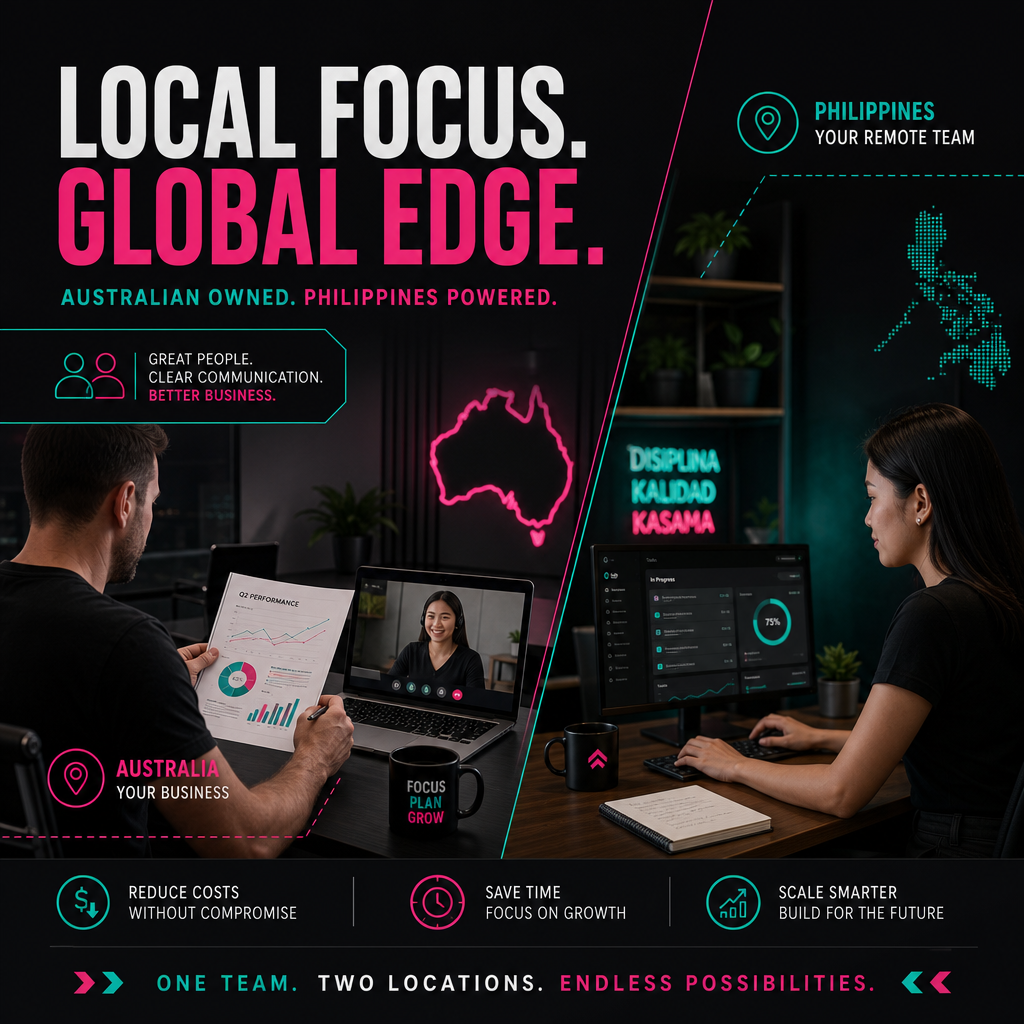
Hiring locally is expensive and slow. Project outsourcing hands control to someone else. And building an offshore team from scratch in a foreign jurisdiction is a compliance minefield most Australian business owners are not equipped to navigate alone. Offshore staff leasing sits between those options, giving you a dedicated, integrated team member working under your direction, without the legal and payroll burden of employing them directly overseas.
In 2026, more Australian businesses are using staff leasing to close capacity gaps in finance, marketing, operations, and client services. But the model is still widely misunderstood. Many owners confuse it with project outsourcing, underestimate the compliance responsibilities it shifts onto them, or assume that finding good talent is the hard part. It rarely is. The hard part is building the delivery structure that makes a leased offshore specialist productive, consistent, and retained beyond 12 months.
This guide explains exactly how offshore staff leasing works, what it costs, who carries the compliance load, and when it is the right model for your business. I will also be direct about where it falls short, because getting this decision wrong is expensive in both time and money.
Key Takeaways
- Offshore staff leasing places a dedicated overseas worker under your operational direction, while a leasing provider handles employment, payroll, and local compliance in the worker's home country.
- It is meaningfully different from project outsourcing (where a third party owns the output) and direct offshore hiring (where you carry the full legal and payroll burden yourself).
- For Australian businesses, the Philippines is the dominant leasing market due to English proficiency, professional skill depth, and established employment infrastructure.
- Cost savings typically range from 50 to 70 per cent compared with equivalent Australian full-time hires, but savings only materialise when the role has a documented delivery structure around it.
- The biggest failure mode is not a talent problem. It is a delivery structure problem. Without SOPs, clear ownership, and a review cadence, leased staff underperform regardless of their skill level.
- Offshore staff leasing suits businesses with repeatable, documented roles. It is not the right model for ad hoc, undefined, or highly variable work.
Summary: Staff Leasing vs Direct Offshore Hire vs Managed Outsourcing
| Factor | Offshore Staff Leasing | Direct Offshore Hire | Managed Outsourcing |
|---|---|---|---|
| Who employs the worker | Leasing provider (EOR) | Your business directly | Outsourcing firm |
| Who directs daily work | You | You | Outsourcing firm |
| Compliance responsibility | Provider handles local payroll/tax; you manage work direction | You carry all local employment law risk | Fully with the outsourcing firm |
| Control over output | High | High | Low to medium |
| Setup complexity | Low to medium | High | Low |
| Cost vs AU hire | 50-70% saving | 50-70% saving (but higher setup cost) | Varies; often project-based |
| Staff integration | Full team member | Full team member | Arm's-length delivery |
| Best for | Recurring, documented roles | Businesses with in-house HR capacity and legal support | Defined project scopes |
| Risk if no delivery structure | High underperformance risk | Very high | Lower (provider absorbs it) |
What Offshore Staff Leasing Actually Means
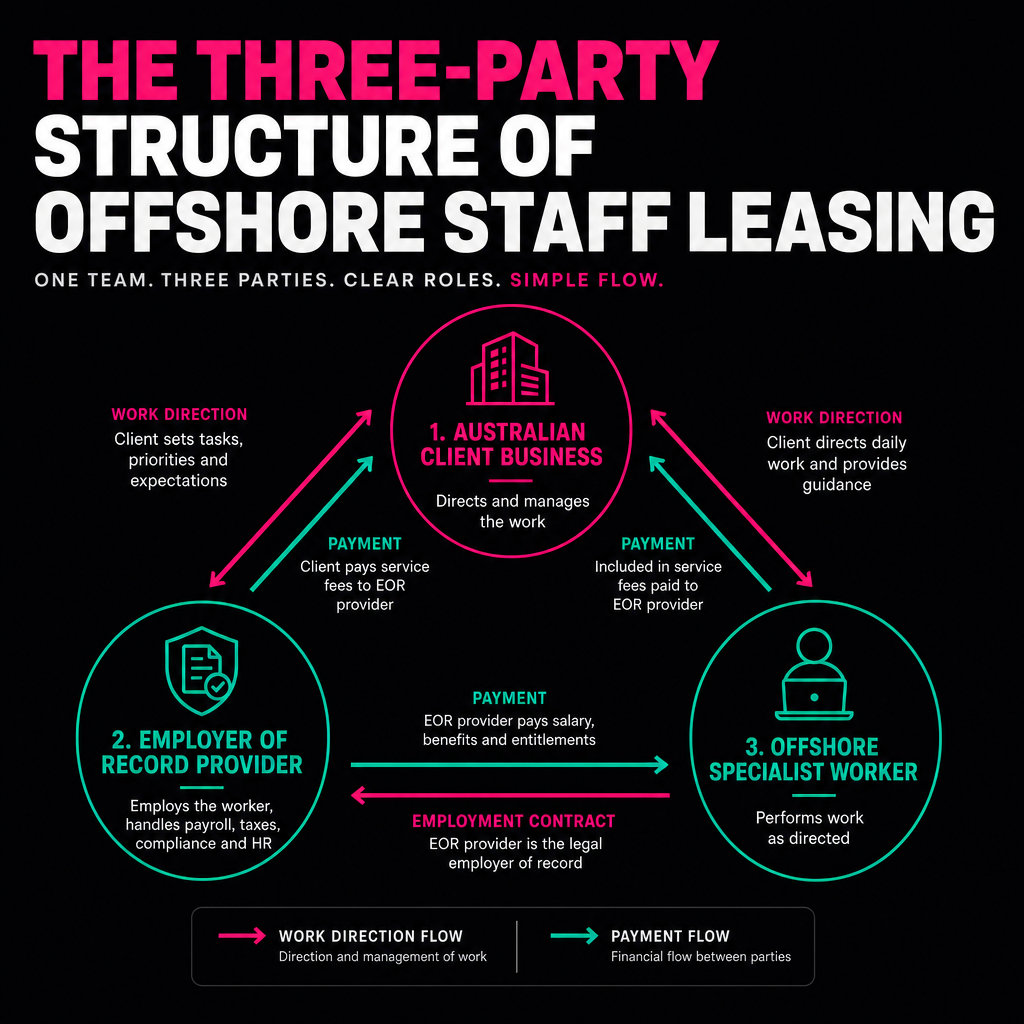
Offshore staff leasing is a commercial arrangement where an Australian business directs and manages a worker based overseas, while a third-party provider acts as the formal employer of record (EOR) in the worker's home country. The provider handles local employment contracts, payroll processing, statutory benefits, tax withholding, and compliance with local labour law. You pay the provider a consolidated fee covering the worker's salary, employer-side contributions, and the provider's service margin. The worker shows up every day as a functional member of your team.
The term "staff leasing" comes from the fact that you are, in effect, leasing employment services. You do not hold the employment contract. The provider does. That distinction matters for compliance, for risk, and for how you structure the relationship.
This is different from outsourcing in a fundamental way. When you outsource a function, say your bookkeeping or your social media management, you hand the output responsibility to another business. You define what you want, and they figure out how to deliver it. With staff leasing, you define the work, you manage the person, and you own the output process. The worker follows your systems, uses your tools, and reports to your team. The provider simply ensures the worker is legally and correctly employed in their home country.
It is also different from hiring directly offshore. Technically, an Australian company can hire a worker in the Philippines as a foreign employee, but doing so requires navigating DOLE (Department of Labour and Employment) regulations, setting up correct payroll withholding under the Philippine Tax Code (TRAIN Law), understanding 13th-month pay obligations, and managing mandatory contributions to SSS, PhilHealth, and Pag-IBIG. Most Australian businesses are not set up to do that correctly, and the risk of getting it wrong is real. The EOR model removes that liability by making the leasing provider the legal employer.
The Employer of Record Structure in the Philippines
The Philippines is Australia's most common offshore staffing market, and for good reason. English is an official language, the tertiary education system produces large cohorts of accounting, engineering, IT, marketing, and healthcare administration graduates each year, and the professional services sector has been supporting Australian and US businesses for over two decades.
In a Philippines-based staff leasing arrangement, the EOR provider holds a DOLE-registered business and is the legal employer on record. They issue the employment contract, process payroll in Philippine pesos, file BIR (Bureau of Internal Revenue) tax obligations, and ensure compliance with the Labour Code of the Philippines. The Australian client enters a separate commercial agreement with the provider that defines the scope of work, the fee structure, the notice periods, and the obligations on both sides.
From a Philippine regulatory standpoint, this structure is governed under the Department of Labor and Employment's rules on contracting and subcontracting (Department Order 174, Series of 2017). A compliant EOR provider must ensure workers receive all statutory entitlements: 13th-month pay, service incentive leave, separation entitlements, and social security contributions. Working with a provider who corners compliance here does not just expose the worker. It creates reputational and legal exposure for your business too.
From an Australian tax perspective, payments to an offshore leasing provider are generally deductible as a business expense, but transfer pricing rules and the ATO's guidance on personal services income may apply depending on your structure. Always confirm with your Australian tax adviser before onboarding.
Cost Structure and Typical Australian Savings
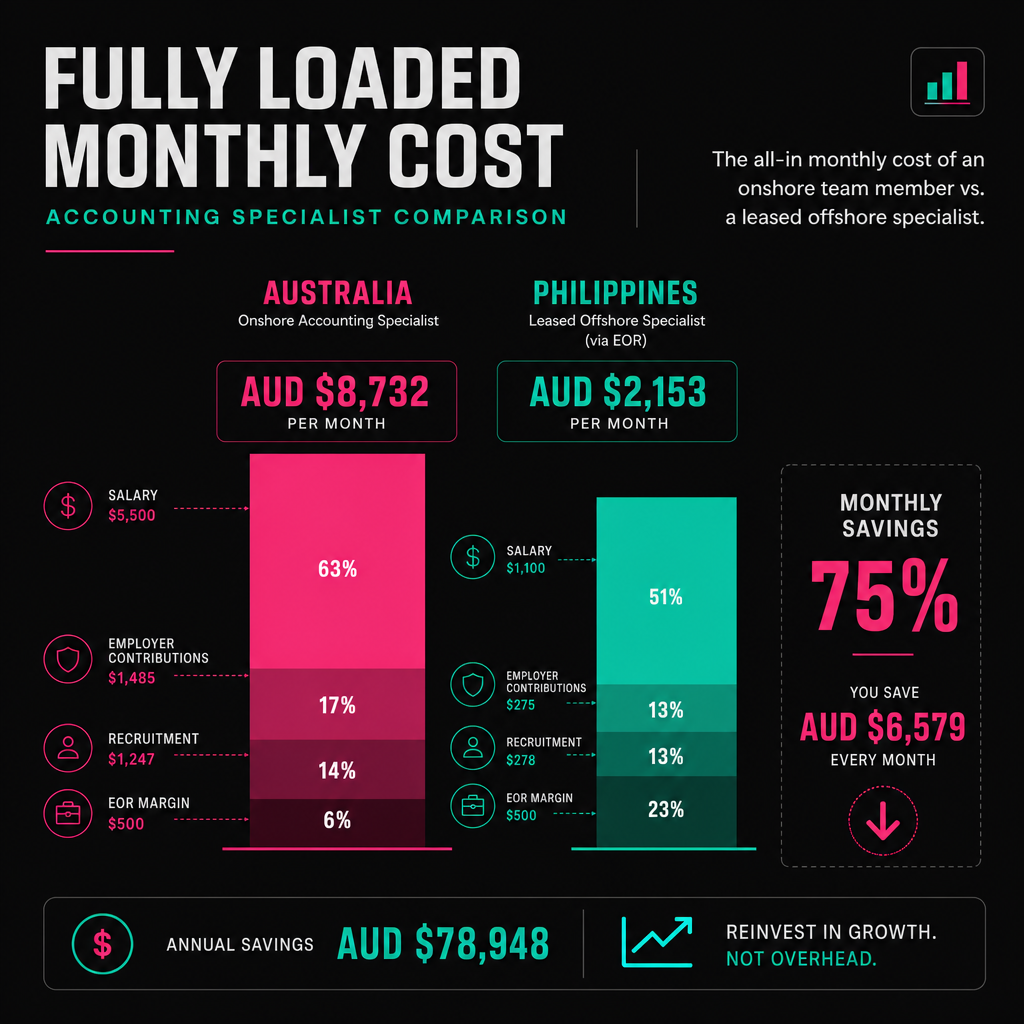
The cost comparison that gets quoted most often is a simple salary differential. A mid-level accountant in Metro Manila might earn AUD $12,000 to $18,000 per year (all-in, including employer contributions and EOR margin). The equivalent role in Sydney or Melbourne carries a full-time salary of $65,000 to $85,000, plus superannuation, leave entitlements, workers' compensation insurance, and recruitment costs that can add another $10,000 to $20,000 on top.
That is not a marginal saving. It is a structural cost shift.
Across Remotee's client base, Australian businesses using offshore staff leasing for roles like bookkeeping, financial reporting, loan processing, marketing coordination, and operations support are achieving fully loaded cost reductions of 50 to 70 per cent compared with Australian equivalents. For a business running three or four of these roles, the annualised saving can exceed $150,000.
But here is what the headline number does not tell you: the saving only materialises when the role is structured correctly. I have seen businesses bring on a leased offshore specialist at a fraction of Australian rates, only to spend six months in revision cycles, miscommunication, and inconsistent output before quietly letting the person go. The talent was fine. The delivery structure was absent. That is a $30,000 to $40,000 lesson.
Typical cost components in an offshore staff leasing arrangement include:
- Worker base salary: The gross salary paid to the specialist, converted and processed in their local currency.
- Employer-side statutory contributions: SSS, PhilHealth, Pag-IBIG, and 13th-month pay in the Philippines. These typically add 10 to 15 per cent on top of base salary.
- EOR / leasing provider margin: The provider's fee for handling employment, payroll, HR, and compliance. This varies by provider and is often bundled into a single quoted AUD rate.
- Equipment and connectivity: Some providers include workstation provisioning; others charge separately. Clarify this upfront.
- Setup and onboarding: Remotee's pricing structure is transparent about what is included at each stage so there are no surprises after you have signed.
For an accounting specialist, a realistic all-in monthly rate through a structured leasing provider is AUD $2,500 to $4,500 depending on seniority. The same role in Australia, fully loaded, would run $6,500 to $9,500 per month. The maths is clear. The question is whether your business is ready to capture that saving.
Legal, Payroll, and Compliance Responsibilities
One of the most common misconceptions I encounter is that offshore staff leasing removes all compliance responsibility from the Australian business. It does not. What it removes is the obligation to comply with Philippine employment law. The compliance obligations that remain on your side are just as important.
What the leasing provider handles:
- Philippine employment contracts and statutory entitlements
- Local payroll processing and tax withholding
- Mandatory benefits (SSS, PhilHealth, Pag-IBIG)
- 13th-month pay
- Local HR management, including disciplinary processes
- Workers' compensation equivalents under Philippine law
What you remain responsible for:
- Fair Work Act obligations do not directly apply to overseas workers, but your conduct as the directing party still carries reputational and contractual obligations. Read your commercial agreement carefully.
- Australian Privacy Act (1988) compliance if the leased worker handles personal data about Australian individuals. The Office of the Australian Information Commissioner (OAIC) is explicit: if you disclose personal information to an overseas entity (including a worker employed by an offshore EOR), the Australian Privacy Principles still apply to you as the disclosing entity.
- ATO obligations around payments to foreign entities, particularly where the arrangement might create a permanent establishment or trigger withholding tax. Most correctly structured EOR arrangements avoid this, but it is worth confirming.
- Work health and safety: under Australian WHS legislation, a duty of care extends to workers whose work activities you direct and control, even if they are not your direct employees. This is an area that is evolving in the context of remote offshore work.
- Intellectual property and data security: your commercial agreement with the leasing provider should specify IP ownership, data handling protocols, and confidentiality obligations.
Remoree builds compliance training into every placement because we treat compliance as a designed feature of the engagement, not an afterthought. That means Australian privacy, data handling protocols, and industry-specific regulatory requirements are addressed before the specialist touches live client data.
Pros, Cons, and Realistic Caveats
The Case For Offshore Staff Leasing
Dedicated, integrated capacity. Unlike project outsourcing, a leased specialist is working for you, not managing a portfolio of clients. They learn your systems, your clients, and your standards. Retention matters here. Remotee's specialist retention rate at 12 months sits above 95 per cent, which means the institutional knowledge your specialist builds stays with your business.
Cost efficiency at scale. The savings are real and significant, as the numbers above show. For businesses carrying multiple operational roles that do not require physical presence, the cumulative saving creates genuine strategic headroom.
Speed to productivity. A well-structured leasing engagement, with proper documentation and onboarding, can have a specialist operational and contributing within three to four weeks. Remotee's placement-to-operational timeline for accounting specialists, for example, is 21 days.
Compliance handled at source. Correctly structured EOR arrangements mean you are not navigating Philippine labour law yourself. That is genuinely valuable.
The Honest Caveats
It is not passive. Leased staff require active management. You are the directing employer. If you are already time-poor and have not documented your processes, leasing a specialist is not going to solve that. It is going to make it worse. I rebuilt a digital marketing agency's entire approval and delegation structure before we placed their offshore coordinator, because the founder was the bottleneck for everything from campaign briefs to invoice approvals. Tasks lived across inbox, chat, and memory. Without fixing that first, we would have added a person to a broken system, not fixed the system.
Cultural and communication nuance. Philippine professionals are highly educated and technically strong, but indirect communication styles can sometimes delay issue escalation. Training your offshore specialist to surface problems early, and building a cadence that makes that safe and expected, is part of the delivery design, not an optional extra.
Minimum viable documentation. If you cannot describe what you want done, in what order, with what tools, and what "done" looks like, a leased specialist cannot reliably deliver it. This is the delivery structure problem I come back to consistently. The role needs to be documented before the specialist is hired, not after.
Provider quality varies significantly. Not all EOR and leasing providers maintain compliant employment structures. A provider cutting corners on statutory contributions or employment contracts is creating exposure for the worker and, indirectly, for your business. Due diligence on your provider's compliance practices is not optional.
When Offshore Staff Leasing Is the Right Model
Offshore staff leasing works well when:
- The role involves repeatable, documented tasks that follow a consistent process (bookkeeping, reporting, loan processing, marketing execution, CRM management, customer service).
- You have, or are willing to build, SOPs and workflow documentation that define the role clearly.
- You want a permanent team member, not a project resource. If the need is genuinely one-off, managed outsourcing or a freelance arrangement may suit better.
- You are prepared to manage the person, set performance expectations, and review output regularly.
- The role does not require physical presence (client-facing in-person meetings, site visits, physical handling of documents).
- Your business is at a stage where consistent operational capacity creates more value than flexibility.
Offshore staff leasing is a poor fit when:
- The role is undefined or highly variable. Vague briefs produce inconsistent results regardless of talent quality.
- You are looking for a quick fix to a structural problem. If your business processes are chaotic, adding offshore headcount without fixing the structure will amplify the chaos.
- You need physical presence or real-time Australian regulatory interaction (e.g. a licensed adviser at a client meeting).
- You are not prepared to invest in onboarding and documentation upfront. The setup investment is what determines whether the saving materialises.
Client Case Studies
Case Study 1: Accounting Firm Reclaims Partner Time
An Australian accounting firm was running a common problem: partners were spending close to 50 per cent of their time on tax preparation, reconciliation, and client file prep, which is work that needs to happen but does not require a CPA-level operator. The firm had looked at local junior hires but the cost and turnover risk at the junior end of the market was making that unattractive.
We placed two offshore accounting specialists under the Remotee offshore staffing model, specifically tasked with preparation, reconciliation, and file assembly work. But before placement, we audited which workflows contained sensitive steps that needed to stay with partners (final review, sign-off, client-facing advice) and which steps were preparation work that could be documented and delegated safely. We built a control model by workflow risk, not by role title. Sensitive approvals stayed internal. Evidence capture at each checkpoint gave the partners a clean audit trail.
Within 90 days, the firm's partners had reclaimed 35 to 40 per cent of the time they had previously spent on prep work. Client throughput increased without adding Australian headcount. The offshore specialists are both still with the firm, now more than 18 months later.
Case Study 2: NDIS Provider Stabilises Compliance Documentation
An NDIS provider was managing documentation across multiple support workers and care plans, with incomplete records, ad hoc exception handling, and quality checks that happened reactively rather than by design. Non-compliance events were recurring because there was no consistent process for catching them before submission.
We placed an offshore documentation and compliance coordination specialist, but the placement was structured around the Remotee Operating System from day one. The SOP pack covered compliance steps, exception handling triggers, and escalation pathways. An approval owner map was built so every document type had a named internal reviewer and a defined escalation point. A monthly quality review cadence was installed with versioned SOP updates when issues surfaced.
Within three months, the provider had measurably fewer repeated compliance exceptions, a reviewable improvements log, and documentation quality that held up under an internal audit. The operations manager described it as the first time they felt confident going into a review cycle.
"Before Remotee, I was spending hours every week chasing incomplete records and fixing the same issues over and over. Now we have a process that catches problems before they become incidents. The specialist they placed is genuinely part of our team, and the systems they helped us build have made the whole operation more reliable." Operations Manager, Australian NDIS Provider
How Remotee Structures Leasing Engagements
Most providers sell you a resume. We sell you a delivery outcome. The distinction sounds like marketing, but it has a structural basis in how we actually run engagements.
Our process follows four phases:
Phase 1: Discovery and Mapping. Before we source a single candidate, we audit your existing workflows and map your software ecosystem. The output is an operational blueprint: what the role actually does, what tools it touches, what decision rights it holds, and what the output looks like when the role is working correctly. This is not a job description exercise. It is a delivery architecture exercise.
Phase 2: The Specialist Match. We headhunt from the top 1 per cent of Philippine talent, running rigorous technical testing against Australian industry standards for your specific role. For an accounting specialist, that means testing against Australian tax knowledge, Australian chart of accounts conventions, and the specific software stack your firm uses. Generic testing produces generic results.
Phase 3: Operational Integration. The specialist is placed alongside a library of industry-specific SOPs with compliance baked in, not bolted on. This is what separates a structured leasing engagement from simply hiring someone offshore. The specialist knows what "done" looks like from day one because we have documented it before they start.
Phase 4: Strategic Mentorship. Every client has a dedicated Australian account manager who runs a recurring review rhythm. Issues do not just get noted. They get turned into versioned SOP improvements. The goal is to move the business owner from Doer to Strategist over time, where the offshore capability layer is running consistently and the owner is working on the business, not in it.
You can see how this applies across different industries at our case studies page.
If you are ready to explore whether offshore staff leasing fits your business, the most useful starting point is a conversation, not a brochure. Get in touch with our team and we will be direct with you about whether leasing is the right model for your situation or whether something else would serve you better.
Offshore Staff Leasing vs Alternatives: Which Model Fits Your Business?
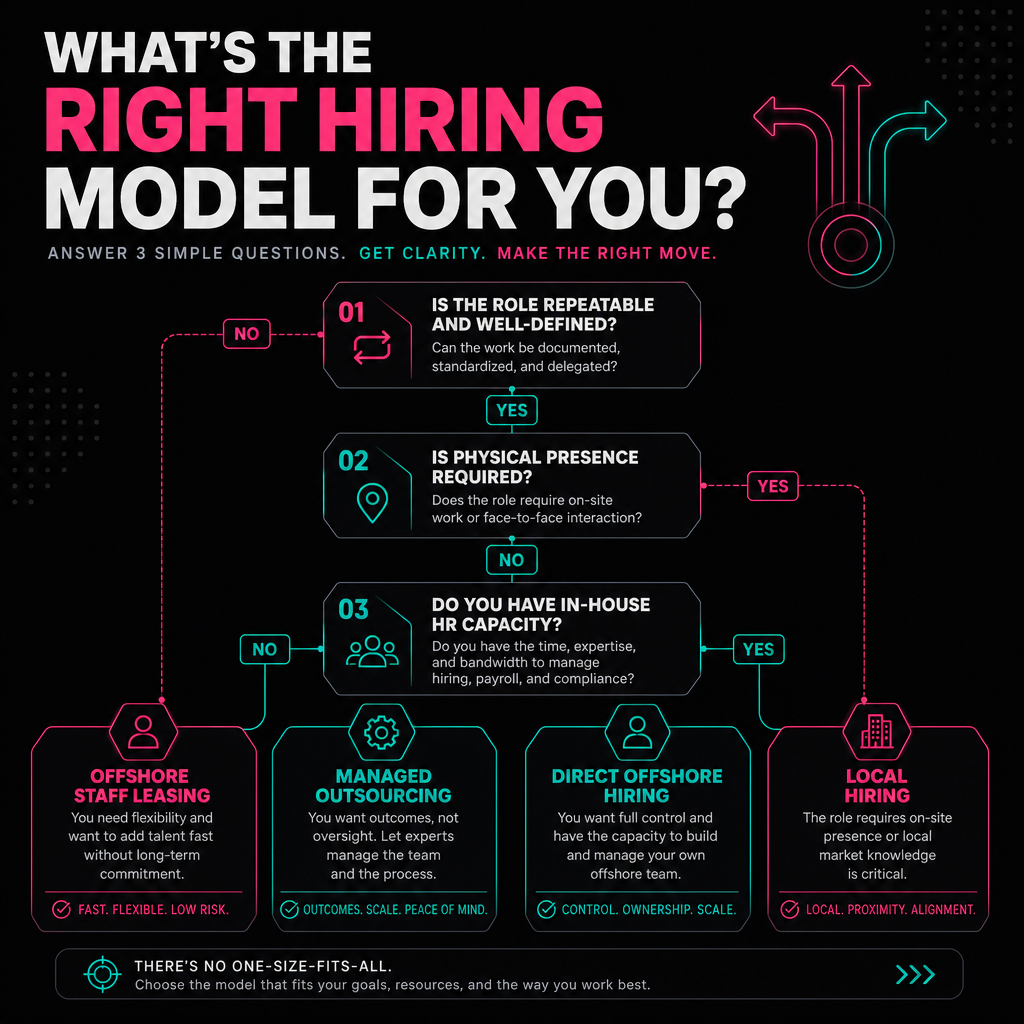
I want to be clear that offshore staff leasing is not always the right answer. Here is how I think about the decision framework:
Choose offshore staff leasing when you have recurring, documentable roles that need dedicated capacity, you want full control over work direction, and you are prepared to invest in onboarding structure upfront.
Choose managed outsourcing when you have a defined project scope, you are comfortable handing the output process to a third party, and you do not want to manage the person directly. The trade-off is less control and less integration.
Choose direct offshore hiring when you have in-house HR and legal capacity to manage foreign employment compliance correctly, you are building at sufficient scale to justify the overhead of direct employment infrastructure, and you want maximum control over the employment relationship itself.
Choose local hiring when the role requires physical presence, real-time Australian regulatory interaction, or a level of seniority and strategic input where local market context is non-negotiable.
For most Australian SMEs and mid-market businesses in professional services, health administration, and digital operations, offshore staff leasing through a structured EOR provider is the most practical entry point. It gives you the cost efficiency of offshore talent without the legal complexity of direct foreign employment, and more integration and control than project outsourcing.
The caveat I will keep repeating: systems over heroics. The businesses that get lasting value from leased offshore staff are the ones that treat the engagement as a delivery system installation, not a headcount solution.
Common Myths About Offshore Staff Leasing
"The quality of Philippine professionals is lower than Australian equivalents." This is not accurate for the roles where offshore leasing is typically applied. Philippine universities produce large cohorts of accountants, IT professionals, engineers, and business administrators who are technically trained and English-fluent. The real quality variable is not the talent pool. It is how well the role is structured and managed.
"I will lose control of my work." The opposite is true compared with outsourcing. In a leasing arrangement, you direct the work. You set the priorities, the standards, and the tools. The provider handles employment compliance. You retain full operational control.
"It is only viable for large businesses." Some of the best outcomes I have seen are with businesses running five to twenty people who are carrying too much operational overhead for the founder to manage strategically. A single well-placed offshore specialist, wrapped in a correct delivery structure, can materially change how a business of that size operates.
"My industry has too much compliance risk." Compliance risk in offshore staffing is almost always a design problem, not an inherent feature of the model. NDIS providers, accounting firms, mortgage brokers, and allied health businesses all operate with leased offshore staff successfully when compliance steps are built into the workflow design, not left as an afterthought.
What to Look for in an Offshore Staff Leasing Provider
Not all providers are equal. Here is what I would assess before signing an agreement:
- EOR compliance in the Philippines. Confirm the provider is DOLE-registered, processes payroll correctly, and pays all statutory contributions on time. Ask for specifics, not assurances.
- Transparency in pricing. A single, fully loaded AUD rate that includes salary, employer contributions, and service margin is cleaner and more trustworthy than a base rate with undisclosed add-ons.
- What happens when things go wrong. Understand the process for underperformance, role changes, and separation. A provider who glosses over this is a provider who has not thought through the hard cases.
- Delivery structure, not just talent supply. A provider who hands you a CV and a start date is leaving the hardest part of the engagement to you. Ask what they provide in terms of onboarding documentation, SOP frameworks, and ongoing support.
- Account management. Once your specialist is placed, who is responsible for the health of the engagement? A dedicated Australian account manager who understands your industry and reviews performance regularly is a substantively different offer to an offshore support inbox.
The Bottom Line
Offshore staff leasing is a mature, proven model that Australian businesses are using at scale to close operational capacity gaps, reduce cost structures, and build long-term capability in roles that do not require physical presence. The cost savings are real. The talent quality in the Philippine market is real. And the compliance infrastructure, when structured correctly, is manageable.
But the model does not succeed on talent quality alone. The businesses that get lasting value are the ones that treat the engagement as a delivery system problem, not a recruitment problem. They document the role before hiring. They install review cadences. They build escalation pathways. They measure output against defined outcomes.
Predictable delivery is not a function of finding good people. It is a function of building the structure that makes good people consistently productive.
If you want to understand whether offshore staff leasing is the right fit for your business, and what that structure would look like in practice, talk to the Remotee team. We will give you a straight answer.
References
-
Department of Labor and Employment, Philippines (DOLE), Department Order No. 174, Series of 2017. Governs rules on contracting and subcontracting in the Philippines, including the obligations of employer-of-record entities and the statutory protections owed to contracted workers. Relevant to understanding legal compliance in Philippine-based leasing arrangements.
-
Australian Taxation Office (ATO), Employees working overseas and foreign worker tax obligations. ATO guidance on deductibility of payments to offshore service providers, withholding obligations, and the permanent establishment risk in cross-border staffing arrangements. Available via the ATO's official website under international tax for businesses.
-
Office of the Australian Information Commissioner (OAIC), Australian Privacy Principles Guidelines, Chapter 8: APP 8 (Cross-border disclosure of personal information). Explains that Australian businesses remain accountable under the Privacy Act 1988 when personal information is disclosed to overseas recipients, including offshore staff operating under direction of an Australian entity.
-
Australian Bureau of Statistics (ABS), Labour Account Australia, 2026. Provides data on Australian employment costs, vacancy rates, and labour market conditions relevant to benchmarking offshore staffing cost comparisons against domestic hiring costs.
-
Philippine Statistics Authority (PSA), Annual Survey of Philippine Business and Industry, Professional Services Sector. Provides data on workforce size, tertiary education outputs, and industry composition in the Philippine professional services sector, relevant to assessing talent supply depth.
-
Safe Work Australia, Work Health and Safety Act (Model WHS Act), Guidance on managing WHS for remote and overseas workers. Addresses the duty of care obligations for Australian businesses that direct workers remotely, including evolving guidance on offshore remote workers under Australian WHS frameworks.
FREQUENTLY ASKED QUESTIONS
Common questions
What is offshore staff leasing and how is it different from outsourcing?
- Offshore staff leasing places a dedicated worker under your operational direction, while a third-party provider acts as the legal employer in the worker's home country. You manage the person and the work. The provider handles employment contracts, payroll, and local compliance. In outsourcing, a third-party firm owns the delivery process and manages the worker themselves. Leasing gives you significantly more control and integration.
Who is responsible for paying tax and superannuation for a leased offshore worker?
- The leasing provider, acting as the employer of record, is responsible for local payroll tax, statutory contributions (in the Philippines: SSS, PhilHealth, Pag-IBIG), and 13th-month pay. Australian superannuation does not apply to offshore workers who are not Australian residents. Always confirm the arrangement with your Australian tax adviser.
Does the Australian Fair Work Act apply to leased offshore staff?
- No. The Fair Work Act 2009 applies to Australian-based employees. Offshore workers employed by a Philippines-based employer of record are subject to Philippine labour law, not Australian employment law. However, other Australian laws such as the Privacy Act may still apply to your conduct as the directing entity.
What roles are best suited to offshore staff leasing in Australia?
- Roles that are repeatable, documentable, and do not require physical presence in Australia are the best fit. Common examples include bookkeepers and accounting assistants, mortgage loan processors, marketing coordinators, CRM administrators, NDIS documentation coordinators, IT support and web developers, and customer service operators.
How long does it take to onboard a leased offshore specialist?
- With a structured provider, a specialist can be placed and operational within three to five weeks from engagement start. Remotee's placement-to-operational timeline for accounting specialists is 21 days. The variable that most affects time-to-productivity is how quickly the client can complete workflow documentation before the specialist starts.
What are the main risks of offshore staff leasing and how do I manage them?
- The primary risks are poor delivery structure, data security and privacy compliance, provider-side employment compliance shortcuts, and cultural communication gaps. These are manageable by documenting workflows before hiring, confirming your provider's employer-of-record compliance credentials, building a review cadence into the engagement from week one, and training your specialist on data handling and communication expectations before they access live systems.
How does offshore staff leasing affect Australian Privacy Act obligations?
- Under the Australian Privacy Act 1988, if your business discloses personal information about Australian individuals to an overseas entity, including an offshore worker you direct, the Australian Privacy Principles still apply to your business. You remain accountable for how that data is handled. Build this into your onboarding documentation and your commercial agreement with the provider.
Is offshore staff leasing cost-effective for small businesses, or only for larger organisations?
- It is cost-effective at almost any business size, provided the role generates sufficient recurring workload to justify a dedicated placement. A single offshore specialist at AUD $3,000 to $4,500 per month (all-in) compares favourably with a part-time local hire in most Australian metro markets. The real constraint for small businesses is the capacity to invest in upfront documentation and onboarding structure, which a structured provider can supply as part of the engagement.

Jon Kelly
Founder, Remotee
Jon helps Australian businesses build compliance-led offshore teams that scale without the burnout. NDIS, accounting, mortgage broking, recruitment and digital marketing.
KEEP READING
Related posts
offshore staff leasing
Long-Term Offshore Staff Leasing: Building Dedicated Teams in Australia
The difference between a capacity gap and a capacity crisis is usually a delivery structure problem, not a talent problem. Australian business owners frequently…
5 July 2026 · 18 min read
offshore staff leasing
Offshore Staff Leasing vs Direct Offshore Hiring: Which Model Suits Australian Businesses in 2026?
Choosing the wrong offshore engagement model will cost you more than choosing the wrong country. That is not hyperbole. I have watched Australian business owner…
13 June 2026 · 27 min read
offshore staff retention
Strategies for High Employee Retention with Offshore Staff
Offshore staff retention improves when employers combine competitive local wages, meaningful benefits, visible career paths, consistent management and genuine t…
21 July 2026 · 20 min read
READY TO SCALE WITHOUT THE BURNOUT?
Build a compliance-led offshore team in 3–4 weeks.
Tell us about your current bottleneck and we'll show you what a Remotee placement would look like for your operation.
Or get our playbooks emailed to you instead.