
How to Hire Dedicated Offshore Staff Quickly and Compliantly
- offshore recruitment
- offshore staff
- hire offshore staff
- offshore staffing services
- Australian business operations

Australian businesses face a persistent problem in 2026: finding skilled talent locally is expensive and slow. HR managers and business owners spend months advertising, interviewing, and negotiating, only to lose top candidates to larger competitors with deeper pockets. When a capacity gap turns into a capacity crisis, the instinct is to rush a local hire. The real problem in most businesses is not just a lack of headcount. It is the absence of documented workflows, clear ownership, and repeatable processes around the role.
Adding headcount without adding system is how scaling creates chaos. You compete on cost, speed, or resumes. We compete on reliability. The goal is predictable delivery, not just headcount. Moving business owners from Doer to Strategist requires installing compliance-baked operating systems around specialist roles. Sourcing dedicated offshore staff from the Philippines provides a highly effective solution, but only if the recruitment and integration process is managed correctly.
This guide maps out the exact steps to hire offshore staff quickly and compliantly. We will cover the end-to-end timeline, rigorous CV screening, skills testing, time zone interview tactics, and formal offer structures. We will also look at real case studies of an Australian real estate agency and an IT firm that successfully integrated offshore talent to reduce operational bottlenecks.
Key Takeaways
- Speed cannot override compliance. Proper employment structures protect your intellectual property and ensure fair labour practices.
- A robust skills testing process is more critical than a polished CV. Test for actual capability, not just presentation.
- Synchronous and asynchronous interview methods must be combined to assess candidates across different time zones effectively.
- Clear, documented workflows must precede onboarding. The difference between success and failure is your internal delivery system.
- Australian businesses can access highly skilled offshore staff at a fraction of local costs, but local market salary data must be understood to ensure competitive offers.
Offshore Staff Recruitment Timeline
| Stage | Task | Timeframe | Key Deliverable |
|---|---|---|---|
| Preparation | Define role, document workflows, set KPIs | 1-2 weeks | Comprehensive brief |
| Sourcing & CV Screening | Initial sourcing, filtering applications | 1 week | Shortlist of 5-10 candidates |
| Skills Testing | Practical assessments and technical tests | 3-5 days | Ranked list of top performers |
| Interviewing | Initial, technical, and cultural fit interviews | 1-2 weeks | Final selection |
| Offer & Onboarding | Formal offer, contracts, system access | 1-2 weeks | Fully integrated staff member |
The Fundamentals of Compliant Offshore Recruitment
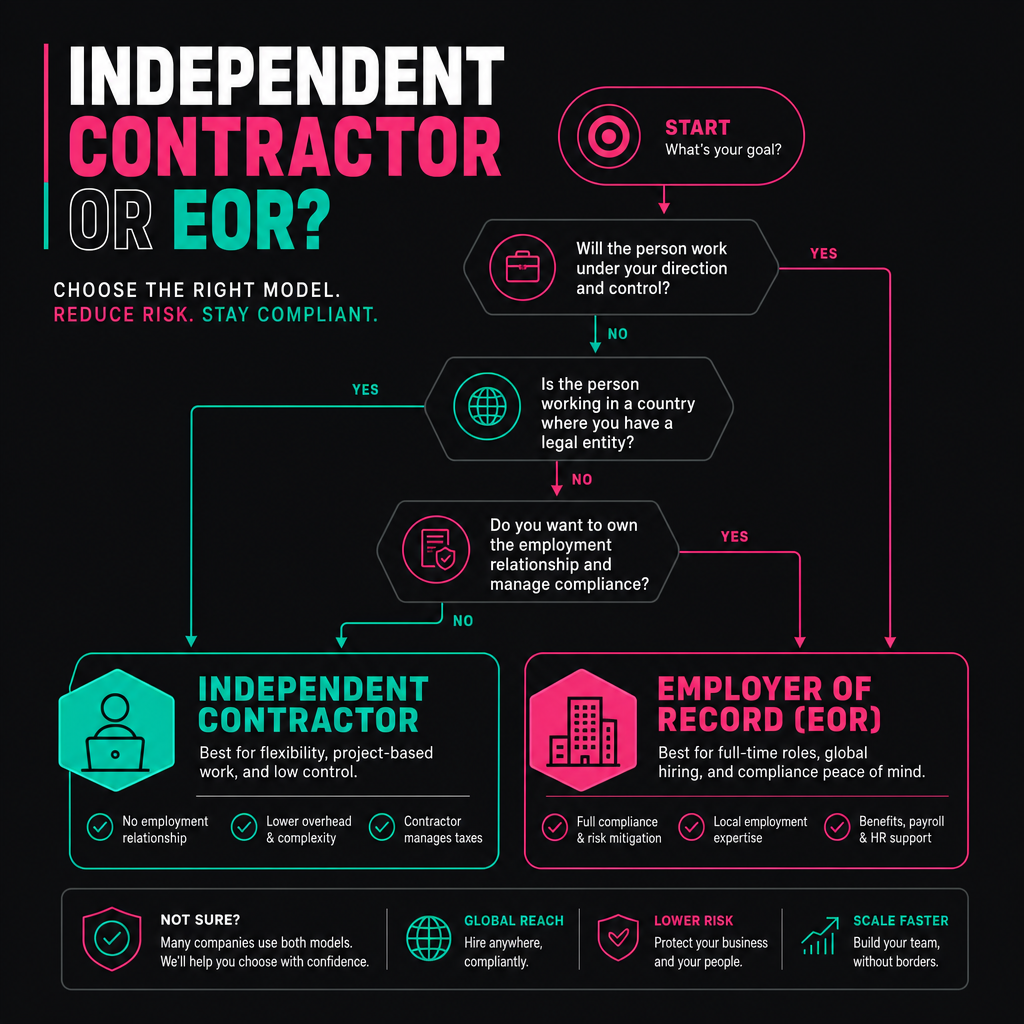
Building a reliable offshore team requires more than just browsing LinkedIn. It requires a structured approach to offshore recruitment that prioritises compliance and quality. Australian businesses must navigate local employment laws, international contractor agreements, and data security protocols. Skipping these steps leads to severe legal and financial consequences. According to the Australian Taxation Office, businesses engaging contractors must continually verify their status to avoid Sham Contracting arrangements under the Fair Work Act. When you hire offshore staff, you must decide whether to engage them as independent contractors or set up an Employer of Record (EOR) arrangement.
An independent contractor arrangement is common for highly specialised, project-based work. However, for full-time, dedicated offshore staff, an EOR model is safer and more reliable. The EOR acts as the legal employer in the offshore country, handling payroll, local taxes, and statutory benefits, while the candidate works exclusively for your Australian business. This ensures full compliance with local labour laws, such as those mandated by the Department of Labor and Employment (DOLE) in the Philippines.
Using professional offshore staffing services guarantees these frameworks are set up correctly. We ensure that every candidate is legally employed, paid fairly, and provided with the mandatory benefits, including health insurance and retirement contributions. Protecting your business means ensuring your delivery system is inherently compliant.
Defining the Role and Documenting Workflows
Before you even look at a CV, you must build the environment the new hire will operate within. The difference between a capacity gap and a capacity crisis is usually a delivery structure problem, not a talent problem. When businesses fail with offshore staff, it is almost never the fault of the employee. It happens because the business threw a smart person into a vacuum without documented processes.
We require every client to complete a comprehensive Role Definition Document. This goes beyond a standard job description. It includes:
- Daily, weekly, and monthly tasks: Exactly what the person will do.
- Key Performance Indicators (KPIs): How success is measured quantitatively.
- Software Stack: The exact tools they will use and the licences required.
- Approval Workflows: Who signs off on their work and how.
When an HR manager or business owner documents these elements, the recruitment process accelerates. Candidates immediately see the structure and recognise a professional environment. This documentation also forms the basis of the training programme, ensuring the new offshore staff member can execute their duties from day one.
CV Screening: Finding the Real Signal
Receiving 200 CVs for a single offshore role is standard. Most HR departments spend seconds on each one. Our offshore recruitment process treats the CV as a baseline requirement, not the deciding factor. We look for specific signals that indicate long-term viability.
A strong CV for an offshore role should demonstrate longevity. We immediately discard CVs that show job hopping every six months. While the offshore market can be transient, candidates who stay in roles for 2-3 years demonstrate reliability. We also look for quantifiable achievements. A virtual assistant stating they "managed emails" tells us nothing. A candidate stating they "managed the inbox of a real estate principal, reducing response times by 40%" gives us a measurable metric.
We use the Remotee process to standardise this screening. Every CV passes through a matrix scoring system based on education, relevant experience, technical skills, and career stability. Only candidates who score in the top 15% proceed to the skills testing phase.
Deep Tactical Advice on Skills Testing
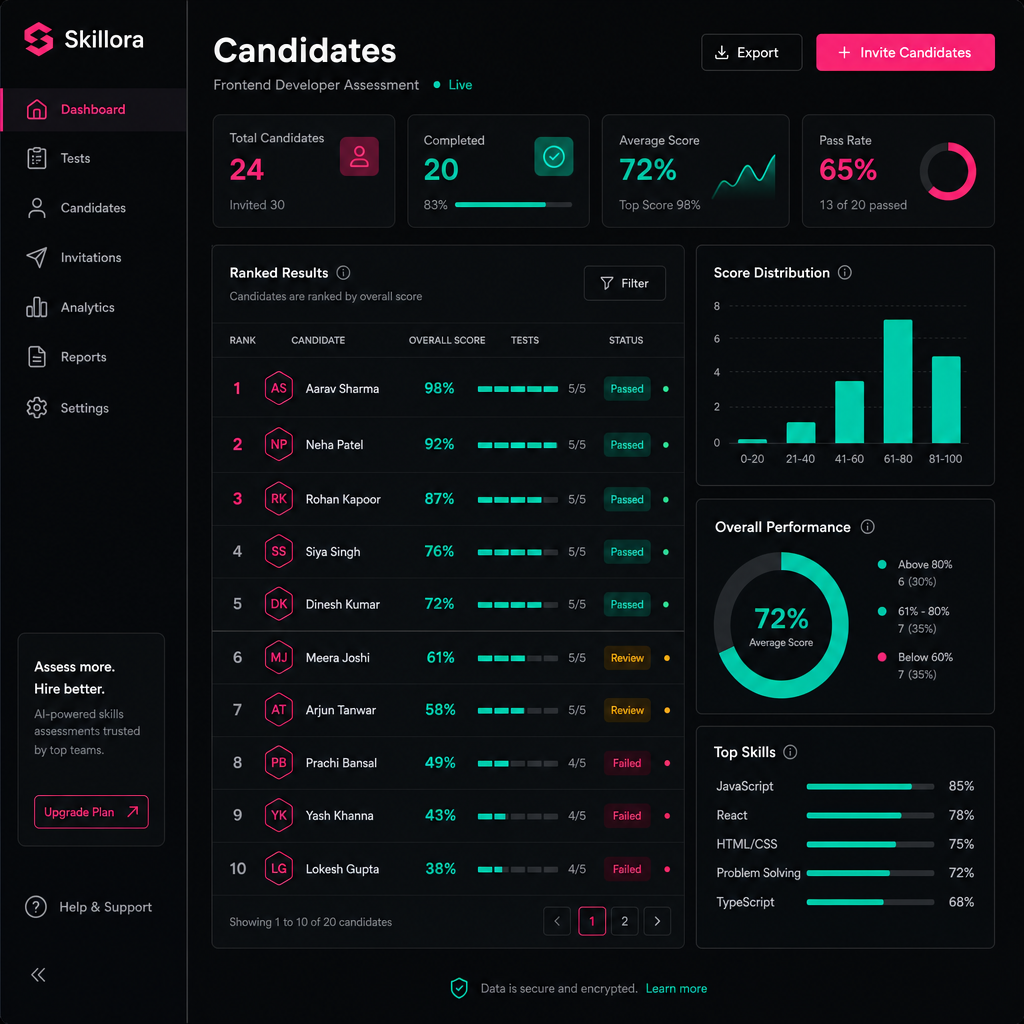
A polished CV and a confident interview do not guarantee competence. Skills testing is where you separate the best candidates from the best interviewers. We mandate rigorous, scenario-based testing for every role, from junior administrators to senior software developers.
Designing the Assessment
The assessment must mirror the actual work the candidate will do daily. Do not use generic online quizzes. A generic typing test is useless. A test requiring the candidate to draft a professional email responding to an angry client, using your company templates, provides real signal.
For technical roles, the testing must be granular. Consider an offshore IT firm hiring a React developer. The skills test should not be a theoretical exam on JavaScript. We provide a broken repository on GitHub and give the candidate 48 hours to fix the bugs, write unit tests, and submit a pull request. This tests their coding ability, their understanding of version control, and their ability to follow instructions.
Real Estate Virtual Assistant Example
When hiring a real estate VA, the assessment must cover property management software, communication, and attention to detail. Our standard test includes:
- Data Entry Accuracy: Providing a messy list of property inspection details and asking the candidate to clean and format it in a spreadsheet.
- Software Proficiency: Recording a short video demonstrating how they would log a maintenance request in a standard CRM.
- Written Communication: Drafting an SMS reminder to a tenant about an upcoming routine inspection.
We pay candidates for their time completing these assessments. This immediately sets a tone of respect and professionalism, which is rare in offshore recruitment. Paying for the test ensures higher completion rates and provides a final filter, as candidates who are not serious will often not invest the time even when compensated.
Interviewing Techniques Across Time Zones
The Philippines operates on Australian Western Standard Time (AWST) or close to it, making it highly accessible for the eastern states. However, coordinating interviews still requires structure. We use a mix of synchronous and asynchronous interviewing to maximise efficiency and reduce bias.
The Asynchronous Video Interview
Before a live interview, candidates complete an asynchronous video interview using a platform like VideoAsk. We provide three questions.
- "Walk us through your CV."
- "Explain a time you had to deal with a difficult stakeholder."
- "Why are you looking to leave your current role?"
Candidates record their responses on their own time. This tests their communication skills, their technological setup, and their ability to articulate thoughts clearly without immediate prompting. For roles requiring high client interaction, such as customer service or reception duties, this stage is heavily weighted.
The Live Competency Interview
Candidates who pass the video stage proceed to a live interview. This is not a general chat. We use the STAR (Situation, Task, Action, Result) method to drill into their past experiences.
During this interview, we also present scenario-based questions relevant to the role. "You realise you have made a mistake on a document already sent to a major client. What are your exact next three steps?" Their answer reveals their problem-solving framework and their honesty.
Evaluating Cultural Alignment
Cultural fit does not mean hiring people who act the same. It means ensuring the candidate can thrive within your operating model. We explicitly discuss Australian workplace norms, direct communication styles, and the fast pace of our clients' businesses. We test their adaptability by asking how they handled changes in software or sudden shifts in priority in previous roles.
Making the Formal Offer and Onboarding
Once the ideal candidate is selected, speed is critical. Top offshore talent gets off the market quickly. We move from final interview to formal offer within 24 to 48 hours. The offer must detail the salary in AUD (or agreed currency), the working hours in Australian time, leave entitlements, and the equipment provision policy.
The onboarding process is the final safety net. Australian businesses must treat offshore staff exactly as they would a local employee. Do not leave them to figure things out alone.
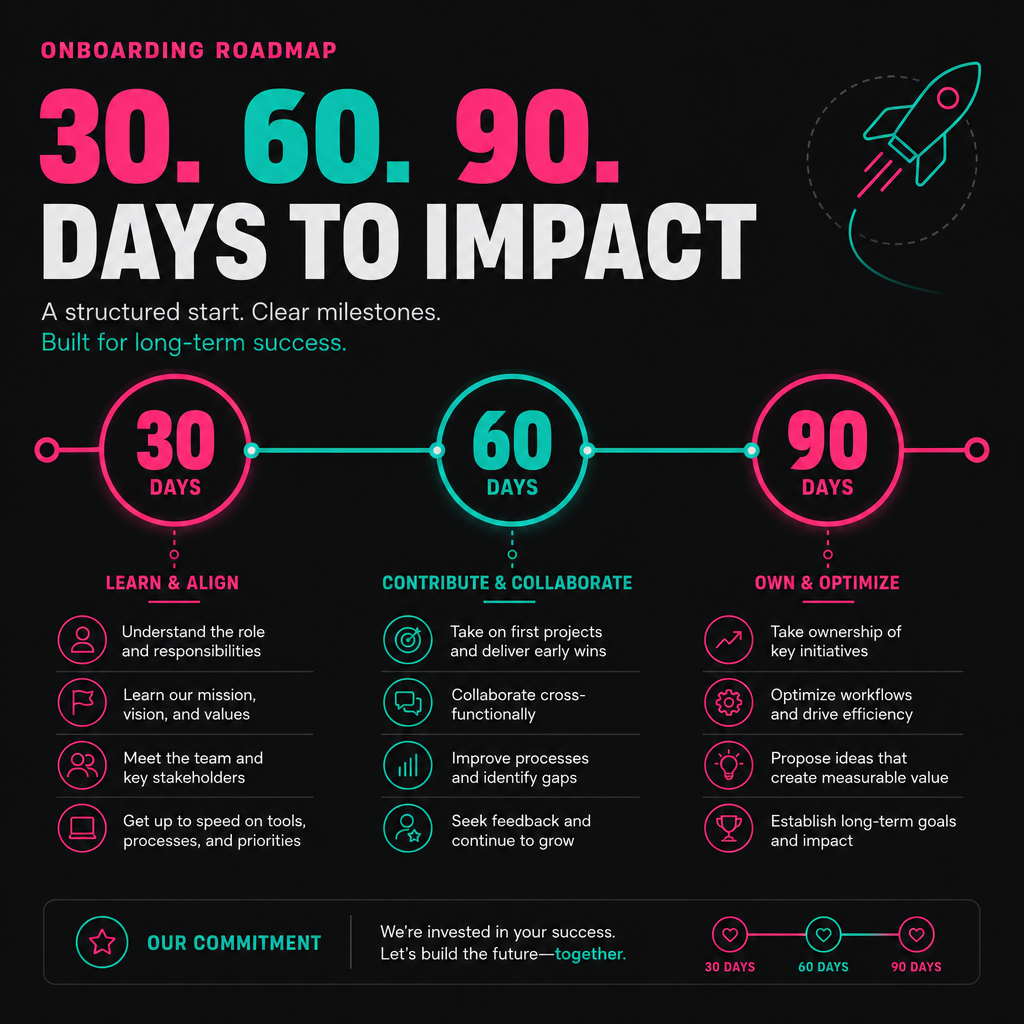
The 30-60-90 Day Framework
A structured onboarding plan guarantees the new hire integrates seamlessly.
Days 1-30: Focus strictly on systems, shadowing, and low-risk execution. The new staff member should be paired with a local buddy. They learn the software, the communication channels, and the specific workflows. Output expectations should be kept at 50% of full capacity while they learn.
Days 31-60: Increase autonomy. Begin assigning complex tasks that require independent problem-solving. Check-in daily via a 15-minute stand-up call.
Days 61-90: Full integration. The new hire should be hitting their KPIs and operating independently. Performance reviews at day 90 help identify any lingering skill gaps or process bottlenecks.
If you are ready to build this structure and access reliable offshore talent, start by consulting our specialist team.
Integrating Offshore Talent: A Business Critical Trust Function
When expanding your team, the initial focus is often on the direct operational tasks like customer service, IT support, or property management. However, building a truly scalable Australian business also requires flawless administrative execution. A critical mistake business owners make is assuming that offshore recruitment only applies to front-end roles. In reality, the highest ROI often comes from outsourcing complex back-office functions that require absolute precision.
Take payroll, for example. Many growing businesses try to manage payroll internally, squeezing it in between tax returns. The Australian Taxation Office reported billions in superannuation charge debts accumulated by businesses in recent years, proving that internal overload and rushed payruns create massive liabilities. Most say payroll should stay in-house because it is too sensitive to outsource. We disagree. Payroll is often safer when it is outsourced to specialists. A specialist payroll team brings structure, controls, deadlines, and compliance focus every cycle. Payroll is a business-critical trust function. When payroll is wrong, staff confidence drops quickly. Accurate, on-time payroll protects culture, cash flow, compliance, and the employer brand.
This is where the integration of offshore staff shines. By utilising dedicated offshore accountants and payroll specialists, you remove the risk of manual checks and people wearing too many hats. We process payroll like it matters because to your staff, it does. STP, super, leave, PAYG and reporting should be handled by people who live in payroll, not jack-of-all-trades accounting. Specialist payroll delivery ensures you avoid payroll fines before they become expensive lessons.
The Accountee Payroll Process in Action
We successfully applied this framework to a hospitality recruitment and labour hire company. They had multiple people in-house as well as external accountants managing their payroll at great expense. They also processed payroll weekly, creating mass workloads. The solution was not simply hiring another local administrator at a high salary.
Our expert team completed a discovery phase and installed a system using offshore talent. We eliminated their reliance on inefficient internal staff and external accountants. We moved their payroll to fortnightly, and our offshore team picked up the entire function. It was plug and play. The outcome was a significant reduction in opex staffing costs and a reduction in payroll processing costs. Furthermore, they achieved an improvement in compliance, as their previous internal team was not aware of multiple industry award requirements. This proves that integrating offshore staff is not just about filling a seat. It is about installing a better delivery system.
Case Studies: Real Results from Offshore Staffing Services
To illustrate the impact of properly structured offshore staffing services, let us examine two recent implementations from 2026. These case studies highlight the time saved and the operational efficiencies gained.
Case Study 1: Real Estate Agency Virtual Assistant
The Problem: A boutique real estate agency in Sydney was spending over $80,000 AUD a year on a local property manager who was bogged down in administrative tasks. The principal wanted to focus on sales, but constantly had to step in to manage tenant queries, lease renewals, and maintenance coordination.
The Intervention: We deployed an offshore recruitment strategy to source a specialised Real Estate Virtual Assistant in Manila. The brief was highly specific. The candidate needed experience with Australian property management software, preferably PropertyMe or Rent Manager, and a strong understanding of the New South Wales tenancy laws.
The Execution: We shortlisted eight candidates. Five completed a scenario-based skills test involving drafting breach notices and processing bond lodgements. The successful candidate, based in Cebu, had three years of experience working for an agency in Melbourne. We facilitated the setup of an Employer of Record, ensuring full compliance with Philippine labour laws.
The Outcome: The agency onboarded the VA within four weeks. The VA took over all administrative duties, including managing the inbox, scheduling inspections, and drafting routine correspondence. The local property manager's capacity increased by 40%, allowing the agency to take on 25% more rent roll without hiring additional local staff. The total cost for the full-time, dedicated offshore staff member was $1,200 AUD per month, inclusive of all agency fees and compliance costs.
Case Study 2: IT Firm Senior React Developer
The Problem: A mid-tier IT services firm in Melbourne needed a senior React developer for a six-month project to rebuild their core client portal. Local recruitment agencies quoted $150,000 AUD plus superannuation for a 12-month contract, which exceeded the project budget.
The Intervention: We initiated offshore recruitment for a senior developer with a minimum of five years of experience in React, Node.js, and AWS.
The Execution: Sourcing top-tier tech talent requires a technical evaluation. We provided a complex coding challenge. Four candidates were selected for live technical interviews with the firm's CTO. The successful candidate started within three weeks.
The Outcome: The developer integrated seamlessly into the firm's agile sprints. Working from 10:00 AM to 7:00 PM Manila time allowed for four hours of direct overlap with the Melbourne team. The project was delivered two weeks ahead of schedule. The firm saved 55% compared to local contractor rates, and retained the developer on a rolling contract for future phases.
Testimonial
"Partnering with Remotee completely changed how we operate. We were hesitant about offshore staffing services due to data security concerns, but the compliance and systems framework they provided was bulletproof. We hired a dedicated marketing analyst who has outperformed our local equivalents. The time-to-hire was exactly 18 days. The structured onboarding meant she was fully autonomous by week three. We have since expanded our offshore team to include an internal sales coordinator." Sarah T., Operations Director, Logistics Firm.
References
- Australian Taxation Office (ATO). Superannuation Guarantee Charge and Employer Obligations.
- Fair Work Ombudsman. Independent Contractors and Sham Contracting Regulations.
- Department of Labor and Employment (DOLE) Philippines. Labor Code Compliance and Benefits.
- Australian Bureau of Statistics (ABS). Labour Force Data and Employment Trends.
FREQUENTLY ASKED QUESTIONS
Common questions
What contracts are required to hire offshore staff compliantly?
- To hire offshore staff compliantly, you need a clear agreement that defines the relationship. If using an Employer of Record (EOR), the EOR signs a local employment contract with the staff member, adhering to local labour laws. Your Australian business signs a Service Agreement with the EOR. If engaging a contractor directly, you need a robust Independent Contractor Agreement that specifies IP ownership, confidentiality, and termination clauses to protect your business from misclassification risks.
Who provides the equipment for offshore staff?
- Equipment provision depends on your chosen model. Many offshore staff in the Philippines provide their own baseline equipment (laptop and internet) if compensated appropriately. However, for data security, we strongly recommend providing company-provided equipment or utilising a secure cloud workspace. The cost of shipping equipment or setting up a local hardware allowance is easily offset by the labour cost savings.
How do we manage data security and privacy?
- Data security is paramount. You must ensure your offshore staff operate within a secured digital environment. Do not provide blanket access to your local servers. Use role-based access controls within your cloud software (Xero, Salesforce, Google Workspace). Implement two-factor authentication for all platforms. If a staff member handles sensitive information, consider routing their traffic through a company-controlled VPN.
How long does the offshore recruitment process take?
- The typical timeframe to hire offshore staff is 2-4 weeks from the initial briefing. The first week involves sourcing and CV screening. The second week focuses on skills testing and interviewing. Once a candidate is selected, finalising the EOR setup and onboarding takes another 5-10 days.
Can we hire offshore staff for part-time roles?
- Yes, you can hire offshore staff for part-time roles. Many offshore professionals seek part-time or flexible arrangements. However, to attract top talent, full-time positions are always preferable. If you only need 20 hours a week, consider hiring a dedicated part-time staff member rather than splitting a role, as this ensures priority focus on your business operations.
How are offshore staff paid?
- If you use an offshore staffing services provider or an EOR, they handle the payment in the local currency. They manage all statutory deductions, taxes, and government contributions. Your Australian business receives a single monthly invoice in AUD. This completely removes the administrative burden of international bank transfers, currency conversions, and local tax compliance.

Jon Kelly
Founder, Remotee
Jon helps Australian businesses build compliance-led offshore teams that scale without the burnout. NDIS, accounting, mortgage broking, recruitment and digital marketing.
KEEP READING
Related posts
offshore staffing services
How to Successfully Engage Offshore Staffing Services in Australia
Business owners across Australia are hitting a wall. Local talent is expensive, hiring takes months, and operational costs are eating into margins. When you fac…
3 July 2026 · 15 min read
offshore staff
Offshore Staff vs Local Staff in Australia: A True Cost and Productivity Comparison
The Bottom Line: Australian businesses that integrate offshore staff effectively reduce their labour costs by 70% while doubling operational capacity. Australia…
2 July 2026 · 18 min read
transparent provider pricing comparison
Offshore Staffing Pricing Transparency: How to Compare Provider Quotes Without Getting Caught Out
Transparent provider pricing comparison means evaluating offshore staffing quotes against total cost of engagement, not headline hourly rate. A genuine quote it…
13 September 2026 · 17 min read
READY TO SCALE WITHOUT THE BURNOUT?
Build a compliance-led offshore team in 3–4 weeks.
Tell us about your current bottleneck and we'll show you what a Remotee placement would look like for your operation.
Or get our playbooks emailed to you instead.