
How to Successfully Engage Offshore Staffing Services in Australia
- offshore staffing services
- offshore staffing solutions
- offshore staff
- Australian payroll compliance
- remote recruitment
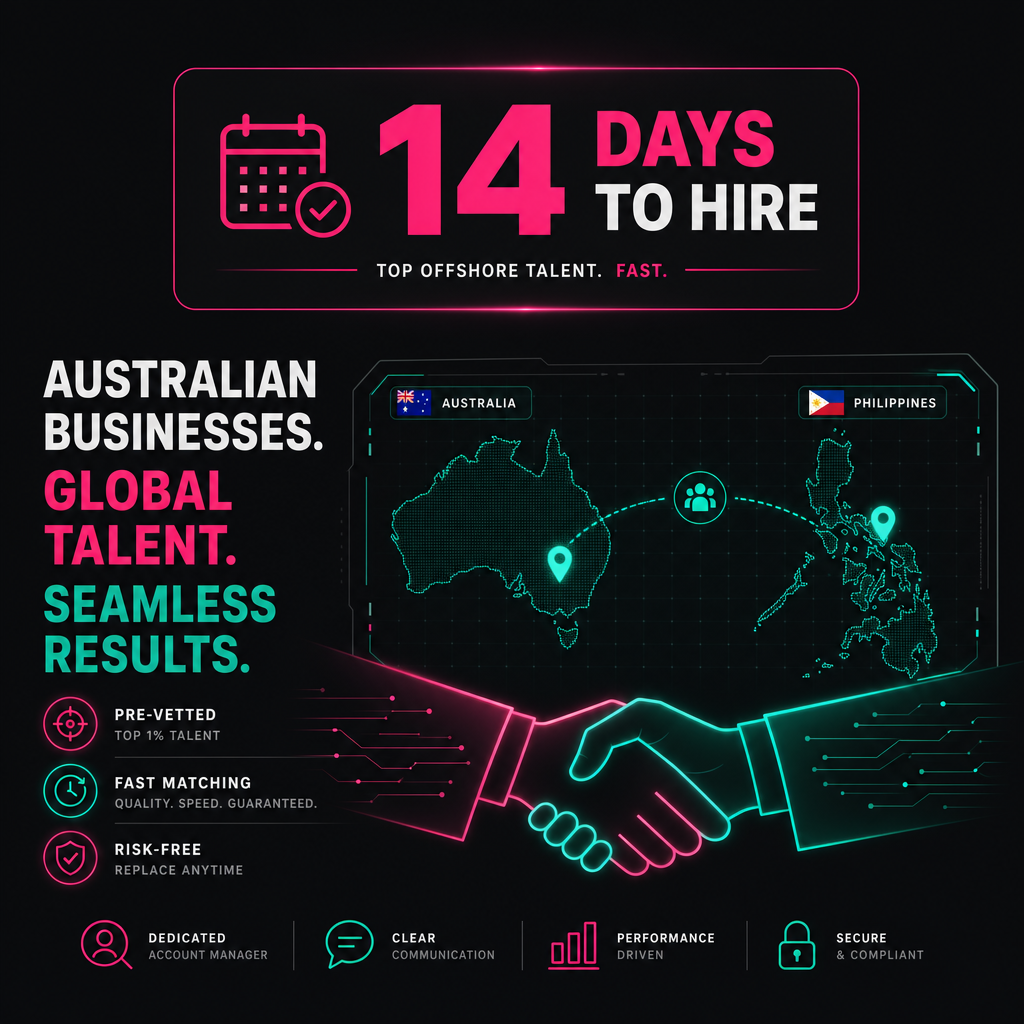
Business owners across Australia are hitting a wall. Local talent is expensive, hiring takes months, and operational costs are eating into margins. When you face a capacity gap, the immediate reflex is to throw headcount at the problem. But adding bodies to a chaotic business model only scales the chaos.
This is why Australian companies turn to offshore staffing services. The appeal is obvious: you access highly skilled professionals at a fraction of the local cost, often within 14 days. But cost savings mean nothing if the delivery fails.
I am Alex Frew, founder of 3P Digital and partner at Remotee. We do not compete on resumes or low hourly rates. We compete on reliability. We believe the difference between a capacity gap and a capacity crisis is usually a delivery structure problem, not a talent problem. If you want to engage offshore staff successfully, you need more than a recruitment portal. You need a system.
Key Takeaways
- Speed matters: A structured offshore agency can deliver shortlisted candidates in 14 days.
- Talent alone fails without documented workflows, clear ownership, and repeatable processes.
- Strict Australian compliance checks (including Federal Police Checks and working rights) are mandatory for remote staff handling sensitive data.
- Moving from an in-house admin model to an offshore delivery system reduces non-billable partner time by 6-10 hours per pay cycle.
- Payroll is a business-critical trust function, not just an admin task. It requires specialist focus.
Summary of Engagement Steps
| Step | Action | Expected Outcome | Timeframe |
|---|---|---|---|
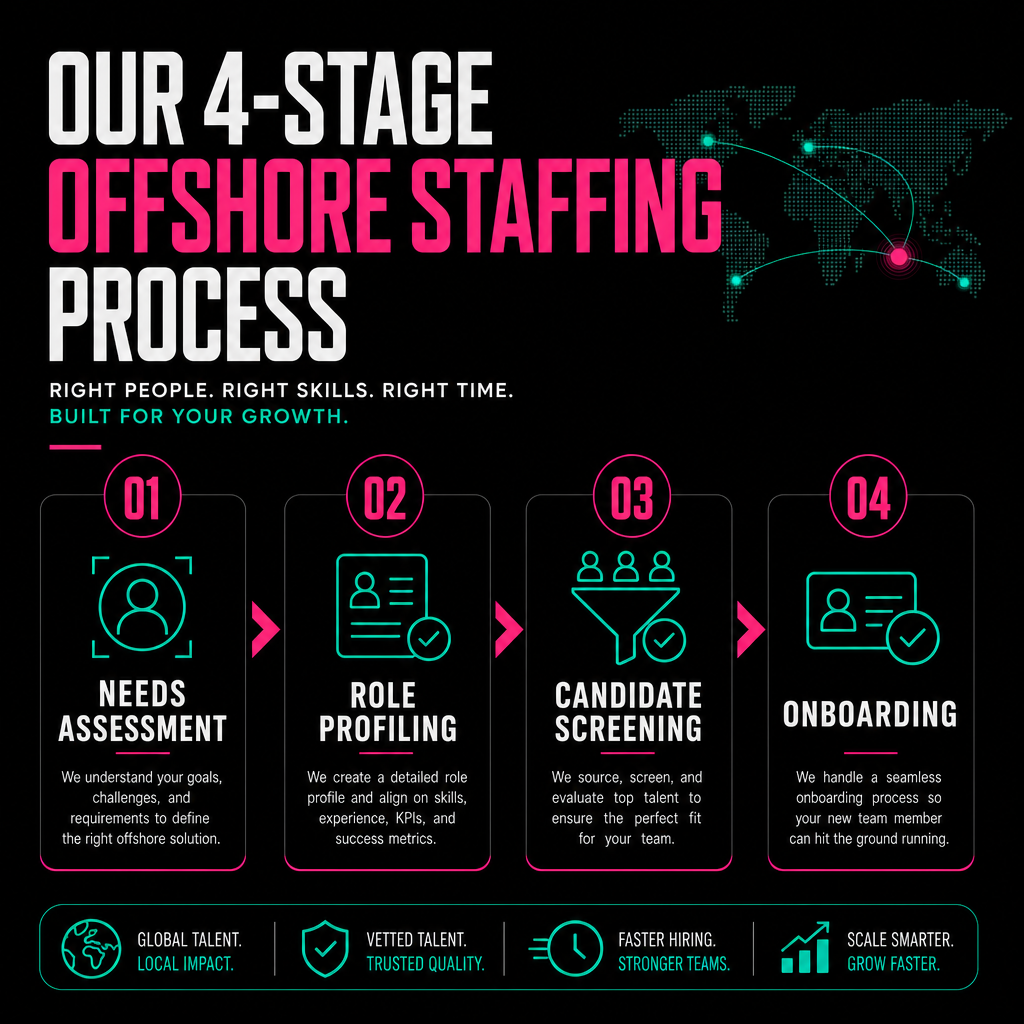
| 1. Needs Assessment | Identify the exact bottleneck, software stack, and daily outputs required. | Clear role definition and workload baseline. | 1-2 Days |
| 2. Role Profiling | Document the processes, SLAs, and KPIs the offshore staff will own. | Comprehensive briefing document for candidates. | 3-5 Days |
| 3. Candidate Screening | Conduct interviews, technical assessments, and background checks. | Shortlist of vetted, compliant professionals. | 7-10 Days |
| 4. Onboarding and Integration | Install the remote staff into your tech stack and begin process execution. | Seamless workflow integration with predictable delivery. | 1-2 Weeks |
Why Most Offshore Staffing Companies Fall Short
Most offshore staffing companies sell access to talent. They act as a resume portal, taking a brief, searching a database, and throwing CVs at your inbox. This approach treats hiring as a transaction. It ignores the operational reality of integrating a new person into a complex Australian business.
When a placement fails, providers blame the candidate's skills or the client's management. In reality, the placement failed because there was no system. We have seen recruitment agencies try to outsource their payroll and admin functions to generalist offshore staff, only to find the process completely breaks down after three weeks. The reason is simple. You cannot hand over a complex function like payroll to someone who only has a resume. You must hand it over inside a rigid, compliance-baked delivery system.
Adding headcount without adding system is how scaling creates chaos. When you engage offshore staffing solutions, you are not just buying someone's time. You are installing an operating model. If the provider cannot explain their delivery framework, their quality assurance processes, and their compliance checks, they are just a middleman.
The Remotee Delivery System: From Capacity Gap to Operating System
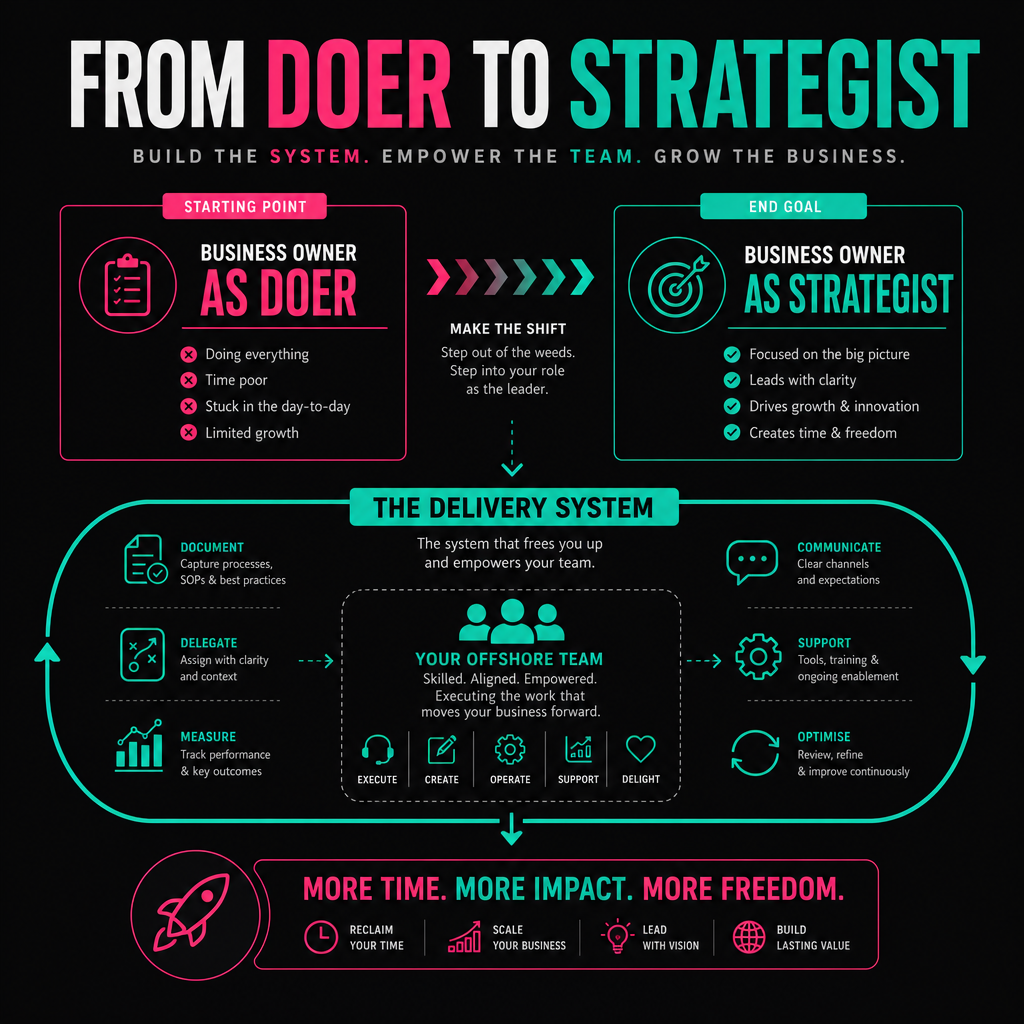
At Remotee, our core belief is that remote hiring only creates value when wrapped in a delivery system. We move Australian business owners from being the Doer to being the Strategist.
Recently, we worked with a recruitment agency. The founders wanted to focus on new business development and operational execution. They did not want to manage payroll and accounting. Hiring locally for these functions did not provide a good return on investment, and managing those resources internally was highly inefficient.
We did not just send them a resume. We installed a payroll system and a dedicated team customised to their specific software and business requirements. Within two weeks of our initial discovery session, we were live and managing their payroll entirely. The outcome was a complete removal of the operational burden. Now, the agency principal approves a single email once per fortnight. Our team manages all payroll, superannuation, compliance, and tax. All inbound queries and timesheet questions are handled by us, allowing the founders to focus purely on recruitment.
This is what predictable delivery looks like. Quality talent matters, but quality alone is not enough. To understand exactly how we install these operating models, review our process.
How to Conduct a Needs Assessment for Offshore Staff
The first step in successfully engaging offshore staffing services is a ruthless needs assessment. You must define the exact problem you are trying to solve. Most business owners think they need more people. They actually need more output in a specific area.
Start by auditing your own time. Track every task you or your senior management team does for two weeks. Highlight the repetitive, rules-based tasks that consume hours but do not generate revenue. These are your prime candidates for offshoring.
For example, if your senior partners are spending 10 hours a pay cycle reviewing timesheets and actioning payroll, you do not have a payroll problem. You have a systems problem. You need specialist payroll accountants, not generalist bookkeepers, to take that function off your plate entirely.
During the needs assessment, document your software stack. If you use a specific CRM, accounting platform, or rostering system, your offshore staff must be proficient in those exact tools. We ensure our offshore staff are fully trained in your specific software before they even start.
Role Profiling and Candidate Screening
Once the needs assessment is complete, you must build a comprehensive role profile. This is where many offshore staffing solutions fail. They rely on generic job descriptions. You cannot offshore a vague role.
Documenting the Process
A role profile for an offshore position must include step-by-step documentation of the processes the candidate will own. If you are hiring an offshore payroll administrator, the role profile must detail:
- How timesheets are collected and verified.
- The specific pay cycles (weekly, fortnightly, monthly).
- How leave, allowances, and deductions are calculated.
- The process for Single Touch Payroll (STP) reporting and superannuation payments.
- The exact approval workflows for pay runs.
If you do not have these processes documented, a premium offshore staffing agency will help you build them before they start sourcing candidates. This ensures the remote staff can execute on day one without needing constant direction.
The Screening Process
Candidate screening must go beyond an interview. We test for technical capability, problem solving, and communication. If a candidate claims to know Xero, we test them in Xero. If they claim to understand Australian Modern Awards, we give them a scenario based on a complex award interpretation.
Payroll is a business-critical trust function. When payroll is wrong, staff confidence drops immediately. Accurate, on-time payroll protects your culture, cash flow, and employer brand. We process payroll like it matters, because to your staff, it does. We do not rely on generalists. We provide payroll specialists who understand recruitment agencies, healthcare providers, and other niche Australian sectors.
Australian Compliance and Working Rights
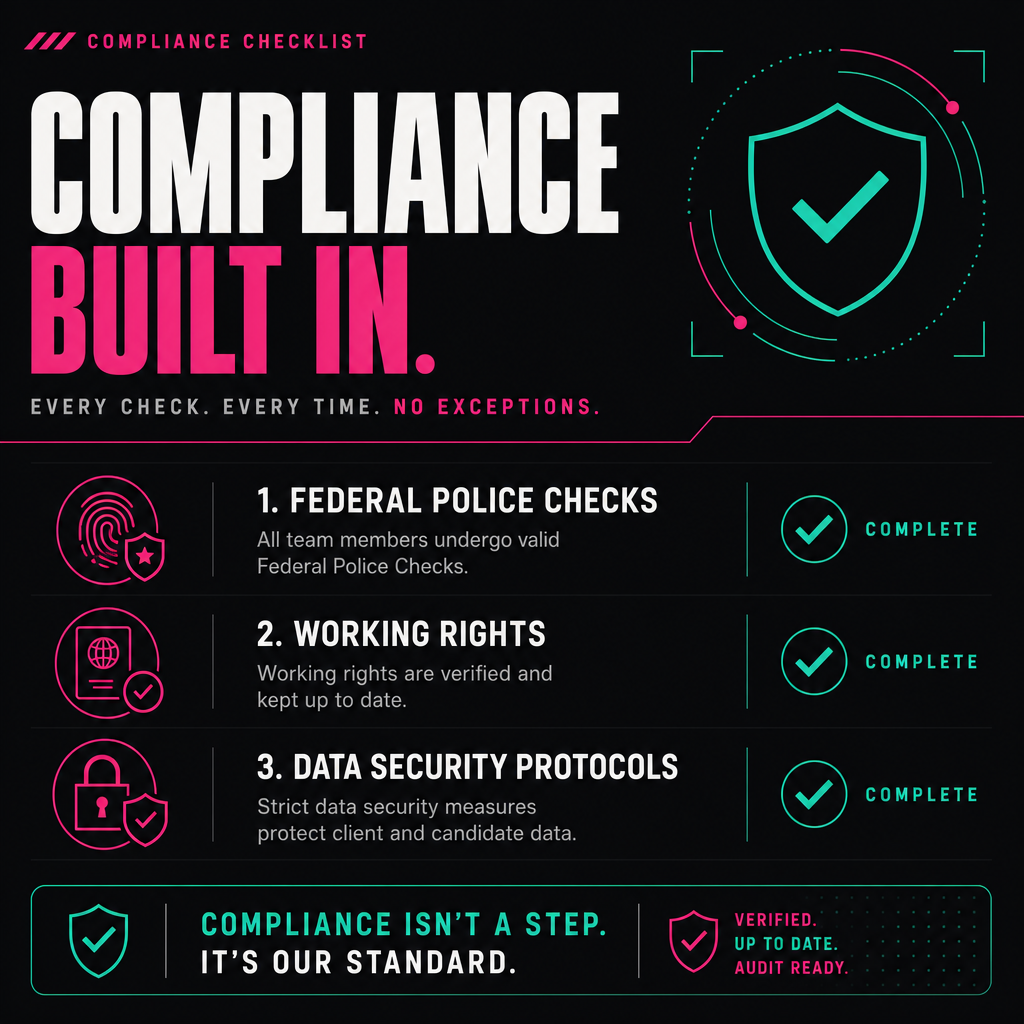
Compliance is non-negotiable. When you hire offshore staff, you must adhere to Australian data security standards and employment laws. At Remotee, we ensure strict compliance and training standards are met across the board. Learn more about our approach at compliance and training.
Data Security and Privacy
Your offshore staff will likely handle sensitive personal and financial information. We ensure all offshore staff operate under strict data security protocols. This includes secured internet connections, restricted access to sensitive client data, and adherence to the Australian Privacy Principles.
Background Checks
Depending on the industry, we facilitate relevant background checks. For example, if you are an NDIS provider hiring offshore admin staff, those staff must pass the equivalent of strict background screening to handle participant data safely. We verify identities, qualifications, and employment histories thoroughly.
Case Study: Hospitality Recruitment Agency Reduces Payroll Costs
A hospitality recruitment and labour hire company approached us after experiencing severe margin squeeze. They had multiple people in-house as well as external accountants managing their payroll at great expense. Furthermore, they were processing payroll weekly, which created massive administrative workloads every Friday.
Our expert team came in and completed a full discovery session. We presented a system that eliminated their reliance on internal admin staff and external accountants. We moved their payroll processing from weekly to fortnightly to halve the workload, and we picked up the entire payroll function. It was a plug and play solution, fully managed by our team.
The outcomes were measurable:
- Immediate reduction in operational expenditure (opex) staffing costs.
- Reduction in external accounting fees.
- Significant improvement in compliance. The internal team was previously unaware of multiple industry award requirements, which had exposed them to massive fines from the Fair Work Ombudsman.
By moving to a specialist offshore solution, they transformed a high-risk, high-cost function into a predictable, flat-rate operating cost.
Case Study: NDIS Provider Reduces Admin Overhead by $45k AUD
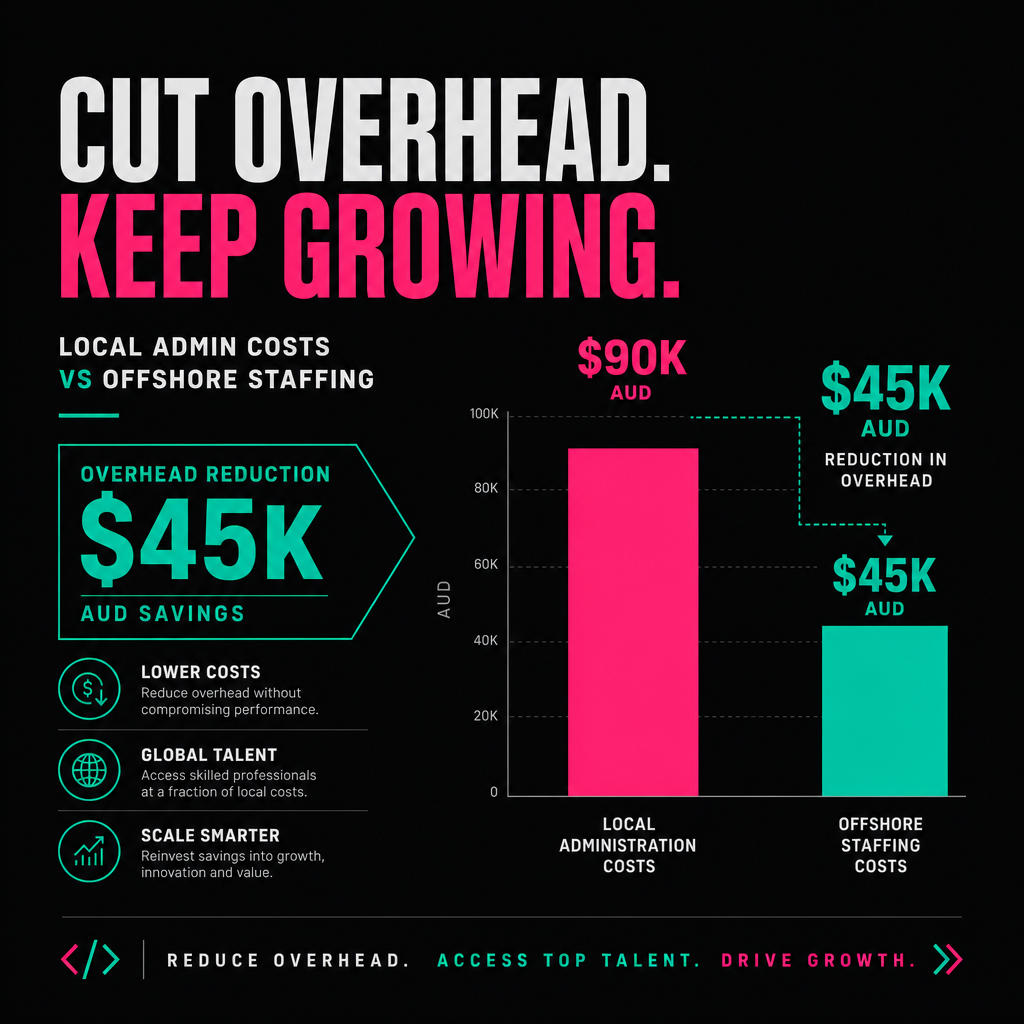
Consider an Australian National Disability Insurance Scheme (NDIS) provider. They were struggling with the sheer volume of paperwork required for service agreements, claims processing, and participant coordination. Their local admin team was overwhelmed, leading to delayed claims and cash flow bottlenecks.
We engaged with them to deploy an offshore staffing solution tailored to the healthcare sector. We did not just hire general admin staff. We sourced specialists in healthcare administration who understood the NDIA pricing arrangements.
By integrating these offshore staff into the NDIS provider's existing CRM, we streamlined their claims processing. The offshore team handled the data entry, document generation, and follow-ups. This allowed the local support coordinators to focus entirely on participant care.
The result was a direct reduction in admin overhead by $45,000 AUD annually. Furthermore, their claims processing time dropped from an average of 10 days to 48 hours, massively improving their cash flow. This is the power of combining quality talent with a strict delivery system.
The Accountee Payroll Process: A Framework for Predictable Delivery
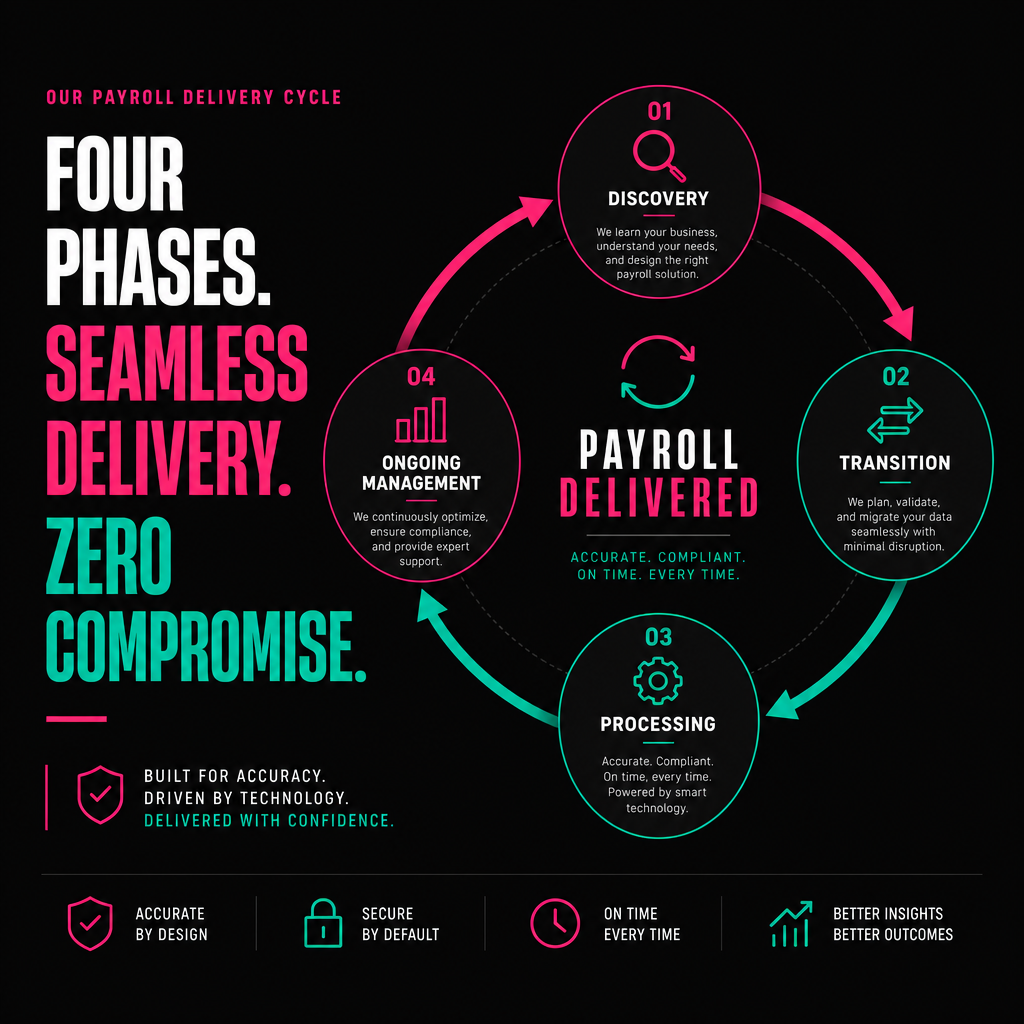
To illustrate how a systemised approach works in reality, let us break down our proprietary framework for payroll delivery. Most businesses think payroll should stay in-house because it is too sensitive. We disagree. Payroll is often safer when it is outsourced to specialists. Most payroll risk comes from internal overload, manual checks, rushed pay runs, and people wearing too many hats. A specialist team brings structure, controls, deadlines, and compliance focus to every cycle.
Our framework consists of four distinct phases:
Phase 1: Payroll Discovery and Setup
We review the client's current payroll process, pay cycles, staff types, award considerations, systems, approvals, and reporting requirements. This builds a clear, documented payroll operating model. We do not guess. We document everything.
Phase 2: Payroll Transition
We take over the payroll function from the client. This includes securing required access, templates, pay run calendars, employee data, timesheet flows, and approval checkpoints. Transition is mapped out meticulously to ensure zero disruption to your staff.
Phase 3: Full Payroll Processing
Our team processes payroll end-to-end. This includes timesheet review, pay calculations, leave, allowances, deductions, STP, superannuation, payroll reporting, and pay run preparation. Payroll done properly. Not squeezed in between tax returns. We handle STP, super, leave, PAYG, and reporting through people who live and breathe payroll.
Phase 4: Ongoing Payroll Management
We provide ongoing payroll delivery, issue resolution, compliance support, reporting, and account management. We ensure payroll runs accurately, on time, and with minimal internal admin. Your payroll should not depend on one busy admin person remembering everything. We systemise it.
Using this exact framework, we have achieved a 100 percent compliance record across 15 implementations in 2026. We have also driven a reduction in non-billable partner time across our recruitment agency clients of 6-10 hours per pay cycle. Payroll is too important to be mostly right. It must be perfect, every single cycle.
Why Premium Offshore Staffing Services Cost More (And Save More)
Business owners often look at the hourly rate of offshore staff and try to find the cheapest option. This is a false economy. Paying $6 an hour for someone who cannot follow a process, does not understand Australian compliance, and requires constant management will cost you more than hiring locally.
Premium offshore staffing services charge more per hour because they wrap the talent in management, quality assurance, and IT support. You are paying for predictability. We structure our pricing to align with your outcomes. When you engage Remotee, you are not just renting a desk in Manila. You are buying a guaranteed output.
Avoid payroll fines before they become expensive lessons. Avoid wasted hours training staff who leave after three months. Invest in a solution that actually moves the needle on your operational efficiency. If you want predictable delivery, not just headcount, reach out to us at Remotee contact.
Best Practices for Managing Offshore Staff
Once your offshore staff are integrated, you must maintain high standards of management. The system does not run itself forever. It requires ongoing optimisation.
Daily Standups and Clear KPIs
Communication is critical. We insist on brief daily standups. These are not hour-long meetings. They are 10-minute check-ins to confirm priorities, identify roadblocks, and ensure alignment. Every offshore staff member must have clear Key Performance Indicators (KPIs). If they are in a payroll function, their KPI is zero errors and 100 percent on-time processing. If they are in admin, their KPI is a specific turnaround time for claims processing.
Building a Culture of Accountability
Offshore staff want to feel part of your team, not just a peripheral contractor. Include them in your team messages. Acknowledge their wins. When they do well, tell them. When the system fails, analyse the process, do not just blame the person. We install systems that highlight exactly where a breakdown occurred, whether it was a data entry error or a flawed process design.
References
- Australian Bureau of Statistics (ABS). Business Indicators and Employment Data. Available at: https://www.abs.gov.au/
- Australian Taxation Office (ATO). Single Touch Payroll (STP) Reporting Guidelines. Available at: https://www.ato.gov.au/
- Fair Work Ombudsman. Payroll, Award Compliance, and Employee Entitlements. Available at: https://www.fairwork.gov.au/
- Office of the Australian Information Commissioner (OAIC). Australian Privacy Principles Guidelines. Available at: https://www.oaic.gov.au/
FREQUENTLY ASKED QUESTIONS
Common questions
What are the standard SLAs for offshore staffing services?
- Our standard Service Level Agreements (SLAs) focus on delivery times and quality benchmarks. For recruitment, our SLA is to present a shortlist of thoroughly vetted candidates within 14 days. For operational delivery, such as payroll, our SLA dictates that all pay runs are processed and submitted for approval 48 hours prior to the designated pay date, ensuring zero late payments.
How do termination clauses work with offshore staff?
- Termination clauses depend on the engagement model. If you hire directly through an Employer of Record (EOR) model, notice periods are dictated by local labour laws in the offshore country, typically 30 days. If you are terminating a managed service agreement with Remotee, we require 30 days notice to ensure a smooth handover of duties, protecting your business from sudden operational gaps.
Who handles the IT equipment and software licensing for offshore staff?
- Remotee handles all IT procurement and setup. Our offshore staff are provided with modern hardware, secured internet connections, and all necessary software licences to execute their roles. You do not need to ship equipment or manage complex IT provisioning. We provide a plug and play solution.
Can offshore staff manage highly sensitive Australian data legally?
- Yes. We implement strict data security protocols that align with Australian standards. Staff are bound by confidentiality agreements, and access is restricted based on role requirements. For highly sensitive sectors like NDIS or finance, we ensure additional background checks and security clearances are completed before staff touch any live data.
How quickly can an offshore staffing solution be live?
- For standard roles like administration, customer service, or basic accounting, we can have a vetted candidate onboarded and live within 14 days. For highly specialised roles that require deep knowledge of specific Australian regulations, the timeline may extend to 21 or 28 days to ensure comprehensive vetting and training is completed.
What happens if the offshore staff member resigns?
- Staff turnover happens in every business. The difference with our service is that the system remains intact. If an offshore staff member resigns, Remotee immediately initiates the transition process. Because we document every process and workflow, we can quickly cross-train another team member or recruit a replacement. We provide a buffer so your operations do not stop because one person leaves.

Jon Kelly
Founder, Remotee
Jon helps Australian businesses build compliance-led offshore teams that scale without the burnout. NDIS, accounting, mortgage broking, recruitment and digital marketing.
KEEP READING
Related posts
reduce labour costs offshore
Proven Strategies to Reduce Labour Costs with Offshore Staff in Australia
Australian business owners and CFOs are facing unrelenting margin pressure. Local wage growth is climbing, onshore overheads are inflexible, and the cost of doi…
11 July 2026 · 14 min read
hire offshore staff
How to Hire Dedicated Offshore Staff Quickly and Compliantly
Australian businesses face a persistent problem in 2026: finding skilled talent locally is expensive and slow. HR managers and business owners spend months adve…
6 July 2026 · 17 min read
offshore staff
Offshore Staff vs Local Staff in Australia: A True Cost and Productivity Comparison
The Bottom Line: Australian businesses that integrate offshore staff effectively reduce their labour costs by 70% while doubling operational capacity. Australia…
2 July 2026 · 18 min read
READY TO SCALE WITHOUT THE BURNOUT?
Build a compliance-led offshore team in 3–4 weeks.
Tell us about your current bottleneck and we'll show you what a Remotee placement would look like for your operation.
Or get our playbooks emailed to you instead.