
Ensuring Data Privacy and Compliance with Offshore Teams for Australian SMEs
- Data privacy
- Offshore teams
- Australian SMEs
- Privacy Act compliance
- Remote workforce security

Australian SMEs can protect data handled by offshore teams by mapping personal information, confirming which privacy laws apply, controlling access, documenting workflows, contracting for security obligations and preparing a breach response plan. Offshore hiring is not inherently unsafe. Risk grows when businesses give people broad access without clear ownership, monitoring or repeatable controls.
Data privacy is a legitimate concern when an offshore specialist can access payroll, customer records, financial systems or commercial documents. The answer is not to avoid offshore hiring. It is to design the role and its delivery system properly.
This guide explains how Australian privacy law applies, what APP 8 means in practice, and how SMEs can establish budget-conscious controls without building an enterprise security department.
Key takeaways
- The Privacy Act 1988 does not cover every small business, but exemptions have important exceptions.
- APP 8 may apply when personal information is disclosed to an overseas recipient.
- Keeping effective control over data can affect whether offshore access is treated as a use or disclosure.
- Secure offshore delivery requires documented workflows, least-privilege access, multifactor authentication and reliable offboarding.
- Contracts should address access, subcontracting, incidents, deletion, audit evidence and data return.
- Privacy compliance is an operating system, not a one-off policy or software purchase.
Offshore privacy compliance at a glance
The following checklist draws on the Privacy Act 1988, OAIC guidance and the Australian Cyber Security Centre's Essential Eight.
| Control area | SME action | Evidence to retain | Primary source |
|---|---|---|---|
| Legal coverage | Confirm whether the Privacy Act and any exemption apply | Written coverage assessment | OAIC small business guidance |
| Overseas access | Determine whether access is a use or overseas disclosure | Data-flow map and legal assessment | OAIC APP 8 guidance |
| Data security | Restrict access according to the role | Access register, logs and review records | Privacy Act 1988 |
| Authentication | Require multifactor authentication and managed credentials | System configuration records | ACSC Essential Eight |
| Incident response | Define escalation, containment and notification responsibilities | Tested response plan and incident log | OAIC Notifiable Data Breaches scheme |
| Exit management | Revoke access and confirm data return or deletion | Offboarding checklist and deletion confirmation | Privacy Act 1988 |
Privacy numbers worth knowing
- 13 Australian Privacy Principles: Schedule 1 of the Privacy Act 1988 contains the APPs governing covered entities.
- $3 million annual turnover: The Privacy Act generally exempts businesses at or below this threshold, subject to important exceptions, according to the OAIC.
- 30 days for breach assessment: The OAIC states that entities generally have 30 calendar days to assess a suspected eligible data breach under the Notifiable Data Breaches scheme.
Does the Privacy Act apply to every Australian SME?
The Privacy Act does not automatically cover every Australian SME. Businesses with annual turnover above $3 million are generally covered, while smaller businesses may qualify for an exemption. However, health services, credit reporting activities, personal-information trading and some contracted services can bring a smaller organisation within the Act.
Do not treat the turnover threshold as a complete privacy assessment. An SME should examine what it does, what data it handles and which contractual or sector obligations apply.
The employee records exemption also causes confusion. It can apply to a private-sector employer's handling of employee records directly related to an employment relationship. It does not mean every payroll provider, recruiter or offshore contractor can handle employee information without privacy obligations.
An offshore provider processing records on behalf of another business is not necessarily the employer. Tax file numbers, superannuation details, bank accounts and identity documents can also be governed by additional requirements.
Even where a legal exemption applies, customers and larger contracting partners may require APP-aligned controls. An exemption is not a security strategy. A data incident can still cause fraud, contractual liability, operational disruption and loss of trust.
A practical coverage review should answer:
- What entities make up the business group?
- What is each entity's annual turnover?
- Does the business provide a health service or handle health information?
- Does it trade in personal information?
- Does it handle tax file numbers, credit information or government-contracted data?
- What privacy obligations appear in customer, insurance and software contracts?
- Does it handle information about people in other jurisdictions?
Legal advice is appropriate where coverage is uncertain. This guide provides operational guidance, not legal advice.
What does APP 8 mean for an offshore team?

APP 8 requires a covered entity to take reasonable steps before disclosing personal information to an overseas recipient. The entity will often remain accountable if the recipient mishandles that information. However, tightly controlled access by a contractor acting only on the Australian entity's behalf may be treated as use rather than disclosure.
That distinction matters. Many articles assume any offshore login is automatically a cross-border disclosure. The OAIC's APP 8 guidance takes a more precise approach.
If the Australian business retains effective control over the information, an offshore contractor's activity may constitute use by the Australian business. Relevant controls can include:
- access only through the Australian business's systems
- no independent purpose for using the information
- contractual restrictions on copying and disclosure
- no authority to appoint subcontractors without approval
- monitored access and activity logging
- instructions covering retention, return and deletion
- practical enforcement of those instructions
A contract saying the business retains control is not enough if everyday operations contradict it. Allowing downloads to unmanaged devices, sharing passwords or permitting unrestricted local storage weakens the position.
If the arrangement is an overseas disclosure, the Australian entity generally needs to take reasonable steps to ensure the recipient does not breach the APPs in relation to the information. Contractual controls are central, but due diligence and monitoring also matter.
Australia does not have a single direct "GDPR equivalent". The Privacy Act and APPs provide Australia's main federal framework. The EU General Data Protection Regulation is a separate regime with its own territorial scope, processor requirements and international transfer rules. An Australian SME may need GDPR advice if it offers goods or services to people in the European Union or monitors their behaviour there.
What should an offshore data privacy checklist include?
A useful checklist follows the full information lifecycle, from collection and access to deletion. It should identify data owners, approved systems, permitted actions and evidence of control. A generic confidentiality clause does not provide this. The checklist must connect legal obligations to the offshore specialist's daily workflow.
Map the data before granting access
List each system the role will use and the information available within it. Classify the information according to sensitivity and business impact.
For example, a marketing assistant may need access to campaign analytics but not complete customer profiles. A payroll specialist may need payroll records but not unrestricted access to the entire accounting platform.
Record:
- the system owner
- categories of information
- why access is required
- approved access method
- whether downloads are permitted
- storage location
- retention requirement
- who approves access
- who reviews activity
This data-flow map is often more valuable than a long privacy policy. It exposes unnecessary access before the role goes live.
Conduct provider and worker due diligence
Ask the provider how it verifies identities, manages devices, handles departures and responds to incidents. Request evidence rather than accepting broad assurances that systems are "secure".
Useful evidence includes security policies, access-control procedures, training records, incident escalation processes and subcontractor lists. Formal certifications can support due diligence, but they do not replace role-specific controls.
Put operational requirements in the contract
The agreement should define:
- permitted purposes for accessing information
- approved countries and work locations
- confidentiality requirements
- minimum device and authentication controls
- restrictions on copying, printing and local storage
- subcontractor approval
- incident reporting timeframes and contacts
- cooperation with investigations and notifications
- audit rights or evidence obligations
- data return and secure deletion at exit
- consequences of non-compliance
The contract should match the actual workflow. A requirement that cannot be implemented or checked provides little protection.
Review access rather than setting and forgetting it
Access should be reviewed when responsibilities change, a project ends or a worker leaves. A scheduled review also catches permissions accumulated over time.
The person approving access should understand the role. IT can implement permissions, but the business owner must decide what the person genuinely needs.
How can SMEs secure offshore access without enterprise spending?
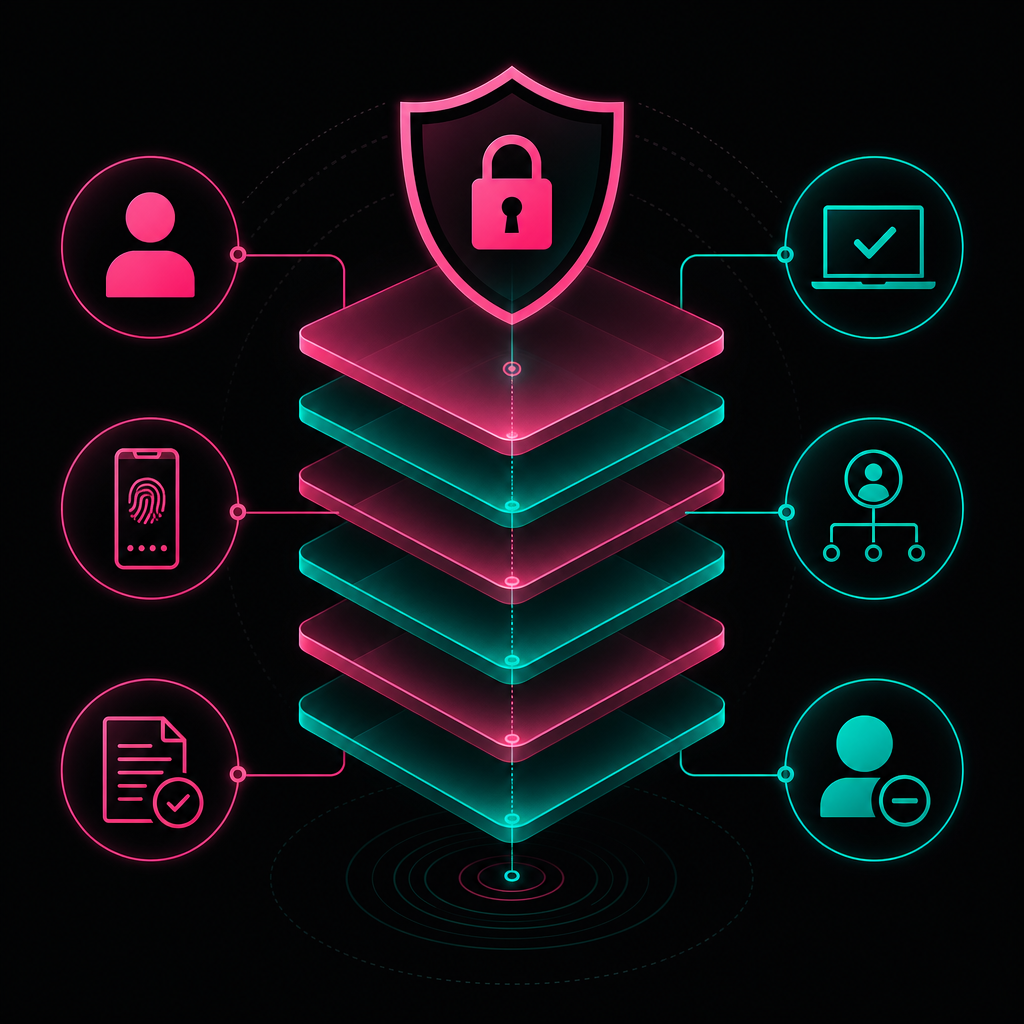
Australian SMEs can materially improve offshore security with existing platform controls and disciplined administration. Start with individual accounts, multifactor authentication, least-privilege permissions, managed password storage, approved devices and rapid offboarding. Expensive security software cannot compensate for shared logins, uncontrolled downloads or unclear responsibility for access decisions.
The ACSC Essential Eight provides a recognised baseline. Not every control can be implemented immediately, but SMEs should prioritise the risks created by the offshore role.
Use individual identities
Every person should have an individual account. Shared credentials remove accountability and complicate offboarding. Where a platform only offers one account, use a password manager with controlled sharing and investigate a better access model.
Require multifactor authentication
MFA should protect email, cloud storage, payroll, accounting, customer relationship management and administrative accounts. Avoid authentication processes that depend on one founder's mobile whenever a worker needs access.
Apply least privilege
Give the role the minimum access needed to complete documented tasks. Separate data entry, approval and payment authority where the system permits it.
For payroll, the person preparing a pay run does not automatically need sole authority to approve payments. For customer support, a worker may need to update a record without exporting the entire database.
Control devices and downloads
Decide whether work can occur through browser-based systems or a controlled virtual desktop. Block downloads where they are unnecessary. Require supported operating systems, screen locking, disk encryption and current security updates on approved devices.
A bring-your-own-device arrangement needs explicit rules. If the business cannot verify basic controls or remove company data, it should not place highly sensitive information on that device.
Centralise work and logs
Keep work in business-controlled systems rather than personal email, messaging accounts or local spreadsheets. Enable audit logs on critical platforms and retain them long enough to investigate unusual activity.
Monitoring should be proportionate and disclosed. The goal is accountable access, not intrusive surveillance.
Build a clean offboarding process
Offboarding should revoke accounts, active sessions, API keys, password-manager access and shared folders. It should also reassign documents and confirm that locally held information has been deleted where applicable.
Your data protection should not depend on one busy admin person remembering everything.
How should offshore staff be trained and managed?
Offshore privacy training should be specific to the role, systems and information involved. Annual awareness slides are not enough. Staff need written procedures for identity checks, data sharing, suspicious requests, incidents and escalation. Managers then need to test whether those procedures are understood and followed during real work.
Start with a role-based operating manual. It should show what the person may access, what they must never do and who owns each decision.
For a payroll role, training should cover:
- verifying changes to bank details
- handling tax file numbers and identity documents
- approved channels for employee queries
- escalation of unusual payroll instructions
- separation between preparation and approval
- secure handling of exported reports
- incident reporting
For customer support, training should cover identity verification, account recovery, payment information, record notes and inappropriate internal browsing.
Phishing simulations and short scenario discussions can reveal whether workers know what to do. Ask practical questions: What happens if a director requests an urgent data export from a new email address? What happens if a spreadsheet is sent to the wrong recipient? Who is called first?
The delivery system should also define ownership. A privacy responsibility matrix can allocate who approves access, reviews logs, updates procedures, manages incidents and signs off offboarding.
Remotee's operating view is direct:
"The difference between a capacity gap and a capacity crisis is usually a delivery structure problem, not a talent problem."
A capable offshore specialist placed inside an undocumented process still creates risk. Predictable delivery requires documented workflows, approval checkpoints and clear escalation paths.
What should an SME do after a suspected data breach?
An SME should immediately contain the incident, preserve evidence, assess affected information and escalate to its privacy decision-maker. If the Notifiable Data Breaches scheme applies, the business must assess whether the incident is likely to cause serious harm and whether remedial action can prevent that harm.
The OAIC's Notifiable Data Breaches guidance states that covered entities generally have 30 calendar days to complete an assessment. That is not a reason to delay containment.
A workable response plan should include:
- Report: Give offshore workers a simple, round-the-clock reporting channel.
- Contain: Disable compromised accounts, revoke sessions or restrict affected systems.
- Preserve: Retain logs, emails, device details and relevant communications.
- Assess: Identify the information, affected people, likely access and possible consequences.
- Remediate: Recover information, reset credentials or contact recipients where possible.
- Decide: Determine whether notification to the OAIC and affected individuals is required.
- Review: Correct the workflow, permission or training weakness that enabled the event.
Contracts should require the offshore provider to report suspected incidents quickly enough for the Australian business to meet its obligations. The provider should not wait until it has completed its own investigation.
Run a tabletop exercise before an incident. Use a realistic scenario, such as a payroll report sent to the wrong customer contact. Confirm who can access logs, who contacts legal advisers, who communicates with affected people and who has authority to shut down access.
Privacy risk usually starts in the workflow, not the country
The common assumption is that keeping sensitive work in Australia automatically makes it safer. That is too simplistic. An overloaded employee using spreadsheets, shared passwords and rushed manual checks can create more risk than a specialist offshore team operating within controlled systems, documented procedures and independent approval checkpoints.
Payroll makes this clear. It contains bank details, tax information, pay rates, leave balances and identity data. Yet many businesses leave the entire process with one busy administrator. That creates concentration risk, weak review and poor continuity.
In one anonymised recruitment-agency engagement, the founders wanted to focus on business development and operational execution rather than payroll and accounting. Hiring and managing more internal resources did not provide an acceptable commercial return.
The team completed discovery and implementation within 2 weeks. Payroll then moved into a documented system with defined access, timesheet flows, approvals and responsibilities. The founders' recurring involvement became approval of one email each fortnight, while the specialist team handled payroll, superannuation, tax, compliance and inbound queries.
A second anonymised hospitality recruitment and labour-hire business had multiple internal staff and external accountants involved in weekly payroll. The fragmented structure created cost and workload without clear ownership. Following discovery, payroll moved to a fortnightly system managed by a specialist team. This removed duplicated handling and identified industry award requirements that had not been properly addressed.
These are operational case studies, not proof that outsourcing removes privacy risk. They show why structure matters. Fewer uncontrolled handovers, defined approvals and specialist ownership can improve both privacy and compliance.
Across 15 Accountee recruitment-agency implementations in 2026, the author's own book-of-business data records a reduction of 6-10 hours in non-billable partner time per pay cycle. The result came from standardised inputs, ownership and approvals, not merely moving tasks offshore.
This is the contrarian position: sensitive work is not always safer in-house. It is safer where access, responsibilities and checks are designed properly. Payroll is too important to be "mostly right", and data privacy deserves the same discipline.
Build privacy into the offshore delivery system
A secure offshore arrangement starts before recruitment. Define the workflow, classify the data, decide which permissions are necessary and establish approval points. Then recruit the specialist into that operating model. Adding headcount first and trying to impose controls later is how scaling creates avoidable chaos.
Remotee focuses on predictable delivery, not just headcount. That means wrapping specialist roles sourced from the Philippines in documented processes, clear ownership, compliance controls and practical management routines.
If your business is considering offshore support for payroll, finance, recruitment or administration, contact Remotee to discuss a secure delivery model. The objective is not simply to fill a role. It is to create reliable capacity without losing control of sensitive information.
References
- Australian Government, Privacy Act 1988
- Office of the Australian Information Commissioner, Small business
- Office of the Australian Information Commissioner, Chapter 8: APP 8 Cross-border disclosure of personal information
- Office of the Australian Information Commissioner, Notifiable Data Breaches
- Australian Cyber Security Centre, Essential Eight
- European Union, General Data Protection Regulation
FREQUENTLY ASKED QUESTIONS
Common questions
Is it legal for an Australian SME to use an offshore team?
- Yes. Australian law does not generally prohibit SMEs from engaging offshore workers. The business must comply with applicable privacy, employment, tax, industry and contractual obligations. APP 8 may apply when personal information is disclosed overseas.
Does the Privacy Act apply to businesses under $3 million turnover?
- Businesses with annual turnover of $3 million or less are generally exempt, but exceptions apply to activities such as providing health services, credit reporting and trading in personal information. Contracts and specific data rules may also apply.
Is Australia's Privacy Act equivalent to GDPR?
- No. Australia's Privacy Act and Australian Privacy Principles are not a direct GDPR equivalent. GDPR has different territorial, processing and international transfer requirements. Australian SMEs handling EU personal data should assess whether GDPR applies.
Must offshore data be stored in Australia?
- The Privacy Act does not impose a blanket requirement that all personal information remain in Australia. Other laws, contracts or sector requirements may restrict location. Storage location does not replace access controls, monitoring and accountability.
What security controls should an offshore worker have?
- Use individual accounts, multifactor authentication, least-privilege permissions, approved devices, managed passwords and documented offboarding. Restrict downloads where practical and keep work inside business-controlled systems.
Who is responsible if an offshore provider causes a data breach?
- Responsibility depends on the law, contract and access model. Under APP 8, an Australian entity may remain accountable for an overseas recipient's handling of disclosed personal information. The Australian business should maintain its own incident assessment and response process.

Jon Kelly
Founder, Remotee
Jon helps Australian businesses build compliance-led offshore teams that scale without the burnout. NDIS, accounting, mortgage broking, recruitment and digital marketing.
KEEP READING
Related posts
offshore team training Australia
Training and Development for Offshore Teams: Empowering Global Talent
Effective offshore team training for Australian businesses combines structured onboarding, role-specific instruction, supervised practice, mentorship and docume…
24 August 2026 · 16 min read
offshore staffing for small business Australia
Offshore Staffing for Australian SMEs: How to Build Your First Remote Team
Offshore staffing for small business in Australia works when an SME assigns suitable roles to skilled overseas professionals, documents how work moves, protects…
4 August 2026 · 17 min read
part-time vs full-time offshore staff
Hiring Part-Time vs Full-Time Offshore Staff: Which is Best for Australian SMEs?
Part-time offshore staff are best for defined, repeatable workloads that do not require constant availability. Full-time staff suit ongoing operational roles wi…
22 July 2026 · 19 min read
READY TO SCALE WITHOUT THE BURNOUT?
Build a compliance-led offshore team in 3–4 weeks.
Tell us about your current bottleneck and we'll show you what a Remotee placement would look like for your operation.
Or get our playbooks emailed to you instead.