
Training and Development for Offshore Teams: Empowering Global Talent
- Offshore teams
- Remote staff training
- Professional development
- Australian business
- Philippines staffing

Effective offshore team training for Australian businesses combines structured onboarding, role-specific instruction, supervised practice, mentorship and documented career development. Training should connect directly to workflows, ownership and measurable work outcomes. The goal is not course completion. It is reliable performance, stronger judgement and a clear path for offshore employees to grow.
Investing in training matters because an offshore hire cannot succeed on talent alone. Even an experienced specialist will struggle if processes live inside someone's head, feedback is inconsistent or responsibility remains unclear.
This guide explains how to build remote staff professional development around real delivery. It covers onboarding, online courses, mentorship, compliance, measurement and career growth, with practical lessons from Remotee's work supporting Australian businesses.
Key takeaways
- Build training around documented workflows and role outcomes, not a catalogue of unrelated courses.
- Combine self-paced learning with live instruction, supervised practice and regular feedback.
- Treat security, privacy, workplace expectations and relevant Australian compliance as core training topics.
- Measure whether learning changes work quality, judgement and independence.
- Create visible career paths so offshore employees can expand their responsibility without leaving management gaps.
- Train managers as well as offshore staff. Poor delegation can undermine even a capable remote employee.
Summary table: Offshore team training framework
| Stage | Primary objective | Recommended method | Evidence of readiness |
|---|---|---|---|
| Role definition | Clarify ownership and expected outputs | Role scorecard and workflow mapping | Employee can explain responsibilities and escalation points |
| Foundation | Build business, system and compliance knowledge | Structured onboarding and guided demonstrations | Core knowledge checks and correct system access |
| Supervised practice | Apply learning in realistic work | Shadowing, sandbox tasks and reviewed production work | Work meets documented acceptance criteria |
| Independent delivery | Complete recurring work reliably | Checklists, quality assurance and coaching | Accurate delivery with appropriate escalation |
| Development | Expand judgement and responsibility | Mentorship, courses and stretch assignments | Stronger capability against the role scorecard |
| Career progression | Prepare people for specialist or leadership work | Development plan and succession preparation | Demonstrated readiness for broader ownership |
Start with a delivery system, not a course catalogue
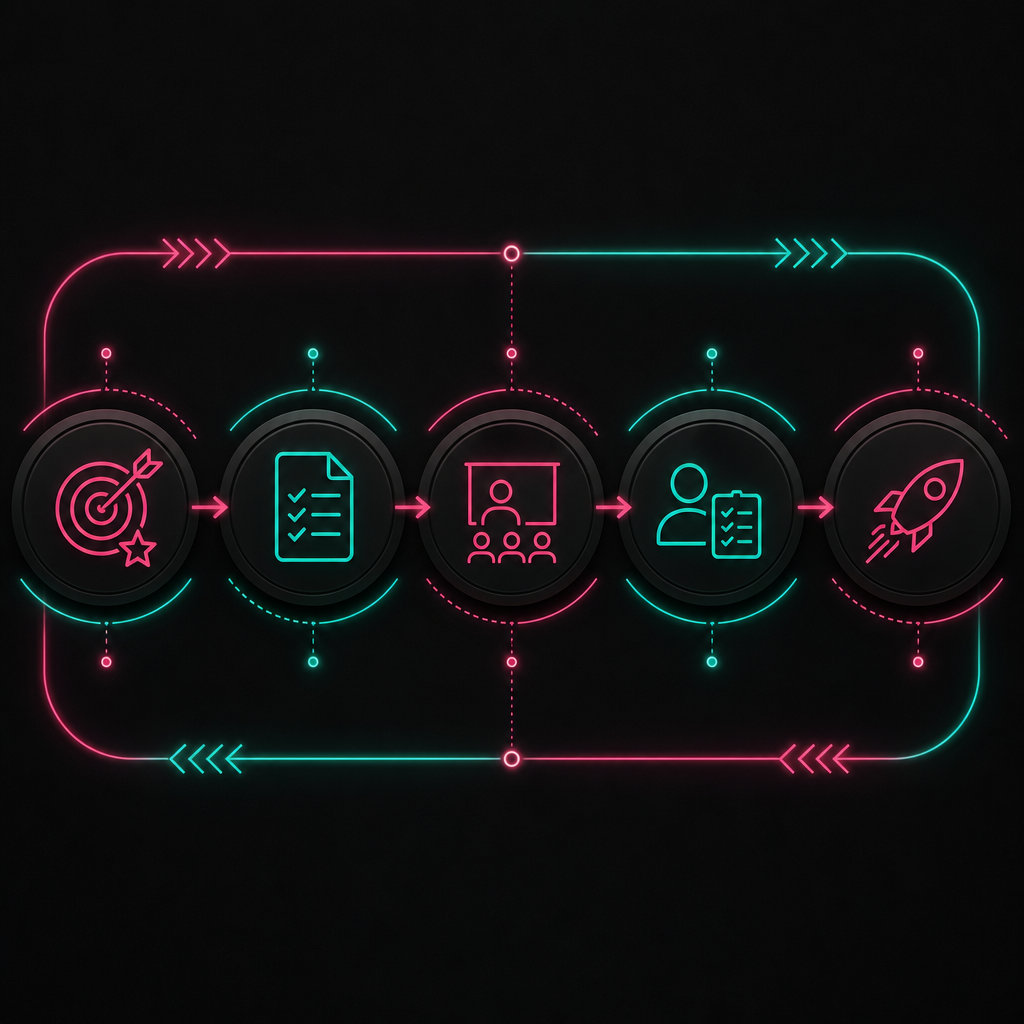
A strong offshore training programme starts by defining what reliable delivery looks like. Map each recurring workflow, assign ownership, document the required systems and identify where judgement or escalation is necessary. Courses should then close specific capability gaps. Buying generic training before completing this work usually creates activity without operational improvement.
Remotee's core position is straightforward: remote hiring only creates value when it is wrapped in a delivery system. Talent quality matters, but quality alone is not enough.
"The difference between a capacity gap and a capacity crisis is usually a delivery structure problem, not a talent problem."
Before selecting training, document five elements for each role:
- Outputs: What must the person produce, complete or maintain?
- Quality standards: What makes the output acceptable?
- Workflow: Which steps, systems and hand-offs are involved?
- Decision rights: What can the employee decide independently?
- Escalation rules: Which risks or exceptions require local input?
This converts a broad instruction such as "manage payroll support" into trainable work. The employee can learn how timesheets enter the system, which checks apply, who approves exceptions and when a matter must be escalated.
It also reveals whether the problem is actually a training gap. Sometimes the employee understands the task, but two managers provide conflicting priorities. In other cases, no one owns final approval. More training will not repair either problem.
Build remote onboarding around progressive responsibility
Remote onboarding should move an employee from observation to supervised practice and then independent ownership. Avoid sending a library of documents and expecting immediate competence. Sequence learning by risk and frequency, provide safe opportunities to practise, and require evidence of readiness before access or responsibility expands.
A practical onboarding sequence includes:
Business and role context
Explain how the Australian organisation makes money, who its customers are and how the offshore role contributes. This helps employees make better decisions when a procedure does not cover an unusual situation.
The role scorecard should define recurring outputs, service expectations, communication channels and ownership boundaries. It should also distinguish between a deadline, a target and a preferred working method.
Systems and security
Provide system access according to role requirements, not convenience. Training should cover password management, multi-factor authentication, suspicious messages, data handling and incident reporting. The Australian Cyber Security Centre's Essential Eight provides a recognised Australian baseline for mitigation planning, although each organisation still needs controls suited to its risk profile.
Workflow demonstrations
Record demonstrations of stable, recurring processes. Pair each recording with a written checklist, required inputs, expected outputs and common exceptions. Videos alone are difficult to scan during live work and become unreliable when software changes.
Supervised production work
Use low-risk work samples before assigning complete ownership. The reviewer should assess the work against documented criteria rather than silently correcting it. Silent correction keeps the employee dependent because they cannot see where their judgement differed.
Readiness approval
Access and responsibility should expand when capability is demonstrated. Calendar time alone is not proof of readiness. A manager should be able to identify what the employee has completed correctly, which risks remain and what still requires review.
Combine courses, mentorship and continuous development
The most effective remote staff professional development uses several methods because each solves a different problem. Online courses can build foundational knowledge. Mentorship develops judgement and context. Supervised work tests application. Continuous professional development plans keep learning connected to changing responsibilities rather than treating training as a one-off onboarding event.
Online courses
Use external courses when the skill is transferable and the provider has suitable expertise. Examples include software certification, technical accounting knowledge, communication, project management and cybersecurity awareness.
For nationally recognised Australian training, check whether delivery needs to come from a registered training organisation. The Australian Skills Quality Authority explains the responsibilities applying to registered training organisations.
A course should have a clear operational purpose. Before approval, record:
- the capability gap being addressed
- why the course is suitable
- how learning will be applied
- who will review the resulting work
- what evidence would demonstrate improvement
Completion certificates prove participation. They do not prove that work changed.
Mentorship
Mentorship is most useful where the role requires judgement. A senior specialist can explain why an exception matters, how Australian customer expectations affect communication and when a technically valid answer may still create operational risk.
Mentoring sessions need structure. Review recent work, discuss one decision, identify the principle behind it and agree on the next application. Unstructured catch-ups can become status meetings without development.
Peer learning
Short technical sessions allow team members to explain recent problems, process changes and useful shortcuts. Rotate presenters so knowledge does not remain concentrated in one person.
Peer sessions should feed back into documentation. If a discussion identifies a better method, update the source workflow. Otherwise, the improvement disappears into meeting notes.
Individual development plans
A useful development plan connects the employee's goals with future business needs. It should identify current capability, the next level of responsibility, required learning and evidence of readiness.
Review the plan regularly, especially when software, customers or responsibilities change. Do not promise promotion based only on course completion. Progression should follow demonstrated capability and an available role.
Treat compliance and privacy as operational skills
Compliance training for offshore employees should be role-specific, practical and repeated when work changes. Australian businesses remain responsible for how their information and obligations are managed. Employees need to understand applicable privacy controls, workplace requirements, security procedures and the limits of their authority, not simply acknowledge a policy document.
Australian Privacy Principles govern how many Australian organisations handle personal information. The Office of the Australian Information Commissioner publishes the Australian Privacy Principles and related guidance.
Where employees in the Philippines process personal information, training should also reflect local requirements. The Philippines National Privacy Commission publishes the Data Privacy Act of 2012.
Practical privacy training should answer questions such as:
- Which records may be downloaded or stored locally?
- Which communication channels are approved?
- How should an employee confirm a requester's identity?
- What must happen after an accidental disclosure?
- Who can approve access to sensitive records?
- When must information be deleted or retained?
Australian employment obligations also matter when offshore staff support payroll, rostering or human resources. Fair Work guidance on payment for hours worked is an example of the source material that should inform Australian payroll procedures.
This is why payroll training cannot be reduced to software navigation. Employees need to understand pay cycles, awards, allowances, leave, superannuation, Single Touch Payroll, PAYG and escalation rules relevant to their work.
Payroll is too important to be "mostly right". We process payroll like it matters, because to staff, it does.
Measure whether learning changes delivery

Training impact should be measured through work, not attendance alone. Start with a baseline, define the expected behaviour and review operational evidence after learning is applied. Useful measures include quality against documented criteria, appropriate escalation, rework themes, process adherence and the employee's ability to complete broader responsibilities independently.
The Kirkpatrick Model separates reaction, learning, behaviour and results. It is useful because it stops managers treating a positive course survey as proof of business impact.
Apply those levels as follows:
Reaction
Was the material relevant, accessible and suitable for remote delivery? Feedback can reveal poor pacing or examples that do not match the employee's role. It cannot establish competence.
Learning
Can the employee explain the concept or demonstrate the procedure? Use scenario questions, system exercises or work samples instead of relying only on multiple-choice quizzes.
Behaviour
Has the employee applied the learning during real work? Review recent outputs, decisions and escalations. Managers should look for sustained behaviour, not one strong task immediately after training.
Results
Did the work become more reliable or create additional capacity? Compare outcomes with the original training objective. If results did not change, investigate the wider system before blaming the employee.
A simple development dashboard can include the targeted capability, baseline evidence, learning activity, application task, reviewer and current readiness. Avoid reducing development to one overall score. A person may be highly capable in recurring work but still need support with rare exceptions.
What Remotee's implementation evidence shows
Remotee's implementation experience indicates that training produces stronger results when it sits inside a documented operating model. In our payroll work, role learning is tied to payrun calendars, templates, approval checkpoints and escalation paths. This structure gives specialists a reliable way to apply their expertise while reducing internal management dependence.
Hero stats bar
| Evidence | Result | Source |
|---|---|---|
| Reduction in non-billable partner time | 6-10 hours per pay cycle | Remotee's data across 15 recruitment agency implementations in 2026 |
| Recruitment agency implementations reviewed | 15 | Remotee's 2026 book of business |
| Discovery and implementation for the recruitment agency case below | Completed within 2 weeks | Remotee client implementation record |
These figures should not be treated as universal benchmarks. They describe Remotee's own implementation experience. The result for another organisation will depend on process complexity, records, systems, management availability and the quality of existing controls.
Case study: Recruitment agency payroll ownership
The founders of an Australian recruitment agency wanted to focus on new business and operational execution rather than payroll and accounting. Hiring and managing the work in-house did not offer acceptable commercial or operational value.
We installed a payroll system and team customised around the agency's software. Discovery and implementation were completed within 2 weeks. The operating model defined timesheet flows, approval responsibilities, inbound query handling and recurring payroll tasks.
The founders' ongoing involvement became approval of one email each fortnight. The team handles payroll, superannuation, compliance, tax, timesheet questions and inbound queries.
The important training lesson is not that a course solved the problem. The specialists were trained inside a complete delivery structure with systems, ownership and approval checkpoints.
Case study: Hospitality labour hire payroll
A hospitality recruitment and labour hire business had internal employees and external accountants involved in payroll. Weekly processing created a heavy recurring workload, while fragmented ownership increased complexity.
Our specialist team completed discovery and designed a consolidated system. Payroll moved to a fortnightly cycle, and the team assumed the end-to-end function. The change reduced operating staffing costs and payroll costs. It also identified industry award requirements that had not previously been addressed.
Again, capability came from combining specialist knowledge with a repeatable process. Specialist payroll accountants, not generalist bookkeepers. Payroll done properly, not squeezed in between tax returns.
Training fails when the manager keeps ownership unclear

Most offshore training advice focuses on what the employee needs to learn. That is incomplete. The larger constraint is often the Australian manager's failure to define ownership, delegate decisions or provide consistent feedback. Upskilling offshore employees cannot create autonomy while every decision remains trapped with a founder or local manager.
This is the point many providers miss. Adding headcount without adding a system is how scaling creates chaos.
A manager may say an employee lacks initiative while requiring approval for every minor decision. Another may complain about repeated questions while keeping exceptions undocumented. These are delivery design failures, not automatically talent failures.
Train managers to:
- delegate outcomes rather than isolated tasks
- define which decisions belong to the offshore role
- provide examples of acceptable work
- explain the reason behind corrections
- distinguish coaching from task takeover
- update documentation after a process change
- hold consistent development conversations
The target is predictable delivery, not just headcount. As capability grows, approval points should be reviewed. Controls should remain where risk requires them, but unnecessary dependencies should be removed.
A useful test is to ask what would happen if the local manager were unavailable. If routine work stops because instructions only exist in that person's memory, the business has not built offshore capability. It has created remote dependency.
Build career growth without creating empty titles
Career progression for offshore employees should be based on expanding capability, judgement and ownership. Create pathways into specialist, quality assurance, training or team leadership work, but define the actual responsibilities attached to each level. Titles without authority, development or changed work do little to support long-term engagement.
A practical capability pathway might move through these stages:
- Practitioner: Completes defined recurring work using documented procedures.
- Senior practitioner: Handles exceptions, reviews work and improves documentation.
- Specialist: Owns a technical domain and supports complex decisions.
- Quality lead: Maintains standards, conducts reviews and analyses recurring issues.
- Team leader: Coordinates delivery, coaching, workload and escalations.
Not every strong specialist should become a people manager. Parallel specialist and leadership paths allow employees to progress without forcing them into work that does not suit their strengths.
Career conversations should cover the employee's interests, current evidence, capability gaps and realistic opportunities. Be clear where business demand limits promotion timing. Honest expectations are more credible than vague promises.
Retention is influenced by more than training. Pay, management quality, workload, recognition, working conditions and career opportunity all matter. A development programme cannot compensate for poor employment practices. It can, however, show employees that the organisation has a considered future for their role.
Invest in your offshore team's future
Australian businesses should treat offshore team development as an operating discipline, not an optional benefit. Define the work, train for real decisions, measure application and create credible progression. When specialist talent is supported by clear systems, managers can step back from recurring execution and focus on strategy, customers and growth.
Remotee helps Australian businesses source specialist talent from the Philippines and install the workflows, ownership and compliance controls needed for dependable delivery. The objective is not simply to place a person. It is to build a role that works inside the business.
Contact Remotee to discuss an offshore hiring and development system built around your operations.
References
- Australian Cyber Security Centre, Essential Eight
- Office of the Australian Information Commissioner, Australian Privacy Principles
- Fair Work Ombudsman, Payment for hours worked
- Australian Skills Quality Authority, Registered training organisations
- Philippines National Privacy Commission, Data Privacy Act of 2012
- Kirkpatrick Partners, The Kirkpatrick Model
FREQUENTLY ASKED QUESTIONS
Common questions
How do you train an offshore team effectively?
- Start with a role scorecard and documented workflows. Combine demonstrations, written procedures, supervised practice and feedback. Expand responsibility after the employee demonstrates readiness. Use external courses for defined capability gaps, then require an application task so the manager can verify that learning has changed real work.
What should an offshore employee onboarding programme include?
- Include business context, role outcomes, systems, communication standards, security, privacy, workflows, decision rights and escalation procedures. Employees should practise realistic tasks before taking full ownership. The programme should also identify who reviews work, how feedback is delivered and what evidence confirms readiness.
How often should remote staff receive training?
- Training should continue throughout employment rather than follow a fixed annual event. Provide learning when responsibilities, systems, regulations or customer requirements change. Use regular development reviews to identify gaps, but avoid scheduling courses without a clear operational purpose or a plan for applying the material.
How can an Australian business measure offshore training outcomes?
- Measure demonstrated knowledge, behaviour during real work and operational results. Review work quality, process adherence, escalation decisions and readiness for broader responsibility. Compare evidence with a documented baseline. Course completion and satisfaction surveys can support evaluation, but neither proves that delivery improved.
Should offshore employees have individual development plans?
- Yes. A development plan connects career interests with the capabilities the business will need. It should define the next responsibility level, required learning, practical application and evidence of readiness. Review it when the role changes and avoid promising promotion based only on completing training.
Who should pay for offshore employee training?
- The answer depends on the employment arrangement, contractual terms and whether training is required for the role. Australian businesses should obtain advice relevant to their structure. As an operating principle, employers should budget for required role training rather than expecting employees to fund essential business-specific capability.

Jon Kelly
Founder, Remotee
Jon helps Australian businesses build compliance-led offshore teams that scale without the burnout. NDIS, accounting, mortgage broking, recruitment and digital marketing.
KEEP READING
Related posts
offshore project management staff Australia
Offshore Project Management Staffing for Australian Businesses
Offshore project management staffing gives Australian businesses access to dedicated project coordinators, PMO analysts and project managers without building ev…
23 August 2026 · 19 min read
offshore sales staff Australia
Offshore Sales Staffing: Expanding Your Australian Sales Team Globally
Offshore sales staff help Australian businesses expand prospecting, qualification, account support and sales administration without overloading local teams. Suc…
17 August 2026 · 17 min read
offshore staffing company comparison criteria
Offshore Staffing Company Comparison Criteria: How Australian Businesses Should Evaluate Providers
Direct Answer: The criteria that actually predict offshore staffing outcomes are the employment and compliance model, documented delivery workflows, supervision…
11 September 2026 · 16 min read
READY TO SCALE WITHOUT THE BURNOUT?
Build a compliance-led offshore team in 3–4 weeks.
Tell us about your current bottleneck and we'll show you what a Remotee placement would look like for your operation.
Or get our playbooks emailed to you instead.