
The Future of Work: How Offshore Staffing is Reshaping Australian Business
- Offshore staffing
- Future of work
- Remote work Australia
- Hybrid workforce
- Business resilience
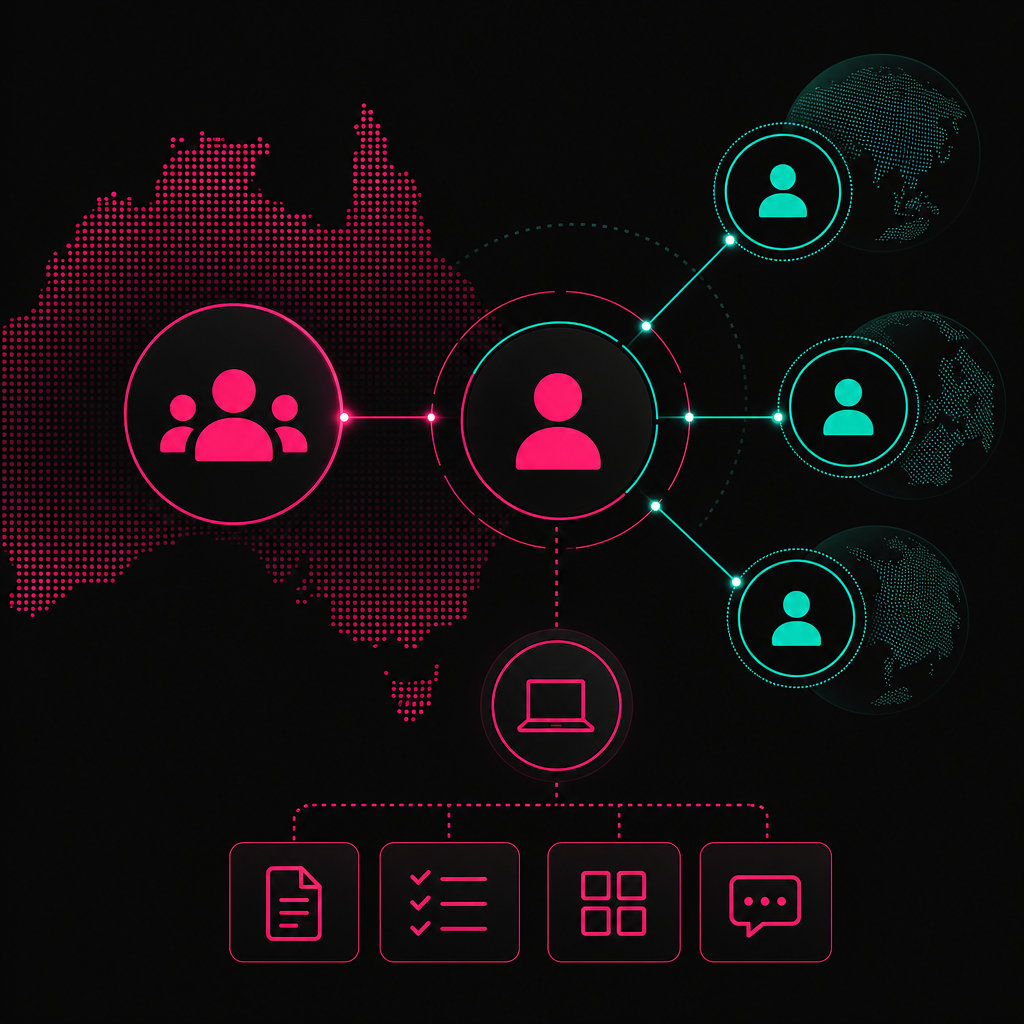
The future of work in Australia will combine local leadership, hybrid workplaces and offshore specialists within one operating model. Offshore staffing can improve capacity, resilience and access to skills, but only when businesses establish documented workflows, clear ownership, secure systems and measurable service standards around every remote role.
Introduction
Australian businesses are no longer choosing simply between office-based employees and outsourcing. They are designing blended workforces in which local teams, remote employees, contractors and offshore specialists contribute to the same workflow. That change creates flexibility, but it also exposes weak processes quickly.
The real issue is not whether work can happen offshore. Most digital and administrative work already crosses locations through cloud platforms. The issue is whether leaders can create predictable delivery across those locations. This guide explains the trends, risks, operating systems and workforce decisions that matter in 2026.
Key takeaways
Offshore staffing is becoming part of mainstream workforce design rather than a separate cost-cutting exercise. Australian businesses that benefit most treat it as an operating model decision. They define the work, assign accountability and build controls before adding people, instead of expecting new hires to repair unclear internal processes.
- Hybrid work has normalised distributed communication, cloud systems and outcome-based management.
- Offshore specialists can add capacity and capability, but cheap headcount is not a sound strategy.
- Documented workflows, approval points and role ownership determine whether remote delivery remains reliable.
- Privacy, cyber security, awards, payroll and tax obligations cannot be delegated without governance.
- Australian businesses should protect local pathways into judgement-heavy roles while allocating repeatable work intelligently.
- The strongest workforce model is designed around business outcomes, not worker location.
Summary table: Key trends and business implications
The main remote work trends in Australia point towards a more distributed workforce, stronger digital controls and closer integration between local and offshore teams. Each trend creates an opportunity, but each also introduces a management requirement. Businesses need to address both sides before changing their workforce structure.
| Trend | Implication for Australian businesses | Required response |
|---|---|---|
| Hybrid work remains established | Employees expect location flexibility where work permits it | Manage outcomes, access and communication consistently |
| Global talent pools are more accessible | Businesses can recruit for skills beyond their local market | Assess capability, communication and role fit, not location alone |
| Cloud-based operations are standard | Work can move between offices, homes and offshore teams | Control permissions, documentation and business continuity |
| Specialist offshore delivery is growing | Repeatable and technical functions can be distributed | Wrap each role in a defined delivery system |
| Automation is changing task design | Routine steps can be automated while exceptions require judgement | Redesign roles around decisions, oversight and customer value |
| Compliance is becoming more complex | Distributed work can create privacy, payroll and employment risks | Retain Australian governance and obtain appropriate advice |
The evidence behind Australia's distributed workforce

Remote work is no longer a temporary workplace response. It is an established feature of Australian employment, particularly in professional and managerial roles. That matters for offshore staffing because local organisations now possess much of the technology and management experience needed to coordinate people across different locations and time zones.
Hero stats bar
The following figures combine recognised Australian labour data with Remotee's own 2026 implementation records. They show both the scale of remote work and the operational effect that structured specialist delivery can have inside recruitment businesses.
| Indicator | Figure | Source |
|---|---|---|
| Employed Australians who usually worked from home in August 2024 | 36% | Australian Bureau of Statistics, Working arrangements |
| Managers and professionals who usually worked from home in August 2024 | 60% | Australian Bureau of Statistics, Working arrangements |
| Reduction in non-billable partner time per pay cycle | 6-10 hours | Remotee and Accountee implementation records across 15 recruitment agency implementations in 2026 |
| Recruitment agency implementations measured | 15 | Remotee and Accountee implementation records, 2026 |
The Productivity Commission's research into working from home also found that remote work can benefit employees and employers when arrangements suit the work and are managed properly. The operative phrase is "managed properly". Location flexibility does not remove the need for supervision, information flow or performance standards.
Australian organisations have already invested in video meetings, cloud accounting, shared workspaces, digital approvals and remote access. Offshore staffing uses the same infrastructure across a wider labour market. The technological jump is often smaller than leaders expect. The management jump can be much larger.
How hybrid work models and offshore staffing fit together
Hybrid work models offshore and local work effectively when teams share one operating rhythm. Offshore specialists should not become a disconnected back office receiving vague requests through email. They need the same task definitions, escalation paths, system access rules and performance expectations applied to any other critical delivery function.
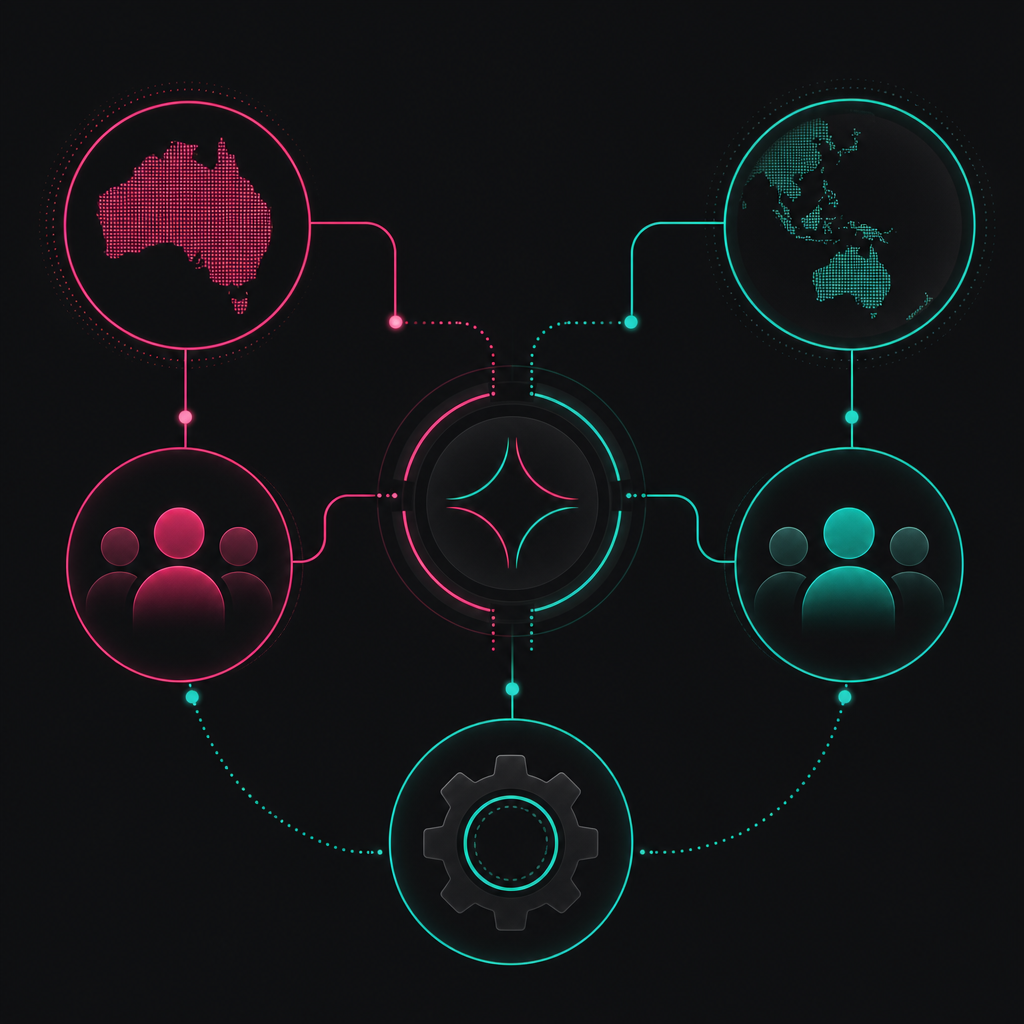
A practical blended model usually separates work according to its operational characteristics:
- Local leaders retain strategy, commercial accountability and sensitive stakeholder decisions.
- Local and offshore specialists collaborate on technical delivery.
- Repeatable processing follows documented workflows and approval checkpoints.
- Exceptions move to the person with the authority and context to resolve them.
- Automation handles suitable mechanical steps without removing human oversight.
This is not a hierarchy of valuable and low-value people. It is a division of responsibility based on context, risk and workflow. An offshore payroll specialist may possess deeper payroll expertise than a local generalist. A local director may still retain final approval because that person owns cash flow and employment decisions.
Time zones also need deliberate design. The Philippines and Australia have overlapping business hours, although the exact overlap varies by Australian state and daylight saving arrangements. That supports live collaboration. Businesses should still document which issues require immediate escalation and which can wait for the next scheduled checkpoint.
The goal is not constant availability. It is reliable handover. A well-designed hybrid team knows where work sits, who owns the next action and when an exception becomes urgent.
Why Australian businesses are building offshore capacity
Australian companies use offshore staffing to access specialist skills, increase delivery capacity and reduce dependence on constrained local recruitment. Cost matters, but treating wage differences as the entire business case creates fragile teams. Sustainable value comes from matching suitable work with capable people and a controlled delivery process.
Access to specialist capability
A business may struggle to justify or recruit every specialist role locally. Offshore talent pools can widen the search for payroll processors, accountants, digital specialists, administrative professionals and customer support staff. The selection standard should remain high. Businesses need evidence of technical competence, communication ability and experience with relevant systems.
Greater operational agility
Demand rarely rises in a smooth line. A distributed workforce can help a business add capacity without expanding its physical office footprint. However, fast hiring only helps when new people can enter a documented system. If training depends on verbal instructions from one busy manager, every additional hire increases interruption and inconsistency.
Better use of local leadership time
Founders and senior professionals often spend too much time approving routine work, answering avoidable questions or repairing incomplete processes. Offshore staffing can release that time, but only if decision rights are clear.
Remotee's own 2026 implementation records across 15 recruitment agency implementations show reductions of 6-10 hours in non-billable partner time per pay cycle. That outcome did not come from handing an inbox to a cheaper worker. It came from installing payroll workflows, calendars, approvals and specialist ownership.
Business resilience through role redundancy
Business resilience from offshore staffing does not mean moving every function to another country. It means reducing dependence on one person, one office or undocumented knowledge. A distributed team can support continuity when access, responsibilities and procedures are recorded. Poorly governed offshore staffing can create the opposite result by adding another single point of failure.
The delivery system matters more than the employment location
The difference between a capacity gap and a capacity crisis is usually a delivery structure problem, not a talent problem. Adding headcount without clarifying the workflow gives a business more people asking the same unresolved questions. Reliable offshore staffing begins by designing the delivery system before recruiting into it.

At Remotee, our position is direct: talent quality matters, but quality alone is not enough. We compete on reliability because predictable delivery is more valuable than a stack of CVs.
A delivery system should define:
- The outcome owned by the role.
- The systems and information required.
- The recurring tasks and deadlines.
- The standard for completed work.
- The approval and quality-control points.
- The exceptions that require escalation.
- The reporting used to identify delays or errors.
- The backup process for leave, outages and staff changes.
Consider a remote accounts specialist told to "manage payroll". That instruction hides dozens of decisions. Who validates timesheets? Which award applies? Who approves allowances? What happens when leave balances look wrong? When is Single Touch Payroll reporting completed? Who releases the payment file?
Without answers, the role depends on memory and constant clarification. With answers, a specialist can deliver consistently while local leaders retain control.
This is especially important in payroll. Payroll is not merely an administrative function. It is a business-critical trust function. When payroll is wrong, staff confidence can fall quickly. Accurate delivery protects cash flow, compliance, culture and the employer brand.
Two Australian payroll case studies
These implementations show why process design matters more than simply placing an offshore worker. In each case, the work involved sensitive payroll information and recurring statutory obligations. The outcome depended on specialist delivery, documented approvals and clear boundaries between the client and the external payroll team.
Case study 1: Recruitment agency founders recover strategic time
A recruitment agency's founders wanted to focus on business development and operational execution rather than payroll and accounting. They did not consider building and managing another in-house team commercially efficient.
We completed discovery, designed a payroll system around the agency's existing software and implemented the operating process. The full discovery and implementation took two weeks, according to Remotee's project records.
The ongoing client requirement became approval of one email each fortnight. The specialist team manages payroll processing, superannuation, tax obligations, inbound payroll questions and timesheet queries. The founders retain approval without becoming the workflow.
The lesson is not that every business should outsource payroll. It is that a controlled approval point can preserve executive oversight without requiring executives to perform routine processing.
Case study 2: Labour hire payroll moves from fragmented to controlled
A hospitality recruitment and labour hire business had several internal people and external accountants involved in payroll. Weekly processing created a heavy recurring workload, while fragmented responsibility increased cost and made accountability unclear.
Our specialist team completed discovery and designed a consolidated system. Payroll processing moved to a fortnightly cycle, and the external team assumed responsibility for the operating workflow. The review also identified industry award requirements that had not been properly addressed.
The business reduced duplicated internal and external effort, lowered operating and payroll processing costs, and improved its compliance process. No percentage or dollar saving is stated because the supplied project record does not quantify those figures.
This case challenges a common assumption that payroll is always safer in-house. Most payroll risk comes from overloaded internal staff, manual checks, rushed pay runs and unclear ownership. A specialist team can create stronger controls when governance is properly designed.
"Predictable delivery, not just headcount." This is Remotee's operating position, not a substituted or fabricated client testimonial.
Compliance, privacy and security cannot be outsourced away
An offshore provider can perform work, but the Australian business still needs to govern the outcome. Privacy obligations, employment rules, payroll reporting, system security and contractual responsibilities must be assessed before access is granted. Outsourcing a task does not automatically outsource accountability for how information and decisions are handled.
The Office of the Australian Information Commissioner explains overseas disclosure obligations under Australian Privacy Principle 8. Businesses handling personal information should determine whether offshore access constitutes a disclosure, conduct due diligence and establish appropriate contractual and technical controls.
Practical controls include:
- Granting access according to role rather than convenience.
- Requiring multi-factor authentication where supported.
- Restricting downloads and local storage of sensitive data.
- Recording who can create, change, approve and release transactions.
- Reviewing access when responsibilities change.
- Maintaining secure offboarding procedures.
- Testing backups and continuity arrangements.
- Establishing a documented privacy and incident response process.
For payroll, Australian governance should also cover applicable modern awards, leave, allowances, deductions, Single Touch Payroll, PAYG withholding and superannuation. The Fair Work Ombudsman maintains information about modern awards, while the Australian Taxation Office publishes the requirements for Single Touch Payroll.
The principle is simple: compliance-first payroll, every pay run. Your payroll should not depend on one busy administrator remembering everything. It should operate through visible controls and specialist accountability.
The Accountee Payroll Process as a workforce model
The Accountee Payroll Process demonstrates how a remote specialist function should be installed. It does not begin with recruitment. It begins with discovery, operating design and risk identification. The people, systems and approval points are then connected through a staged transition into ongoing delivery.
Phase 1: Payroll Discovery and Setup
The team reviews pay cycles, staff types, awards, systems, approvals, reporting requirements and the current payroll process. This creates a clear operating model before responsibility changes hands.
Phase 2: Payroll Transition
Access, employee data, templates, pay-run calendars, timesheet flows and approval checkpoints are transferred methodically. Transition should prove that information can move securely and that each participant understands their responsibility.
Phase 3: Full Payroll Processing
Specialist payroll accountants manage timesheet review, calculations, leave, allowances, deductions, Single Touch Payroll, superannuation, payroll reporting and pay-run preparation. Specialist payroll accountants, not generalist bookkeepers.
Phase 4: Ongoing Payroll Management
The process continues through issue resolution, compliance support, reporting and account management. Recurring delivery is monitored rather than assumed.
The same sequence applies beyond payroll. Discover the work, design the workflow, transition responsibility and manage performance. Offshore hiring fails when businesses skip the first two stages and expect a new team member to reverse-engineer the company through scattered messages.
What Australian leaders should do before hiring offshore
Leaders should prepare the role, process and controls before opening recruitment. A useful offshore workforce plan identifies the business outcome, separates routine work from judgement-heavy decisions and establishes how quality will be checked. Recruitment should follow operating design rather than act as a substitute for it.
Start with these questions:
- What business outcome should improve?
- Which tasks create that outcome?
- Which tasks require Australian market context or physical presence?
- Which tasks can be performed securely from another location?
- Who owns final approval and exception handling?
- What information will the role access?
- How will work quality, timeliness and capacity be measured?
- What happens if the assigned person is unavailable?
Do not build the business case solely around salary comparison. Include management time, recruitment effort, software, security, provider fees, training, rework and compliance oversight. The cheapest quoted role can become expensive when local staff spend their week correcting work or supplying missing instructions.
A pilot can be useful when it tests a complete workflow rather than assigning miscellaneous tasks. Choose a bounded process with a clear input, output, owner and service expectation. Review exceptions and communication gaps before expanding the model.
The overlooked risk is hollowing out local capability
Australia should not treat offshoring as a licence to remove every junior or process-based role. Entry-level work often teaches future leaders how transactions, customers and systems behave. Businesses need to preserve deliberate learning pathways locally while using offshore specialists to improve capacity and delivery quality.
This concern is not theoretical. The University of Technology Sydney has warned that sending high-value roles offshore can weaken Australia's future corporate capability by removing pathways through which graduates and early-career employees develop experience.
My view is that the answer is not blanket resistance to offshore staffing. It is better work design.
Keep roles local when physical presence, local judgement, regulated accountability or leadership development requires it. Use offshore specialists where the work can be documented, securely accessed and measured. Then design local development around analysis, exception handling, customer understanding and decision-making, not endless manual processing.
This creates a stronger model than either extreme. Businesses gain global capability without abandoning the local talent pipeline. Junior Australian employees can spend more time learning why decisions are made, while specialists handle well-defined delivery within controlled systems.
What will define the next phase of offshore staffing
Offshore staffing will become more specialised, integrated and accountable. Generic virtual assistant models will remain, but established Australian businesses will increasingly expect providers to supply role-specific expertise, implementation support and operating controls. The competitive question will shift from "How cheaply can we hire?" to "How reliably can this function deliver?"
Several developments are likely to shape the next phase:
- Artificial intelligence will remove parts of tasks, not the need for accountable roles.
- Offshore professionals will work inside Australian business systems rather than through disconnected task lists.
- Providers will be expected to document implementation, security and continuity controls.
- Performance management will focus more on outputs and service levels than online presence.
- Specialist teams will replace broad, generalist role descriptions in higher-risk functions.
- Workforce planning will combine local development, automation and offshore capability.
Artificial intelligence deserves particular caution. Automating a broken workflow makes errors move faster. Businesses should first define the correct process, then determine which steps machines can support and where human judgement remains necessary.
The winners will not be the organisations with the largest offshore teams. They will be the organisations that can allocate work intelligently across local people, offshore specialists and technology without losing accountability.
Future-proofing requires an operating system, not more CVs
The future of work Australia offshore debate is often framed as a contest between local and overseas workers. That framing misses the practical issue. Businesses need reliable systems that let capable people contribute from different locations while preserving security, compliance, knowledge and clear Australian leadership.
Remotee's core position is deliberately non-consensus: headcount does not fix operational chaos. If ownership is unclear, another person adds another communication path. If a process depends on memory, moving it offshore preserves the weakness. If quality is undefined, managers cannot determine whether the model works.
The stronger sequence is:
- Define the business outcome.
- Document the workflow and exceptions.
- Assign ownership and approval rights.
- Select specialist talent suited to the work.
- Implement secure systems and controls.
- Monitor delivery and improve the process.
This is how owners move from Doer to Strategist. They do not abandon control. They replace constant involvement with structured visibility.
Future-proofing is not predicting the exact composition of the workforce several years from now. It is building an organisation that can add talent, change technology and absorb disruption without losing delivery discipline.
To build offshore capacity around a controlled delivery system, contact Remotee. The objective is predictable delivery, not just headcount.
References
These sources provide the Australian labour, workplace, privacy, taxation and policy context used in this article. Remotee implementation figures and case studies come from the author's supplied 2026 business records. They are identified separately rather than being presented as independent industry benchmarks.
- Australian Bureau of Statistics, Working arrangements.
- Productivity Commission, Working from home.
- Office of the Australian Information Commissioner, Australian Privacy Principle guidelines, Chapter 8.
- Fair Work Ombudsman, Awards.
- Australian Taxation Office, Single Touch Payroll.
- University of Technology Sydney, Australia risks losing its corporate brain if more high-value jobs keep being sent offshore.
FREQUENTLY ASKED QUESTIONS
Common questions
What is the future of offshore staffing in Australia?
- Offshore staffing is likely to become more specialised and integrated with local teams. Australian businesses will expect providers to support implementation, documentation, security and performance management rather than simply supply candidates.
How does offshore staffing support business resilience?
- Offshore staffing can reduce dependence on one location or employee when workflows, access and backup responsibilities are documented. It can weaken resilience when critical knowledge sits with one remote worker or the business lacks continuity controls.
Is offshore staffing only a cost-saving strategy?
- No. Labour cost differences may form part of the business case, but capability, capacity and management time often matter more. A sound assessment also includes provider fees, systems, training, supervision, rework, compliance and continuity.
Which business functions are suitable for offshore staffing?
- Functions are suitable when their inputs, outputs, systems, quality standards and escalation paths can be defined. Payroll processing, accounting support, administration, customer support and digital operations can fit this model, subject to privacy and regulatory requirements.
Can payroll be safely managed by an offshore team?
- Yes, when specialist payroll staff work within controlled access, documented approvals and Australian compliance oversight. Risk usually comes from weak permissions, manual processes, rushed checks and unclear ownership rather than location alone.
Will artificial intelligence replace offshore staff?
- Artificial intelligence will automate parts of many roles, but businesses will still need people to manage exceptions, verify outputs, communicate with stakeholders and remain accountable.
How should an Australian business start with offshore staffing?
- Start with a defined workflow rather than a broad job title. Document the outcome, tasks, systems, quality standard, approvals and escalation rules, then recruit a specialist suited to that operating model.

Jon Kelly
Founder, Remotee
Jon helps Australian businesses build compliance-led offshore teams that scale without the burnout. NDIS, accounting, mortgage broking, recruitment and digital marketing.
KEEP READING
Related posts
provider due-diligence checklist
Offshore Staffing Provider Due Diligence Checklist for Australian Businesses
An offshore staffing provider due-diligence checklist should verify the provider's delivery model, legal employing entity, payroll controls, recruitment process…
14 September 2026 · 18 min read
Australian employer obligations when offshoring
Australian employer obligations when offshoring
Australian employers offshoring work must assess employment status, applicable workplace laws, tax, superannuation, privacy, data security, intellectual propert…
1 September 2026 · 17 min read
Offshore staffing service inclusions
Offshore staffing service inclusions
An offshore staffing service should include workforce planning, candidate sourcing, screening, compliant employment, payroll, onboarding, technology setup, secu…
31 August 2026 · 20 min read
READY TO SCALE WITHOUT THE BURNOUT?
Build a compliance-led offshore team in 3–4 weeks.
Tell us about your current bottleneck and we'll show you what a Remotee placement would look like for your operation.
Or get our playbooks emailed to you instead.