
Scaling Your Business with Offshore Teams: A Step-by-Step Australian Guide
- Offshore Staffing
- Business Growth
- Remote Teams
- Australian Business
- Operational Scaling

Scaling a business offshore in Australia requires more than hiring lower-cost staff. Sustainable growth comes from selecting repeatable roles, documenting delivery, assigning clear ownership and expanding in controlled stages. Australian businesses must also address employment, payroll, privacy, security and quality controls before offshore staff become embedded in daily operations.
Australian businesses often look offshore when local teams are overloaded or growth is being constrained by recruitment capacity. The opportunity is real, but adding people without changing the delivery structure usually creates more coordination work for senior staff.
This guide explains how to identify scalable roles, establish an offshore operating model, run a controlled pilot and expand without losing quality, accountability or company culture.
Key takeaways
- Offshore scaling works best when repeatable workflows are documented before recruitment begins.
- Choose roles according to process maturity, business impact and supervision requirements, not salary savings alone.
- Start with a defined operating unit rather than a collection of unrelated tasks.
- Build compliance, data access and approval controls into the operating model from the start.
- Expand only after quality, turnaround, ownership and escalation standards are working consistently.
- Protect culture through clear communication practices, shared context and genuine inclusion in business operations.
Scaling evidence from Remotee's operating experience
| Operating result | Supplied business data | Source |
|---|---|---|
| Reduction in non-billable partner time per pay cycle across recruitment agency implementations | 6-10 hours | Remotee and Accountee book-of-business data covering 15 implementations in 2026 |
| Recruitment payroll implementation time in the case study below | 2 weeks | Remotee's supplied client implementation record |
| Reported compliance result | 100% | Remotee's supplied book-of-business data |
These figures are Remotee's own operational data, not an industry benchmark. Results depend on workflow complexity, data quality, software access, award coverage and the responsiveness of internal approvers.
Summary: a framework for strategic offshore scaling
| Stage | Core decision | Required output | Expansion gate |
|---|---|---|---|
| Diagnose | Where is capacity being lost? | Workflow and constraint map | The underlying problem is defined |
| Select | Which work can move safely? | Prioritised role or service unit | Outputs and risks are measurable |
| Design | How will delivery operate? | Ownership, access and escalation model | Accountability is unambiguous |
| Pilot | Can the system work under normal conditions? | Tested workflow and review record | Quality is consistent without constant intervention |
| Expand | What should be added next? | Staffing sequence and pod structure | Existing delivery remains stable |
| Govern | How will standards be maintained? | Quality, security and culture controls | Problems are detected and corrected early |
What strategic offshore scaling actually means
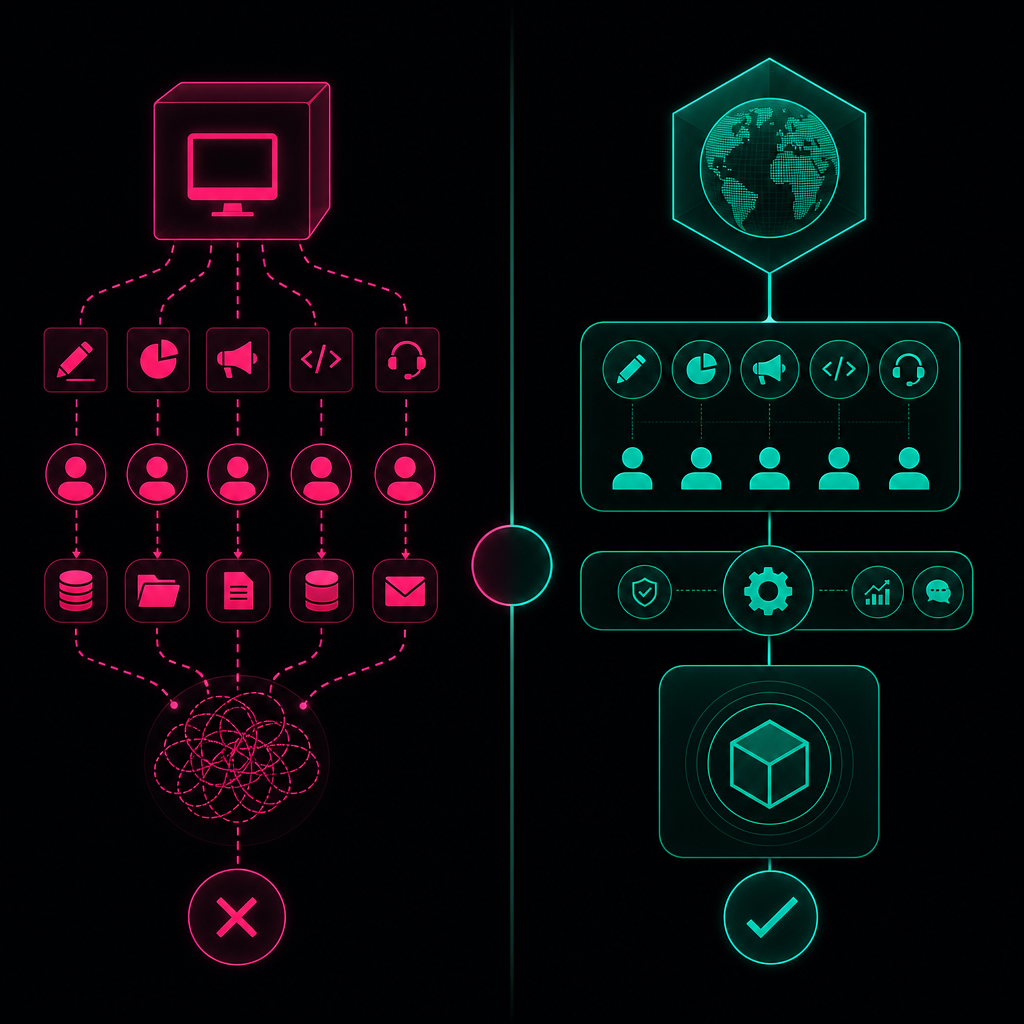
Strategic offshore scaling means building a repeatable delivery capability across borders, not distributing miscellaneous tasks to remote workers. The business defines the outcome, documents the process, assigns decision rights and installs controls before increasing headcount. Cost matters, but reliability determines whether the model can support sustained business growth.
There is an important difference between outsourcing tasks and expanding with offshore staff. Task outsourcing transfers a narrow activity. Offshore scaling creates an integrated function that contributes to normal business operations.
A properly designed offshore team should answer five questions without ambiguity:
- What result does the team own?
- Which tasks and decisions sit inside that ownership?
- What information and systems can team members access?
- Who approves exceptions or high-risk actions?
- How is quality reviewed and corrected?
If those answers exist only in the founder's head, the business is not ready to scale that work. Recruitment might still fill a seat, but it will not remove the operational dependency.
This is why Remotee's focus is predictable delivery, not just headcount. Talent quality matters. However, capable staff cannot compensate indefinitely for missing instructions, conflicting priorities or unclear authority.
The Philippines is often considered by Australian organisations because of its established professional services workforce and practical time-zone overlap. Those advantages can support collaboration, but geography does not create process maturity. The operating system still has to be built.
Step 1: identify the work that should scale offshore
The best offshore roles contain recurring work, observable outputs and enough volume to justify a dedicated operating rhythm. Start by mapping where work accumulates, where senior people repeat low-value administration and where delays affect customers or cash flow. Do not begin with a list of the cheapest roles available.
Map constraints before writing job descriptions
Review the flow of work from request to completion. Look for recurring handovers, rework, approval delays and tasks that depend on one person remembering what happens next.
Useful questions include:
- Which work repeats daily, weekly or each pay cycle?
- Where do founders or partners become default approvers?
- Which activities interrupt billable or growth-focused work?
- Which outputs can be checked against an objective standard?
- Which processes rely on sensitive customer, employee or financial information?
- What fails when the usual employee is absent?
This analysis often reveals that the visible staffing gap is not the real constraint. A business may believe it needs another administrator when it actually needs a defined payroll function, customer support queue or finance operations process.
Classify work by suitability and risk
Strong early candidates commonly include structured administration, payroll operations, accounts support, recruitment coordination, customer support and recurring reporting. Suitability depends on the specific workflow, not the role title.
A role becomes harder to offshore when work is highly ambiguous, authority is undefined or performance depends on undocumented internal relationships. That does not make the role impossible. It means more operating design is required before recruitment.
Use three practical classifications:
- Ready to move: documented workflow, clear output and known approver.
- Ready after redesign: recurring work exists, but ownership or documentation is weak.
- Keep local for now: judgement is highly contextual, controls are immature or legal obligations require closer review.
The phrase "for now" matters. Process maturity can change. A poor offshore candidate can become viable after the business standardises inputs, approvals and quality checks.
Step 2: choose the offshore operating model and controls
Australian businesses should choose an offshore model according to the level of ownership, support and control they need. Direct hiring offers control but creates management obligations. Freelancers suit contained projects. Managed offshore delivery is better when the business needs recruitment, operating structure, continuity and ongoing oversight around specialist roles.
Direct employment or contractor engagement
Direct engagement can suit businesses with established remote management, legal advice and internal capability to handle recruitment, contracts, payroll, performance and local requirements. The apparent simplicity of hiring directly can disappear once the business encounters leave, equipment, information security or continuity questions.
Contractors can be effective for genuinely independent, outcome-based projects. They should not be used merely to label an employment-style relationship differently. Australian businesses should obtain advice on employment, tax and contractor classification for their circumstances.
Managed offshore teams
A managed model wraps recruitment and delivery support around the worker. The exact service varies considerably between providers. Some providers stop at candidate placement. Others support workflow implementation, performance management, continuity and compliance controls.
Ask prospective providers who owns each of the following:
- Role design and candidate assessment
- Employment and local payroll administration
- Equipment and access provisioning
- Process documentation
- Performance review and issue management
- Leave and continuity planning
- Security incident escalation
- Replacement recruitment
Compare the complete operating model, not a quoted wage in isolation. Remotee's offshore staffing pricing should be assessed against the internal management, recruitment and delivery work the model replaces or reduces.
Australian privacy and security obligations
Offshore access does not remove the Australian organisation's responsibility for information handling. The Office of the Australian Information Commissioner explains that Australian Privacy Principle 8 applies to many cross-border disclosures of personal information. Organisations may remain accountable for how an overseas recipient handles that information (OAIC).
Before granting access, define:
- The minimum information required for the role
- Which systems can be accessed and from what devices
- Multi-factor authentication requirements
- Download, storage and deletion restrictions
- Approval requirements for exporting information
- Incident reporting and access removal procedures
The Australian Cyber Security Centre's Essential Eight provides a recognised baseline for improving cyber security controls (Australian Cyber Security Centre). Implementation should be adjusted to the organisation's risks and technical environment.
Step 3: design the role as a delivery system

An offshore role should be designed around owned outcomes, recurring workflows and decision boundaries. A conventional job description is not enough. The team member needs to know what starts the process, what a correct output looks like, which exceptions require escalation and who has final approval for sensitive actions.
Build a role scorecard
A useful scorecard defines the role through operational evidence rather than broad traits. It should include:
- Purpose: why the role exists
- Owned outputs: what must be completed
- Inputs: what information or instruction begins the work
- Service standard: when and how the output is delivered
- Quality standard: what makes the output acceptable
- Decision rights: what the person can decide independently
- Escalation triggers: what must be referred to another person
- Dependencies: systems, people and approvals required
Avoid vague measures such as being proactive or working hard. Those expectations are reasonable, but they do not tell a remote team member how performance is judged.
Document the workflow at the right level
Documentation should make correct action easier. It should not become a large manual that nobody updates.
For each recurring workflow, capture:
- The trigger
- Required information
- Sequence of actions
- System used at each point
- Review or approval checkpoint
- Expected output
- Exception path
- Record that proves completion
Screen recordings can support training, but they are not a complete operating procedure. Software interfaces change, and recordings are difficult to scan during urgent work. Pair visual demonstrations with concise written checklists.
Separate execution from approval
Sensitive functions need explicit separation between preparation and authorisation. An offshore payroll specialist might prepare a pay run, investigate discrepancies and produce reports. A nominated Australian manager may retain final approval before payment.
This is not a sign of mistrust. It is sound control design. The same principle can apply to supplier payments, refunds, account changes and the release of confidential information.
Step 4: run a controlled offshore pilot
A pilot should test the complete delivery system under normal working conditions, not merely test whether a new hire can complete isolated tasks. Start with a defined workflow, establish a baseline, run real work through the process and record every exception. Expansion should wait until recurring failures have been corrected.
Begin with a complete slice of work
Assigning scattered tasks makes performance difficult to evaluate. Instead, choose a contained service unit such as candidate onboarding administration, accounts receivable follow-up or payroll preparation for a defined employee group.
A complete slice gives the offshore team meaningful ownership. It also exposes weak inputs, unclear approvals and system gaps faster than disconnected task allocation.
Use parallel review where risk warrants it
During transition, the existing process and proposed process may be compared before full ownership moves. The purpose is to identify differences and improve controls, not to preserve duplicate work indefinitely.
Record:
- Missing information
- Incorrect assumptions
- Approval delays
- Rework causes
- Access problems
- Unusual cases not covered by the procedure
Each issue should lead to a specific response. Update the process, clarify ownership, change the form or add a control. Telling the new team member to "be more careful" rarely fixes a system problem.
Define the pilot exit conditions
A pilot is complete when the business can rely on the process without constant founder intervention. Look for stable quality, predictable turnaround, correct escalation and clear visibility over outstanding work.
Do not expand because the calendar says the pilot period has ended. Expand when the evidence shows the operating model is ready.
Step 5: expand with offshore staff in controlled increments

Offshore teams should expand according to workload, process stability and management capacity. Add related roles around an established workflow rather than hiring across several functions at once. Each staffing increment should solve a defined constraint while preserving the quality and visibility achieved during the previous stage.
Scale pods, not isolated individuals
A pod is a small operating unit built around a business outcome. It might contain coordination, processing and quality responsibilities linked to the same workflow.
This structure is stronger than accumulating unrelated assistants because team members share context, cover predictable absences and contribute to a common service result. It also gives managers a clearer unit to supervise.
A sensible sequence is:
- Establish the core specialist role.
- Stabilise the workflow and approvals.
- Add adjacent capacity where demand is proven.
- Introduce quality or coordination responsibility as complexity grows.
- Create continuity for critical activities.
The sequence should change according to the business. A customer support operation may need coverage planning earlier. A finance function may prioritise review controls and segregation of duties.
Watch management capacity
Every new hire creates communication, review and decision requirements. If those requirements all flow to the founder, the offshore team has increased organisational load rather than released it.
Create a clear reporting line and assign one accountable process owner. That person does not need to answer every question personally. They must ensure decisions are made, standards remain current and unresolved issues reach the right authority.
Plan continuity before it is needed
Your payroll should not depend on one busy admin person remembering everything. Neither should another critical process.
Continuity planning should cover documented access, shared process knowledge, leave handovers and urgent escalation. Avoid sharing passwords or bypassing access controls in the name of convenience. Each worker should use an individually assigned account wherever the system supports it.
How to maintain quality and company culture while scaling
Quality and culture remain stable when offshore team members receive clear standards, business context and consistent access to decision-makers. Frequent meetings alone do not create alignment. Businesses need documented expectations, visible priorities, structured feedback and inclusive communication practices that treat offshore specialists as part of the operating team.
Make quality observable
Quality controls should be attached to the workflow. Examples include review checklists, exception reports, reconciliation evidence and approval logs. The method depends on the function, but the principle stays the same: quality must be visible before a customer, employee or regulator discovers the problem.
In payroll, Fair Work requires employers to make and keep accurate employee records and provide payslips (Fair Work Ombudsman). The Australian Taxation Office also sets out employer responsibilities for reporting payroll information through Single Touch Payroll (Australian Taxation Office).
Payroll is too important to be "mostly right". Errors affect employee trust, cash flow and compliance. That is why the Remotee and Accountee position is direct: payroll is often safer with a specialist delivery system than with an overloaded internal generalist.
Give offshore teams context, not just instructions
People make better decisions when they understand the customer, commercial model and consequences of an error. Include offshore staff in relevant planning updates, service reviews and process discussions.
Do not force them to infer priorities from a crowded task list. Explain which work is urgent, which is important and who can change the order.
Design communication around decisions
Separate routine visibility from decision-making:
- Use workflow systems to show status and ownership.
- Use written updates for progress and non-urgent questions.
- Use meetings for decisions, coaching and complex exceptions.
- Record decisions where affected people can find them.
This prevents meeting volume from growing in proportion to headcount.
Treat offshore specialists as professionals
Culture deteriorates when offshore staff receive less context, poorer tools or no path to increased responsibility. Integration means applying the same clarity, respect and performance standards across locations.
That does not require pretending every role is identical. It requires recognising that reliable business growth remote teams can support depends on trust, accountability and access to the information required to perform.
Two payroll scaling case studies from Australian recruitment businesses
These cases show why strategic offshore scaling starts with process design rather than recruitment alone. In both businesses, payroll had become a recurring drain on internal capacity. The useful intervention was not simply moving tasks offshore. It was redesigning the operating model, approvals, compliance checks and ongoing ownership around specialist payroll delivery.
Case study: recruitment agency founders released from payroll operations
A recruitment agency's founders wanted to focus on business development and operational execution. Payroll and accounting administration repeatedly pulled them back into non-billable work. Hiring and managing additional in-house resources was not considered commercially efficient.
We completed discovery, designed a payroll system around the agency's software and implemented the operating process within 2 weeks. The live model reduced the founders' recurring involvement to approving one email each fortnight.
The specialist team manages payroll, superannuation, tax, compliance, inbound payroll questions and timesheet queries. The outcome was not just delegated administration. It was clear ownership of a business-critical function.
Across 15 recruitment agency implementations in 2026, Remotee and Accountee's supplied business data shows a reduction of 6-10 hours in non-billable partner time per pay cycle. That is first-party operational data and should not be treated as a universal forecast.
Case study: labour hire payroll consolidated into one delivery system
A hospitality recruitment and labour hire company used several internal people and external accountants to manage weekly payroll. The arrangement created duplicated effort, high operating costs and fragmented accountability.
Our team completed discovery and designed a consolidated process. Payroll moved from weekly to fortnightly, and the specialist team took responsibility for the complete operating workflow. Internal payroll staffing and external accounting involvement were removed from that process.
The company reduced payroll-related operating costs and internal workload. The compliance review also identified industry award requirements that had not been addressed in the previous fragmented model.
Fair Work explains that awards can set minimum pay rates and employment conditions for covered employees (Fair Work Ombudsman). Award interpretation should be handled carefully and supported by appropriate professional advice.
The Accountee Payroll Process
For established Australian businesses that want to focus on growth rather than accounting operations, we apply four connected phases:
- Phase 1, Payroll Discovery and Setup: review pay cycles, staff types, awards, systems, approvals and reporting requirements.
- Phase 2, Payroll Transition: establish access, templates, calendars, employee data, timesheet flows and approval checkpoints.
- Phase 3, Full Payroll Processing: manage timesheets, calculations, leave, allowances, deductions, STP, superannuation, reporting and pay-run preparation.
- Phase 4, Ongoing Payroll Management: handle recurring delivery, issues, compliance support, reporting and account management.
The central operating principle is simple: specialist payroll accountants, not generalist bookkeepers. Payroll done properly. Not squeezed in between tax returns.
The real offshore scaling constraint is delivery structure
The difference between a capacity gap and a capacity crisis is usually a delivery structure problem, not a talent problem. Businesses often respond to overload by hiring quickly. If ownership, workflows and approvals remain unclear, every additional person creates more handovers, messages and decisions for the same overloaded leaders.
This is where Remotee takes a different position from providers that compete mainly on cost, speed or CV volume. Headcount is an input. Reliable delivery is the result that matters.
A founder moves from Doer to Strategist only when work can proceed without the founder acting as the organisation's memory, dispatcher and quality controller. Offshore hiring can support that change, but only when the delivery system removes those dependencies.
Before approving another offshore role, calculate the management work it will create. Ask who will assign priorities, resolve exceptions, review quality and update procedures. If every answer names the same overloaded person, recruitment should pause while the operating model is redesigned.
This is also why starting with a specialist function can be more effective than hiring a general virtual assistant. A specialist role has a clearer body of knowledge, more definable outputs and stronger quality criteria. Not jack-of-all-trades accounting. Specialist payroll delivery.
Scale your Australian business efficiently with Remotee
Remotee helps Australian businesses build offshore capability around documented workflows, specialist talent and compliance-conscious delivery. The goal is not to place more people into an unclear structure. It is to create reliable operating capacity that gives owners and senior teams more time for customers, strategy and sustainable growth.
Before hiring, we examine the work, operating constraints, required controls and internal ownership. That creates a practical basis for selecting roles and sequencing expansion.
Review Remotee's pricing and service options, or contact Remotee to discuss where offshore capacity can support your business without adding operational chaos.
References
The following sources support the privacy, cyber security, payroll and workplace compliance principles discussed in this guide. They provide general guidance rather than advice for a specific organisation. Australian businesses should obtain professional legal, tax, employment and security advice where their obligations or risks are unclear.
- Office of the Australian Information Commissioner, Chapter 8: APP 8 Cross-border disclosure of personal information
- Australian Cyber Security Centre, Essential Eight
- Fair Work Ombudsman, Record-keeping
- Fair Work Ombudsman, Awards
- Australian Taxation Office, Single Touch Payroll
- International Organization for Standardization, ISO/IEC 27001 information security management systems
FREQUENTLY ASKED QUESTIONS
Common questions
When is an Australian business ready to scale offshore?
- A business is ready when it has recurring work, enough demand to justify dedicated capacity and an internal owner who can define the required result. It must also be willing to document workflows, set access controls and clarify decision rights.
Which roles should an Australian business offshore first?
- Start with roles that have repeatable workflows, observable outputs and manageable risk. Payroll operations, accounts support, recruitment coordination, customer support and structured administration can be suitable when their processes and ownership are clearly defined.
How quickly should an offshore team expand?
- Expand after the first workflow produces reliable quality, turnaround and escalation without constant founder intervention. Add adjacent capacity in controlled increments rather than hiring across several unrelated functions simultaneously.
How can an Australian business protect data with offshore staff?
- Apply least-privilege access, individual accounts, multi-factor authentication, device controls and documented incident procedures. Review Australian privacy obligations for cross-border disclosure and obtain advice appropriate to the information and regulatory environment.
How do you maintain company culture with an offshore team?
- Give offshore team members business context, visible priorities, relevant decision access, clear expectations and useful feedback. Include them in appropriate planning and provide the tools and information required to work as professional members of the operating team.
Is offshore staffing only about reducing costs?
- No. Cost is one factor, but the stronger case is access to specialist capacity and reliable execution. Strategic offshore scaling should reduce operational dependency and release senior staff from repeatable delivery work.

Jon Kelly
Founder, Remotee
Jon helps Australian businesses build compliance-led offshore teams that scale without the burnout. NDIS, accounting, mortgage broking, recruitment and digital marketing.
KEEP READING
Related posts
HR offshore staff Australia
Optimising HR Processes with Offshore Staff for Australian Companies
HR offshore staff can help Australian companies manage recruitment administration, onboarding, employee records, reporting and payroll support. The model works…
29 August 2026 · 21 min read
offshore marketing operations Australia
Offshore Marketing Operations Staffing for Australian Brands
Offshore marketing operations in Australia means building a remote team that executes defined marketing work under clear Australian ownership. Suitable roles in…
27 August 2026 · 18 min read
offshore staffing risks Australia
Mitigating Risks in Offshore Staffing: A Guide for Australian Businesses
Offshore staffing risks in Australia are best managed through documented workflows, controlled system access, clear accountability, lawful data handling and tes…
26 August 2026 · 22 min read
READY TO SCALE WITHOUT THE BURNOUT?
Build a compliance-led offshore team in 3–4 weeks.
Tell us about your current bottleneck and we'll show you what a Remotee placement would look like for your operation.
Or get our playbooks emailed to you instead.