
Philippines delivery model and talent locations
- Philippines remote staffing
- Offshore delivery models
- Philippines talent locations
- Australian outsourcing
- Remote team management
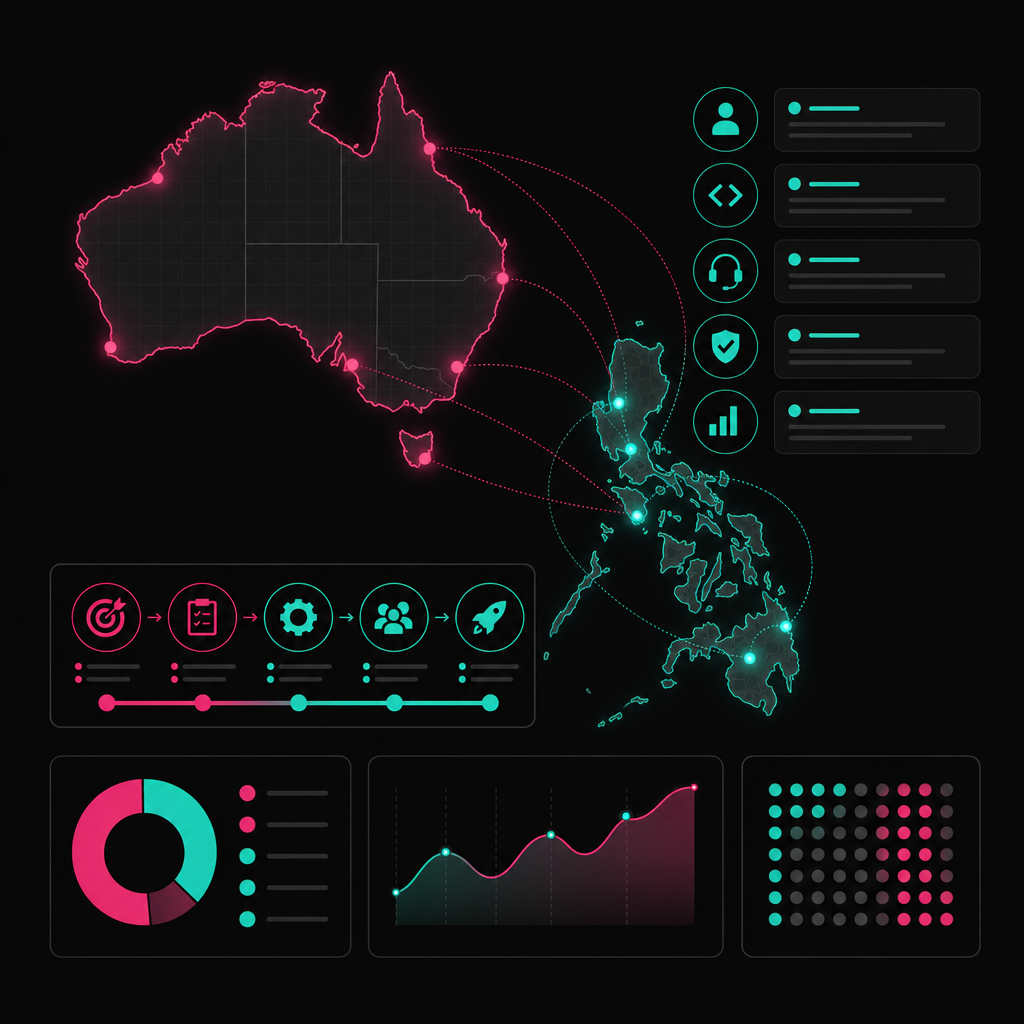
A Philippines delivery model should combine the right employment structure, talent location, workflow ownership, security controls and management cadence. Australian businesses can hire directly, build a dedicated remote team or outsource a managed function. The best location depends on role depth, continuity requirements, working hours, infrastructure and access to specialist talent.
Choosing the Philippines is only the first decision. Businesses must also decide how work will be delivered, who owns outcomes and where talent should be sourced.
This guide explains the main delivery models, compares Philippine talent locations and sets out the operating controls required for predictable delivery. The objective is not cheaper headcount. It is reliable capacity that lets business owners move from Doer to Strategist.
Key takeaways
- Talent quality does not compensate for unclear workflows, weak ownership or inconsistent management.
- Dedicated staffing suits businesses that already have strong internal processes and capable managers.
- A managed function is better when the provider must own an operational outcome, not merely supply a person.
- Metro Manila offers broad talent depth, while Cebu, Clark, Davao, Iloilo and Bacolod can suit targeted hiring strategies.
- Location decisions should consider continuity, internet redundancy, commuting, management coverage and role-specific supply.
- Australian privacy, employment, payroll and information-security obligations must be designed into delivery from the beginning.
Summary table
| Decision area | Main options | Best fit | Primary risk to control |
|---|---|---|---|
| Delivery structure | Direct hire, dedicated team, managed function | Depends on internal management maturity | Confusing headcount with accountability |
| Talent location | Metro Manila, Cebu, Clark, Davao, Iloilo, Bacolod, distributed hiring | Depends on role specialisation and continuity needs | Choosing a city based only on salary |
| Management | Client-led, shared or provider-led | Match management to process maturity | Unclear ownership and duplicated supervision |
| Employment | Local employee, contractor or provider-employed team member | Depends on legal, operational and tenure requirements | Misclassification or weak local support |
| Data access | Open access, role-based access or controlled environment | Match access to data sensitivity | Excessive permissions and unmanaged devices |
| Continuity | Office-based, home-based or hybrid delivery | Match the role's service requirements | Dependence on one person, connection or site |
What is a Philippines delivery model?

A Philippines delivery model defines how remote talent is employed, managed, measured and integrated into an Australian business. It covers more than recruitment. A complete model assigns workflow ownership, approval rights, performance standards, communication routines, data access, escalation paths and business continuity responsibilities before delivery begins.
The common mistake is to treat the model as a hiring channel. A business selects a candidate, provides software access and expects productivity to follow. That approach can work when internal processes are already documented and a capable manager has time to train, review and improve the role.
It fails when the new team member inherits fragmented instructions from several stakeholders. Adding headcount without adding system is how scaling creates chaos.
Our position is direct: the difference between a capacity gap and a capacity crisis is usually a delivery structure problem, not a talent problem.
A sound model answers practical questions:
- Is the team member responsible for tasks, outputs or an end-to-end function?
- Who sets priorities when several Australian stakeholders request work?
- Which decisions can be made without approval?
- What evidence proves that work has been completed correctly?
- Who provides cover during leave, outages or unexpected absences?
- How are errors recorded, corrected and prevented from recurring?
- Which systems and data can the role access?
If these questions remain unanswered, the business has recruited capacity but has not built delivery.
Which delivery model should an Australian business choose?
Australian businesses should choose between direct remote hiring, a dedicated team and a managed function based on process maturity and desired accountability. Direct hiring provides control but requires internal management. Dedicated staffing adds employment support. Managed delivery is appropriate when the provider must own workflow design, quality control and operational results.
Direct remote hiring
Under direct hiring, the Australian business recruits and manages the worker. Depending on the arrangement, that person may be engaged as an employee, through a local employment provider or as a genuine independent contractor.
This model can suit a business with documented procedures, clear supervision and internal capacity to handle onboarding. It gives the Australian manager close control over priorities and daily work.
It also places more responsibility on that manager. Recruitment, classification, local employment requirements, equipment, performance management, leave coverage and continuity all require attention. Calling someone a contractor does not determine their legal status. Fair Work Ombudsman guidance explains that sham contracting occurs when an employment relationship is misrepresented as independent contracting (Fair Work Ombudsman). Businesses should obtain advice for their specific arrangement.
Dedicated remote team
A dedicated team model places selected Philippine professionals inside the client's operating structure while a provider handles agreed employment and support functions.
The client normally owns work allocation, training and performance priorities. The provider may manage local employment, payroll, equipment, human resources support and workplace matters.
This is often a strong fit for established teams adding recurring capacity in administration, finance, recruitment support, customer operations, marketing or software delivery. It works best when the client knows what good performance looks like.
The risk is split accountability. If the client assumes the provider is managing output while the provider assumes the client is doing so, the team member receives little useful direction. Responsibilities must be written down.
Managed function
A managed function assigns responsibility for an operational outcome to the provider. The provider supplies the people, process, controls, reporting and issue management required to deliver it.
Payroll is a clear example. It is not enough to appoint a remote payroll officer and send occasional instructions. The operating model must cover employee data, timesheet cut-offs, awards, leave, allowances, deductions, Single Touch Payroll, superannuation, approvals, reporting and exception handling.
Our Accountee Payroll Process moves through payroll discovery and setup, transition, full processing and ongoing management. The sequence matters because the team is installed around a defined workflow. It is not jack-of-all-trades accounting. It is specialist payroll delivery.
Where is talent located in the Philippines?
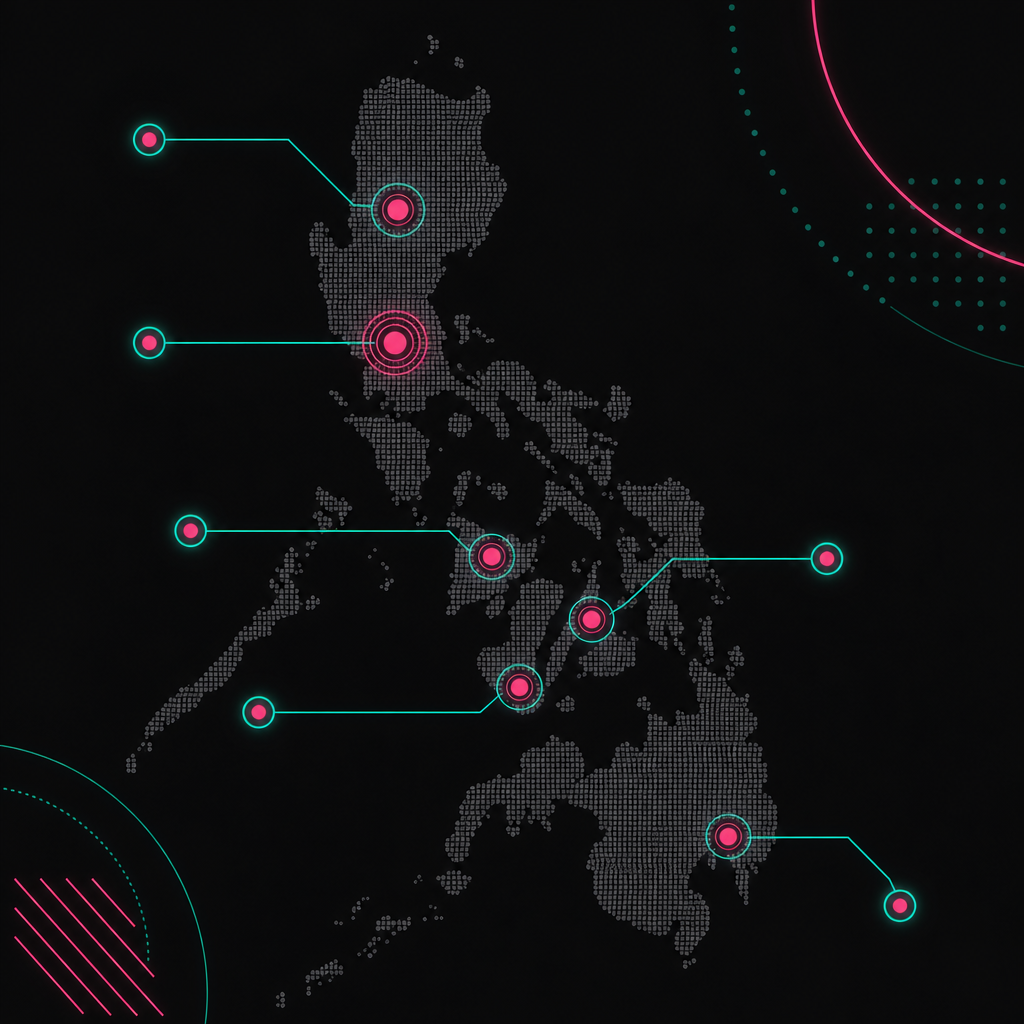
Philippine remote talent is distributed across Metro Manila and regional centres including Cebu, Clark, Davao, Iloilo and Bacolod. Metro Manila generally offers the widest role coverage, while regional markets can support focused hiring and distributed teams. The right choice depends on the role, operating model, infrastructure and required management support.
Metro Manila
Metro Manila is the broadest starting point for roles requiring specialist experience, exposure to international clients or familiarity with established business process operations. Its scale supports finance, recruitment, customer service, technology, marketing and administrative hiring.
However, a Manila-only strategy can create avoidable constraints. Commuting, competition for specialist candidates and dependence on a single metropolitan area should be considered. Office attendance requirements also affect the realistic catchment area.
Businesses should assess the candidate's actual suburb, proposed work arrangement and backup options rather than relying on a broad Manila label.
Cebu
Cebu has an established services and technology workforce. It can suit customer operations, finance support, software roles, digital work and administrative delivery.
For Australian businesses, Cebu can provide a useful alternative to Manila without abandoning access to an experienced professional workforce. The same diligence still applies. City selection does not remove the need to test communication, technical capability, employment history and home-working conditions.
Clark and Central Luzon
Clark and nearby Central Luzon locations can support office-based, hybrid and remote teams. The area is relevant for businesses seeking access outside Metro Manila while retaining links to a developed commercial centre.
Clark may be attractive when a provider maintains local facilities or management coverage there. A location only creates value when the operating support exists around it. An office address alone does not guarantee good supervision or continuity.
Davao
Davao expands access to talent in Mindanao and can support administrative, customer service, finance and digital roles. It can also form part of a geographically distributed delivery model.
The decision should be role-led. If the required specialist pool is narrow, insisting on a single city can reduce candidate quality. Remote delivery allows the recruitment area to widen when management and security controls support it.
Iloilo and Bacolod
Iloilo and Bacolod are established regional business centres with professional talent suitable for selected support and service roles. They should not be treated as interchangeable low-cost alternatives. Candidate supply differs by occupation, seniority and employer demand.
A provider should show evidence of local recruitment reach, management capability and continuity arrangements before recommending either location.
Distributed hiring
A distributed model recruits across several Philippine locations rather than concentrating the team in one city. This can widen the talent pool and reduce dependence on one office or metropolitan area.
It also requires stronger systems. Equipment standards, internet checks, access control, communication routines and leave coverage must remain consistent regardless of where each person works.
The Philippine Economic Zone Authority provides information about economic zones supporting export-oriented industries and services (PEZA). Economic-zone presence can be relevant to a provider's corporate structure, but it should not replace operational due diligence.
How should businesses compare Philippine talent locations?
Businesses should compare Philippine talent locations using role availability, infrastructure, continuity, retention conditions, management support and total delivery risk. Salary should not be the deciding factor. A cheaper candidate becomes expensive when weak connectivity, unsuitable working conditions or poor supervision cause missed work, rework and management overhead.
Start with the work, not the map. Define the role's outputs, systems, collaboration requirements and data sensitivity. Then test whether a location and working arrangement can support them.
Role-specific talent depth
A broad claim that a city has good talent is not useful. Ask whether the provider can source the exact experience required. Payroll award interpretation, recruitment database administration, paid media, software quality assurance and executive support require different candidate pools.
Review recent candidate examples where legally and ethically available. Examine tenure, software exposure, writing ability, judgement and experience with Australian customers or regulations.
Home-working conditions and infrastructure
For remote roles, assess the actual working environment. Useful checks include connection type, backup connection, power contingency, device ownership, workspace privacy and household interruptions.
These controls should be verified during onboarding and revisited. A screenshot from a speed test is not a continuity plan.
Management coverage
A distributed team still needs accessible management. Confirm who handles attendance issues, performance concerns, workplace matters, equipment failures and urgent escalations in Philippine local time.
For managed functions, also confirm who reviews technical quality. General human resources support is not a substitute for a manager who understands the work.
Retention and career fit
Retention starts with accurate role design. Candidates should know the working hours, responsibilities, reporting line, performance measures and development path before accepting.
Businesses sometimes combine unrelated tasks into one remote role because each task appears small. That creates a poorly defined position and makes performance difficult to assess. Specialist roles usually deliver better when priorities are coherent.
What operating controls make remote delivery reliable?

Reliable remote delivery requires documented workflows, one accountable owner, measurable outputs, controlled system access, regular reviews and a tested escalation process. The controls should reduce dependence on individual memory. Your delivery should not depend on one busy admin person remembering every deadline, exception and approval.
Document the workflow before measuring the person
A standard operating procedure should show inputs, actions, decision points, approvals and evidence of completion. It should also identify common exceptions.
Do not use documentation to record every mouse click. Document the judgement points where mistakes create downstream risk. The goal is repeatability, not bureaucracy.
Separate task completion from quality assurance
A status marked complete only proves that someone changed the status. High-risk work needs review criteria. Payroll, finance, customer complaints and data changes may require reconciliations, approval checkpoints or exception reports.
This is why we say payroll is too important to be "mostly right". The same principle applies to any workflow affecting staff, customers, cash or compliance.
Control access by role
Remote workers should receive only the access required for their responsibilities. Shared credentials should be avoided. Access should be reviewed when duties change and removed promptly when an engagement ends.
Australian Privacy Principle Eight addresses cross-border disclosure of personal information. The Office of the Australian Information Commissioner explains that an Australian entity taking reasonable steps before overseas disclosure can remain accountable in relevant circumstances (OAIC). The Philippines also has its own Data Privacy Act and National Privacy Commission (National Privacy Commission). Legal advice may be required for sensitive data or complex arrangements.
Build continuity around the process
Continuity means the work can proceed when a person, device, connection or location is unavailable. Critical workflows need documented handovers, shared records and clear cover arrangements.
The objective is not to remove people from delivery. It is to prevent knowledge from existing only inside one person's inbox or memory.
Why predictable delivery matters more than cheaper headcount
The best Philippines strategy does not begin with labour cost. It begins with the operational constraint preventing the Australian business from growing. Once that constraint is documented, remote specialists can be installed with clear ownership. This produces predictable delivery, rather than another person the founder must constantly supervise.
We have seen this distinction clearly in payroll operations. In one recruitment agency implementation, the founders wanted to focus on business development and execution rather than payroll and accounting. Hiring and managing an internal resource did not offer an acceptable commercial return.
We completed discovery, customised the payroll system and installed the delivery team. According to our implementation record, the service was live within two weeks. The founders then approved one email each fortnight while our team managed payroll, superannuation, tax, compliance, inbound questions and timesheet queries.
Across Accountee recruitment agency engagements, our internal records show a reduction of 6-10 hours of non-billable partner time per pay cycle across 15 implementations completed in 2026. The lesson is not that every offshore role saves the same time. It is that capacity appears when the workflow, approvals and specialist ownership are designed together.
A second hospitality recruitment and labour hire engagement began with internal staff and external accountants sharing payroll responsibility. We redesigned the workflow, moved processing to a fortnightly cycle and assumed end-to-end delivery. The important change was not simply where the work occurred. It was replacing fragmented ownership with a single operating model and stronger award-compliance review.
That is the contrarian point many outsourcing comparisons miss. Remote hiring does not fix operational disorder. It exposes it. Build the delivery system first, then place capable Philippine talent inside it.
How to implement a Philippines delivery model
Implementation should begin with process discovery, followed by role design, delivery-model selection, recruitment, controlled onboarding and ongoing review. Recruitment should not start until the business can explain the role's outputs, owner, systems, approval points and failure risks. Otherwise, candidate selection is based on an incomplete job.
Use this sequence:
- Map the current workflow, including exceptions and bottlenecks.
- Decide whether the business needs a person, dedicated capacity or an owned function.
- Define outputs and authority before writing the position description.
- Select locations based on role supply and continuity requirements.
- Confirm employment, privacy, security and equipment arrangements.
- Recruit for specialist capability and judgement, not generic availability.
- Run structured onboarding using real workflows and controlled access.
- Review output quality, turnaround, exceptions and management effort.
- Improve the process when recurring issues appear.
Do not judge success only by whether the person is busy. Measure whether work is completed accurately, on time and with less intervention from Australian leaders.
If your business needs predictable Philippine delivery rather than more unmanaged headcount, visit Remotee's contact page at /contact to discuss the role, workflow and operating model.
References
FREQUENTLY ASKED QUESTIONS
Common questions
Is the Philippines suitable for Australian remote teams?
- Yes. The Philippines can support Australian businesses across finance, administration, recruitment, customer operations, marketing and technology. Suitability depends on the specific candidate and delivery system, including communication, role capability, workflow ownership and management support.
Is Manila always the best location for Philippine talent?
- No. Metro Manila offers broad talent coverage, but Cebu, Clark, Davao, Iloilo, Bacolod and distributed hiring can suit particular roles. The best location is where the required capability, infrastructure and management support intersect.
Should we hire a contractor or use an employment provider?
- The answer depends on the real working relationship, local legal requirements and required support. A contract label does not determine worker classification. Australian businesses should obtain appropriate employment and tax advice before selecting a structure.
What is the difference between staff augmentation and a managed function?
- Staff augmentation supplies capacity that the client manages. A managed function assigns an operational outcome to the provider, together with responsibility for process, quality control and reporting.
How do we protect Australian customer and employee data?
- Use role-based access, approved devices, unique credentials, multi-factor authentication, confidentiality obligations, access logs and prompt offboarding. Map where personal information is stored and disclosed, and consider Australian and Philippine privacy requirements.

Jon Kelly
Founder, Remotee
Jon helps Australian businesses build compliance-led offshore teams that scale without the burnout. NDIS, accounting, mortgage broking, recruitment and digital marketing.
KEEP READING
Related posts
offshore staff cultural integration Australia
Cultural Nuances: Onboarding Offshore Staff into Australian Business Culture
Offshore staff cultural integration in Australia works when businesses explicitly teach communication norms, decision rights, feedback expectations, workplace b…
13 August 2026 · 17 min read
offshore staff performance metrics
Setting KPIs and Performance Metrics for Offshore Staff
Offshore staff performance metrics should connect each role to a business outcome, define acceptable quality, clarify ownership and support regular coaching. Ef…
27 July 2026 · 18 min read
provider due-diligence checklist
Offshore Staffing Provider Due Diligence Checklist for Australian Businesses
An offshore staffing provider due-diligence checklist should verify the provider's delivery model, legal employing entity, payroll controls, recruitment process…
14 September 2026 · 18 min read
READY TO SCALE WITHOUT THE BURNOUT?
Build a compliance-led offshore team in 3–4 weeks.
Tell us about your current bottleneck and we'll show you what a Remotee placement would look like for your operation.
Or get our playbooks emailed to you instead.