
Cultural Nuances: Onboarding Offshore Staff into Australian Business Culture
- Offshore staffing
- Australian business culture
- Remote team management
- Employee onboarding
- Cross-cultural communication

Offshore staff cultural integration in Australia works when businesses explicitly teach communication norms, decision rights, feedback expectations, workplace boundaries and local compliance. A strong onboarding programme combines cultural context with documented workflows, named owners, practical rehearsals and regular check-ins, so international staff can contribute confidently without guessing how the Australian team operates.
Successful integration goes beyond technical competence. A capable offshore employee can still struggle when an Australian manager relies on shorthand, informal feedback or unwritten expectations.
This guide explains how to build cultural understanding into onboarding, daily communication and operational delivery. It also shows why documented systems matter more than vague instructions to "fit in".
Remotee implementation snapshot
| Measure | Result | Source |
|---|---|---|
| Recruitment agency implementations reviewed | 15 during 2026 | Remotee and Accountee internal implementation data supplied for this article |
| Reduction in non-billable partner time | 6-10 hours per pay cycle | Remotee and Accountee internal implementation data supplied for this article |
Key takeaways
Cultural integration succeeds when expectations become observable behaviours rather than abstract values. Managers must explain how work is assigned, challenged, approved and escalated. Offshore employees also need safe ways to ask questions, raise risks and clarify Australian expressions without being treated as less capable.
- Australian directness can be unclear when mixed with understatement, humour or implied requests.
- Respect for hierarchy may discourage offshore staff from challenging a manager or reporting a problem early.
- Onboarding international staff should cover workflows, decision rights and quality standards, not just company history.
- Inclusion requires equal access to information, recognition, development and consequential work.
- Local employment, privacy and payroll obligations must sit inside the operating system.
- Regular check-ins should identify process friction, not become surveillance or unnecessary meetings.
Summary table: key cultural considerations
Australian business culture is not uniform, and offshore employees should never be reduced to national stereotypes. The practical approach is to identify likely differences, explain the local expectation and then test mutual understanding through realistic work. This table provides a starting point for those conversations.
| Cultural consideration | Possible point of friction | Better onboarding practice |
|---|---|---|
| Communication style | Indirect requests, slang and understatement cause ambiguity | Use explicit instructions, examples and written acceptance criteria |
| Hierarchy | Staff may avoid disagreeing with senior people | Give clear permission and a process for challenging assumptions |
| Feedback | Direct Australian feedback may feel personal | Discuss the work, explain the standard and agree on the correction |
| Initiative | "Use your judgement" means different things to different people | Define decision boundaries and escalation triggers |
| Work-life boundaries | Time zone overlap can become constant availability | Set working hours, response windows and urgent contact rules |
| Relationships | Offshore staff may miss informal context shared locally | Include them in planning, decisions and relevant informal contact |
| Compliance | Overseas delivery can obscure Australian obligations | Assign local accountability and document required controls |
| Recognition | Offshore contributions can become less visible | Credit work publicly and provide equivalent development access |
Why cultural integration needs a delivery structure
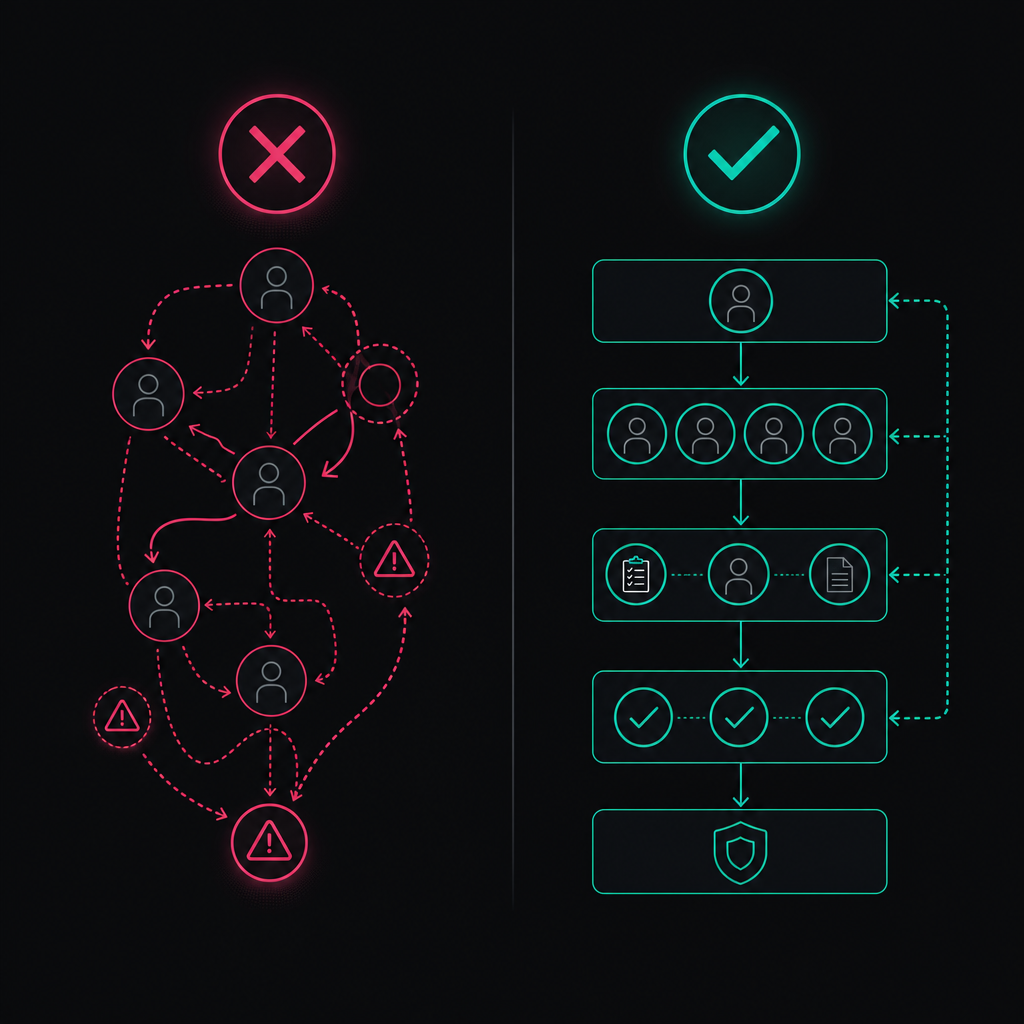
Cultural integration fails when businesses expect personal goodwill to compensate for operational ambiguity. A welcoming introduction helps, but it cannot replace documented workflows, clear ownership, service standards and escalation paths. Remote hiring creates value only when capable people enter a delivery system that tells them how successful work is produced.
Most integration advice focuses on social connection. Virtual coffees, team introductions and celebration rituals can help people build relationships. They do not tell an offshore employee which task takes priority, who can approve an exception or when a potential error must be escalated.
That distinction matters because people interpret ambiguity through their previous workplace experience. An Australian manager might say, "Have a look when you get a chance," while expecting action before the afternoon meeting. An offshore employee may interpret the same sentence as a low-priority suggestion. Neither person is careless. The request was poorly specified.
Remotee's position is direct: the difference between a capacity gap and a capacity crisis is usually a delivery structure problem, not a talent problem. Adding headcount without adding a system spreads uncertainty across more people.
A reliable delivery structure should define:
- The owner of each process and output.
- The required inputs, systems and access permissions.
- The order in which work is completed.
- What "done" means, including examples of acceptable output.
- Approval points and decision rights.
- Risks that require immediate escalation.
- Expected response windows by communication channel.
- The process for recording changes and lessons.
This structure does not remove judgement. It gives people enough context to apply judgement safely.
Which Australian business culture differences cause friction?
The most common friction points involve communication, hierarchy, initiative, feedback and work-life boundaries. These are tendencies rather than fixed national traits. Managers should use them as prompts for discussion, then learn how each employee prefers to communicate, receive feedback and make decisions.
Direct language mixed with understatement
Australians often describe their communication as direct. In practice, Australian workplaces also use understatement, humour and soft requests. Phrases such as "not bad", "a bit of an issue" or "we might need to revisit this" can conceal strong opinions.
Slang compounds the problem. "Arvo", "no worries", "touch base" and "give it a crack" may be familiar locally but unclear to someone working in a second language. Managers should use plain English for operational instructions. Informal language can develop naturally through relationships.
Ask employees to summarise the agreed outcome, owner and due time in their own words. This is a closed-loop communication check, not a language test.
Hierarchy and respectful disagreement
Some offshore staff have worked in organisations where openly disagreeing with a manager carries social or career risk. Telling them that Australian workplaces are informal will not immediately remove that learned caution.
Managers need to make disagreement procedurally safe. Useful prompts include:
- "What could make this plan fail?"
- "Which assumption would you challenge?"
- "What information are we missing?"
- "If you think I am wrong, where should you record it?"
Praise the first well-reasoned challenge publicly. Employees learn cultural expectations from what leaders reward, not what appears in a values presentation.
Initiative and decision boundaries
"Be proactive" is weak guidance. It can mean making independent decisions, identifying options or simply raising a concern earlier.
Replace it with decision boundaries. For example, an employee might resolve routine customer queries within an approved policy, recommend a response for unusual cases and escalate anything involving privacy, money or contractual commitments.
This creates initiative without forcing staff to guess how much authority they hold.
Feedback and saving face
Direct criticism can cause defensiveness in any culture. It becomes harder when language, hierarchy and remote communication remove context.
Use a factual sequence: identify the output, show the required standard, explain the business consequence and agree on the next action. Avoid character judgements such as "careless" or "not proactive enough". They provide no usable correction.
Work-life boundaries
Time zone overlap should be designed, not improvised. Offshore staff should know their standard hours, required overlap, meeting windows and genuine emergency rules.
Australian employees also have a workplace right to disconnect in circumstances covered by the Fair Work Act. The Fair Work Ombudsman's right to disconnect guidance provides current information for employers and employees. Offshore arrangements require separate legal analysis, but the cultural principle remains useful: availability is not the same as commitment.
How should Australian businesses onboard international staff?

Effective onboarding international staff should combine cultural orientation, role training, workflow rehearsal, security controls and structured feedback. Do not compress everything into an introductory video call. Sequence onboarding so the employee first understands the business, then observes the work, practises it and finally takes ownership with defined support.
Before the start date
Prepare the environment before welcoming the employee. Nothing undermines confidence faster than missing access, contradictory instructions or managers who have not decided what the role owns.
Complete these steps first:
- Confirm the role purpose and measurable outputs.
- Name the Australian process owner and day-to-day contact.
- Document core workflows and exceptions.
- Prepare system access using the minimum permissions required.
- Establish working hours, meeting expectations and leave procedures.
- Record privacy, confidentiality and information-handling requirements.
- Send a plain-English glossary covering internal terms and Australian expressions.
Australian organisations subject to the Privacy Act should align access and data handling with the Australian Privacy Principles. Where staff are based in the Philippines, local privacy requirements also need consideration. The Philippines National Privacy Commission publishes the Data Privacy Act of 2012.
During the first working week
Start with context before task volume. Explain how the business makes money, who its customers are, what creates risk and how the offshore role affects other teams.
Use live process demonstrations supported by written procedures. The employee should then repeat the process in a controlled environment. Ask them to explain why each checkpoint exists. Someone who can follow steps but cannot explain the risk behind them may struggle when an exception appears.
Include cultural expectations explicitly:
- Questions are expected before assumptions become errors.
- Managers can be challenged respectfully.
- Bad news should travel early.
- Deadlines include an agreed date, time and time zone.
- Silence does not automatically mean agreement.
- Humour must not be used to disguise critical instructions.
During the first month
Move from observation to supervised ownership. Review actual outputs against written standards. Track repeated questions because they often reveal missing documentation rather than employee weakness.
Hold separate conversations about performance and onboarding quality. If both topics share one meeting, employees may avoid criticising the onboarding process because they fear it will affect their evaluation.
Ask:
- Which instruction required the most guesswork?
- Where did two documents conflict?
- Which approval took too long?
- What Australian phrase or expectation was unclear?
- Which task should have an example or checklist?
Update the operating system from those answers. Onboarding should improve each time it is used.
How can cross-cultural remote communication stay clear?
Clear remote communication requires channel rules, explicit written commitments and respectful confirmation. Australian managers should not assume that informality creates clarity. Teams work better when everyone knows where decisions are recorded, how quickly messages require a response and which issues justify interrupting another person's work.
Assign each channel a purpose. Instant messaging suits short coordination. Project systems should hold tasks, owners and due dates. Video calls suit sensitive discussions and complex ambiguity. Formal approvals and consequential decisions need a durable written record.
After meetings, record:
- The decision made.
- The person accountable.
- Required contributors.
- The due date and time zone.
- The acceptance criteria.
- Any unresolved risk.
Do not use activity indicators as a substitute for delivery management. Online status, rapid replies and constant video meetings measure visibility, not useful output.
Make feedback culturally legible
Australian managers sometimes soften criticism with humour. That can leave an offshore employee unsure whether the issue is serious. Say what needs to change, why it matters and when the corrected work is required.
Positive feedback should also be specific. "Great job" gives little guidance. "Your reconciliation identified the missing approval before processing" tells the employee which behaviour to repeat.
Create a formal escalation ladder
An escalation ladder removes the social risk of raising bad news. It can define routine questions, blocked work, customer risk, financial risk, privacy incidents and urgent compliance concerns.
For each level, specify the channel, contact and expected response. Include a backup contact so delivery does not depend on one busy manager remembering everything.
How do you make offshore staff part of the Australian team?
Offshore staff feel included when they receive the same business context, respect, recognition and access to meaningful work as local employees. Inclusion is not achieved by adding someone to social calls while excluding them from planning, decisions and professional development. Operational inclusion matters more than ceremonial inclusion.
Invite offshore specialists to meetings where their work or expertise affects the decision. Do not invite them to every meeting. Inclusion without relevance becomes meeting overload.
Practical actions include:
- Rotate meeting times when teams span difficult time zones.
- Share agendas and pre-reading early enough for thoughtful input.
- Credit ideas and completed work to the person responsible.
- Explain Australian public holidays and learn the employee's local holidays.
- Include offshore staff in training and career conversations.
- Avoid calling the local team "the real team" or "head office people".
- Budget for relationship building rather than expecting it to happen accidentally.
Australia itself is culturally diverse. The Australian Bureau of Statistics cultural diversity data is a useful reminder that there is no single Australian employee experience. Cultural onboarding should explain workplace practices without presenting Australian behaviour as inherently superior.
ISO 30415 also provides guidance on diversity and inclusion in organisational settings. It can help larger employers connect offshore integration with broader governance rather than treating it as an isolated HR activity.
The cultural integration lesson most providers miss

The biggest remote team cultural fit problem is often described as a personality or nationality mismatch when it is actually process ambiguity. Before blaming culture, inspect the workflow. If ownership, standards, approvals and escalation rules remain unwritten, people from any location will interpret the work differently.
This is where our view differs from providers selling resumes and fast placements. Predictable delivery, not just headcount, is the objective. Cultural orientation supports that objective, but it cannot carry an incomplete operating model.
Case study: recruitment agency payroll delivery
In one anonymised recruitment agency engagement, the founders wanted to focus on business development and operational execution rather than payroll and accounting. They did not consider building and managing the function internally to be commercially efficient.
We installed a payroll system and specialist team customised to the agency's software and working methods. Discovery and implementation were completed within 2 weeks, based on our own engagement records supplied for this article.
The resulting workflow required the client to approve one email each fortnight. The delivery team managed payroll, superannuation, tax, compliance, inbound questions and timesheet queries.
The cultural lesson was not simply that offshore staff could process payroll. Trust came from a visible approval checkpoint, defined ownership and a repeatable process. The founders knew what remained their responsibility and what the specialist team owned.
Case study: hospitality recruitment and labour hire
A second anonymised business had multiple internal employees and external accountants involved in weekly payroll. The arrangement created duplicated effort, high operating costs and weak ownership.
Following discovery, we presented a system that removed those parties from routine payroll processing and moved the business to a fortnightly cycle. The specialist team then assumed end-to-end delivery. This reduced staffing and payroll processing costs, while identifying industry award requirements the business had not previously recognised.
Again, cultural integration followed delivery clarity. Offshore expertise became part of the organisation because the process defined access, responsibilities, approvals and compliance expectations.
Practitioner testimony
"The difference between a capacity gap and a capacity crisis is usually a delivery structure problem, not a talent problem."
That principle is especially important in payroll. Payroll is a business-critical trust function, not general administration. When it is wrong, staff confidence drops quickly. Payroll is too important to be "mostly right".
Our approach is specialist payroll accountants, not generalist bookkeepers. Payroll done properly. Not squeezed in between tax returns. The ATO's Single Touch Payroll guidance and the Fair Work Ombudsman's record-keeping guidance show why processes and records must remain central to payroll delivery.
How Remotee supports cultural onboarding
Remotee wraps offshore hiring in a delivery system rather than handing over a CV and leaving the business to improvise. Support should connect role design, documented processes, access controls, communication standards, ownership and ongoing management so cultural differences do not become recurring delivery failures.
That means clarifying the work before adding headcount. We examine what the role owns, how outputs are approved, which systems are required and where compliance risks sit. The onboarding programme can then teach a real operating model instead of introducing an employee to a collection of unwritten habits.
For payroll engagements, the Accountee Payroll Process provides a useful example:
- Payroll discovery and setup: Review pay cycles, staff types, awards, systems, approvals and reporting requirements.
- Payroll transition: Establish access, templates, calendars, employee data, timesheet flows and approval checkpoints.
- Full payroll processing: Handle timesheets, calculations, leave, allowances, deductions, STP, superannuation, reporting and pay-run preparation.
- Ongoing payroll management: Manage delivery, issue resolution, compliance support, reporting and account oversight.
The same logic applies beyond payroll. Cultural integration improves when the employee can see the complete system, understand their place within it and identify the correct response when normal work stops being normal.
To build an offshore team around clear delivery and cultural expectations, contact Remotee. The objective is seamless cultural integration with reliable operating controls, not headcount added without structure.
References
These references support the article's guidance on Australian workplace practices, cultural diversity, privacy, payroll and inclusion. Legal obligations depend on the employing entity, worker location and contractual structure. Businesses should obtain professional advice for their specific employment, tax, privacy and workplace arrangements.
- Australian Bureau of Statistics, Cultural diversity: Census
- Fair Work Ombudsman, Right to disconnect
- Office of the Australian Information Commissioner, Australian Privacy Principles
- Philippines National Privacy Commission, Data Privacy Act of 2012
- Australian Taxation Office, Single Touch Payroll
- Fair Work Ombudsman, Record-keeping
FAQ_SCHEMA_JSON
FREQUENTLY ASKED QUESTIONS
Common questions
How do you integrate offshore staff into Australian business culture?
- Explain communication norms, decision rights, feedback expectations and work-life boundaries directly. Support them with documented workflows, examples, named owners and escalation rules. Include offshore staff in relevant decisions and review onboarding friction regularly.
How long should offshore employee onboarding take?
- There is no universal duration. Sequence onboarding through orientation, observation, supervised practice and controlled ownership. Progress should depend on demonstrated capability, role complexity and risk rather than an arbitrary calendar date.
How can managers overcome communication barriers with offshore staff?
- Use plain English, avoid unexplained slang and record decisions in writing. Specify the owner, output, due time, time zone and acceptance criteria. Ask the employee to summarise the agreement so misunderstandings can be corrected early.
Should offshore staff follow Australian working hours?
- Only where role requirements and the employment arrangement justify it. Define necessary overlap, local working hours, meeting windows and urgent contact rules. Constant availability should not be treated as evidence of commitment or performance.
How do you encourage offshore employees to speak up?
- Create formal prompts and escalation channels. Ask for risks and alternative views before announcing the preferred answer. Respond constructively when concerns are raised, especially when an employee challenges a senior manager or reports bad news.
How do you measure remote team cultural fit?
- Assess whether the employee understands expectations, communicates risks, works effectively with others and produces outputs to the agreed standard. Also assess whether managers provide sufficient context, documentation and support.
What should be included in cultural onboarding?
- Include business context, communication practices, decision rights, feedback methods, meeting rules, work-life boundaries, privacy requirements, escalation paths and examples of acceptable work. Prioritise operational clarity over cultural trivia.

Jon Kelly
Founder, Remotee
Jon helps Australian businesses build compliance-led offshore teams that scale without the burnout. NDIS, accounting, mortgage broking, recruitment and digital marketing.
KEEP READING
Related posts
offshore staff performance metrics
Setting KPIs and Performance Metrics for Offshore Staff
Offshore staff performance metrics should connect each role to a business outcome, define acceptable quality, clarify ownership and support regular coaching. Ef…
27 July 2026 · 18 min read
provider due-diligence checklist
Offshore Staffing Provider Due Diligence Checklist for Australian Businesses
An offshore staffing provider due-diligence checklist should verify the provider's delivery model, legal employing entity, payroll controls, recruitment process…
14 September 2026 · 18 min read
Philippines delivery model and talent locations
Philippines delivery model and talent locations
A Philippines delivery model should combine the right employment structure, talent location, workflow ownership, security controls and management cadence. Austr…
2 September 2026 · 15 min read
READY TO SCALE WITHOUT THE BURNOUT?
Build a compliance-led offshore team in 3–4 weeks.
Tell us about your current bottleneck and we'll show you what a Remotee placement would look like for your operation.
Or get our playbooks emailed to you instead.