
Best Practices for Remote Team Communication and Collaboration in Australia
- Remote teams
- Offshore staffing
- Team communication
- Business operations

Strong remote team communication in Australia depends on documented workflows, clear ownership, suitable synchronous and asynchronous channels, defined response times and disciplined meetings. Businesses must also account for cultural differences, data security, workplace obligations and time zones. The goal is not constant contact. It is predictable delivery without unnecessary interruption.
Remote and offshore hiring only creates value when it is supported by a delivery system. Adding capable people without defining responsibilities, approvals and communication protocols usually creates more messages, meetings and management work.
This guide explains how Australian businesses can build reliable communication around remote specialists. It covers channel selection, response standards, cultural awareness, project tools, meeting design, security and practical examples from Remotee's payroll implementations.
Key takeaways
Effective remote communication comes from operating discipline rather than message volume. Teams perform better when they know where information belongs, who owns each decision, when responses are expected and how work moves from request to completion. The communication system should reduce ambiguity while protecting focused work.
- Separate urgent, conversational and permanent communication into different channels.
- Document responsibilities, approval points and escalation paths before adding headcount.
- Set response expectations by message type rather than demanding instant availability.
- Use asynchronous updates for routine coordination and meetings for decisions or complex discussion.
- Manage cultural differences through explicit standards, not national stereotypes.
- Treat security, record keeping and Australia's right to disconnect as workflow requirements.
Summary table: practical remote communication standards
A useful communication framework tells employees which channel to use, what information to include and what happens next. The table below provides a starting point, but each organisation should adjust it around operational risk, customer commitments, time zones and the consequences of delay.
| Communication need | Recommended channel | Required protocol | Common mistake |
|---|---|---|---|
| Urgent operational issue | Agreed urgent channel | State impact, owner and required action | Marking routine work as urgent |
| Routine status update | Project platform or written update | Record progress, blockers and next action | Repeating updates across several tools |
| Complex discussion | Video or voice meeting | Circulate context and desired decision first | Scheduling a meeting without preparation |
| Formal approval | Workflow system or email | Name the approver and preserve the decision | Treating a chat reaction as approval |
| Process instruction | Shared knowledge base | Maintain one controlled source | Storing instructions in private messages |
| Sensitive employee data | Approved restricted system | Apply access controls and retention rules | Sending payroll files through open chat |
Remotee implementation evidence
| Internal measure | Result | Source |
|---|---|---|
| Non-billable partner time removed per pay cycle across recruitment agency implementations | 6-10 hours | Remotee internal implementation records, based on 15 implementations in 2026 |
| Recruitment agency implementations reviewed | 15 | Remotee internal implementation records, 2026 |
These results did not come from sending more messages. They came from replacing informal coordination with documented inputs, approval checkpoints and clear ownership.
Build the delivery system before choosing communication tools
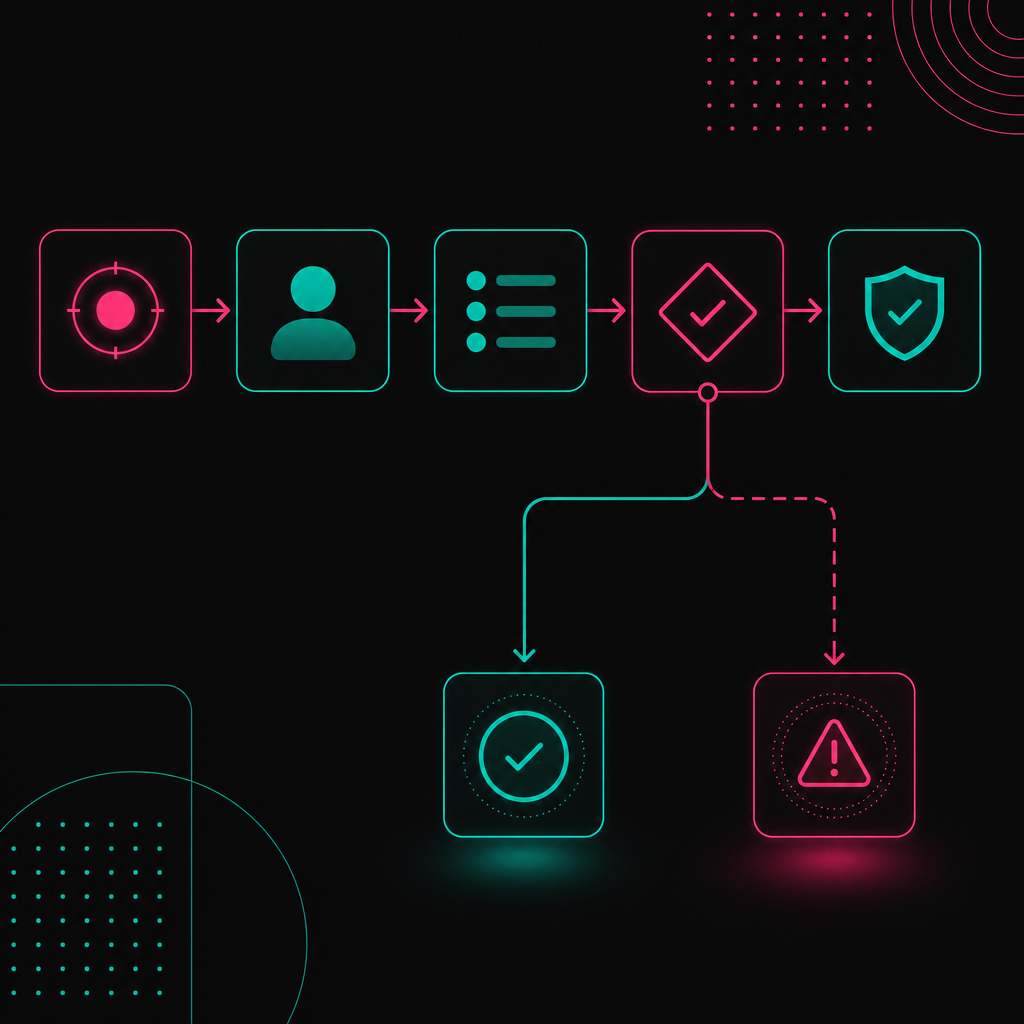
The best remote communication system begins with workflow design, not software selection. Before comparing offshore team collaboration tools, document the work, its owner, required inputs, approval authority, completion standard and escalation path. A new platform cannot repair unclear responsibilities or an undocumented process.
Most communication failures that look like people problems are actually delivery design problems. A remote employee receives a task, but nobody explains which template controls the work. Two managers provide conflicting instructions. Approval sits in a private inbox. The employee then compensates by asking more questions or waiting.
For each recurring workflow, define:
- Trigger: What starts the work?
- Owner: Who remains accountable for completion?
- Inputs: Which files, data and instructions are required?
- Sequence: In what order should the work occur?
- Approval: Who can authorise the final output?
- Definition of done: What must be true before the task closes?
- Escalation: What issue requires immediate attention, and who receives it?
- Record: Where are the task, decision and supporting documents stored?
This structure changes communication from improvised conversation into controlled delivery. It also makes onboarding easier because expectations do not live in one manager's memory.
Remotee's position is direct: the difference between a capacity gap and a capacity crisis is usually a delivery structure problem, not a talent problem. Talent quality still matters. However, quality alone cannot overcome missing inputs, shifting priorities or vague accountability.
Create a communication charter
A communication charter is a short operating document that answers practical questions. It should identify approved tools, channel purposes, working hours, response expectations, meeting rules, escalation contacts and documentation standards.
Keep it specific. "Communicate promptly" is not a usable standard. "Acknowledge an urgent payroll issue through the nominated channel and assign an owner" is clearer. Avoid unnecessary numerical promises unless the business can maintain them during leave, peak periods and system outages.
The charter should also explain that visibility is not the same as surveillance. Managers need reliable evidence of progress, not a stream of online status indicators.
Balance synchronous and asynchronous communication
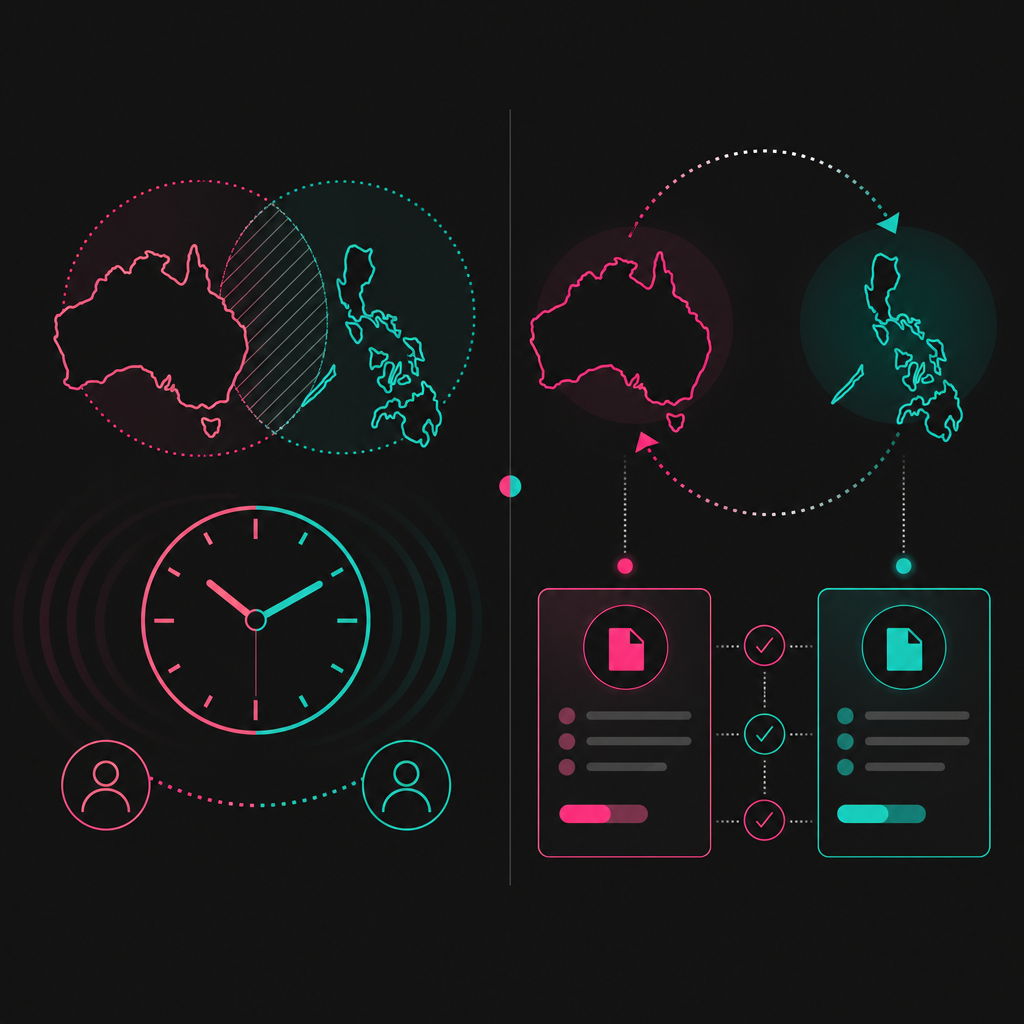
Australian remote teams should default routine coordination to asynchronous communication and reserve synchronous communication for decisions, ambiguity, sensitive conversations and urgent issues. This balance protects focused work across time zones while ensuring difficult matters receive enough context and human interaction.
Synchronous communication happens when people interact at the same time. Examples include video meetings, calls and live chat. It is useful when the cost of delayed clarification exceeds the interruption caused by the conversation.
Asynchronous communication allows people to respond at different times. Examples include project updates, recorded demonstrations, documented procedures and structured email. It is better for repeatable work, handovers and information that must remain available later.
Use synchronous channels when interaction changes the outcome
A live conversation is justified when the team needs to:
- resolve conflicting interpretations;
- make a decision involving several stakeholders;
- discuss performance or sensitive employee matters;
- respond to a genuine operational incident;
- build rapport through purposeful team interaction; or
- work through an unfamiliar process where rapid questions are likely.
Do not use a meeting merely because speaking feels easier for the organiser. That convenience transfers the interruption to every attendee.
Use asynchronous channels for repeatable delivery
Written or recorded communication works well for:
- task briefs and acceptance criteria;
- daily or weekly progress updates;
- process changes;
- routine approvals;
- handovers between Australian and offshore working hours;
- meeting notes and decisions; and
- training material that several people will reuse.
A strong asynchronous update should state what was completed, what remains, what is blocked, who owns the next action and whether a decision is required. "Still working on it" creates little operational value.
Do not confuse asynchronous work with delayed accountability
Asynchronous communication is not permission to disappear. Every task still needs an owner and visible status. Managers should be able to inspect the workflow without asking each person for an individual update.
That requires one system of record. Chat can support discussion, but final decisions and task status must return to the project platform or controlled document.
Set response times, availability and escalation rules
Response expectations should reflect urgency, operational impact and working hours. Australian businesses should avoid a single blanket response rule because it encourages constant monitoring and makes genuinely urgent messages harder to identify. Define separate standards for routine work, approvals, customer-impacting issues and critical incidents.
Start by classifying communication into practical categories such as routine, time-sensitive and urgent. Then specify the channel, expected acknowledgement, decision owner and fallback contact for each category. The organisation should choose realistic timeframes based on its service commitments rather than copying another company's policy.
An offshore employee should not have to guess whether a late Australian message is tomorrow's work or an immediate escalation. Add the required action and timing to the message itself. For example:
Payroll input is missing for the current pay run. Please review it when your roster begins and update the task before calculation starts. No after-hours action is required.
That sentence prevents uncertainty without demanding constant availability.
Respect Australia's right to disconnect
The Fair Work Ombudsman explains that eligible employees may refuse to monitor, read or respond to contact outside working hours unless that refusal is unreasonable. The entitlement began for non-small-business employees on 26 August 2024 and small-business employees on 26 August 2025, according to the Fair Work Ombudsman's right to disconnect guidance.
By 2026, after-hours expectations should already be reflected in communication policies. Managers need to distinguish genuine emergencies from poor planning. Scheduled messages, clear rosters and documented escalation coverage reduce unnecessary contact.
The rules applying to a particular employee can depend on their engagement model, location and contract. Obtain appropriate workplace advice rather than assuming one policy covers Australian employees, contractors and offshore personnel identically.
Choose offshore team collaboration tools by function
The right collaboration stack gives each type of information one logical home. Australian businesses usually need tools for messaging, video, project delivery, documentation, file control and secure access. Select products by workflow requirements, integrations, permissions and governance rather than popularity alone.
A practical stack may include Microsoft Teams or Slack for conversation, Zoom or Teams for meetings, and platforms such as Asana, Monday.com, Jira, ClickUp or Trello for project delivery. A knowledge base might sit in SharePoint, Confluence, Notion or another controlled repository.
The brand matters less than the operating rules. Before introducing a tool, answer these questions:
- What information belongs here?
- What must never be stored here?
- Is this the system of record or only a discussion channel?
- Who can create projects, channels and external accounts?
- How are permissions reviewed?
- What happens when a person leaves?
- How are decisions, files and versions retained?
- Which integrations can access sensitive information?
Avoid tool sprawl
Tool sprawl occurs when employees cannot tell where to find the current instruction. A decision starts in email, changes in chat and ends in a meeting without reaching the task record. Work then depends on personal memory.
Give each platform a defined role. For example, chat handles quick clarification, the project platform controls ownership and due work, and the knowledge base stores approved procedures. If a decision changes delivery, record it in the system controlling that delivery.
Protect sensitive information
Remote access expands the number of devices, accounts and locations involved in business data. The Australian Cyber Security Centre's Essential Eight provides recognised mitigation strategies for Australian organisations. Not every control will apply in the same way, but access management, patching and multi-factor authentication deserve deliberate attention.
The Office of the Australian Information Commissioner states in its Guide to securing personal information that organisations should take reasonable steps to protect personal information throughout its lifecycle. For remote teams, that means avoiding uncontrolled downloads, shared passwords and sensitive attachments in broad chat channels.
Payroll requires particular discipline. STP, super, leave, PAYG and reporting should be handled by people who live in payroll. Your payroll should not depend on one busy admin person remembering everything.
Run effective remote meetings in Australia
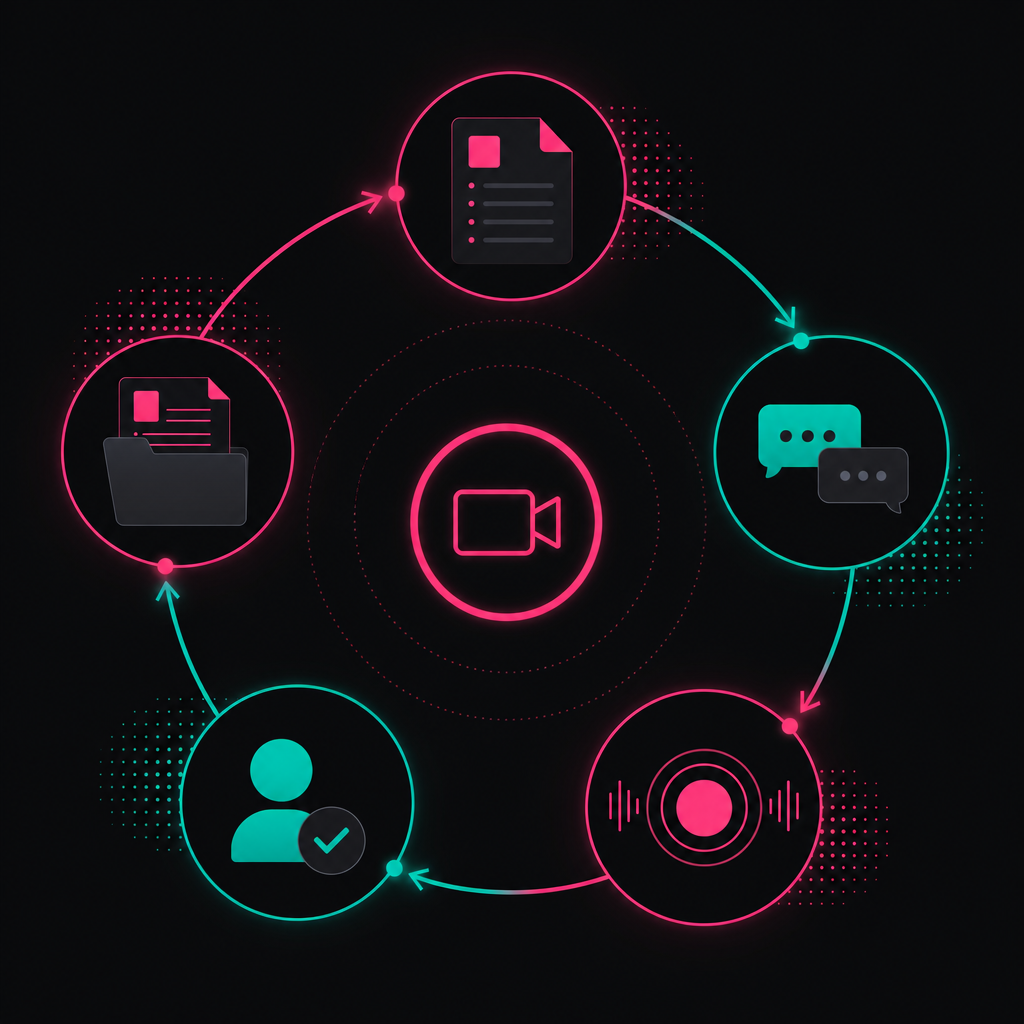
Effective remote meetings in Australia need a stated purpose, relevant attendees, prepared context, a decision owner and documented actions. If the desired outcome can be achieved through a structured written update, do not schedule the meeting. Meetings should remove uncertainty, not compensate for weak documentation.
Every invitation should answer three questions:
- What outcome is required?
- What should attendees read or prepare?
- Which decision or action will close the meeting?
Circulate background material early enough for different time zones. Begin with the decision required, not a long recap that participants could have read. End by recording the decision, owner, next action and any changed process.
Design for time-zone fairness
Australian businesses working with Philippine specialists often have useful overlap, but schedules still vary across Australian states and daylight-saving periods. Confirm times using named time zones rather than writing "our time". Rotate inconvenient meetings when several regions are involved.
Do not require offshore employees to remain on video throughout their working day. Cameras can support rapport, but continuous camera expectations do not prove output. Delivery systems should show work status directly.
Make recurring meetings earn their place
Review recurring meetings regularly. Cancel sessions that only repeat dashboard information. Short written updates can replace status meetings, while a focused call can address blockers requiring discussion.
A useful agenda follows the workflow:
- exceptions since the previous review;
- blockers requiring a decision;
- upcoming risks or deadlines;
- changes to ownership or priorities; and
- confirmed actions entered into the project system.
This approach keeps meetings tied to delivery rather than general conversation.
Manage cultural differences without relying on stereotypes
Cultural differences should be managed through explicit expectations, psychological safety and observable behaviours, not assumptions about nationality. Australian managers should explain how disagreement, escalation, feedback and decision-making work inside their organisation, then invite remote employees to clarify anything that remains ambiguous.
A manager may interpret silence as agreement. A remote specialist may see silence as respect, uncertainty or reluctance to challenge authority. Neither interpretation should be assumed. Replace inference with direct checks.
Instead of asking, "Does everyone understand?", ask:
- What will you do first?
- Which part of this brief is unclear?
- What could prevent completion?
- Which decision do you need from me?
- Can you summarise the acceptance criteria in the task?
These questions test shared understanding without putting someone under unnecessary pressure.
Make disagreement safe and useful
Managers should explicitly permit employees to identify missing information, unrealistic deadlines and compliance concerns. Reward early escalation. If people are criticised whenever they raise a risk, they will wait until the problem is visible.
Feedback should be specific and connected to the agreed standard. Describe the output, identify the gap, explain its effect and confirm the expected correction. Avoid vague labels such as "not proactive enough" unless you can define the required behaviour.
Open dialogue does not mean every decision becomes a group vote. The accountable owner should hear relevant concerns, decide and record the reasoning.
Two remote delivery examples from Australian payroll operations
Remote collaboration becomes easier to evaluate when it is attached to real operational work. In our experience, payroll provides a useful test because inputs, deadlines, approvals and compliance obligations are visible. If the communication model is weak, errors and bottlenecks surface quickly.
Recruitment agency: one controlled approval per pay cycle
The founders of an Australian recruitment agency wanted to focus on business development and operational execution, not payroll and accounting. Hiring and managing additional in-house resources did not present an attractive commercial or operational return.
We installed a payroll system and specialist team customised around the agency's software and existing operations. Discovery and implementation were completed within 2 weeks. The service then went live with defined timesheet flows, payroll responsibilities and approval checkpoints.
The founders' recurring involvement became approval of one email once per fortnight. Our team handled payroll, super, tax, compliance, inbound questions and timesheet queries.
This was not simply a staffing result. The communication improvement came from consolidating requests, defining one approval point and assigning ongoing ownership. Payroll done properly. Not squeezed in between tax returns.
Hospitality labour hire: fewer handovers and clearer compliance ownership
A hospitality recruitment and labour hire company had several internal staff and external accountants involved in weekly payroll. The structure created substantial workload and cost, while responsibility was spread across multiple parties.
Our specialist team completed discovery and presented a model that moved payroll to a fortnightly cycle. We then assumed end-to-end payroll responsibility. The change removed duplicated internal and external involvement and improved compliance oversight, including attention to industry award requirements the business had not previously identified.
The lesson for remote team communication is straightforward. More participants do not automatically create stronger control. Every additional handover can introduce delay, context loss and unclear accountability. A specialist owner operating a documented process can be more reliable than several partially involved people.
We process payroll like it matters, because to staff, it does. Payroll is a business-critical trust function, not an administrative task to squeeze between unrelated priorities.
Communication problems are usually delivery-system problems
Our view differs from much conventional remote-work advice: connection is not the first problem to solve. Most businesses do not need more chat, more virtual social events or another meeting. They need documented workflows that specify inputs, ownership, approvals, exceptions and completion standards.
Remotee's internal records across 15 recruitment agency implementations in 2026 show a reduction of 6-10 hours in non-billable partner time per pay cycle. That improvement was produced by system design around specialist delivery, not by asking founders to communicate more often.
The deeper point is that communication has a cost. Every clarification request, duplicated update and approval chase consumes the capacity the remote hire was meant to create. Measure communication quality by how reliably work moves, not by message volume.
A useful test is the handover audit. Select one recurring workflow and inspect every point where responsibility or information changes hands. For each handover, ask:
- Is the required input standardised?
- Can the receiver identify the current version?
- Is ownership transferred explicitly?
- Does the approver know a decision is waiting?
- Can another authorised person continue if someone is absent?
- Is the final decision preserved outside private chat?
This audit often exposes the true cause of remote friction. The business may think it has a communication problem when it actually has fragmented ownership.
That is why Remotee competes on reliability rather than resumes alone. Predictable delivery, not just headcount, is what moves an owner from Doer to Strategist.
Implement the communication system without overcomplicating it
Begin with one important recurring workflow, map its handovers and assign a controlled home for tasks, decisions and procedures. Train managers and remote staff on the same protocol, then review exceptions. Expanding a proven model is safer than launching a large collection of rules at once.
A practical implementation sequence is:
- Select a workflow where delay or errors create meaningful business risk.
- Document the trigger, owner, inputs, approval and definition of done.
- Identify every communication channel currently used.
- Remove duplicated channels and nominate one system of record.
- Define routine, time-sensitive and urgent escalation paths.
- Confirm working hours, availability and after-hours boundaries.
- Review access permissions and sensitive-data handling.
- Run the workflow, record exceptions and update the process.
Performance management should then focus on agreed outputs, quality, timeliness, judgement and escalation behaviour. The Queensland Government's remote working practices and resources also emphasise expectations, technology, performance, communication, trust and education.
Work health and safety obligations still matter when employees work remotely. Safe Work Australia's working from home guidance explains that organisations should manage health and safety risks associated with working from home. Policies should therefore address safe work arrangements alongside communication and technology.
Enhance remote collaboration with a managed delivery system
Remote hiring should create dependable capacity, not another layer of coordination for Australian managers. Remotee combines specialist staffing from the Philippines with documented processes, clear ownership and compliance-aware operating systems. The result is a team designed around predictable delivery rather than unmanaged headcount.
If your remote specialists are capable but managers still spend their days answering questions, chasing approvals and checking task status, adding another communication tool will not solve the underlying problem.
Contact Remotee to discuss an integrated staffing model built around your workflows, responsibilities and delivery standards.
References
The following sources support the Australian employment, privacy, cyber security and work health and safety guidance used in this article. Operational outcomes are separately identified as Remotee's internal implementation data rather than independent industry benchmarks.
- Fair Work Ombudsman, Right to disconnect
- Fair Work Ombudsman, Flexible working arrangements
- Australian Cyber Security Centre, Essential Eight
- Office of the Australian Information Commissioner, Guide to securing personal information
- Safe Work Australia, Working from home
- Business Queensland, Remote working practices, techniques and resources
FREQUENTLY ASKED QUESTIONS
Common questions
What is the best way to communicate with a remote team in Australia?
- Use a documented channel strategy. Keep tasks and ownership in a project system, approved procedures in a knowledge base, quick clarification in chat and complex discussion in meetings. Define response and escalation rules so employees do not have to infer urgency.
How often should a remote team meet?
- Meet only when live interaction improves the outcome. Use asynchronous updates for routine reporting and meetings for decisions, blockers, sensitive feedback or complex collaboration. Remove recurring meetings that repeat information already available elsewhere.
Which offshore team collaboration tools should an Australian business use?
- Choose tools covering messaging, video, project delivery, documentation, file control and secure access. The best selection depends on workflow, permissions, integrations and governance rather than brand popularity.
How do you manage communication across Australian and Philippine time zones?
- Define shared working windows, use named time zones and place routine updates in asynchronous systems. Reserve overlapping hours for decisions and complex work. State whether messages require immediate action, next-shift action or no response.
How can managers prevent misunderstandings in multicultural remote teams?
- Document expectations and ask people to restate the next action, acceptance criteria and possible blockers. Avoid national stereotypes, make respectful disagreement safe and connect feedback to observable work standards.
Does Australia's right to disconnect affect remote team communication?
- It can affect communication with eligible Australian employees. Policies should define working hours, emergency escalation and when no after-hours response is expected. Businesses should review Fair Work guidance for their circumstances.

Jon Kelly
Founder, Remotee
Jon helps Australian businesses build compliance-led offshore teams that scale without the burnout. NDIS, accounting, mortgage broking, recruitment and digital marketing.
KEEP READING
Related posts
offshore staffing for small business Australia
Offshore Staffing for Australian SMEs: How to Build Your First Remote Team
Offshore staffing for small business in Australia works when an SME assigns suitable roles to skilled overseas professionals, documents how work moves, protects…
4 August 2026 · 17 min read
Offshore staffing service inclusions
Offshore staffing service inclusions
An offshore staffing service should include workforce planning, candidate sourcing, screening, compliant employment, payroll, onboarding, technology setup, secu…
31 August 2026 · 20 min read
offshore staffing real estate Australia
Offshore Staffing for Australian Real Estate Businesses: Growing Your Portfolio Remotely
Offshore staffing helps Australian real estate businesses increase capacity by assigning documented property management, sales administration, marketing and com…
30 August 2026 · 15 min read
READY TO SCALE WITHOUT THE BURNOUT?
Build a compliance-led offshore team in 3–4 weeks.
Tell us about your current bottleneck and we'll show you what a Remotee placement would look like for your operation.
Or get our playbooks emailed to you instead.