
The Benefits of Outsourcing vs Hiring In-House: A Cost Comparison for Australian Businesses
- Outsourcing
- Business Growth
- Payroll Services
- Cost Reduction
- Remote Teams
Australian businesses are facing a capacity crisis. It is not just about finding talent; it is about the cost of keeping them and the infrastructure required to support them. In 2026, the conversation has shifted from "can we find someone?" to "can we afford the overhead?" The traditional model of hiring internally, with its associated superannuation, payroll tax, and regulatory burden, is buckling under the weight of modern compliance requirements.
The benefits of outsourcing are no longer just about saving a few dollars on an hourly rate. It is about structural efficiency. It is about moving from a model where you invest heavily in infrastructure to one where you invest directly in output. When you strip back the hype, outsourcing versus hiring in-house comes down to a simple calculation: do you want to manage an internal system of people and processes, or do you want to buy a predictable result?
Key Takeaways
- Outsourcing provides substantial operational expenditure (OpEx) savings by eliminating recruitment fees, payroll tax, and overhead costs associated with local employment.
- The strategic advantage lies in access to specialised skills immediately, bypassing the local talent shortages affecting Australian sectors like recruitment and hospitality.
- Risk is significantly reduced when outsourcing compliance-critical functions like payroll to specialists, compared to relying on generalist internal staff.
- Scalability becomes a linear cost rather than a step-change expense, allowing businesses to flex up or down without redundancy liabilities.
- The real value in outsourcing emerges when it is paired with documented delivery systems, not just cheaper labour.
Summary Table: Outsourcing vs In-House Comparison
| Feature | In-House Hiring | Outsourcing (Offshore/Remote) |
|---|---|---|
| Initial Cost | High (Recruitment fees, onboarding, equipment) | Low (Often immediate start, minimal equipment) |
| Ongoing Cost | High (Salary + Super + Payroll Tax + Benefits + Overheads) | Fixed or Variable (Service fee or hourly rate, no local tax) |
| Speed to Hire | Slow (4-12 weeks in current market) | Fast (Days to 2 weeks) |
| Scalability | Difficult (Rigid employment contracts, redundancy costs) | Flexible (Scale up/down with demand) |
| Compliance Risk | High (Reliant on internal admin staying updated) | Managed (Provider shoulders regulatory burden) |
| Management Focus | High (Requires daily supervision, HR management) | Low (Outcome-focused management) |
The True Cost of an Australian Employee
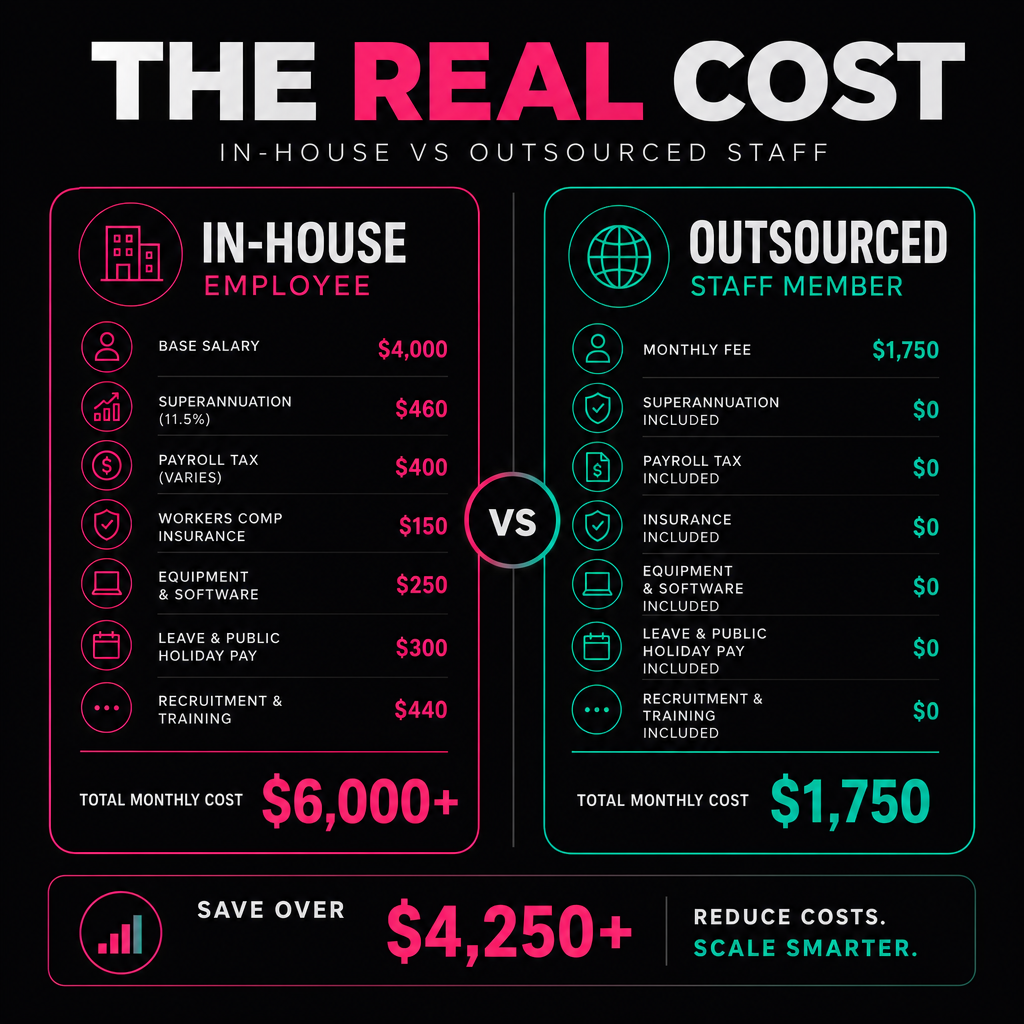
When Australian business owners look at hiring, they often fixate on the base salary. This is a dangerous mistake. The fully loaded cost of an employee is significantly higher. For every $100,000 you pay in salary, you are paying an additional amount in statutory obligations. In Australia, this includes the 11% Superannuation Guarantee, Payroll Tax (which varies by state but hovers around 4-5%), and workers' compensation insurance. Then there are the hidden costs: annual leave loading, sick leave, and the tangible overheads of desk space, software licences, and equipment.
In 2026, the Fair Work Ombudsman is increasingly vigilant on compliance. One misstep in interpreting a modern award can result in back-pay orders that cripple a small business. When you hire in-house, you absorb the risk of that interpretation. You are trusting that your internal team, likely a generalist office manager or a busy founder, understands the intricate nuances of the Fair Work Act. This is a high-stakes gamble.
Outsourcing, particularly to a provider who specialises in a specific function, shifts this risk. The provider is responsible for the employment obligations. You pay a fee. That fee includes their labour, their compliance, and their infrastructure. The variable costs of running a business become fixed. You can predict your cash flow with much greater accuracy because you are not suddenly hit with an unexpected payroll tax adjustment or a workers' compensation premium hike.
Strategic Outsourcing: It is About Systems, Not Just Staff
There is a pervasive myth in the industry that outsourcing is simply "cheaper labour." This view misses the point entirely and leads to failed engagements. The benefits of outsourcing are realised only when it is wrapped in a delivery system. Talent quality matters, but quality alone is not enough. The real problem in most businesses is not headcount. It is the absence of documented workflows, clear ownership, and repeatable processes.
The difference between a capacity gap and a capacity crisis is usually a delivery structure problem, not a talent problem. Most providers compete on cost, speed, or resumes. We compete on reliability. Our position is that adding headcount without adding system is how scaling creates chaos. If you outsource a role to a remote worker but expect your local team to manage them without a defined process, you have not solved your problem; you have exported it.
For outsourcing to work, it must be predictable delivery, not just headcount. The goal is to move business owners from Doer to Strategist. This requires installing compliance-baked operating systems around specialist roles. When you engage a provider like Remotee, you should not just be getting a pair of hands. You should be getting a process that guarantees an outcome.
The Outsourcing vs In-House Debate: Financial Deep Dive
Let us look at the numbers. Consider a mid-tier hospitality recruitment and labour hire company. They had multiple people in-house as well as external accountants, managing their payroll at great expense. They processed payroll weekly, creating massive workloads and disrupting the flow of the business.
We came in and completed a discovery phase. We presented a system that eliminated all internal staff and external accountants related to this function. We moved their payroll from weekly to fortnightly. Our team picked up the payroll, plug and play. All done for them.
The outcome was a reduction in operational expenditure (OpEx) staffing costs. They saw a reduction in payroll costs simply because we moved them to a more efficient, compliant cycle. Perhaps more importantly, they saw an improvement in compliance. They were not aware of multiple industry award requirements. They were underpaying staff simply because the complexity of the Hospitality Award [General] was too much for a generalist admin to handle while doing their other job. By outsourcing to specialists, they dodged a bullet that would have cost them significantly in back-pay.
Recruitment Agency Case Study
Take another example. A recruitment agency I worked with had founders who wanted to focus on new business development or operational execution, not payroll and accounting. Hiring in-house and managing those resources was not deemed to be a good ROI commercially or efficiently.
We installed a payroll system and team, customised to their business and the software they use. We executed a full discovery and implementation within two weeks. We were live and managing their payroll. The intervention changed their business.
Now, the founders approve one email once per fortnight. Our team manages all payroll, super, compliance, and tax. All inbound queries and timesheet queries are handled by us. The result is our clients focus on what they do best: recruitment. Across our Accountee recruitment agency clients in 2026, we have seen a reduction in non-billable partner time of 6 to 10 hours per pay cycle. That is time partners can now spend on clients or business development.
The Specialist Payroll Argument
There is a strong consensus in the business community that "payroll should stay in-house because it is too sensitive to outsource." I disagree with this position. Payroll is often safer when it is outsourced to specialists.
Most payroll risk comes from internal overload, manual checks, rushed pay runs, and people wearing too many hats. In many small Australian businesses, payroll is "squeezed in between tax returns" by a generalist bookkeeper. It is treated as an afterthought. But payroll is a business-critical trust function. When payroll is wrong, staff confidence drops quickly. Accurate, on-time payroll protects culture, cash flow, compliance, and the employer brand.
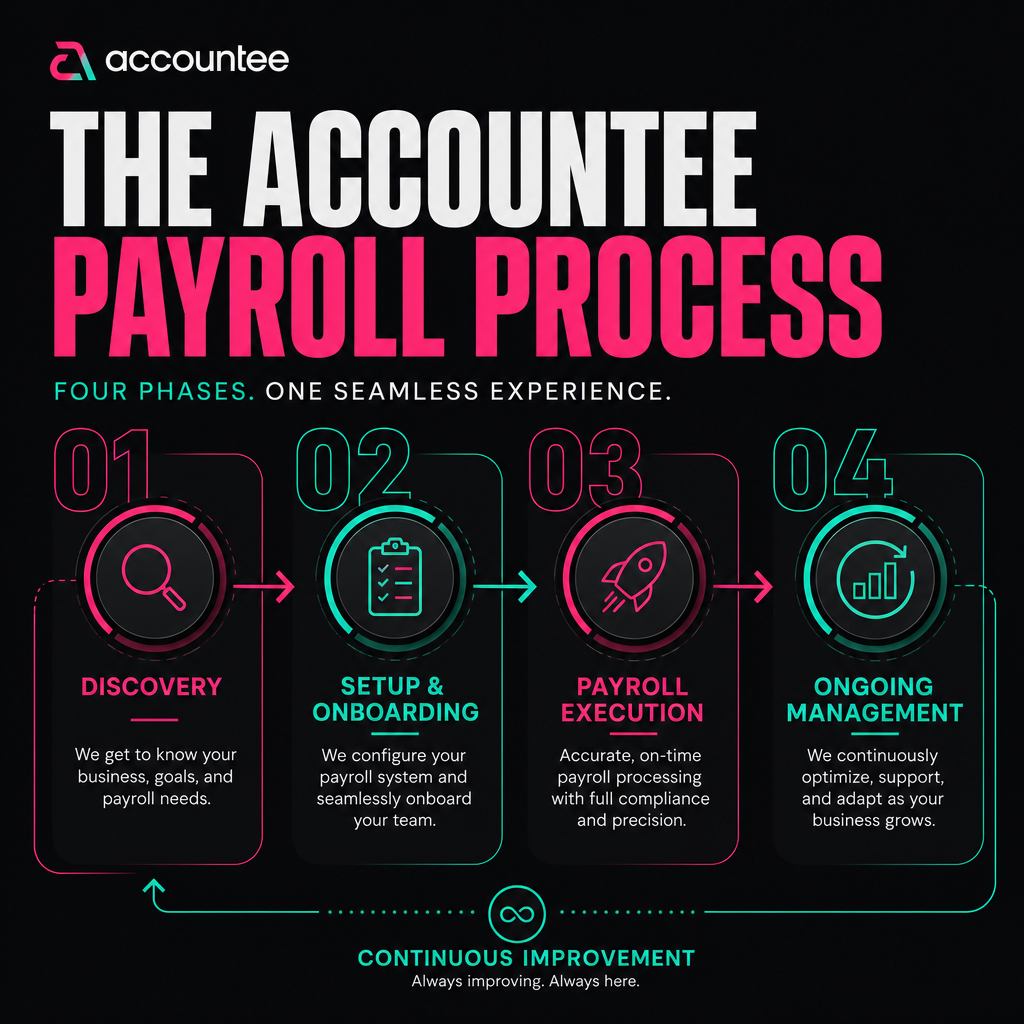
Your payroll should not depend on one busy admin person remembering everything. A specialist payroll team brings structure, controls, deadlines, and a compliance focus every cycle. We use what we call "The Accountee Payroll Process." It is a rigorous framework designed to eliminate error.
This process involves four phases. Phase 1 is Payroll Discovery and Setup. We review the client's current payroll process, pay cycles, staff types, award considerations, systems, approvals, and reporting requirements. We build a clear payroll operating model.
Phase 2 is the Payroll Transition. We take over the payroll function from the client, including required access, templates, pay run calendars, employee data, timesheet flows, and approval checkpoints.
Phase 3 is Full Payroll Processing. We process payroll end-to-end. This includes timesheet review, pay calculations, leave, allowances, deductions, STP, superannuation, payroll reporting, and pay run preparation.
Phase 4 is Ongoing Payroll Management. We provide ongoing payroll delivery, issue resolution, compliance support, reporting, and account management to ensure payroll runs accurately, on time, and with minimal internal admin.
This is "payroll done properly." It is compliance-first payroll, every pay run. It avoids payroll fines before they become expensive lessons. STP, super, leave, PAYG, and reporting are handled by people who live in payroll. They are not jack-of-all-trades accountants. They are specialist payroll accountants, not generalist bookkeepers.
Advantages of Outsourcing: Beyond the Balance Sheet
While the cost savings are clear, the advantages of outsourcing extend into areas that are harder to quantify but just as valuable.
Talent Access and Quality
Australia is currently experiencing a skills shortage in key sectors. The unemployment rate is historically low, meaning the talent pool is shallow. When you hire in-house, you are often fighting for a small group of candidates who are being courted by everyone else. This drives up salaries and extends time-to-hire.
Outsourcing, particularly to skilled markets like the Philippines, opens up a global talent pool. You are not settling for the best person available in your suburb. You are accessing the best person for the role in a region that produces highly educated, English-speaking professionals. For roles like recruitment coordination, admin support, and specialised accounting, the calibre of talent available offshore is exceptional.
24-Hour Operational Coverage
For service-based businesses, the sun never sets. By having a team in a different time zone, you can effectively extend your operating hours without forcing your local team to work night shifts. We have clients who submit work at the end of their Australian day and wake up to find it completed, processed, and ready for them the next morning. This "follow the sun" model accelerates project timelines and improves client responsiveness.
Focus on Core Business
Every hour a business owner spends on non-core tasks is an hour not spent on strategy. If you are a recruitment agency owner, you should be building relationships with clients, not troubleshooting payroll software. If you run a hospitality group, you should be focusing on the customer experience, not rostering admin.
Outsourcing acts as a filter. It removes the lower-value, high-volume repetitive tasks from your plate. This allows you to operate at your highest point of contribution. It moves you from being the person who "does" everything to the person who "directs" everything. This shift is essential for scaling a business beyond the reach of the founder.
When Outsourcing Makes Sense (And When It Does Not)
Outsourcing is not a silver bullet. It works best when tasks are repetitive, process-driven, or require specialised expertise that is expensive to source locally. It is perfect for back-office functions like payroll, data entry, bookkeeping, and initial recruitment screening.
It is less effective for roles that require deep, physical integration with your company culture or high-level strategic decision-making that relies on intimate local market knowledge. However, even here, lines are blurring. We see highly skilled offshore professionals excelling in marketing, graphic design, and even software development.
The key is to start small. Do not try to outsource your entire business overnight. Identify one pain point. Perhaps it is the payroll processing that ruins your weekend. Perhaps it is the candidate screening that piles up on your desk. Solve that one problem. Build the system. Prove the value. Then expand.
Overcoming the Myths
Sceptics often point to loss of control as a reason to avoid outsourcing. The argument is that you cannot manage someone you cannot see. This is an outdated view based on a lack of trust and a lack of systems.
If you have a documented workflow, you do not need to see the person to manage the output. You manage the checkpoints. You manage the deliverables. In fact, outsourcing often gives you more control because you have clear service level agreements (SLAs) and reporting structures that are often missing in informal in-house arrangements.
Another myth is that offshore staff will not understand the Australian context. This is a training issue, not a geography issue. When you invest in onboarding and treat your remote staff as an extension of your local team, they develop a deep understanding of your business and your market. They know the awards. They know the compliance landscape. They know your clients.
Conclusion: The Strategic Choice
The debate between outsourcing vs in-house is settled by data and experience. For Australian businesses in 2026, the burden of local employment is heavy. The costs are high. The risks are significant.
Outsourcing offers a path to scalability, efficiency, and risk mitigation. It allows you to access specialist talent, reduce your OpEx, and focus on what you do best. But it requires a shift in mindset. It requires you to value systems over headcount. It requires you to prioritise predictable delivery over the illusion of control.
If you are tired of the admin grind, if you are worried about payroll compliance, or if you simply cannot find the staff you need locally, it is time to look at offshore staffing as a serious strategic option. Do not let capacity constraints hold your business back. Build a system that supports your growth, rather than a team that creates more work.
Ready to explore how outsourcing can transform your operations? Contact us today for a discussion on your specific needs. You can also review our case studies to see real-world examples of our delivery systems in action.
References
- Australian Taxation Office (ATO). 'Superannuation guarantee'. Accessed 2026.
- Fair Work Ombudsman. 'Payroll tax and obligations'. Accessed 2026.
- Australian Bureau of Statistics (ABS). 'Labour Force, Australia'. Accessed 2026.
FREQUENTLY ASKED QUESTIONS
Common questions
What are the main cost benefits of outsourcing for Australian businesses?
- The primary benefit is the reduction in the fully loaded cost of employment. You eliminate payroll tax, superannuation guarantees, workers' compensation premiums, and overhead costs like office space and equipment. You also save on the hidden costs of recruitment and turnover. For many roles, the total cost of an outsourced provider is 40-60% lower than the equivalent local hire.
Is outsourcing payroll safe for Australian companies?
- Yes, it is often safer than keeping it in-house. Most payroll risks stem from internal overload, manual errors, and a lack of specialised knowledge. Outsourcing to specialist payroll accountants ensures that experts who live and breathe payroll are managing your compliance. We process payroll like it matters, because to your staff, it does.
How does outsourcing compare to hiring in-house for scalability?
- Outsourcing offers superior scalability. In-house hiring is a step-change expense. Hiring a new staff member is a fixed, long-term commitment. Scaling down involves redundancy costs and legal issues. Outsourcing allows you to scale up or down linearly. You can increase hours or add team members for a project, then reduce them when the work is done, without redundancy payouts or HR headaches.
What are the common risks of outsourcing and how can they be mitigated?
- Common risks include communication barriers and a perceived loss of control. These are mitigated by choosing a provider that focuses on 'delivery systems' rather than just 'staff.' By establishing clear workflows, documented processes, and regular reporting checkpoints, you maintain control over the output. Hiring providers with strong cultural alignment and English proficiency, like those in the Philippines, further mitigates communication risks.
Can outsourcing help with the Australian talent shortage?
- Absolutely. Outsourcing allows you to bypass the tight local labour market entirely. You access a global pool of talent, giving you access to skilled professionals in fields like IT, accounting, and administration where local talent is scarce and expensive. It is not about replacing local jobs; it is about filling capacity gaps that local hiring cannot solve, allowing your local business to grow.
How quickly can I implement an outsourced team compared to local hiring?
- The speed is vastly different. Local hiring in Australia can take 4 to 12 weeks from advertising to start date, often longer for specialist roles. With a streamlined provider like Remotee, we can execute a full discovery and implementation within two weeks. We can be live and managing critical functions like payroll almost immediately, bridging capacity gaps in days rather than months.

Jon Kelly
Founder, Remotee
Jon helps Australian businesses build compliance-led offshore teams that scale without the burnout. NDIS, accounting, mortgage broking, recruitment and digital marketing.
KEEP READING
Related posts
scaling business offshore Australia
Scaling Your Business with Offshore Teams: A Step-by-Step Australian Guide
Scaling a business offshore in Australia requires more than hiring lower-cost staff. Sustainable growth comes from selecting repeatable roles, documenting deliv…
21 August 2026 · 20 min read
offshore virtual assistant Australia
Building an Offshore Virtual Assistant Team for Australian Businesses
An offshore virtual assistant team gives Australian businesses reliable capacity when each role has defined outcomes, documented workflows, secure access and cl…
10 August 2026 · 18 min read
offshore staffing roi
Calculating the True ROI of Offshore Staffing for Australian Businesses
Offshore staffing ROI compares the measurable value created by offshore staff with the complete cost of recruiting, onboarding, managing and supporting them. Au…
19 July 2026 · 19 min read
READY TO SCALE WITHOUT THE BURNOUT?
Build a compliance-led offshore team in 3–4 weeks.
Tell us about your current bottleneck and we'll show you what a Remotee placement would look like for your operation.
Or get our playbooks emailed to you instead.