
Thinking About Offshore Staffing? What Australian Businesses Need to Know Before They Start in 2026
- offshore staffing
- remote hiring Australia
- offshore staffing Philippines
- Australian business operations
- offshore staffing guide
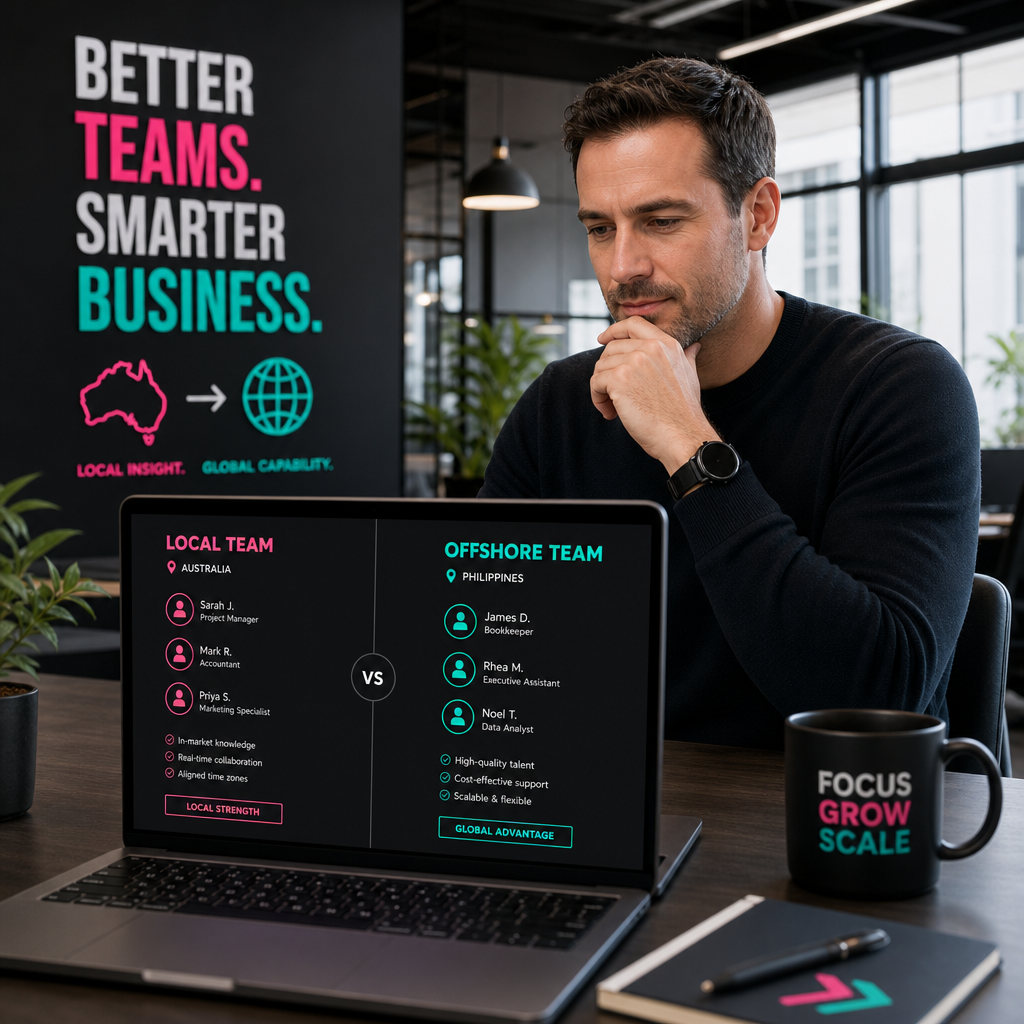
If you have found yourself Googling "offshore staffing" at 11pm, you are probably not doing it because business is running perfectly. You are doing it because the cost of hiring locally has become genuinely painful, good candidates are disappearing before you can make an offer, and the work is piling up faster than your team can handle it. You are curious. You are also nervous.
That nervousness is completely reasonable. Offshore staffing carries a reputation for being complicated, risky, and something that only large corporations with dedicated HR departments can pull off. I want to be direct with you: most of that reputation is outdated, and a good portion of it was never accurate to begin with. But there are also real situations where offshoring is the wrong move, and any provider who tells you otherwise is not being straight with you.
This guide is for Australian business owners who are in the early consideration stage. I am going to walk you through why businesses are exploring this in 2026, answer the concerns I hear most often, give you an honest view of when it does not work, and show you what a low-risk first step actually looks like. No hype, no bait-and-switch. Just what you need to know.
Key Takeaways
- Labour costs and persistent skills shortages are pushing Australian businesses of all sizes toward offshore staffing in 2026, not just multinationals.
- The most common fears (quality, data security, communication) have practical, tested solutions when the right delivery structure is in place.
- Offshoring is not right for every business or every role. Knowing when to wait is just as important as knowing when to move.
- A managed offshore model significantly reduces risk compared to a DIY approach, particularly for businesses new to remote hiring.
- The first step does not have to be a leap. A single, well-scoped role with documented workflows is a sensible way to begin.
- Cost savings are real, but treating them as the only metric is how businesses end up disappointed. Reliability and process fit matter more.
Summary: Signs You Are Ready vs Signs to Wait
| Signs You Are Ready to Explore Offshore Staffing | Signs You Should Wait |
|---|---|
| You have repeatable, documented tasks that eat your team's time | Your processes are undocumented and change constantly |
| You are paying $80,000+ AUD for roles that do not require local presence | You have no one available to onboard and manage a new team member |
| You have trialled local outsourcing or contractors before | This would be your first time managing any remote worker |
| You can define the role clearly in a job brief | The role requires daily face-to-face client interaction |
| You are growing and need to scale capacity without exploding overhead | You are in a cash-flow crisis and need a quick fix |
| Leadership is willing to invest in process documentation | You are hoping offshore staff will fix internal disorganisation |
| You have 4-6 weeks to onboard properly | You need someone productive in under two weeks |
Why Australian Businesses Are Exploring Offshore Staffing in 2026
The conversation has changed. Five years ago, offshore staffing was mostly discussed in hushed tones, as if it were a slightly embarrassing cost-cutting measure. In 2026, it is a mainstream operational decision for businesses ranging from two-person consultancies to mid-market firms with 200 staff.
Three structural forces are driving this.
The Cost of Local Hiring Has Become a Real Constraint
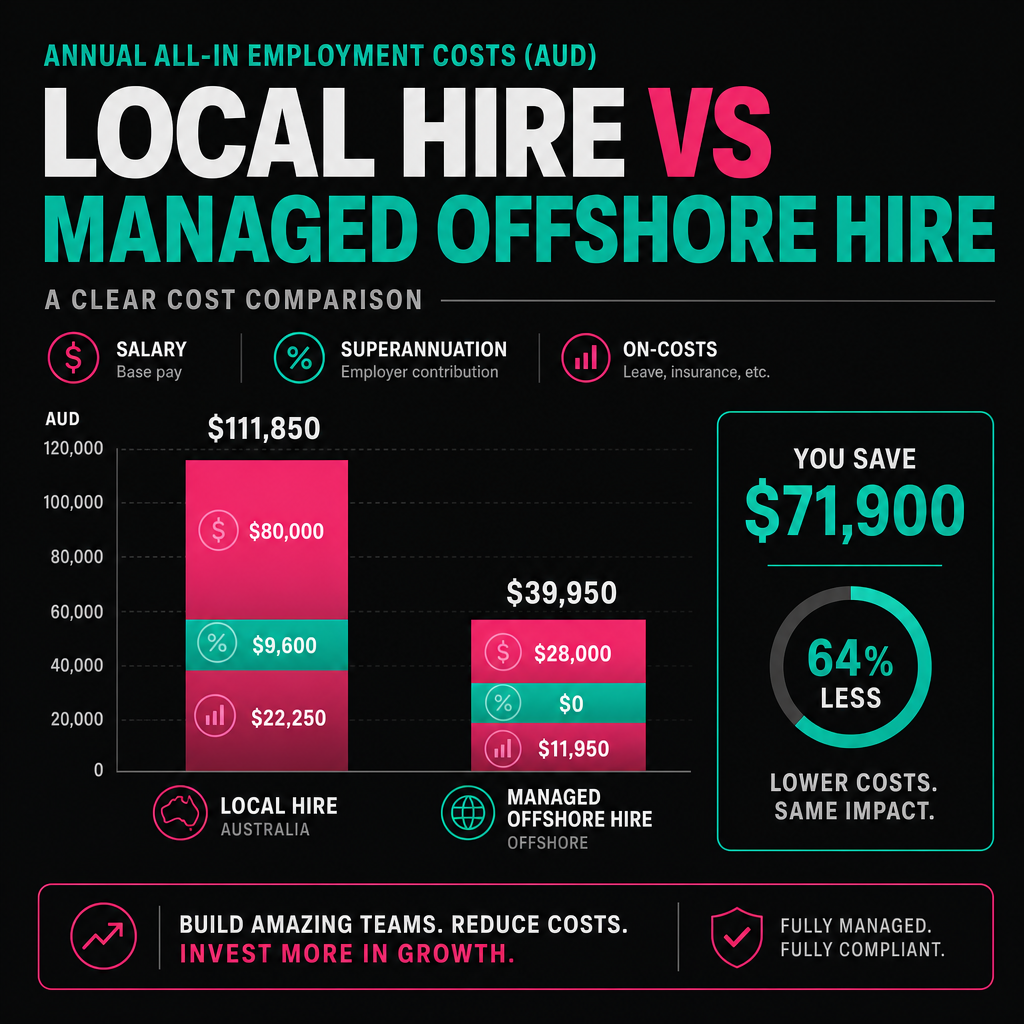
The Australian Bureau of Statistics reported that the Wage Price Index rose 3.2% in the year to September 2025, continuing a sustained period of above-trend wage growth. When you layer compulsory superannuation contributions (now at 11.5% under the Superannuation Guarantee), payroll tax thresholds, and the cost of recruiting locally, a mid-level administrative or support role in a capital city can land at $70,000 to $95,000 AUD all-in per year before you account for office space and equipment.
For a small business, that is not a minor line item. It is often the difference between hiring and not hiring, between growing capacity and staying stuck.
The Talent Shortage Is Not Easing
The National Skills Commission and Jobs and Skills Australia have consistently identified critical shortages across accounting, IT, digital marketing, administration, and customer service roles. In regional areas the picture is even more acute. This is not a temporary post-pandemic blip. Demographic trends suggest the tightness in skilled labour markets will persist for years, particularly in professional services and technology.
Businesses that wait for the local market to loosen are, in many cases, waiting for something that is not coming.
Fair Work Complexity Is Adding Friction
The Fair Work Act 2009 and its associated Modern Awards create a compliance environment that is genuinely complex, particularly for businesses in industries with multiple award streams. Getting a hire wrong, misclassifying a role, or missing an annualised salary review can carry significant exposure. The ACCC and Fair Work Ombudsman have both been active in publicising underpayment investigations across sectors. Many business owners are quietly factoring this compliance risk into their hiring decisions, and offshore roles, managed through a reputable provider with clear contractual structures, can reduce some of that domestic employment law exposure.
None of this means offshore staffing is a silver bullet. But it does explain why the conversation is happening at the scale it is in 2026.
Common Concerns and the Honest Answers
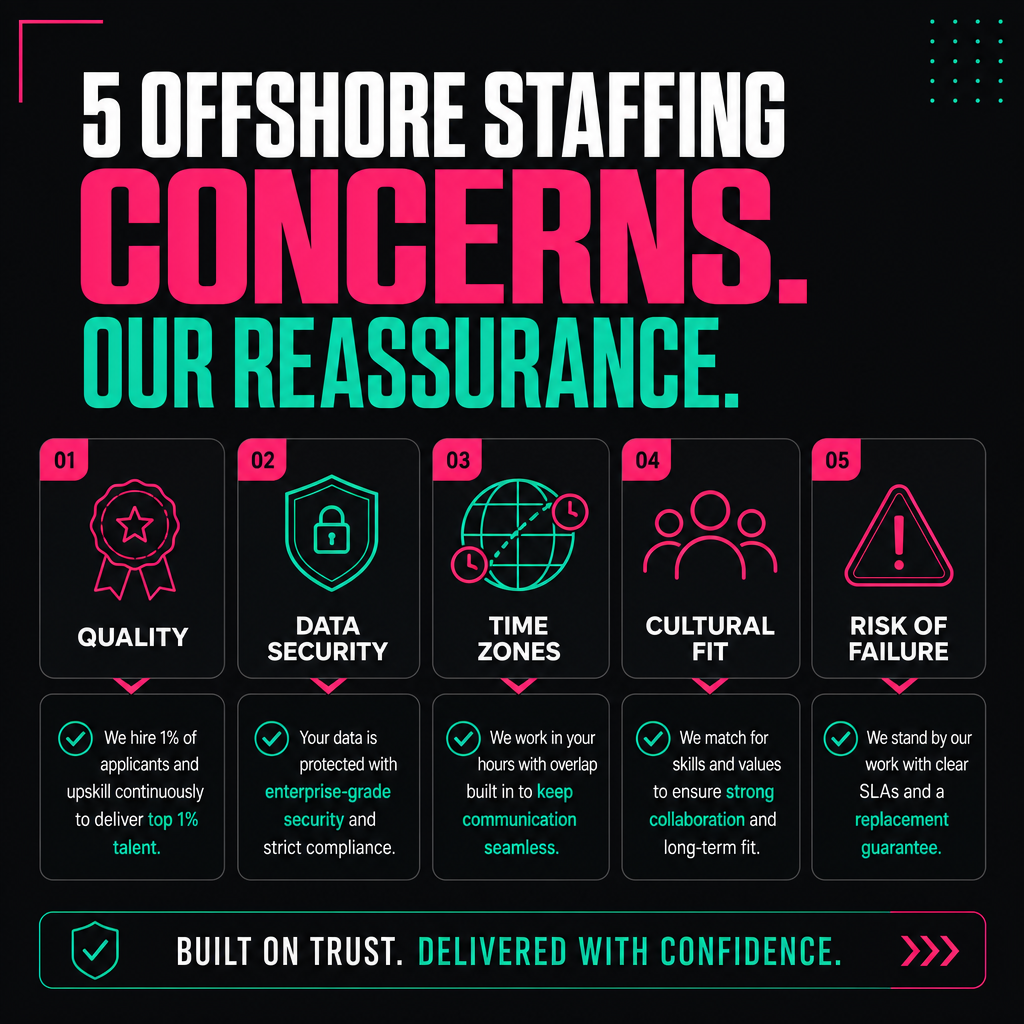
I have spoken to hundreds of Australian business owners about offshore staffing. The same concerns come up every time. Here is what I actually think about each one.
"How Do I Know the Quality Will Be Good Enough?"
Quality is always a legitimate question, and I would be worried about any provider who brushed it off. But here is what I have observed consistently: quality problems in offshore arrangements are almost never a talent problem. They are a delivery structure problem.
When a business hires an offshore team member, gives them a vague brief, no documented workflows, and checks in once a week, and then complains the output is inconsistent, that is not an indictment of the talent pool. That is a management structure that would produce inconsistent output from any hire, local or offshore.
The businesses that get excellent results from offshore staffing have done the work of documenting what "good" looks like. They have defined their workflows, their quality checks, and their communication cadences before the hire starts. The talent in the Philippines, where the workforce is highly educated, largely English-speaking, and experienced in supporting Australian, US, and UK businesses, is strong. The structure around that talent is what determines the outcome.
This is the core belief I operate from: adding headcount without adding system is how scaling creates chaos. Talent quality matters, but quality alone is not enough. The real problem in most businesses is not headcount. It is the absence of documented workflows, clear ownership, and repeatable processes.
"What About Data Security and Privacy?"
This is one I take seriously, and you should too. Australian businesses operating under the Privacy Act 1988 and the Australian Privacy Principles have obligations around how personal data is handled, stored, and accessed, including by third parties overseas.
The right answer here is not to dismiss the concern. It is to work with a provider who has documented data handling protocols, uses encrypted platforms, restricts system access on a need-to-know basis, and includes data processing clauses in the contractual arrangement. The Office of the Australian Information Commissioner (OAIC) has published guidance on cross-border data flows, and any reputable offshore staffing provider should be familiar with it.
Practically, most offshore roles involve access to the same categories of business data that a local contractor or outsourced service provider would access. The risk is real but manageable when the controls are in place.
"Will Time Zones Be a Problem?"
For Philippine-based offshore staff, the time zone gap with Australian eastern states is between one and three hours, depending on daylight saving. The Philippines sits at UTC+8. This is not a significant operational barrier for most roles, and many Philippine-based professionals are accustomed to working schedules that align with Australian business hours.
For roles that require real-time collaboration during core hours, this is easy to solve at the hiring and scheduling stage. For roles that are largely asynchronous, the slight offset can actually be an advantage, with outputs ready for review when you start your day.
"Will There Be Cultural Fit Issues?"
Cultural fit is a fair question that is often used as a polite proxy for other concerns. The Philippines has a long history of professional services delivery to Australian businesses. The cultural overlap is significant: English is an official language of the Philippines, the educational system is modelled on Western frameworks, and Filipino professionals are well-regarded for their diligence, client-service orientation, and adaptability.
That said, cultural fit does require active work. Onboarding that treats an offshore hire as a second-tier team member will produce second-tier engagement. Businesses that include their offshore staff in team meetings, brief them on company values, and give them genuine ownership of their work consistently report stronger retention and performance.
"What If It Does Not Work Out?"
This is the fear underneath most of the other fears: the sunk cost, the disruption, the embarrassment of having tried something and having it fail. It is a reasonable concern, and it is why your first offshore hire should be scoped conservatively.
A single, well-defined role with documented expectations and a managed provider behind it is a far lower-risk entry point than attempting to hire, manage, and support offshore staff independently. The managed model exists precisely to reduce this risk, and I will get into what that looks like shortly.
When Offshore Staffing Is NOT the Right Move
I want to be direct here because not enough providers say this plainly.
Offshore staffing is not right for your business right now if:
Your processes are undocumented and chaotic. If the person currently doing the work cannot explain clearly how they do it, an offshore hire will inherit that chaos and amplify it. The first step in that situation is process documentation, not hiring.
You need a culture carrier, not a task executor. Some roles require deep embeddedness in your physical workplace, your client relationships, and your local context. A sales director who needs to be in the room, a site manager on a construction project, a therapist with a patient caseload. These roles do not suit offshore delivery.
You are in a cash-flow crisis and treating this as a quick fix. Offshore staffing reduces cost over time, but it is not an immediate cash-flow solution. There are setup costs, onboarding time, and a learning curve. If your business needs relief in the next four weeks, this is not the mechanism.
You have no internal capacity to onboard and manage. Offshore staff are not autonomous robots. They need a point of contact, feedback loops, and someone who will answer their questions. If your entire leadership team is at maximum capacity and cannot give a new hire genuine attention for the first month, wait until you have that bandwidth.
The role has a legal or regulatory requirement for Australian residency or local licensure. Some roles, particularly in financial advice, legal practice, and certain healthcare settings, have licensing requirements that mean the work must be done by an Australian-licensed professional. Know your industry obligations before you scope offshore.
Being honest about these limits is not a sales tactic. It is how you avoid a bad experience that poisons your view of offshore staffing permanently.
What Good Looks Like: Managed Model vs DIY
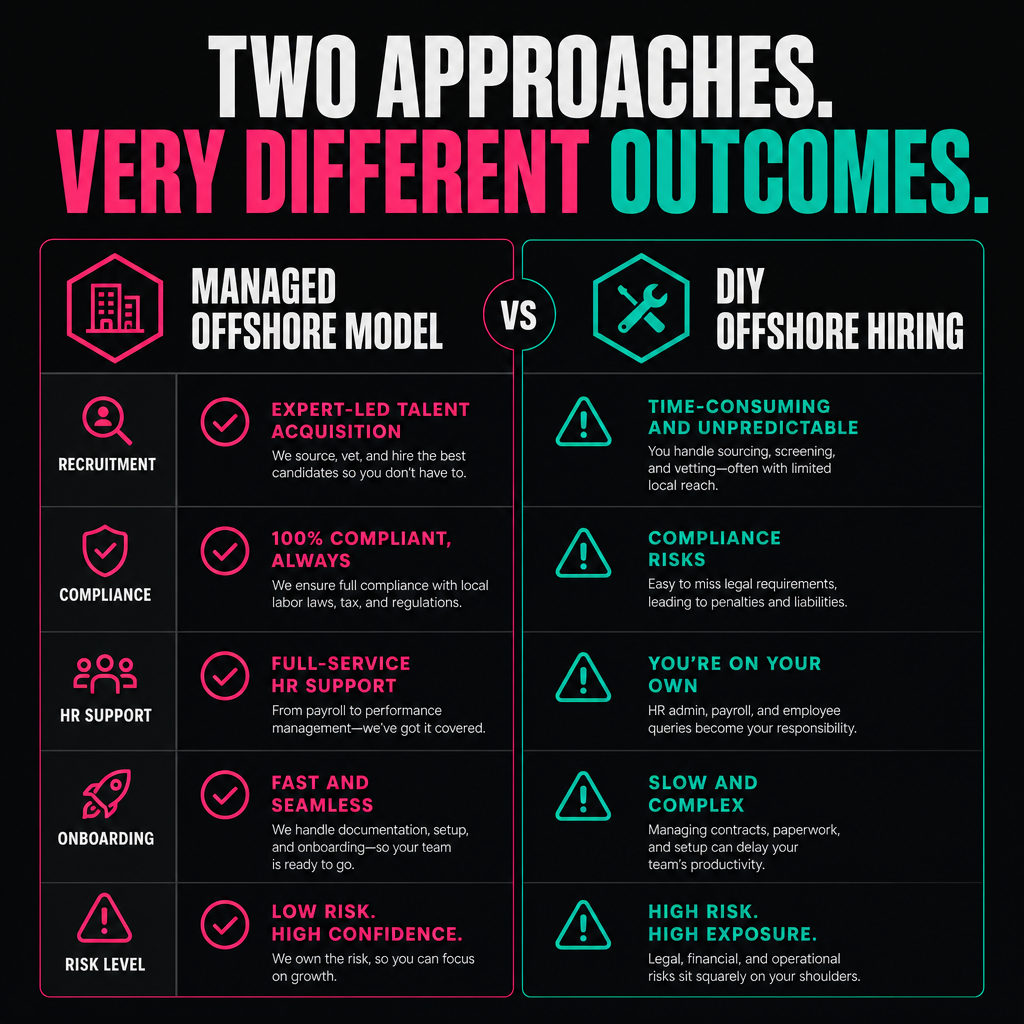
There are broadly two ways Australian businesses approach offshore staffing. Understanding the difference is important before you commit to anything.
The DIY Approach
Some businesses attempt to hire offshore staff independently: posting on international job boards, conducting their own interviews, setting up their own payroll entity or using a freelance arrangement, and managing compliance themselves. This can work, but it requires:
- Knowledge of Philippine employment law and common contractor structures
- The ability to vet candidates without local market knowledge
- Internal HR and payroll capability to manage the arrangement
- Time investment in setup that most small-to-medium businesses simply do not have
The DIY approach tends to attract businesses motivated purely by cost. The problem is that cost minimisation at the setup stage often produces the quality and reliability problems that fuel offshore staffing's negative reputation. Cheap and unsupported offshore hiring is not offshore staffing done well. It is just offshore hiring done badly.
The Managed Model
A managed offshore staffing model means working with a provider who handles recruitment, vetting, employment, payroll, compliance, and ongoing HR support for your offshore team member. You get a dedicated professional working in your business, with the operational and legal infrastructure managed by someone who does this at scale.
This is the model I recommend for businesses new to offshore staffing, and honestly, for most businesses at any stage. The cost difference between DIY and managed is often smaller than people expect, and the reliability difference is substantial.
With a managed model, you are buying predictable delivery, not just headcount. You are buying a system around the hire, not just the hire itself.
For a clear picture of how this works end-to-end, Remotee's process is worth reviewing: see how Remotee structures the offshore staffing process.
What Roles Actually Work Offshore?
One of the most common questions I get is: "What can I actually give to an offshore team member?"
The honest answer is: more than you probably think. Here is a practical breakdown.
Roles that consistently work well offshore:
- Bookkeeping and accounts payable/receivable
- Payroll administration and processing
- Data entry, database management, and CRM management
- Graphic design and digital asset production
- Social media scheduling and content coordination
- SEO and digital marketing support
- IT support, system administration, and helpdesk
- Recruitment coordination and sourcing
- Legal document drafting support and paralegal tasks
- Executive assistant and administrative support
- Customer service (chat, email, and tier-one phone support)
- Project coordination and scheduling
Roles that require more careful scoping:
- Client-facing relationship management (can work with the right structure, but requires trust-building time)
- Sales development roles (outbound prospecting works; closing tends to work better locally)
- Roles requiring deep local market knowledge (real estate appraisals, local government liaison)
The pattern across the roles that work well is the same: they are task-definable, process-driven, and do not require physical presence. If you can describe the work in a clear standard operating procedure, you can most likely deliver it offshore.
Real Results: What This Looks Like in Practice
Case Study 1: Recruitment Agency Frees Up 8 Hours Per Pay Cycle
A recruitment agency I worked with had a founder who wanted to focus entirely on new business development and key client relationships. Instead, he was regularly pulled into payroll queries, timesheet approvals, and compliance questions. The business had considered hiring someone in-house but the ROI on a dedicated internal resource for a business their size did not stack up.
We came in, completed a full discovery of their payroll process, their software, their pay cycle, their award obligations, and their approval requirements. Within two weeks we were live, managing their payroll end-to-end. The outcome: one email approval, once per fortnight. Our team handles all payroll processing, superannuation, compliance, STP, and inbound staff queries.
The founder reclaimed between 6 and 8 hours per pay cycle, which he reinvested entirely into business development activity. The compliance outcomes improved because the work was being done by specialists focused on payroll, not by someone squeezing it in between other tasks. Payroll done properly. Not squeezed in between tax returns.
Across our 15 implementations with recruitment agency clients in 2026, the average reduction in non-billable partner time is 6 to 10 hours per pay cycle. That is not a rounding error. That is a material recovery of capacity in a business.
Case Study 2: Hospitality Labour Hire Business Reduces Payroll Overhead and Lifts Compliance
A hospitality recruitment and labour hire company came to us with a payroll function that had grown organically and expensively. They had multiple internal staff and external accountants across the payroll process, were running payroll weekly (which in their model created a significant recurring workload), and were spending considerably more than necessary to keep the function running.
We completed discovery, identified the redundancies in the process, and presented a model that consolidated the function, moved the cycle to fortnightly, and installed our team as the end-to-end payroll operator. The result: a reduction in operational staffing costs, a reduction in payroll processing costs from the shift to fortnightly, and a meaningful improvement in compliance. The compliance finding was significant, they were not across several industry award requirements that applied to their workforce. Not jack-of-all-trades accounting. Specialist payroll delivery.
This is the kind of compliance exposure that sits quietly in a business until it does not. Avoid payroll fines before they become expensive lessons.
The Principle Behind Both Stories
In both cases, the problem looked like a capacity problem. It was actually a delivery structure problem. Adding more local staff would have added more cost without fixing the underlying architecture of how the work was being done. The intervention was structural, not just numerical.
This is what I mean when I say the difference between a capacity gap and a capacity crisis is usually a delivery structure problem, not a talent problem.
How to Take the First Low-Risk Step
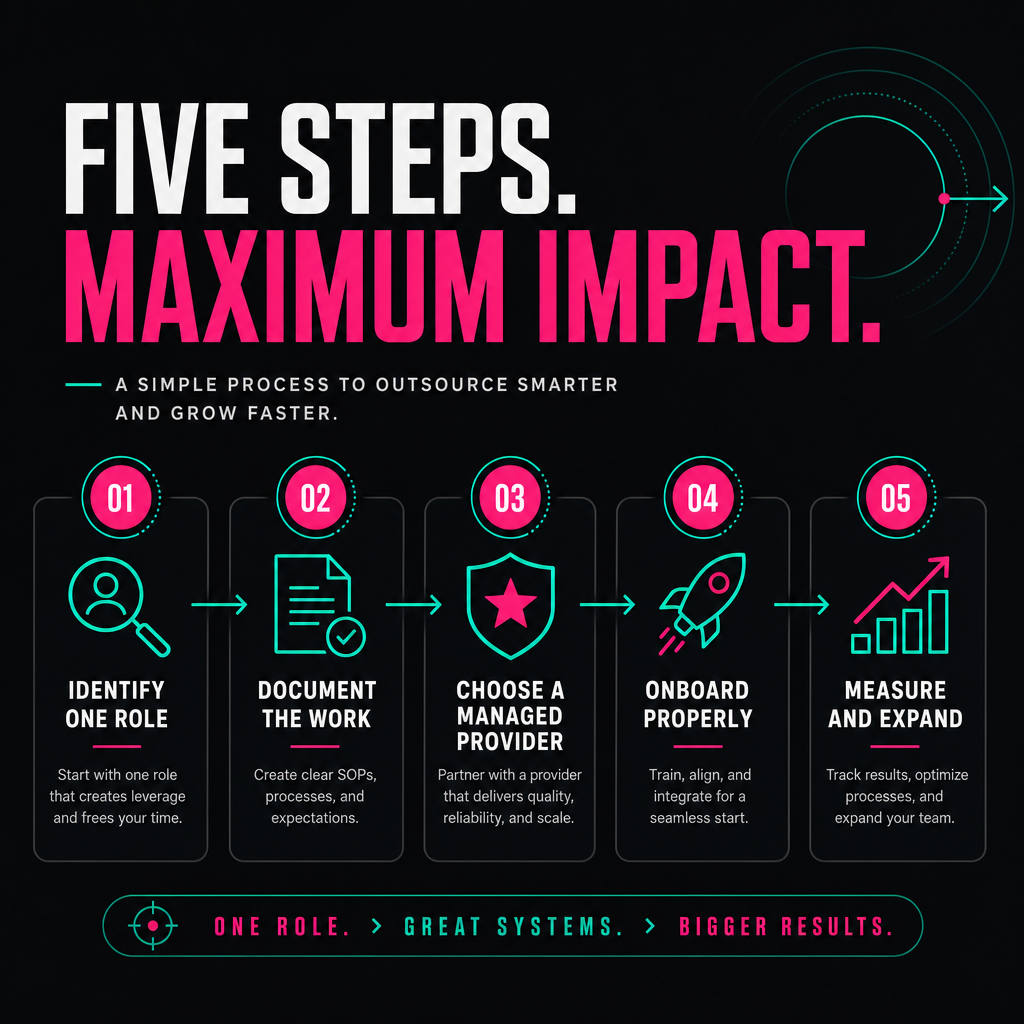
If you have read this far and you are thinking "this might actually make sense for my business," here is a practical first-step framework.
Step 1: Identify One Role with Defined, Repeatable Work
Do not start by offshoring your most complex or most client-sensitive function. Start with a role where you can define the tasks clearly, the quality of output is measurable, and the impact of a short learning curve is manageable. Administrative support, bookkeeping, or a specific digital task are common strong starting points.
Step 2: Document the Work Before You Hire
Spend a week (ideally less) creating a simple standard operating procedure for the role. It does not need to be a 40-page manual. It needs to cover: what tasks are involved, how they are done, what tools are used, what good output looks like, and who the hire communicates with. This exercise is valuable regardless of whether you proceed with offshore staffing. It makes the work visible.
Step 3: Choose a Managed Provider, Not a Freelance Platform
For your first offshore hire, use a provider who manages the employment, compliance, and HR infrastructure. The marginal cost is worth it for the risk reduction. This is not the place to save money by going unsupported.
Step 4: Onboard Like It Matters
Plan for a four-to-six week onboarding period. Include your offshore hire in team communication channels. Give them a named point of contact. Check in regularly in the first month. This investment pays back many times over in retention and performance.
Step 5: Measure and Expand
After three months, review the arrangement against the metrics you defined upfront. Output quality, turnaround times, communication reliability, cost per task. If it is working, you have proof of concept to expand. If something needs adjustment, you have data to work with.
For more on what this process looks like with Remotee, you can explore our offshore staffing services or review transparent pricing. If you want to talk through whether your business is a fit before committing to anything, get in touch directly.
The Numbers That Matter: Offshore Staffing Cost Context for Australian Businesses
I want to give you a realistic picture of the cost dynamics because this is where a lot of the confusion and disappointment comes from.
A full-time offshore staff member in the Philippines through a managed provider typically costs between $18,000 and $36,000 AUD per year, depending on the role, experience level, and the specific provider model. Senior or specialist roles sit at the higher end. General administrative roles sit lower.
Compare that to a locally employed equivalent in Sydney or Melbourne, where the all-in cost (salary, superannuation, leave loading, workers compensation, equipment) for a comparable role typically falls between $65,000 and $95,000 AUD per year.
The cost differential is real and material. But here is the caveat I always give: the savings are only realised if the offshore hire is actually productive. A poorly scoped, poorly onboarded offshore hire who produces half the expected output at half the cost is not a win. It is a 50% efficiency drag at a discounted price.
This is why the process and structure around the hire matter at least as much as the cost comparison. You can see a breakdown of how Remotee structures this commercially on the pricing page.
What Clients Actually Say
Across the businesses we have worked with, the feedback that comes up most consistently is not about the cost saving. It is about the relief of having a functional, reliable system. One client in the professional services space described it this way: "I stopped worrying about whether it was going to get done. It just gets done."
That might sound like a modest outcome. It is not. For a business owner who has been carrying operational worry as background noise for years, removing that noise is a significant change to how they work and how they lead.
You can see more detailed outcomes on the Remotee case studies page.
The Bottom Line
Offshore staffing in 2026 is a mature, well-understood model that works reliably for Australian businesses when it is set up properly. The fears that circle it, quality problems, security risks, communication breakdowns, are mostly the product of poor implementation rather than inherent flaws in the model.
The businesses that get it right share a few characteristics: they are honest about their readiness, they choose a managed model for the first hire, they invest in documentation and onboarding, and they define success before they start.
If you are sitting on the fence, the best thing you can do is have an honest conversation with a provider who will tell you when it is not the right fit. That is what we do.
Talk to the Remotee team about your specific situation. No obligation, no pitch. Just a straight answer.
References
- Australian Bureau of Statistics. "Wage Price Index, Australia." ABS. https://www.abs.gov.au/statistics/economy/price-indexes-and-inflation/wage-price-index-australia
- Jobs and Skills Australia. "Skills Priority List." Australian Government. https://www.jobsandskills.gov.au/data/skills-priority-list
- Fair Work Ombudsman. "Pay and Conditions." Australian Government. https://www.fairwork.gov.au/pay-and-wages
- Office of the Australian Information Commissioner. "Australian Privacy Principles." OAIC. https://www.oaic.gov.au/privacy/australian-privacy-principles
- Office of the Australian Information Commissioner. "Sending Personal Information Overseas." OAIC. https://www.oaic.gov.au/privacy/privacy-guidance-for-organisations-and-government-agencies/handling-personal-information/sending-personal-information-overseas
- Australian Taxation Office. "Super Guarantee Rate." ATO. https://www.ato.gov.au/businesses-and-organisations/super-for-employers/work-out-if-you-have-to-pay-super/super-guarantee-percentage
FREQUENTLY ASKED QUESTIONS
Common questions
How much does offshore staffing cost for an Australian business?
- For a managed, full-time offshore staff member based in the Philippines, expect to pay between $18,000 and $36,000 AUD per year depending on the role and experience level. Senior or specialist positions sit at the higher end. When you compare this to the all-in cost of a locally employed equivalent in a capital city, which typically ranges from $65,000 to $95,000 AUD per year including superannuation, leave, and on-costs, the difference is material. Be realistic about setup costs and onboarding time, as these affect your true return in the first few months.
Is offshore staffing legal for Australian businesses?
- Yes. Hiring offshore staff is legal for Australian businesses. The most common arrangement is through a managed service provider who employs the staff member in the Philippines under Philippine employment law, with the Australian business engaging the provider commercially. This is a standard employer-of-record model. You should ensure your provider has clear contractual terms, data handling protocols aligned with the Australian Privacy Act 1988, and transparent employment documentation. Always get proper advice if your industry has specific licensing or regulatory requirements.
How do I protect sensitive business data when using offshore staff?
- Data security starts with the controls your provider has in place: encrypted access, role-based system permissions, documented data handling procedures, and contractual obligations around confidentiality. Your provider should be able to point you directly to their data security protocols. On your side, limit system access to what the role genuinely requires, use a password manager rather than sharing credentials, and ensure your contracts include data processing clauses consistent with the Australian Privacy Principles under the Privacy Act. The OAIC provides guidance on cross-border disclosure obligations.
What roles are best suited to offshore staffing?
- Roles with repeatable, process-driven, task-definable work are the strongest fit. Common examples include bookkeeping and accounts, payroll administration, data entry and CRM management, graphic design, digital marketing support, SEO, IT helpdesk, recruitment coordination, executive assistance, and customer service via chat or email. The common thread is that the work can be documented in a clear process and does not require the person to be physically present in your office or Australia.
How long does it take to get an offshore staff member started?
- With a managed provider, the typical timeline from initial brief to a hire starting is four to eight weeks. This covers role scoping, candidate sourcing, vetting, interviews, selection, and employment setup. Add another four to six weeks for a proper onboarding period before you can expect consistent full-productivity output. Plan for ten to fourteen weeks from decision to full productivity as a realistic benchmark.
What is the difference between a managed offshore model and hiring a freelancer directly?
- A managed model means a provider handles the employment, payroll, compliance, and HR infrastructure for your offshore team member. You get a dedicated professional working in your business with the legal and operational complexity managed externally. Hiring a freelancer directly means you take on the management of the arrangement yourself, including vetting, contract structure, tax and payment logistics, and performance management without local support. For a first offshore hire, the managed model significantly reduces risk and is worth the additional cost.
Do I need to change how I manage my team to work with offshore staff?
- Some change is needed, but it is not as significant as most people fear. The main adjustment is moving from informal, ad-hoc task management to more structured communication and documented workflows. Daily or weekly check-ins, clear task tracking, and documented processes are the building blocks of effective offshore team management. Businesses that make these adjustments typically find their overall operational clarity improves, not just their offshore team performance.
Can a small business under 10 staff use offshore staffing effectively?
- Absolutely, and small businesses are increasingly among the strongest use cases. When you have a small local team, a single offshore hire covering a specific function such as bookkeeping, design, or admin support can free up the local team disproportionately. The key is scoping the role tightly and having one person internally who owns the relationship and onboarding. A business with five local staff and one offshore team member handling finance administration is a common and effective model.

Jon Kelly
Founder, Remotee
Jon helps Australian businesses build compliance-led offshore teams that scale without the burnout. NDIS, accounting, mortgage broking, recruitment and digital marketing.
KEEP READING
Related posts
transparent provider pricing comparison
Offshore Staffing Pricing Transparency: How to Compare Provider Quotes Without Getting Caught Out
Transparent provider pricing comparison means evaluating offshore staffing quotes against total cost of engagement, not headline hourly rate. A genuine quote it…
13 September 2026 · 17 min read
onboarding offshore staff
Onboarding Offshore Staff: A Step-by-Step Process for Australian Businesses in 2026
Hiring offshore staff is the easy part. Posting a role, reviewing candidates, making an offer, most Australian businesses can work through that sequence without…
10 June 2026 · 29 min read
offshore staffing agencies
Offshore Staffing Agencies in Australia: How to Vet and Choose the Right One in 2026
Most Australian businesses that have tried offshore staffing and walked away disappointed made the same mistake at the start: they picked an agency on price. Th…
3 June 2026 · 21 min read
READY TO SCALE WITHOUT THE BURNOUT?
Build a compliance-led offshore team in 3–4 weeks.
Tell us about your current bottleneck and we'll show you what a Remotee placement would look like for your operation.
Or get our playbooks emailed to you instead.