
Offshore Staffing Agencies in Australia: How to Vet and Choose the Right One in 2026
- offshore staffing
- offshore recruitment
- remote hiring Australia
- business operations
- Philippine staffing

Most Australian businesses that have tried offshore staffing and walked away disappointed made the same mistake at the start: they picked an agency on price. The pitch was compelling, the hourly rate looked great on a spreadsheet, and six months later they were managing a revolving door of replacements, chasing quality issues, and wondering whether offshore hiring was ever going to work for them. The problem was almost never the talent. It was the absence of any delivery structure around the talent.
Offshore staffing is not a shortcut. It is a strategic decision that, done properly, gives growing Australian businesses a long-term capability layer they could not build locally at the same cost. Done poorly, it adds headcount without adding capacity and creates more problems than it solves. The difference between those two outcomes sits almost entirely in the agency you choose and the system they bring with the hire.
This guide is built for decision-stage buyers: business owners and operations leaders in Australia who are actively evaluating offshore staffing agencies and want to know what actually separates a reliable partner from a resume-delivery service. I will walk you through what these agencies really do, the red flags that should end a conversation immediately, a 10-point vetting checklist, the questions worth asking before you sign anything, and what realistic costs look like in the Australian market in 2026.
Key Takeaways
- Price is the least reliable selection criterion. Compliance, recruitment depth, security standards, and support model matter far more over a 12-month horizon.
- Most offshore staffing problems are delivery structure problems, not talent problems. The agency you choose should bring a system, not just a hire.
- Data security and legal compliance are non-negotiable. Ask specifically about ISO 27001, Philippine DOLE compliance, and how payroll is handled before you go any further.
- Australian business-hours overlap is a practical requirement for most roles. Confirm minimum overlap hours in writing.
- Replacement guarantees vary wildly. Understand exactly what triggers a free replacement and what the timeline is.
- A good agency moves you from Doer to Strategist. If the onboarding process is entirely on you, that is a warning sign.
Summary Table: Key Criteria When Evaluating Offshore Staffing Agencies
| Criterion | What to Look For | Red Flag |
|---|---|---|
| Compliance and legal structure | Philippine DOLE compliance, employer-of-record model, local HR support | No clear legal employment entity in the Philippines |
| Recruitment depth | Role-specific technical testing, reference checks, structured interviews | CV-only shortlisting, no skills validation |
| Data security | ISO 27001 certification or equivalent controls, signed NDAs, device policies | Vague answers about data handling |
| Australian hours overlap | Minimum 4-6 hours overlap with AEST/AEDT confirmed in writing | Only night-shift or async arrangements |
| Payroll and HR handling | Fully managed payroll, statutory benefits, leave management | You carry payroll liability or admin |
| Replacement guarantee | Free replacement within defined window, clear trigger conditions | No guarantee or charge for replacements |
| Support model | Dedicated Australian account manager, performance reviews | Offshore-only support, no local contact |
| Pricing transparency | Fixed monthly fee, itemised inclusions, no hidden setup costs | Quote-only pricing, reluctance to itemise |
| Onboarding and SOP support | SOPs, workflow documentation, structured onboarding plan | Hire-and-hope, no structured handover |
| Retention track record | Published or verifiable 12-month retention rate | No data, evasive on retention metrics |
What an Offshore Staffing Agency Actually Does
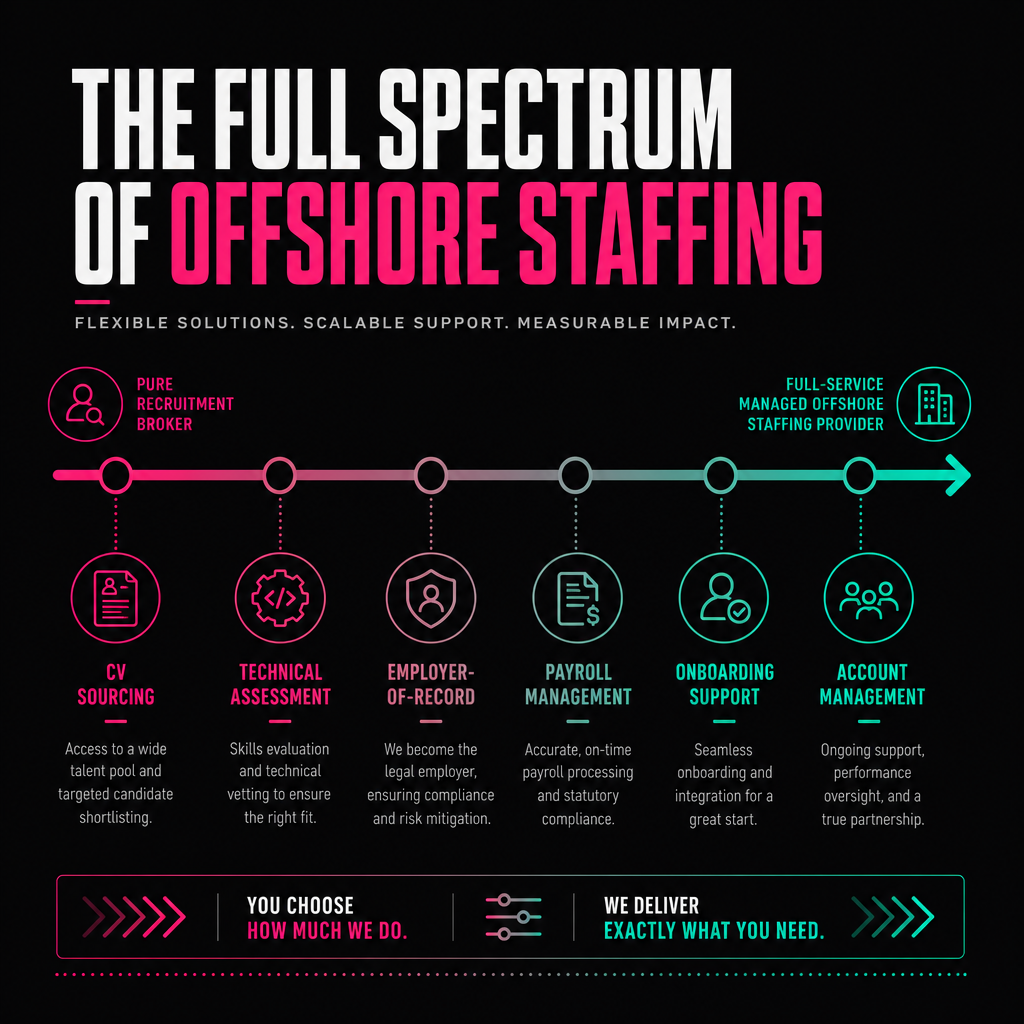
The term gets used loosely. At one end of the market you have pure recruitment brokers: they source candidates, present CVs, and hand them over. At the other end you have managed service providers who act as an employer-of-record, handle payroll and HR, provide in-country infrastructure, and take accountability for ongoing performance. Most agencies sit somewhere between these two poles and describe themselves with the vocabulary of the higher-value option regardless of where they actually operate.
Understanding this distinction is the most important thing a buyer can do before starting any evaluation. Here is what a full-service offshore staffing agency should actually be doing for your business:
Sourcing and recruitment
This means active headhunting, not just posting to job boards. For specialist roles in accounting, mortgage broking support, NDIS administration, or digital marketing, the best candidates are employed and not actively looking. A credible agency has established sourcing channels, a pre-screened talent pool, and a recruitment process that includes role-specific technical testing, not just a resume review and a culture-fit interview.
At Remotee, we headhunt from the top 1% of Philippine talent and run technical assessments benchmarked against Australian industry standards. For an accounting role, that means testing against Australian tax law and software like Xero or MYOB, not generic bookkeeping competency.
Employment, payroll, and HR
A legitimate agency operates as or partners with an employer-of-record in the Philippines. They handle payroll in Philippine Pesos, manage statutory contributions (SSS, PhilHealth, Pag-IBIG), administer leave, and ensure compliance with Philippine DOLE regulations. This structure removes you from payroll liability and HR administration. If an agency is asking you to set up your own entity, handle compliance, or manage payroll directly, you are not working with a managed staffing provider. You are doing DIY outsourcing.
Onboarding and integration
This is where the gap between agencies is most visible. A resume-delivery service considers onboarding complete when the hire shows up on day one. A delivery-focused agency installs the specialist into your workflow with documented processes, clear output expectations, and a structured review cadence. The quality of this onboarding is what determines whether the hire produces consistent results or becomes another management burden.
Ongoing support and account management
Your support structure should include a dedicated Australian-based account manager who understands your industry, reviews performance against defined outcomes, and flags issues before they become problems. Offshore-only support creates a communication lag that compounds over time, particularly when performance or compliance issues need to be addressed quickly.
Red Flags to Walk Away From
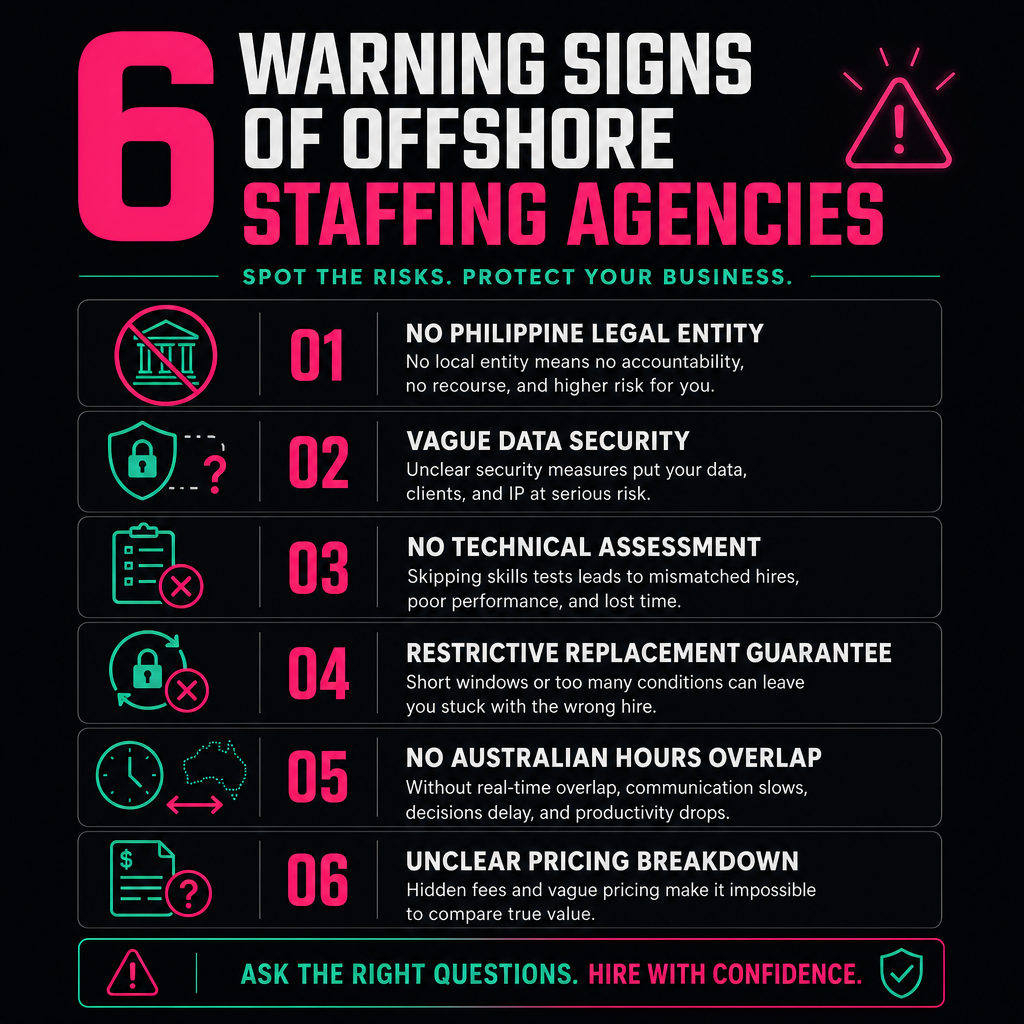
I have reviewed a lot of agency proposals over the years. These are the patterns that should end a conversation:
No clear legal entity in the Philippines. If the agency cannot name the Philippine company that will employ your specialist, their registered address, and their DOLE compliance status, stop there. You have no visibility over the employment structure and no recourse if something goes wrong.
Vague or evasive answers about data security. For any role that touches client data, financial records, or personal information, ISO 27001 certification or a documented equivalent security framework is the minimum bar. If the answer is "we take security seriously" without specifics, that is not a security posture. That is a sales line.
No technical assessment in the recruitment process. Reviewing CVs and conducting a personality interview does not validate technical capability. Ask specifically what role-specific tests are used and what the pass threshold is. If the answer is "we review their experience and do a culture interview," the shortlist quality is unpredictable.
Replacement guarantees buried in conditions. Some agencies offer a "free replacement guarantee" that is effectively unusable: it only triggers after a performance management process you are responsible for running, or it excludes the most common reasons for replacement. Read the conditions carefully.
No Australian-hours overlap. Asynchronous work is viable for some task types. For roles that require collaboration, client communication, or real-time coordination with your team, no overlap means communication delays that accumulate into delivery problems. Confirm minimum overlap hours before you proceed.
The pricing does not itemise what is included. A single monthly number with no breakdown makes it impossible to evaluate whether payroll, HR, infrastructure, account management, and replacement guarantees are included. Agencies that resist itemisation are usually protecting a margin built on things you have not noticed yet.
No retention data. A 12-month retention rate below 80% is a meaningful signal about the working environment, the quality of the match, or both. Ask for the number. If the agency does not track it or will not share it, draw your own conclusion.
The 10-Point Vetting Checklist
Use this checklist in every agency conversation. Each point includes what to ask and what a credible answer looks like.
1. Legal and employment structure
Ask: "Which Philippine entity employs our specialist, and can you provide their DOLE registration?" A credible answer names the entity and provides documentation on request. This is non-negotiable.
2. Data security certification
Ask: "Do you hold ISO 27001 certification? If not, what documented security controls do you have?" Look for specifics: encrypted devices, VPN policies, data handling SOPs, signed confidentiality agreements. Remotee's compliance and training framework covers these controls in detail and is available for review before you commit.
3. Recruitment and assessment process
Ask: "Walk me through your recruitment process step by step. What technical assessments do you use for this specific role type?" The answer should include sourcing method, technical testing, reference checking, and shortlist criteria. Ask how many candidates are typically assessed before a shortlist is presented.
4. Australian business-hours overlap
Ask: "What are the guaranteed overlap hours with Australian Eastern Standard Time?" Get the answer in writing. Four to six hours minimum is a practical threshold for most collaborative roles.
5. Payroll and statutory compliance
Ask: "Do you manage payroll, SSS, PhilHealth, and Pag-IBIG contributions directly, or is that passed to us?" The answer should be fully managed on their side. If you are taking on any payroll liability or administration, factor that cost and risk into your evaluation.
6. Replacement guarantee terms
Ask: "What is your replacement guarantee, and what specifically triggers it? Is it free and what is the timeline?" Read the written policy, not just the verbal summary. The key questions are: what constitutes a valid trigger, who runs the performance management process, and what the replacement timeline is.
7. Onboarding and SOP support
Ask: "What does your onboarding process include? Do you provide workflow documentation or SOPs, or is that our responsibility?" An agency that expects you to build all the onboarding structure is shifting the most time-consuming part of the engagement onto you.
8. Account management structure
Ask: "Who is our primary contact in Australia, and how often will they be in contact with us?" An Australian-based account manager who understands your industry and checks in with a defined cadence is a meaningful differentiator. An offshore support ticket system is not account management.
9. Pricing transparency
Ask for an itemised breakdown of what is included in the monthly fee. Confirm: payroll and HR admin, infrastructure (desk, hardware, internet), account management, replacement guarantee, training and onboarding support, and any setup fees. Check the Remotee pricing page for a transparent example of how this should be structured.
10. Retention and track record
Ask: "What is your 12-month specialist retention rate?" Then ask for case studies or references from clients in your industry. Remotee's 12-month retention rate sits above 95%, which reflects both the quality of the match and the working environment built around the role.
Questions to Ask Before You Sign
Beyond the checklist, these questions help you assess cultural fit and realistic expectations:
- "Can you describe a placement that did not work out and how you handled it?" Honest agencies have a structured answer. Evasive answers are a signal.
- "How do you handle performance issues during the first 90 days?" The response should include defined checkpoints and a clear escalation path.
- "What industries do your specialists have most experience in?" Generic answers suggest a generalist pool. Specific answers suggest a specialist pipeline.
- "How do you keep specialists current with Australian regulatory changes?" For accounting, mortgage broking, and NDIS roles, this is a compliance question, not a nice-to-have.
- "What happens if our specialist resigns?" Understand the timeline, process, and cost of a replacement before you are in that situation.
Realistic Cost Expectations for Australian Businesses in 2026
Offshore staffing costs in Australia vary more than most buyers expect. The range for a fully managed specialist role, including payroll, HR, account management, and infrastructure, typically sits between $1,800 and $3,500 AUD per month depending on role complexity, seniority, and what is included in the fee.
A direct hire locally for the same role would typically cost $65,000 to $95,000 AUD per year in salary alone, before superannuation, leave entitlements, recruitment costs, office space, and hardware. The cost comparison is compelling. The risk is assuming that a lower monthly offshore rate automatically translates to a lower total cost if the agency model requires you to manage HR, rebuild onboarding processes repeatedly, or absorb the productivity loss from high turnover.
When evaluating cost, calculate the total cost of the engagement, not just the headline rate. Include:
- Agency fee (monthly)
- Your internal time investment in onboarding and management (hours per week multiplied by your time cost)
- Replacement frequency and the productivity gap between placements
- Any compliance or legal exposure from unclear employment structures
The right offshore staffing arrangement is materially cheaper than local hiring at comparable quality. But the cheapest offshore agency is rarely the best value. The gap between a $1,900 per month and a $2,500 per month arrangement often comes down to whether the agency brings a delivery system or just a hire, and whether that system saves your team time or costs them more of it.
Two Case Studies: What Delivery Structure Actually Changes
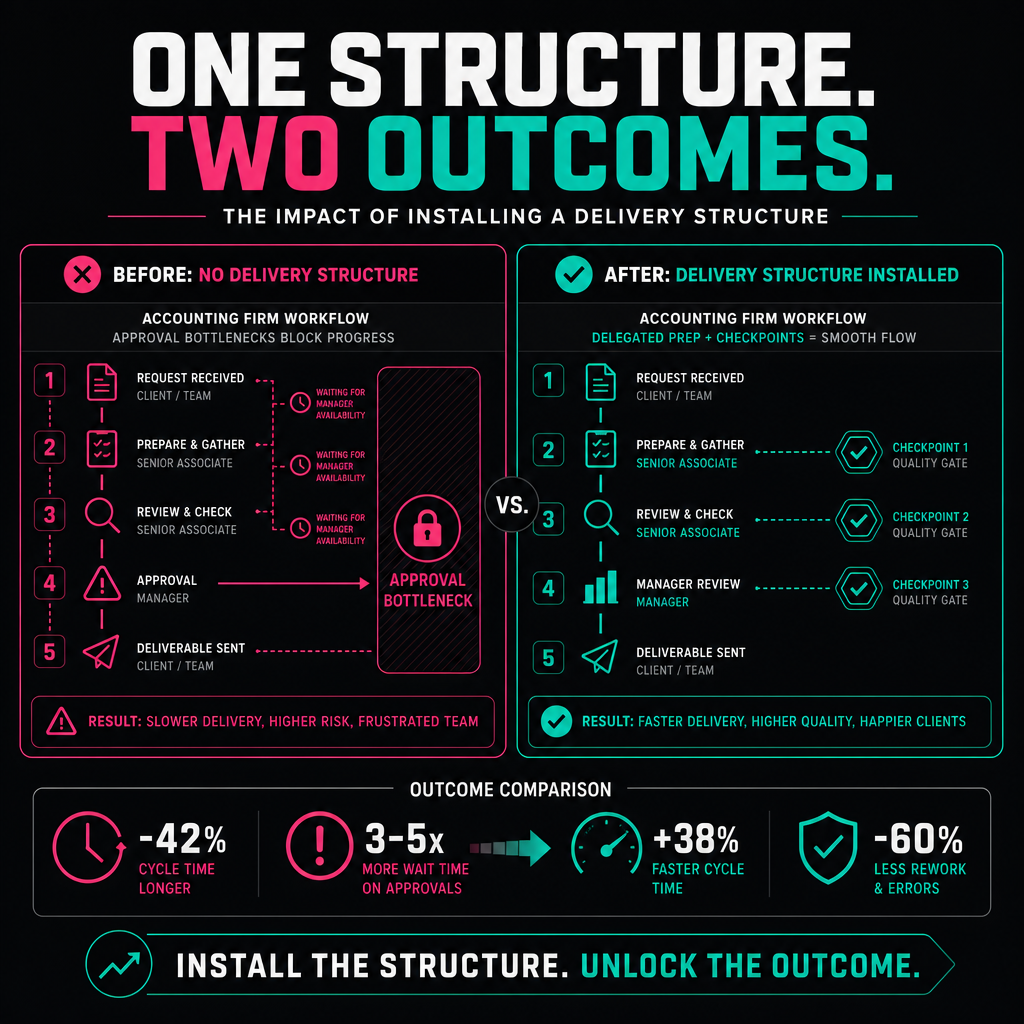
Theory is useful. Real numbers are more useful. Here are two examples from my own book of business that illustrate what the difference between headcount and a delivery system looks like in practice.
Case Study 1: Accounting Firm, Brisbane
An accounting firm came to us because their partners were spending a disproportionate amount of time on prep work: data gathering, reconciliations, and workpaper assembly that should not require a senior accountant's attention. The problem was not that they lacked the budget for a specialist. The problem was that they had never mapped which tasks in each workflow were genuinely partner-level decisions and which were delegation candidates.
Before placing a specialist, we ran a workflow audit and built a control model by workflow risk. Sensitive approvals stayed with the partners. Prep work, data entry, reconciliation, and routine correspondence were delegated with evidence capture built into the handoff process. We installed checkpoints so the partner reviewed output at defined stages rather than monitoring the specialist in real time.
The result: partners recovered 35-50% of their previously non-billable time within the first 90 days. The specialist was operational within 21 days of placement. And because the approval structure was documented, there was a cleaner audit trail for every decision. Critically, this was not a talent story. The specialist was strong. But without the delivery structure, that talent would have produced inconsistent results as volume grew.
Case Study 2: NDIS Provider, Melbourne
An NDIS provider was struggling with documentation compliance. Exception handling was ad hoc. Quality checks were inconsistent. When the same issue recurred, there was no system to capture the fix and prevent it from happening again.
We placed a specialist and wrapped the role in an SOP pack built specifically for NDIS compliance requirements. The SOP included exception handling steps, escalation triggers, and a monthly quality review cycle with versioned SOP updates. An approval owner map clarified who signed off at each stage of the documentation process.
The outcomes were measurable: more consistent compliance execution, a documented improvements log that eliminated repeated issues, and better reviewability for audits. The owner went from personally reviewing every document to reviewing the system outputs at a weekly cadence. That is the shift from Doer to Strategist in practice.
"Before Remotee, I was the bottleneck in my own business. Every approval sat with me because there was no structure for anyone else to own it. What changed was not just having someone capable to hand work to, it was having a documented system that made delegation actually work. Three months in, I had reclaimed my Fridays." Director, Digital Marketing Agency, Sydney (name withheld on request)
You can read more examples on the Remotee case studies page.
How Remotee's Process Is Different
Most offshore staffing agencies compete on cost, speed, or the quality of resumes they can supply. Remotee competes on reliability. The distinction matters because talent quality alone does not produce consistent outcomes. Without documented workflows, checkpoints, and cadence, even strong hires produce inconsistent results as the business scales.
The Remotee Method is a four-phase delivery process built around that belief:
Phase 1: Discovery and Mapping. Before we recruit anyone, we audit your existing workflows and map your software ecosystem. This produces an operational blueprint that defines exactly what the specialist role needs to deliver and how it connects to the rest of your business. Most agencies skip this entirely.
Phase 2: The Specialist Match. We headhunt from the top 1% of Philippine talent. Candidates go through technical testing benchmarked against Australian industry standards for the specific role. We do not present a shortlist of who applied to a job ad. We find who should be in the role.
Phase 3: Operational Integration. The specialist is delivered alongside a library of industry-specific SOPs with compliance baked in. Not bolted on after the fact. Built into the workflow from day one. This is what makes the operating model audit-ready rather than requiring a scramble every time a review comes up.
Phase 4: Strategic Mentorship. An Australian account manager stays engaged, reviews performance against defined outcomes, and works with you to evolve the role as your business grows. The goal is to move you from Doer to Strategist, not to hand you a hire and disappear.
This is what we call the Remotee Operating System: define outcomes, document the workflow, train and validate early delivery, and install cadence and accountability. It is designed to make outcomes predictable, reviewable, and easier to manage long-term.
If you want to understand exactly how the process works before committing to a conversation, the Remotee process page walks through each phase in detail.
When you are ready to talk about your specific situation, reach out via our contact page. We run a discovery session before any commercial discussion because the right structure for your business depends on what you are actually trying to solve.
References
-
Australian Bureau of Statistics, Labour Account Australia (2026 release): ABS data on employment costs, vacancy rates, and wage growth across Australian industry sectors. Used as context for local hiring cost comparisons.
-
Fair Work Act 2009 (Cth), Fair Work Commission publications: Authoritative source on Australian employment obligations, contractor versus employee classification, and compliance requirements relevant to offshore staffing structures.
-
Privacy Act 1988 (Cth) and Office of the Australian Information Commissioner (OAIC) guidance: Governs how Australian businesses must handle personal information, including when processed offshore. Relevant to data security requirements in offshore staffing arrangements.
-
Philippine Department of Labor and Employment (DOLE) regulations and employer compliance guidelines: Primary source for Philippine employment law, statutory contributions (SSS, PhilHealth, Pag-IBIG), and DOLE registration requirements for employers operating in the Philippines.
-
ISO/IEC 27001:2022 Information Security Management standard (International Organisation for Standardisation): The internationally recognised standard for information security management systems. Referenced as the benchmark for data security certification in offshore staffing contexts.
-
Deloitte Access Economics, Australian Business Outlook reports: Commentary on productivity, operational efficiency, and the cost impact of offshore capability strategies for Australian SMEs and mid-market businesses.
FREQUENTLY ASKED QUESTIONS
Common questions
What is an offshore staffing agency and how is it different from a recruitment agency?
- A recruitment agency finds candidates and places them in your business. You then employ them directly and manage all HR, payroll, and compliance obligations. An offshore staffing agency, at its full-service end, acts as or partners with an employer-of-record in the source country. They handle employment, payroll, statutory contributions, HR administration, and often ongoing performance support. You manage the day-to-day work; they manage the employment relationship.
How much does offshore staffing cost for Australian businesses in 2026?
- For a fully managed specialist role, expect to pay between $1,800 and $3,500 AUD per month depending on role complexity and what is included. This compares to $65,000 to $95,000 AUD per year for a comparable local hire in salary alone, before super, leave, and recruitment costs. Always ask for an itemised breakdown. The headline rate does not always reflect the total cost of the engagement.
What roles are best suited to offshore staffing?
- Roles with defined, repeatable outputs and clear quality criteria are the strongest candidates: accounting support and bookkeeping, mortgage broking administration, NDIS documentation and coordination, digital marketing execution, CRM and data management, customer service and scheduling. Roles that require physical presence, real-time complex decision-making, or highly sensitive client relationships benefit from a hybrid model rather than a fully offshore structure.
How do I ensure my offshore specialist complies with Australian privacy and data laws?
- Start with the agency's data security posture. Ask for ISO 27001 certification or documented equivalent controls. Confirm that your specialist will operate on a managed device with a VPN, that data is stored in compliant infrastructure, and that confidentiality agreements are signed before access is granted. You should also confirm your own obligations under the Privacy Act 1988 (Cth) with your legal adviser if you are handling personal or sensitive data.
What is a reasonable replacement guarantee for an offshore staffing arrangement?
- A credible replacement guarantee should be free of charge, should not require you to run a formal performance management process as a precondition, and should cover the most common departure scenarios including the specialist resigning voluntarily. The replacement timeline should be stated clearly: 30 days is common, 60 days is a stronger commitment. Read the written policy rather than relying on the verbal summary during a sales conversation.
How much Australian business-hours overlap should I expect from an offshore specialist?
- For roles requiring real-time collaboration, client communication, or team coordination, four to six hours of overlap with Australian Eastern Standard Time is the practical minimum. Many Philippine-based specialists work a shift that provides full AEST overlap if structured correctly. Confirm the exact overlap hours in writing and establish what happens during non-overlap periods for urgent requests.
How long does it take to get an offshore specialist operational?
- This varies by agency and role complexity. At Remotee, the placement-to-operational timeline for accounting specialists averages 21 days from confirmed brief to first productive output. For more complex roles or those requiring extensive onboarding, 30 to 45 days is realistic. Be cautious of agencies promising sub-two-week placements for specialist roles. Speed in recruitment usually means reduced diligence in the assessment process.
What should I do if the placement is not working out?
- Address it early. Most agencies have a 90-day early performance window that governs replacement rights. Document the specific performance gaps against the outcomes defined at onboarding. Escalate to your account manager with examples. A credible agency will treat this as a priority and manage the replacement process. If you are being asked to run a formal performance improvement programme before a replacement is triggered, your agency has misaligned incentives.

Jon Kelly
Founder, Remotee
Jon helps Australian businesses build compliance-led offshore teams that scale without the burnout. NDIS, accounting, mortgage broking, recruitment and digital marketing.
KEEP READING
Related posts
offshore staffing company comparison criteria
Offshore Staffing Company Comparison Criteria: How Australian Businesses Should Evaluate Providers
Direct Answer: The criteria that actually predict offshore staffing outcomes are the employment and compliance model, documented delivery workflows, supervision…
11 September 2026 · 16 min read
offshore staffing implementation timeline
Offshore Staffing Implementation Timeline: What Australian Businesses Should Expect Week by Week
A realistic offshore staffing implementation timeline runs 8 to 12 weeks from scoping to a fully productive seat: roughly 2 weeks for role design and process do…
6 September 2026 · 16 min read
offshore staffing companies
How to Evaluate Offshore Staffing Companies in Australia
[Remotee Client Satisfaction: 98% Retention in 2026] [Data based on 15 full offshore staffing implementations managed by Remotee in 2026.] Most Australian busin…
7 July 2026 · 14 min read
READY TO SCALE WITHOUT THE BURNOUT?
Build a compliance-led offshore team in 3–4 weeks.
Tell us about your current bottleneck and we'll show you what a Remotee placement would look like for your operation.
Or get our playbooks emailed to you instead.