
Managing Offshore Teams Across Time Zones: A Practical Guide for Australian Businesses in 2026
- offshore staffing
- time zone management
- Philippines offshore teams
- remote team management
- Australian business
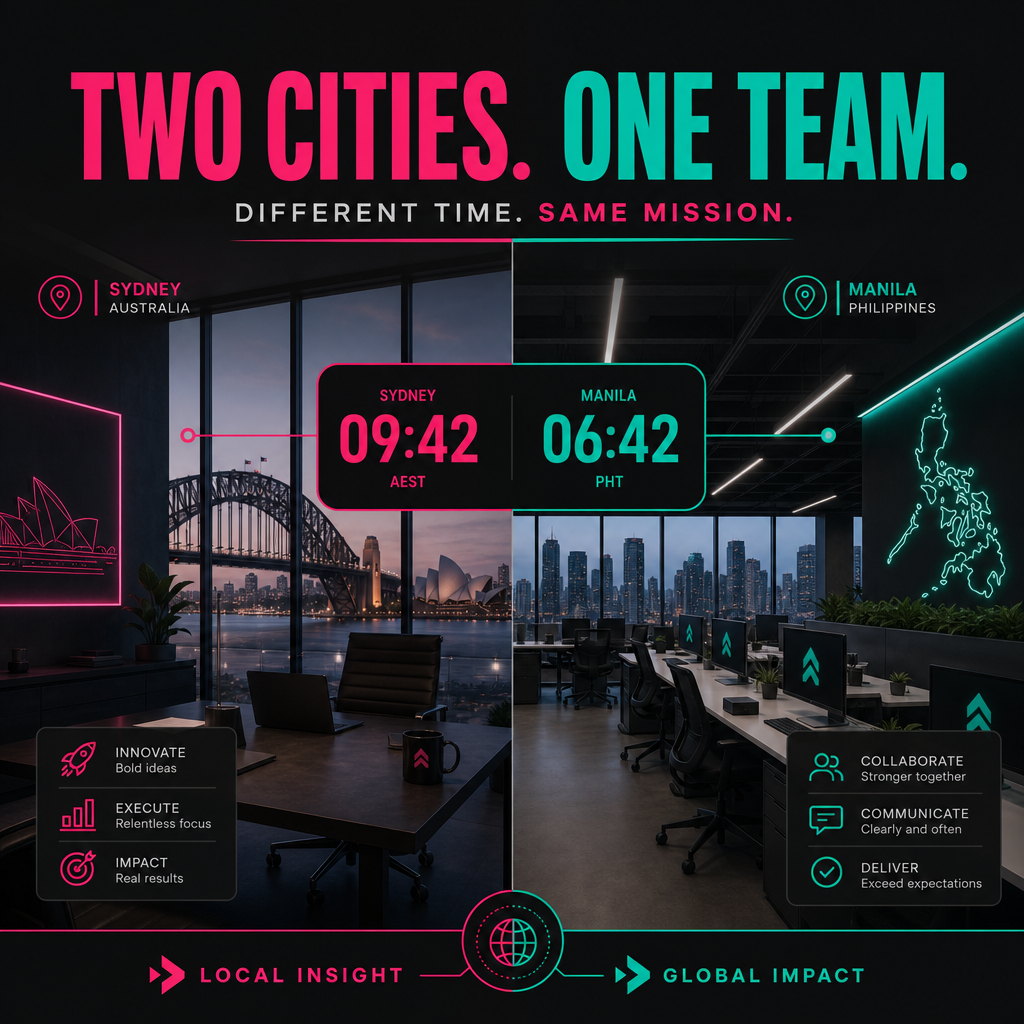
Here is the honest conversation most offshore staffing providers avoid: the real blocker to offshore hiring is rarely cost. It is whether your team stays accountable when you are asleep. Business owners who have hesitated to hire offshore are not worried about resumes. They are worried about what happens at 2 am Sydney time when a deadline is missed, a process is skipped, or no one is sure who owns a decision.
That concern is legitimate. But it is also solvable, and the solution is not surveillance software or 24-hour check-ins. It is a delivery structure built around the role from day one. Time zone management is not a people problem. It is a systems problem. When you have documented workflows, clear ownership, and a predictable cadence in place, geography becomes almost irrelevant to output quality.
This guide covers exactly how to set that structure up. We will look at the real overlap window between Australia and the Philippines, how to design shifts and workflows around it, the tools and cadences that create visibility without micromanagement, and how to handle the edge cases like public holidays and async communication gaps. Everything here is drawn from direct experience running offshore teams for Australian businesses across professional services, marketing, healthcare, and finance.
Key Takeaways
- Australia and the Philippines share a 2-3 hour overlap window during standard business hours, which is enough for daily standups, handoffs, and escalation if your async workflows are tight.
- Structuring shifts around Australian business needs, rather than defaulting to a standard 9-5 Manila schedule, is the single biggest lever for improving offshore team productivity.
- Async-first communication does not mean communication-light. It means communication that is documented, structured, and reviewable.
- KPIs and SLAs set in advance replace the need to micromanage. You manage outcomes, not hours.
- Public holidays differ significantly between Australia and the Philippines. A shared holiday calendar is not optional; it is a basic operational requirement.
- The difference between a smooth offshore engagement and a chaotic one is almost never the quality of the talent. It is almost always a delivery structure problem.
Summary Table: Australia vs Philippines Time Zone and Work Overlap
| Factor | Detail |
|---|---|
| Philippines time zone | Philippine Standard Time (PST), UTC+8 |
| AEST (Sydney, Melbourne) | UTC+10 in summer, UTC+11 AEDT |
| AEST vs PST difference | 2 hours ahead (AEST) in summer, 3 hours ahead (AEDT) |
| Real overlap (standard hours) | Approx. 7 am to 10 am AEST when Philippines works 9 am to 6 pm PST |
| Shift adjustment option | Philippines shift starts 7 am PST, extends overlap to approx. 12 pm AEST |
| Public holidays (AU) | 8 national + state-specific (e.g. Melbourne Cup Day, WA Day) |
| Public holidays (PH) | 12 regular national holidays + additional special non-working days |
| Best sync window for standups | 9 am to 10 am AEST (7 am to 8 am PST standard shift) |
| Async tools recommended | Loom, Notion, ClickUp, Slack with thread discipline |
The Real Overlap Window Between Australia and the Philippines
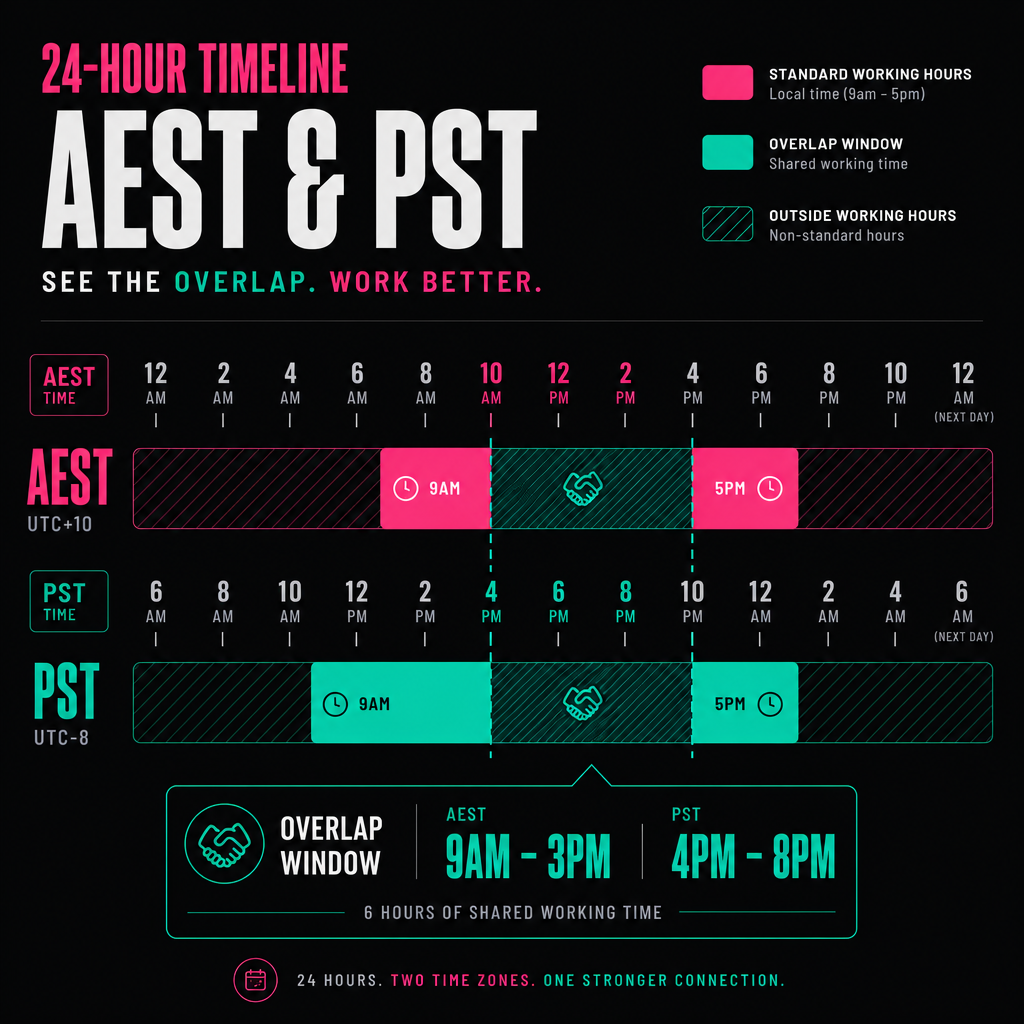
The time difference between the Philippines and Australia is small enough to be genuinely useful. Philippine Standard Time sits at UTC+8. Sydney and Melbourne operate on AEST (UTC+10) in winter and AEDT (UTC+11) during daylight saving. That means the Philippines is typically 2-3 hours behind the east coast of Australia.
On a standard schedule where your Manila team works 9 am to 6 pm PST, the overlap with a Sydney team working 9 am to 6 pm AEST looks like this: from 9 am AEST (which is 7 am PST) until around 10 am AEST (8 am PST before the Manila day starts in full) and then again once you factor in the flip. The cleanest way to frame it: if your Philippines specialist starts at 9 am PST, you have live overlap from roughly 11 am to 6 pm AEST, which is a solid five-to-seven-hour window.
Compare that to managing a team in Eastern Europe or South America, where Australian businesses often face a completely inverted working day with zero live overlap. The Philippines-Australia corridor is one of the most time-zone-friendly offshore arrangements available to Australian businesses. The challenge is not the gap. The challenge is designing workflows that use the overlap for high-value synchronous work and handle everything else asynchronously without things falling through the cracks.
Shift Design: Small Adjustments, Big Impact
Most offshore providers default your Philippines team to a standard 9 am to 6 pm PST shift because it is simple. It is not always optimal. A shift start of 7 am PST instead of 9 am PST pushes your overlap window back to 9 am AEST, meaning you can run a daily standup at the start of your own working day with full live participation. For Australian businesses in finance, law, or healthcare where mornings are high-activity, this is worth the conversation.
Alternatively, a later shift, say 11 am to 8 pm PST, means your Philippines team is still live until 10 pm or 11 pm AEST, which suits businesses where afternoon reviews, end-of-day reporting, or client deliverables need to be completed before Sydney or Melbourne wakes up to review them the next morning.
The point is this: shift design is a business decision, not a default. When we work with clients through our process at Remotee, one of the first things we map is when output is actually needed and by whom, and we structure the role around that rather than around a generic Manila timetable.
Async vs Synchronous Workflows: Getting the Balance Right
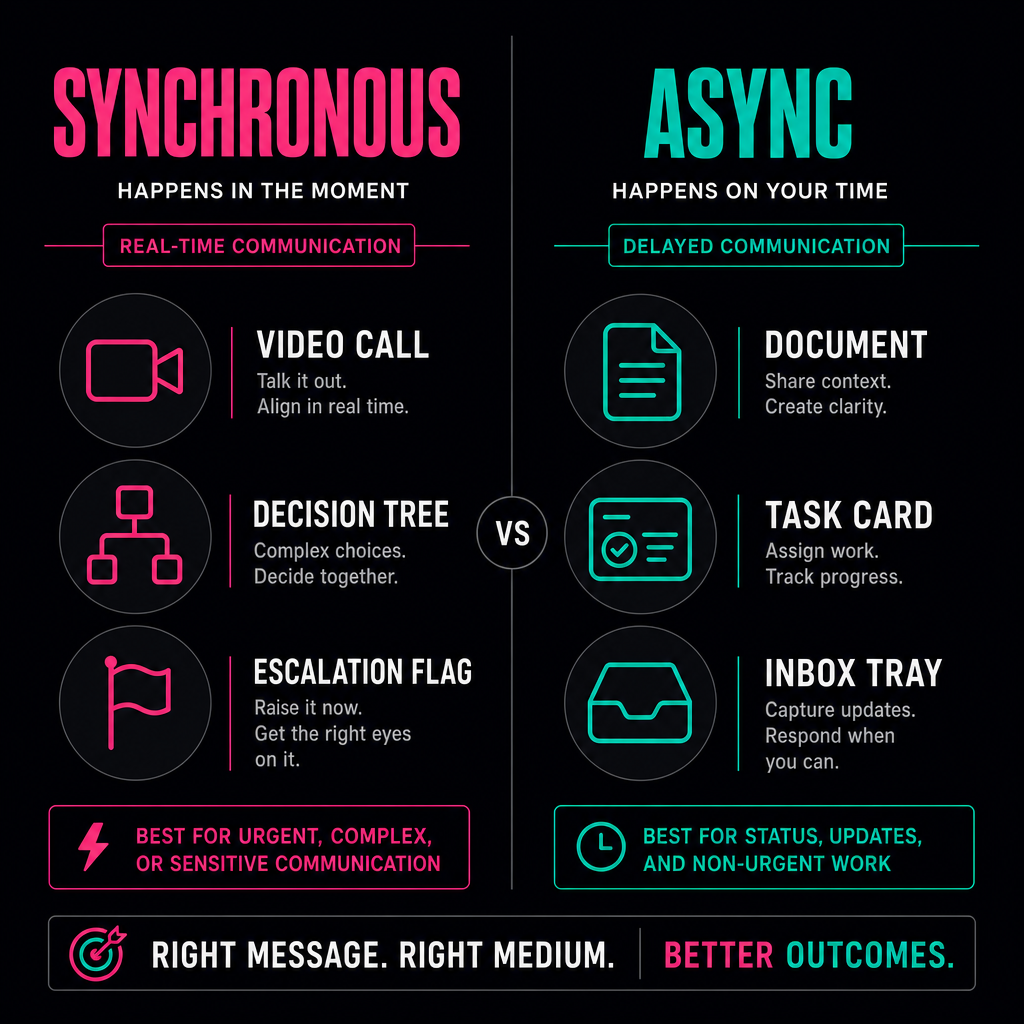
Async-first is not the same as async-only. The mistake I see consistently is businesses that either over-index on synchronous communication, scheduling multiple live calls per day and burning the overlap window on status updates, or under-invest in async structure entirely and wonder why things go quiet overnight.
The framework I use is straightforward. Synchronous time is for decisions, escalations, and relationship. Async time is for execution, documentation, and status updates. If you are using your live overlap window to ask questions that could have been answered in a Loom video or a Notion task comment, you are wasting both your time and your specialist's.
What Belongs in Async Communication
- End-of-day summaries from your Philippines team, structured around a template so you can scan them in 90 seconds
- Task handoffs with context notes, output files, and any blockers flagged
- Process queries where the answer is documented in an SOP and the specialist just needs confirmation
- Feedback on completed work, with specific reference to quality checkpoints
What Belongs in Synchronous Communication
- Daily standup, maximum 15 minutes, focused on today's priorities and any blockers that cannot be resolved without a decision
- Weekly review of KPIs and output quality
- Onboarding check-ins during the first 30-60 days of a new role
- Escalations that require judgement rather than process
When I was working with a digital marketing agency, the founder was the approval bottleneck for every piece of routine work. Tasks lived across inbox, chat, and memory. Rework kept happening because expectations were never written down. We installed a delegation map that defined who owned approvals at each task level, a quality checkpoint checklist for weekly review, and an SOP pack that handled the most common exception scenarios. The outcome was faster handoffs, significantly less rework, and predictable weekly output that the founder could review on a scorecard rather than chase across Slack threads. That is what async-first actually looks like in practice.
Daily Standups and Reporting Cadences That Actually Work
A daily standup is your anchor. It is the moment of synchronous alignment that makes the rest of the day's async work coherent. But only if it is structured.
The format I recommend for offshore teams:
- What did you complete yesterday? (Output, not activity.)
- What are you working on today? (Three priorities maximum.)
- Is there anything blocking you that I need to resolve before our next sync?
That is it. Fifteen minutes. If you are running a standup that regularly runs to 45 minutes, you have a workflow clarity problem, not a communication problem.
Weekly Cadence
Beyond the daily standup, a weekly rhythm is essential. This is where you review output quality against the agreed KPIs, flag any process gaps, and update the SOP if a recurring issue has identified a gap in documentation. I treat the weekly review as a system improvement meeting as much as a performance conversation. Every repeated issue is a documentation gap waiting to be fixed.
End-of-Day Reports
A structured end-of-day report from your Philippines team is not about surveillance. It is about creating a written record that you can review asynchronously and that gives the next day's work a clean starting point. The report should cover: tasks completed, tasks carried over and why, any decisions flagged for review, and the file or output location for each completed item. Takes your specialist five minutes to write. Saves you twenty minutes of investigation the next morning.
Tools for Visibility Without Micromanaging
The tools you choose set the ceiling for your offshore team's visibility and accountability. The wrong tools create noise without insight. The right tools create a live picture of where work stands without requiring you to ask.
Project Management
ClickUp and Asana are both strong for Australian offshore teams. ClickUp in particular handles complex task dependencies well, which matters when your Philippines specialist is three steps into a workflow that your internal team picks up at step four. The non-negotiable is that every piece of work lives in the project management tool. If it is only in email or Slack, it does not exist for the purposes of accountability.
Communication
Slack is the industry default and it works, provided you enforce thread discipline. Every task discussion happens in the relevant thread, not in direct messages. Direct messages are for urgent or sensitive matters only. This sounds like a minor process point but it is the difference between a communication history that is searchable and useful versus one that is scattered and invisible six weeks later.
Time Tracking
Time Doctor and Hubstaff are the most common tools for offshore teams and both integrate with the major project management platforms. I want to be clear about what time tracking is for: it is not about checking whether your specialist is at their desk. It is about understanding where time is being spent so you can identify bottlenecks and improve workflows. If a task that should take 30 minutes is consistently taking 90 minutes, that is a process signal, not a performance signal. Fix the process.
For clients who want to understand more about the technology and security stack we recommend, we have documented our approach to tool integration and data security in detail, including how we handle sensitive client data for regulated industries.
Documentation and SOPs
Notion and Confluence are both solid for SOP documentation. The key is version control. Every time a process is updated because a recurring issue identified a gap, the update is dated and logged. This is what I mean by compliance baked in, not bolted on. Your documentation is not a static artifact from onboarding. It is a living system that improves as your team learns.
Setting KPIs and SLAs for Offshore Roles
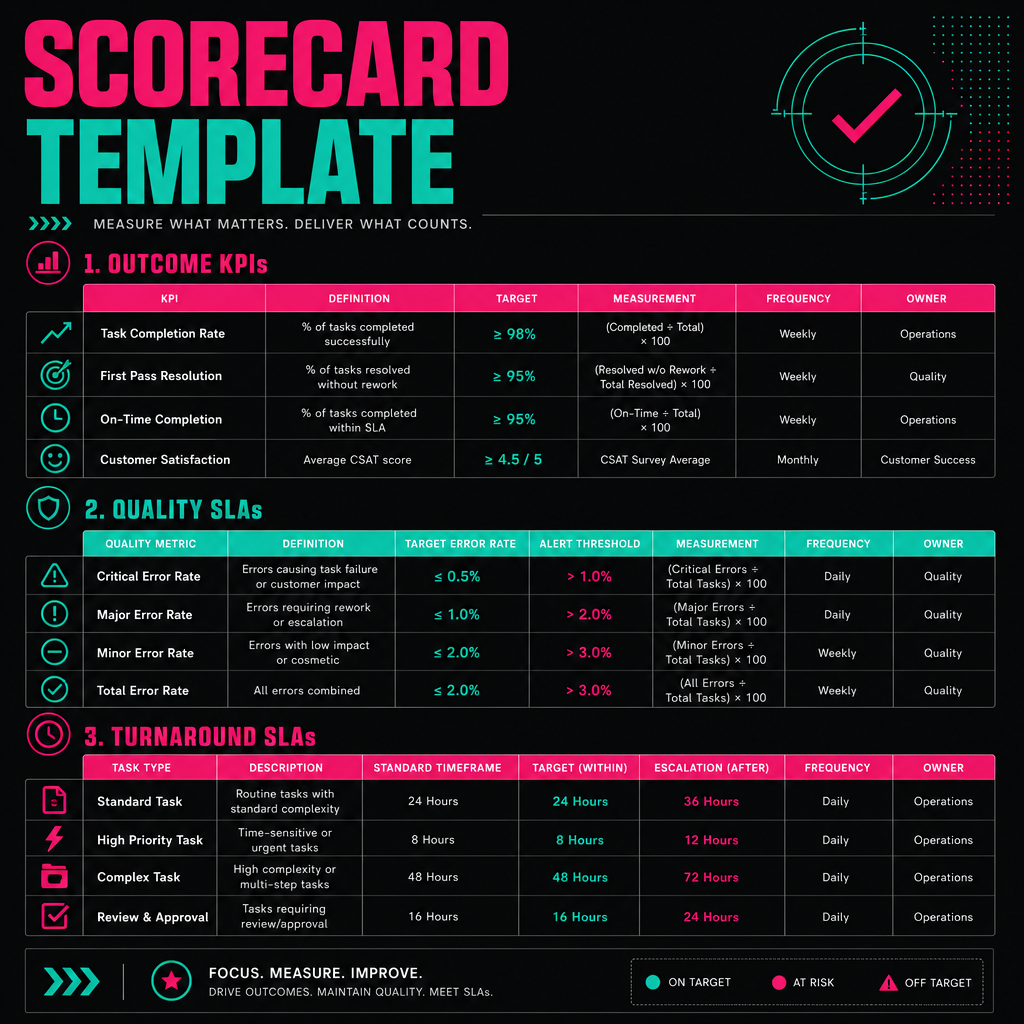
KPIs and SLAs are the mechanism that makes managing offshore teams manageable. Without them, you are managing by feel. With them, you are managing by data.
The structure I use for every Remotee engagement:
Outcome KPIs: What does done look like? Not activity metrics like "tasks completed" but outcome metrics like "100% of leads followed up within 4 business hours" or "monthly management accounts delivered by the 5th of each month."
Quality SLAs: What is the acceptable error rate and what is the escalation trigger? For a mortgage broking client, we set an SLA that any client-facing communication required a quality checkpoint review before sending, with a maximum review turnaround of 2 hours. That one SLA eliminated the inconsistent client updates that had been the biggest complaint in the business.
Turnaround SLAs: For each task type, what is the expected completion window? These need to be realistic. If your Philippines specialist is working a 9-6 shift and a task lands at 5:45 pm PST, a 1-hour SLA is not reasonable. Build your SLAs around the actual shift and workflow constraints.
The gym and fitness business I worked with had inconsistent lead follow-up and unreliable CRM data that made pipeline reporting nearly impossible. We installed a role scorecard with weekly pipeline outcomes, handoff templates with approval gates, and an SOP-led process for CRM hygiene. Within eight weeks, follow-up consistency was measurably higher, pipeline visibility improved substantially, and the sales leaders were spending less time chasing data and more time closing deals. The KPIs were not punitive. They were clarifying. That is the point of this kind of structure.
Building Accountability Without Micromanaging
This is the question I get most often from Australian business owners considering their first offshore hire: "How do I know they are actually working if I cannot see them?"
The answer is that visibility and presence are not the same thing. You have internal team members who can be physically present and still not be accountable for outcomes. Accountability is a systems question, not a location question.
The Remotee Operating System is built around four principles that make accountability structural rather than reliant on monitoring:
-
Define outcomes and done. Before a task is assigned, the output is described clearly. Not "update the CRM" but "update all leads from this week's enquiry list with contact date, outcome, and next action, and flag any leads without a next action by Friday 5 pm."
-
Document the workflow. Every repeatable task has an SOP with tool rules, exception handling, and escalation triggers. Work does not live in someone's memory.
-
Train and validate early delivery. The first two to four weeks of any offshore role should include checkpoint reviews of early deliverables against the quality standard. This is not about micromanagement. It is about confirming that the specialist understands the standard before volume builds.
-
Install cadence and accountability. The weekly review is where issues become improvements. Every recurring problem gets a versioned SOP update. Systems over heroics, every time.
When this structure is in place, you do not need to check in constantly. You check the scorecard, review the end-of-day reports, and run the weekly review. Everything else is execution.
Handling Public Holidays Across Australia and the Philippines
This is the operational edge case that catches businesses off guard. Australia has eight national public holidays plus a collection of state-specific days. New South Wales, Victoria, Queensland, Western Australia, and South Australia all have different additional holidays. Melbourne Cup Day is a public holiday in metropolitan Melbourne but not in regional Victoria and not in any other state. The ACT has its own Reconciliation Day. Western Australia has WA Day. If your business operates across multiple states, you are already managing a patchwork of local holidays.
The Philippines has twelve regular national holidays plus a series of special non-working days that can shift year to year by presidential proclamation. Key Philippine holidays that affect operations include: New Year's Day, Maundy Thursday and Good Friday (which align broadly with Australia's Easter break but can fall on different days), Eid al-Fitr and Eid al-Adha (dates vary by lunar calendar), Independence Day (12 June), National Heroes Day (last Monday of August), All Saints' Day and All Souls' Day (1-2 November), Bonifacio Day (30 November), Christmas Day and Rizal Day (25 and 30 December).
The practical management approach:
- Maintain a shared holiday calendar in your project management tool that marks all Australian national and relevant state holidays alongside all Philippine public holidays.
- Set a standing rule that any holiday in either jurisdiction triggers an advance notice to all affected team members at least five business days prior, with a clear plan for how in-progress work will be managed.
- Build holiday coverage into your SLAs. If your SLA is 24-hour turnaround and a Philippine holiday falls in that window, the SLA clock should reflect the actual available working time.
- For high-stakes deliverable dates, do not schedule them to land on or immediately after a holiday period in either country without a buffer.
Case Study 1: Accounting Firm Reduces Non-Billable Partner Time
An accounting firm came to us with a familiar problem. Senior partners were spending a significant portion of their week on prep work, data gathering, and routine compliance tasks that did not require their level of expertise. Delegation felt risky because the sensitive steps in each workflow made partners reluctant to hand off anything without maintaining tight control.
We installed what I call a control model by workflow risk. Prep work and data formatting were delegated to a Philippines-based specialist. Sensitive review steps and client-facing approvals stayed with the internal partners. We introduced evidence capture at checkpoints so every decision point had a documented audit trail. The specialist was operational within 21 days of placement.
The result: partners reclaimed a substantial portion of their week from prep work, sensitive approvals stayed controlled and documented, and the firm now has a cleaner audit trail for every client file. Across our accounting clients, we see non-billable partner time reduce by 35-50% when this structure is properly installed. That is not a headcount story. It is a delivery structure story.
Case Study 2: Mortgage Broking Business Improves Client Update Consistency
A mortgage broking business was struggling with inconsistent client communication. Updates were being missed, client requests were not being captured reliably, and the delivery rhythm felt reactive rather than controlled. The brokers were talented. The problem was not talent. The problem was the absence of any intake and prioritisation structure.
We installed intake templates that captured every client request in a standardised format, a prioritisation rule set that determined sequence and urgency, a cadence for proactive client updates and follow-ups, and a quality checkpoint for outbound communication before it was sent.
The business went from reactive to structured within six weeks. Missed requests dropped significantly. Client updates became consistent. The brokers were no longer spending mental energy tracking what had and had not been communicated. That freed them to focus on the work that actually required their expertise. Our data shows mortgage broking clients see an average 30% reduction in time-to-settle when this kind of delivery structure is wrapped around the support role.
What Clients Say
"Before Remotee, I was the one holding everything together across the team. Every task came back to me for a decision, even the routine ones. After they installed the delegation structure and the SOPs, I stopped being the bottleneck. My offshore specialist knows exactly what to do and when to escalate. The weekly scorecard takes me ten minutes to review. I actually take Fridays off now."
Founder, Australian professional services business
Making the Decision: Is Your Business Ready?
If you have read this far, you are probably past the "should we" stage and into the "how do we" stage. That is the right question. The businesses that struggle with offshore teams are almost always the ones who hired talent without installing structure. The businesses that thrive are the ones who treated the offshore engagement as a systems project as much as a hiring project.
The Remotee Method is designed specifically for established Australian businesses with repeatable operations who want compliance-ready systems and a long-term capability layer. We do not place a specialist and walk away. We headhunt from the top 1% of Philippine talent, deliver them alongside an SOP library built for your industry, and provide ongoing support from a dedicated Australian account manager to move you from Doer to Strategist.
If you want to understand exactly how that works in practice, read through our case studies or get in touch directly to talk through your specific workflow and what an offshore role could look like inside your business.
Predictable delivery, not just headcount. That is what this is built for.
References
-
Australian Bureau of Statistics, Labour Force Data (2026), ABS time series data on employment by industry and occupation, used to contextualise the skills gap driving offshore hiring demand among Australian SMEs.
-
Philippine Statistics Authority, Overseas Employment Statistics (2026), PSA data on the professional services and BPO sector workforce in the Philippines, supporting claims about talent depth and specialist availability.
-
Fair Work Australia, National Employment Standards and Public Holiday Register (2026), Official register of national and state public holidays applicable to Australian employers, referenced for holiday management guidance.
-
Official Gazette of the Republic of the Philippines, Proclamation on Regular and Special Non-Working Holidays (2026), Philippine government proclamation listing public and special non-working holidays for the calendar year, referenced for holiday planning guidance.
-
Productivity Commission of Australia, Working from Home and Remote Work Patterns Report (2025-26), Analysis of distributed workforce productivity patterns in Australian businesses, supporting the case for structured async communication frameworks.
-
Remotee Internal Client Data, 2024-2026, Proprietary data from Remotee's Australian client portfolio, including partner time reduction rates, placement-to-operational timelines, and 12-month specialist retention rates across accounting, mortgage broking, and professional services clients.
FREQUENTLY ASKED QUESTIONS
Common questions
How many hours of overlap do Australian businesses actually get with a Philippines offshore team?
- On a standard 9 am to 6 pm PST shift, an Australian east coast team on AEST gets roughly five to six hours of live overlap in the afternoon. If you adjust the Philippines shift to start at 7 am PST, you push that overlap window to start at 9 am AEST, which aligns with the beginning of the Australian working day. The overlap is generous compared to most offshore jurisdictions and is more than sufficient for daily standups, handoffs, and real-time decision-making when your async workflows are well-structured.
What is the best communication cadence for managing a Philippines-based offshore team?
- A daily 15-minute standup at the start of the overlap window, structured around yesterday's output, today's priorities, and any blockers. A structured end-of-day summary sent asynchronously by the offshore team before close of their shift. A weekly review of KPIs and output quality. Everything else is async through your project management tool. More meetings than this usually indicates a workflow clarity problem rather than a communication problem.
What tools do Australian businesses use to manage offshore team productivity?
- ClickUp or Asana for project management, Slack with thread discipline for communication, Loom for async video walkthroughs of complex tasks, and either Time Doctor or Hubstaff for time tracking. For documentation and SOPs, Notion and Confluence are both solid. The critical principle is that every piece of work lives in the project management tool. If it is only in email or direct messages, it lacks accountability and traceability.
How do I handle public holidays when managing a Philippines offshore team?
- Maintain a shared calendar in your project management tool that includes all Australian national and relevant state public holidays as well as all Philippine public holidays and special non-working days. Set a standing rule that any upcoming holiday triggers advance notice and a coverage plan at least five business days prior. Build holiday periods into your SLAs so turnaround expectations reflect actual available working time. Philippine public holidays can also be approved by presidential proclamation on short notice, so building a small buffer into your planning for November and December is wise.
How do I set KPIs for an offshore team member I cannot physically supervise?
- KPIs should be outcome-based, not activity-based. Define what done looks like for each role: the output, the quality standard, and the turnaround expectation. Then set a weekly review cadence where actual output is compared to those standards. Time tracking tools provide supporting data but the primary accountability mechanism is output quality against defined outcomes, not hours logged. If the output meets the standard, the work is done. If it does not, the SOP needs updating or the checkpoint review needs to catch the issue earlier.
Is a 2-3 hour time difference enough to maintain a strong working relationship with an offshore team?
- Yes, provided your async communication structure is solid. The Philippines-Australia time difference is one of the smallest of any major offshore destination. The relationship is built through the daily standup, the quality of your feedback, and the clarity of your documentation. Businesses that invest in clear SOPs, structured handoffs, and regular check-ins consistently report strong working relationships with their Philippines teams regardless of the time gap.
What happens to productivity during the hours my offshore team is working and I am asleep?
- Your SOPs do the managing. When every task type has a documented process, exception triggers, and a clear escalation path, your specialist does not need you to be available to move work forward. Blockers that cannot be resolved by the SOP are flagged in the end-of-day report for your review first thing in the morning. The goal is not a team that never encounters ambiguity. It is a team that has a documented process for handling ambiguity without stopping.
How long does it take to get a Philippines offshore specialist operational within an Australian business?
- With the right onboarding structure, a specialist can be genuinely operational within 21 days of placement. The first two weeks focus on workflow familiarisation, SOP training, and early deliverable review. By week three, the specialist is running at full capacity with checkpoint reviews in place to catch any quality gaps early. This is the timeline Remotee consistently hits because the SOP library and onboarding structure is built before the specialist starts, not after.

Jon Kelly
Founder, Remotee
Jon helps Australian businesses build compliance-led offshore teams that scale without the burnout. NDIS, accounting, mortgage broking, recruitment and digital marketing.
KEEP READING
Related posts
offshore staffing company comparison criteria
Offshore Staffing Company Comparison Criteria: How Australian Businesses Should Evaluate Providers
Direct Answer: The criteria that actually predict offshore staffing outcomes are the employment and compliance model, documented delivery workflows, supervision…
11 September 2026 · 16 min read
offshore staffing roles
Which Roles Are Best Suited to Offshore Staffing? A Guide for Australian Businesses in 2026
The most expensive offshore staffing mistake I see Australian business owners make is not hiring the wrong person. It is offshoring the wrong role. They start w…
23 June 2026 · 23 min read
offshore staffing cost
How Much Does Offshore Staffing Cost in Australia? A 2026 Breakdown of Savings and Pricing
Key Stats: Australian employers pay an average of 20-30% on top of base salary in statutory on-costs (superannuation, payroll tax, WorkCover, leave loading). A…
20 June 2026 · 26 min read
READY TO SCALE WITHOUT THE BURNOUT?
Build a compliance-led offshore team in 3–4 weeks.
Tell us about your current bottleneck and we'll show you what a Remotee placement would look like for your operation.
Or get our playbooks emailed to you instead.