
How to Hire and Manage Offshore Accounting Staff for Australian Firms
- Offshore accounting staff
- Accounting outsourcing
- Bookkeeping outsourcing
- Australian accounting firms
- Philippines staffing

Offshore accounting staff can expand an Australian firm's capacity when qualified people are supported by documented workflows, Australian compliance training, clear approval limits and local oversight. Start with repeatable roles such as bookkeeping, AP and AR. Keep tax advice, BAS responsibility and final professional judgement with appropriately registered or authorised Australian personnel.
Australian accounting firms and SME finance teams rarely have a headcount problem in isolation. They have deadlines, undocumented processes, overloaded reviewers and work that depends on one experienced person remembering every step.
The right offshore staffing solution addresses those operating weaknesses before adding people. This guide explains which roles to offshore, how to assess Philippine qualifications, how to control GST and BAS work, and how to manage delivery without creating more review work for Australian staff.
Key takeaways
Successful accounting offshoring depends on role design, supervision and process control rather than access to inexpensive labour. Australian firms should define authority boundaries, test practical competence and document each workflow before recruitment. The objective is reliable delivery, not simply moving tasks to another location.
- Offshore repeatable, rules-based work before judgement-heavy advisory work.
- A Philippine CPA qualification does not create Australian tax agent or BAS agent authority.
- GST coding, BAS preparation and ATO workflows require structured Australian familiarisation.
- Measure total delivered cost, including review time, software, management and rework.
- Protect data with role-based access, audit logs, secure devices and documented incident procedures.
- Build a delivery system before increasing headcount. Otherwise, extra capacity can increase chaos.
Summary of offshore accounting roles
The best starting role depends on transaction volume, process maturity and the judgement required. AP, AR and bookkeeping usually provide clearer entry points than tax work. A qualified accountant can handle more complex preparation, but Australian registration, supervision and sign-off boundaries still apply.
| Role | Suitable offshore responsibilities | Qualifications to assess | Australian controls required | Usually retained locally |
|---|---|---|---|---|
| AP and AR officer | Invoice entry, supplier checks, payment batch preparation, debtor follow-up and reconciliations | Accounting education, software competence, written communication and control awareness | Segregation of duties, supplier change verification and payment approval limits | Bank release, disputed supplier decisions and cash-flow authority |
| Bookkeeper | Bank reconciliations, ledger maintenance, payroll journals, month-end schedules and GST coding | Bookkeeping experience, accounting fundamentals and platform certification where relevant | Chart-of-accounts guide, GST decision rules and reviewer approval | BAS lodgement authority and unusual transaction treatment |
| Philippine CPA | Management reporting, workpapers, balance-sheet reconciliations and financial statement preparation | Philippine CPA licence, relevant degree, practical testing and applicable reporting experience | Australian standards training, review thresholds and evidence requirements | Australian professional sign-off and regulated advice |
| Tax accountant | Tax workpaper preparation, data collection, reconciliations and draft calculations | Relevant tax experience, strong documentation and demonstrated Australian tax knowledge | Registered tax agent supervision, access controls and mandatory review | Tax agent services, advice, client representations and lodgement authority |
What offshore accounting staff should actually do

Offshore accounting staff should own clearly defined outputs rather than act as general assistants waiting for instructions. Good roles have recurring inputs, documented decision rules, deadlines, review criteria and escalation points. Poor roles contain undefined responsibility, constant exceptions and authority that has not been matched with appropriate controls.
A practical starting point is to separate accounting work into four categories:
- Transaction processing: invoice capture, coding, receipts, bank matching and data maintenance.
- Control work: reconciliations, exception reports, supplier verification and aged debtor reviews.
- Preparation work: month-end schedules, BAS workpapers, management reports and tax workpapers.
- Judgement and authority: advice, accounting policy decisions, payment release, lodgement and professional sign-off.
The first three categories can often be performed offshore when the process is controlled. The fourth usually needs Australian leadership, regulated supervision or formal delegation.
AP and AR
An offshore AP officer can manage invoice intake, validate required information, check purchase orders, identify duplicates and prepare payment batches. The person should not be able to create a supplier, change bank details and release payment without an independent control.
AR work can include invoice generation, receipt allocation, debtor statements and follow-up based on approved communication scripts. Disputed debts, credit decisions and sensitive customer negotiations should move to an authorised Australian manager.
Bookkeeping and month-end support
Bookkeeping outsourcing works when coding rules are explicit. A generic instruction such as "code this correctly" is not a process. The operating guide should explain the chart of accounts, GST treatment, required evidence, materiality rules and situations requiring escalation.
Month-end responsibilities can include bank reconciliations, balance-sheet schedules, accrual support and variance packs. Each output should have a definition of done. For example, a reconciliation is not complete merely because its balance matches. Old reconciling items must be explained, supported and assigned for resolution.
Qualified accounting work
A Philippine CPA may have strong technical accounting skills, but the qualification must be interpreted correctly. The Professional Regulation Commission regulates the Philippine accountancy profession. A Philippine licence does not automatically provide Australian tax agent registration, BAS agent registration or membership rights with an Australian professional body.
Use qualified offshore accountants for work that benefits from technical understanding, such as financial statement preparation, workpaper review and complex reconciliations. Do not use the title alone as proof of Australian competence. Test the actual work the person will perform.
Tax preparation support
Tax accountants offshore can collect documents, prepare workpapers, reconcile ledgers and draft calculations under appropriate supervision. Australian tax law changes, entity structures and substantiation requirements make unsupervised tax work risky.
If an activity constitutes a tax agent service or BAS service under Australian law, the firm must consider Tax Practitioners Board requirements. Workflow convenience does not override registration obligations.
How to assess qualifications and accounting competence in the Philippines
Assess offshore candidates through evidence, practical work and role-specific judgement. Degrees, licences and software badges help with screening, but they do not prove that a candidate can apply Australian GST rules, prepare review-ready workpapers or identify a control failure. Recruitment should test the actual outputs expected after hiring.
Verify qualifications rather than relying on a CV
For a Philippine CPA candidate, verify the licence through the relevant Professional Regulation Commission channels. Confirm the candidate's accountancy education, employment history and the type of entities they have supported.
For non-CPA roles, look for relevant accounting education and substantial experience in comparable workflows. Platform certifications for Xero, MYOB or QuickBooks can be useful, but software familiarity is not equivalent to accounting competence.
Use a practical assessment
A strong assessment resembles the job. Depending on the role, ask the candidate to:
- reconcile a bank account containing timing differences and an unexplained item
- review an AP file for duplicate invoices and supplier-control failures
- prepare a month-end balance-sheet schedule with supporting evidence
- identify GST coding questions in a mixed transaction file
- write an escalation note explaining what cannot be concluded
- explain how they would correct an error without destroying the audit trail
The assessment should reward escalation, not guessing. A candidate who recognises insufficient evidence is often safer than one who confidently selects an unsupported tax code.
Assess communication as a control skill
Accounting communication is not merely a language test. Offshore staff need to explain exceptions, ask precise questions and distinguish blocked work from incomplete work.
Ask candidates to write a short review note covering the issue, evidence checked, risk, proposed treatment and required decision. This reveals whether their work will reduce or increase reviewer effort.
Check experience at the right level
Years of experience alone say little about task complexity. A candidate may have processed high transaction volumes without owning reconciliations or controls. Another may have fewer years but stronger month-end and reporting experience.
Ask what the candidate personally prepared, what they reviewed, what authority they held and how errors were detected. That produces a clearer picture than job titles.
Australian GST, BAS and accounting standards familiarisation

Offshore accountants need a structured Australian familiarisation programme before handling live GST, BAS or financial reporting work. Training should cover the firm's actual client base, transaction evidence, escalation rules and review standards. Generic software training is insufficient because compliance decisions depend on facts, documentation and Australian law.
GST is not a simple tax-code exercise
The Australian Taxation Office distinguishes taxable sales, GST-free sales, input-taxed sales and transactions outside the GST system. The correct treatment affects whether GST is collected and whether input tax credits may be claimed.
An offshore bookkeeper should not infer treatment from the supplier name or account code alone. The workflow should require appropriate tax invoices, entity-specific coding rules and escalation for uncertain transactions.
Build a GST decision guide containing:
- common transaction types for the business or client portfolio
- required source documents
- approved tax codes
- recurring exceptions
- private or non-deductible components where applicable
- rules for adjustments and credit notes
- reviewer thresholds
- examples of transactions that must be escalated
The guide should support judgement without pretending every transaction can be reduced to a checklist.
BAS preparation needs a defined authority boundary
Offshore staff can assemble BAS workpapers, reconcile GST control accounts and investigate differences. However, firms must assess whether the work constitutes a BAS service and ensure it is performed within the requirements administered by the Tax Practitioners Board.
A sound BAS workflow separates preparation, review, client approval and lodgement. It should show who owns each stage and what evidence is retained.
Preparation should include more than extracting a software report. The preparer should reconcile reported amounts to the ledger, review unusual tax codes, inspect material adjustments and document unresolved issues.
ATO systems and credentials require tight controls
Do not share individual credentials. Access should be issued to the person who needs it, limited to the required function and removed promptly when responsibilities change.
Where staff interact with ATO-related workflows, maintain an access register and review it periodically. Record who prepared, reviewed, approved and lodged each obligation. The audit trail should remain usable even when a team member leaves.
Relevant Australian accounting standards
Offshore accountants preparing reporting work should be familiar with the standards relevant to the entity and engagement. These may include:
- AASB 101 Presentation of Financial Statements, for financial statement structure and presentation requirements
- AASB 107 Statement of Cash Flows, for cash-flow classification and presentation
- AASB 15 Revenue from Contracts with Customers, for revenue recognition questions
- AASB 16 Leases, for lease recognition, measurement and disclosure
- AASB 108 Accounting Policies, Changes in Accounting Estimates and Errors, for consistent policy application and correction of errors
Not every bookkeeper needs deep technical knowledge of every standard. The training depth should match the role. What matters is that staff recognise when a transaction falls outside routine processing and requires technical review.
Payroll compliance should be treated separately
Payroll is a business-critical trust function, not leftover administration. It involves employee data, pay conditions, PAYG withholding, superannuation, leave and Single Touch Payroll reporting.
Payroll is often safer with a specialist team than with an overloaded internal generalist. Most risk comes from rushed pay runs, manual checks and unclear ownership. Specialist payroll accountants, not generalist bookkeepers, should own the recurring process.
Award interpretation must be handled carefully. Fair Work awards can affect minimum rates, overtime, penalties, allowances and other entitlements. Offshore processing does not reduce the Australian employer's obligations.
How to design the offshore delivery system
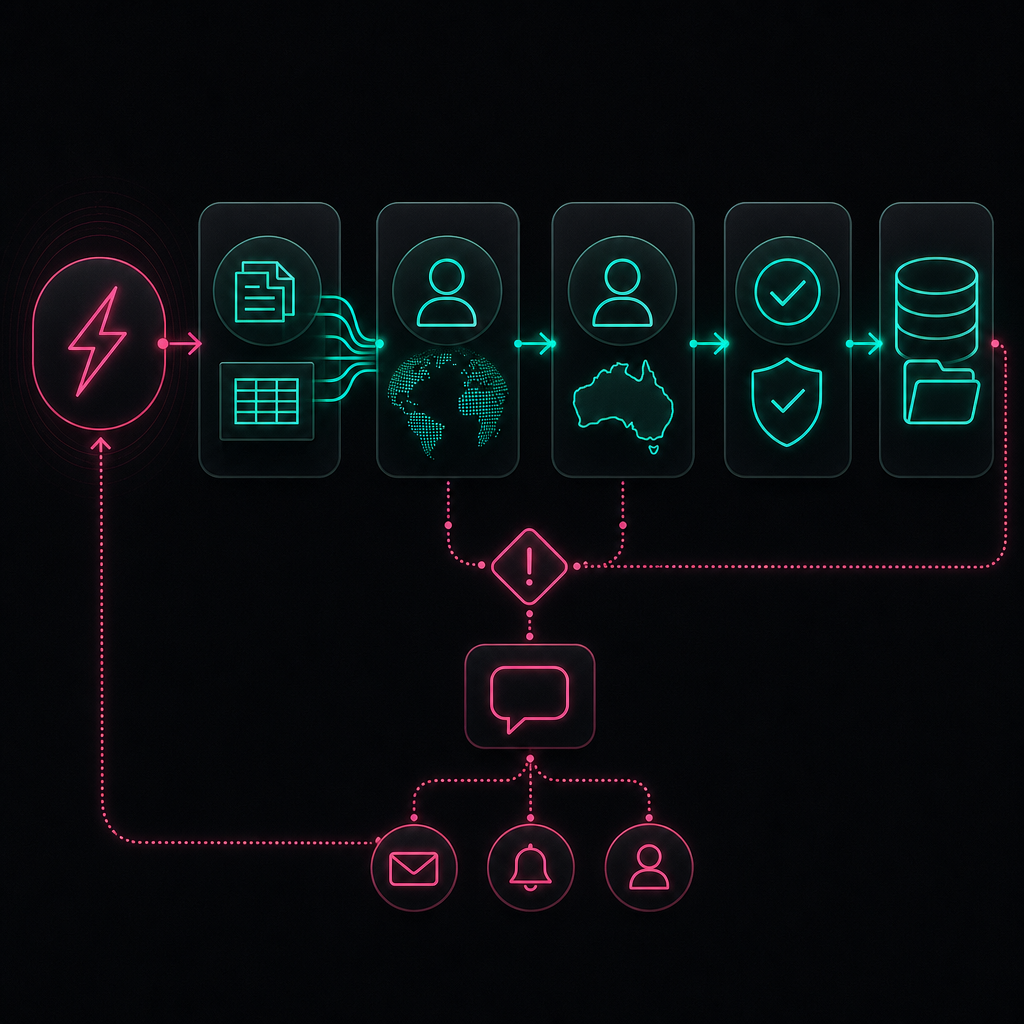
A reliable offshore model begins with workflow design, ownership and controls before recruitment. The difference between a capacity gap and a capacity crisis is usually a delivery structure problem, not a talent problem. Adding people to undocumented work simply distributes confusion across more people and locations.
Map the work before writing the job description
Start with outputs, not a list of software skills. For each recurring process, document:
- the trigger that starts the work
- required inputs and where they arrive
- the person responsible for preparation
- decision rules and approved templates
- the deadline and service expectation
- quality checks
- reviewer and approver
- escalation conditions
- evidence retained after completion
This work often exposes the real constraint. A firm may believe it needs another accountant when its actual bottleneck is partner approval, missing client documents or inconsistent workpaper templates.
Remotee's accounting capacity assessment is designed to identify those constraints before a role is added.
Separate responsibility from authority
An offshore employee can own preparation without holding final authority. This distinction should be visible in the workflow.
For payment processing, one person may prepare the batch, another may verify supplier changes and an authorised Australian manager may release funds. For BAS work, an offshore accountant may prepare the reconciliation while the registered or authorised person reviews and approves the service.
Use a responsibility matrix that identifies the preparer, reviewer, approver and informed stakeholders. Avoid shared ownership. If everybody is responsible, nobody is accountable when a deadline is missed.
Create a controlled knowledge base
Standard operating procedures should be concise enough to use during work. A long document that nobody opens is not an operating system.
Each procedure should contain screenshots or examples where useful, decision rules, escalation points, the expected output and a revision owner. Record process changes when software, regulations or client requirements change.
Build review into the workflow
Review should be risk-based. New employees and new processes need closer review. Stable, low-risk work can move towards exception-based checking after quality is demonstrated.
Do not remove review simply because deadlines are busy. Tax season is precisely when rushed processing and unclear responsibility create risk.
Plan for continuity
Your accounting process should not depend on one busy person remembering everything. Maintain shared procedures, controlled credentials, work queues and handover requirements. Cross-training can reduce key-person exposure, but access should remain limited to genuine business need.
For firms exploring offshore accounting staffing, continuity should be part of the service design rather than an informal promise.
Data security, privacy and fraud controls
Australian firms remain accountable for protecting financial and personal information when work is performed offshore. Security should combine contractual obligations, controlled devices, identity-based access, segregation of duties and active monitoring. A confidentiality clause by itself cannot prevent credential misuse, payment fraud or accidental disclosure.
Apply least-privilege access
Give each employee only the access required for their current role. Avoid shared logins and broad administrator rights. Use multi-factor authentication where supported and maintain a central record of granted access.
Access should be reviewed when responsibilities change and removed immediately at departure. A checklist is useful, but a named owner must be accountable for completing it.
Control supplier changes and payments
AP fraud risk increases when one person can receive a bank-detail request, amend the supplier record and release payment. Separate those functions.
Verify bank-detail changes through an independently sourced contact method. Do not rely solely on the reply details in the change request. Keep evidence of verification and report all amendments for review.
Consider Australian privacy obligations
The Australian Privacy Principles govern how covered organisations handle personal information. When information is disclosed overseas, APP 8 can be relevant to the organisation's responsibilities for cross-border disclosure.
Obtain legal advice where needed. Operationally, map what data offshore staff can access, where it is stored, whether local downloads are permitted and how incidents are reported.
Secure the working environment
A controlled environment may include managed devices, encrypted storage, endpoint protection, screen-lock policies and restrictions on removable media. The exact control set should reflect the sensitivity of the information and the firm's regulatory obligations.
Technology does not replace management. Investigate unusual access, repeated failed logins, bulk downloads and unexplained changes to supplier or payroll records.
Hiring and onboarding offshore accounting staff
Hire only after the role, workflow and authority limits are defined. A structured process combines qualification checks, practical assessment, reference verification, security screening and staged access. Onboarding should then prove that the employee can deliver a complete output under the firm's Australian compliance and review requirements.
Write an output-based role scorecard
The scorecard should state what the employee will deliver and how quality will be judged. Examples include completed bank reconciliations with documented exceptions, AP batches supported by approved evidence, or month-end schedules submitted by the agreed deadline.
Avoid vague expectations such as "assist the finance team". They make performance difficult to manage and encourage work to flow through private messages rather than controlled queues.
Use staged onboarding
A practical onboarding sequence includes:
- systems, security and privacy induction
- Australian accounting and compliance familiarisation
- demonstration using completed examples
- supervised practice in a test or controlled environment
- live work with full review
- documented feedback and correction
- increased ownership after competence is demonstrated
Access should expand with proven need. Do not give broad access on the first day merely because it is convenient.
Train reviewers as well as offshore staff
Australian managers often become the bottleneck because feedback is late, inconsistent or delivered through scattered messages. Review notes should explain the issue, required correction and underlying rule.
Recurring review findings belong in the procedure or training material. If the same error appears repeatedly, the system has failed to absorb the lesson.
How to manage performance without micromanagement
Manage offshore accounting staff through visible outputs, queue health, quality and escalation behaviour rather than constant activity monitoring. Effective managers can see what is due, what is blocked, who owns the next action and whether work meets the agreed standard. That provides control without turning management into surveillance.
Use a short operating rhythm
Daily communication should focus on deadlines, blocked items and risks. Detailed problem-solving can occur separately with the relevant people.
A weekly review can examine recurring errors, overdue inputs, workflow capacity and upcoming obligations. Monthly process reviews should identify procedures, templates or controls requiring change.
Track measures that expose delivery quality
Useful measures include:
- work completed by the agreed deadline
- items returned for correction
- unresolved reconciliation differences
- ageing of blocked work
- number and type of review findings
- exceptions escalated before the deadline
- tasks dependent on a single person
Do not reward output volume alone. High throughput with hidden errors creates downstream cost.
Calculate real savings rather than comparing salaries
A simple salary comparison can mislead. The relevant comparison is total delivered cost.
For an Australian hire, consider salary, superannuation, recruitment, software, workspace, management and vacancy risk. For an offshore model, consider service cost, software, onboarding, review time, security controls and rework.
Then compare both options against the same output and quality standard. A lower salary is not a saving if Australian partners spend their time repairing work.
The cost-saving formula is:
Annual delivered saving = current total delivery cost minus proposed total delivery cost
The business case should also show whether partner and manager time is released for billable work, client advice or business development. Remotee's own 2026 implementation data across 15 recruitment-agency implementations records a reduction of 6-10 hours of non-billable partner time per pay cycle. This is Remotee business data, not an industry benchmark.
Capacity should be solved as a control problem first
My view is direct: accounting offshoring fails when firms recruit before fixing delivery. Talent quality matters, but quality alone cannot repair missing workflows, unclear approval limits or inconsistent review. The right sequence is to stabilise the process, define ownership and then add specialist capacity around that system.
This position differs from providers competing mainly on cost, speed or CV volume. Predictable delivery matters more than headcount.
What tax-season scaling should look like
Consider a hypothetical accounting firm approaching tax season with a backlog of reconciliations and workpapers. Hiring several offshore tax accountants immediately may appear to solve capacity. It can instead create a larger review queue if every accountant uses different templates and escalation rules.
The better sequence is to standardise workpapers, define evidence requirements, categorise work by complexity and assign review ownership. Offshore staff can then prepare routine files while local tax professionals handle advice, difficult positions and regulated services.
No financial result is claimed for this scenario because none was supplied. The important lesson is operational: capacity becomes useful only when work can move through a repeatable system.
What AP automation should look like
Consider a hypothetical business adding invoice-capture software while leaving supplier verification, exception handling and payment authority undefined. Data entry may become faster, but the business has not automated control.
A sound AP model combines technology with an offshore owner who monitors the queue, validates evidence, resolves coding exceptions and prepares payment batches. Independent people still verify supplier changes and release funds.
Again, there is no invented savings figure. The financial case should be calculated from the business's current processing cost, error correction, approval time and fraud-control requirements.
First-hand payroll implementation: recruitment agency
In one recruitment agency implementation, the founders wanted to focus on new business and operations rather than payroll and accounting. Hiring and managing additional internal resources was not considered commercially efficient.
We completed discovery, installed a payroll system and assigned the delivery team. The process was live within 2 weeks, based on Remotee's implementation records. The founders' recurring responsibility became approval of one email each fortnight. The team managed payroll, superannuation, tax, compliance, timesheet questions and inbound payroll queries.
The commercial outcome was released founder capacity. A dollar saving was not supplied in the implementation data, so I will not manufacture one.
First-hand payroll implementation: hospitality labour hire
A hospitality recruitment and labour-hire business had internal employees and external accountants involved in weekly payroll. The arrangement created duplicated effort and significant workload.
Our team completed discovery, redesigned the process, moved the pay cycle from weekly to fortnightly and took over payroll delivery. The implementation reduced internal staffing and external accounting requirements. It also identified industry award obligations that had not been adequately addressed.
The recorded outcome was lower operating and payroll-processing costs, although no verified dollar amount was supplied. The more important control outcome was clearer specialist ownership. Payroll done properly. Not squeezed in between tax returns.
The Accountee Payroll Process
For established Australian businesses, the Accountee Payroll Process applies the same system-first principle:
- Payroll Discovery and Setup: Review pay cycles, staff types, awards, systems, approvals and reporting requirements.
- Payroll Transition: Transfer access, employee data, templates, calendars, timesheet flows and approval checkpoints.
- Full Payroll Processing: Manage timesheets, calculations, leave, allowances, deductions, STP, superannuation and reporting.
- Ongoing Payroll Management: Maintain delivery, issue resolution, compliance support, reporting and account management.
We process payroll like it matters, because to staff, it does. Offshore staffing should apply the same discipline to every accounting role.
Common offshoring mistakes to avoid
Most offshoring failures are predictable. Firms delegate unclear work, provide excessive system access, treat training as a software demonstration and measure only labour cost. These mistakes can be prevented by defining outputs, authority, evidence and review before the employee begins handling live financial information.
Hiring a generalist for several specialist roles
An employee described as an accountant, bookkeeper, payroll officer, tax preparer and executive assistant rarely receives a coherent workload. The role becomes reactive and quality varies by task.
Use specialist role design. Not jack-of-all-trades accounting. Specialist delivery.
Sending work through email and chat
Private messages hide deadlines and make handovers difficult. Use a controlled work queue with ownership, due dates, status and evidence links.
Email can notify people. It should not be the only record of an accounting workflow.
Assuming offshore means unsupervised
Offshore staff require management, especially during onboarding. The objective is not zero supervision. It is efficient supervision built into the process rather than repeated rescue work.
Ignoring time-zone handovers
The Philippines and Australia can support useful working-day overlap, but daylight-saving differences and local holidays should be reflected in calendars. Define cut-off times and urgent escalation channels rather than assuming everybody is available.
Treating documentation as a one-off project
Procedures become inaccurate when software, regulations, staff or client requirements change. Assign an owner and update the document when the process changes.
Build the system before adding the seat
Offshore accounting staff can release meaningful capacity, but only when the delivery model is designed around them. Define the output, authority, controls, review and escalation path first. Then recruit for the technical and communication skills required to operate that system consistently.
If your accounting workload is growing faster than your internal process, contact Remotee to assess the workflow before adding headcount. The goal is predictable delivery, not just another CV.
References
These sources provide the regulatory and technical foundations for GST treatment, BAS services, Australian accounting standards, privacy, workplace obligations and Philippine CPA regulation. Firms should check current guidance and obtain professional or legal advice where their circumstances require it.
- Australian Accounting Standards Board, Accounting Standards.
- Australian Taxation Office, Goods and services tax.
- Tax Practitioners Board, BAS services.
- Office of the Australian Information Commissioner, Australian Privacy Principles guidelines.
- Fair Work Ombudsman, Awards.
- Professional Regulation Commission, Philippines, Board of Accountancy.
FAQ_SCHEMA_JSON
FREQUENTLY ASKED QUESTIONS
Common questions
How much can Australian firms save with offshore accounting staff?
- There is no responsible universal percentage. Savings depend on the role, seniority, service structure, Australian review time, software and rework. Compare total delivered costs against equivalent outputs, including superannuation, recruitment, management, security and quality-control costs.
Can offshore accounting staff prepare BAS returns?
- Offshore staff can assist with data preparation, reconciliations and workpapers when appropriately trained and supervised. Firms must consider Tax Practitioners Board requirements and clearly separate preparation, review, approval and lodgement authority.
Does a Philippine CPA qualification apply in Australia?
- A Philippine CPA licence does not automatically provide Australian tax agent registration, BAS agent registration or Australian professional membership. Firms should verify the licence and separately assess Australian technical knowledge and practical competence.
Which accounting role should be offshored first?
- Start with a repeatable role that has stable inputs and measurable outputs. AP, AR, bookkeeping and reconciliations are common starting points. Avoid beginning with poorly documented advisory work or a role containing several unrelated functions.
How should financial data be protected offshore?
- Use managed devices, identity-based access, multi-factor authentication, least-privilege permissions and audit logs. Separate supplier maintenance from payment release and assess obligations under the Australian Privacy Principles.
How long does offshore accounting onboarding take?
- There is no fixed period for every role. Duration depends on workflow complexity, system access, documentation quality and compliance training. Onboarding should continue until the employee demonstrates complete, review-ready work.

Jon Kelly
Founder, Remotee
Jon helps Australian businesses build compliance-led offshore teams that scale without the burnout. NDIS, accounting, mortgage broking, recruitment and digital marketing.
KEEP READING
Related posts
Offshore staffing service inclusions
Offshore staffing service inclusions
An offshore staffing service should include workforce planning, candidate sourcing, screening, compliant employment, payroll, onboarding, technology setup, secu…
31 August 2026 · 20 min read
offshore team training Australia
Training and Development for Offshore Teams: Empowering Global Talent
Effective offshore team training for Australian businesses combines structured onboarding, role-specific instruction, supervised practice, mentorship and docume…
24 August 2026 · 16 min read
offshore project management staff Australia
Offshore Project Management Staffing for Australian Businesses
Offshore project management staffing gives Australian businesses access to dedicated project coordinators, PMO analysts and project managers without building ev…
23 August 2026 · 19 min read
READY TO SCALE WITHOUT THE BURNOUT?
Build a compliance-led offshore team in 3–4 weeks.
Tell us about your current bottleneck and we'll show you what a Remotee placement would look like for your operation.
Or get our playbooks emailed to you instead.