
Australian Recruitment & Talent Statistics for 2026
- Australian recruitment statistics
- Australia talent shortage data
- skills gap Australia statistics
- offshore staffing market share Australia
- remote work statistics
- Australian labour market
- talent acquisition
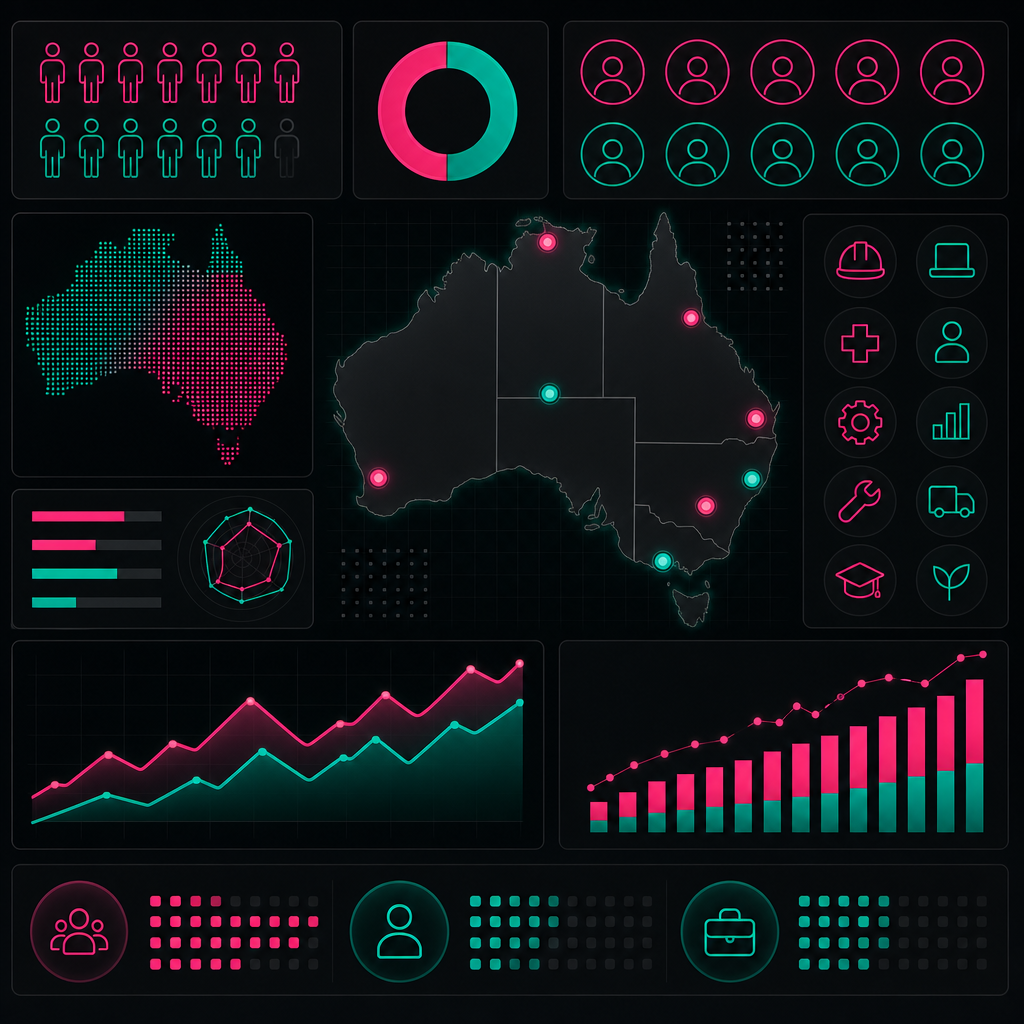
Key Statistics Summary
- According to Jobs and Skills Australia (Occupation Shortage List), 33% of assessed occupations were in shortage in 2024, compared with 36% in 2023 and 31% in 2022.
- According to the Australian Bureau of Statistics (Job Vacancies, Australia), employers reported approximately 344,000 vacant positions in November 2024. That was 51.3% above the February 2020 level.
- According to the Australian Bureau of Statistics (Labour Force, Australia), the unemployment rate was 3.9% in November 2024 and the labour-force participation rate was 67.0%.
- According to the Australian Bureau of Statistics (Working Arrangements), 37% of employed Australians usually worked from home in August 2023, compared with approximately 32% before the COVID-19 pandemic.
- According to the Australian Bureau of Statistics (Average Weekly Earnings), full-time adult average weekly ordinary-time earnings reached $1,923.40 in August 2024, an annual increase of 4.6%.
- According to Jobs and Skills Australia (Employment Projections), national employment was projected to increase by approximately 950,000 positions, or 6.5%, over the five years to May 2029.
- According to the Department of Home Affairs (Migration Program statistics), Australia's permanent Migration Program delivered 190,000 places in 2023-24, including 137,100 places in the Skill stream.
| Headline indicator | Latest cited result | Reference period | Source |
|---|---|---|---|
| Occupations assessed as being in shortage | 33% | 2024 | Jobs and Skills Australia |
| Job vacancies | 344,000 | November 2024 | Australian Bureau of Statistics |
| Unemployment rate | 3.9% | November 2024 | Australian Bureau of Statistics |
| Labour-force participation rate | 67.0% | November 2024 | Australian Bureau of Statistics |
| Employed people usually working from home | 37% | August 2023 | Australian Bureau of Statistics |
| Full-time adult average weekly ordinary-time earnings | $1,923.40 | August 2024 | Australian Bureau of Statistics |
| Permanent Migration Program places | 190,000 | 2023-24 | Department of Home Affairs |
Introduction
Australian recruitment statistics are important because a low unemployment rate can coexist with substantial occupation shortages, persistent vacancies and uneven access to qualified applicants. Employers therefore need to distinguish between economy-wide labour availability, occupation-specific scarcity and recruitment problems caused by pay, location, working arrangements or an inefficient selection process. This 2026 report consolidates the latest clearly identifiable public data available from government and recognised research bodies. Most of the underlying releases relate to 2023 and 2024 because comprehensive labour-market datasets are published after their reference periods.
The report is intended for workforce planners, recruiters, business owners, policy researchers and journalists seeking a defensible overview of Australia talent shortage data. It covers the overall labour market, skills gap Australia statistics, remote work, recruitment pressure, migration and workforce responses. It also explains where the available evidence has limits. In particular, there is no single official measure of offshore staffing market share Australia, so offshore hiring should not be assigned a national market-share figure without a transparent dataset and definition.
Overall Labour Market and Vacancy Statistics

Australia entered the period covered by this report with a labour market that remained comparatively tight. Employment growth continued, participation was historically elevated and the stock of vacancies remained well above its pre-pandemic level. These conditions do not mean every employer faces the same recruitment difficulty, but they reduce the pool of immediately available candidates in many occupations.
- According to the Australian Bureau of Statistics (Labour Force, Australia), Australia's unemployment rate was 3.9% in November 2024.
- According to the same ABS release, the labour-force participation rate reached 67.0% in November 2024. High participation indicates that a large share of the working-age population was already employed or actively seeking employment.
- According to the Australian Bureau of Statistics (Job Vacancies, Australia), there were approximately 344,000 job vacancies in November 2024.
- According to the ABS vacancy release, the November 2024 vacancy estimate was 4.3% lower than in August 2024 and 12.3% lower than in November 2023. Recruitment demand was easing, but it had not returned to its pre-pandemic baseline.
- According to the same ABS source, November 2024 vacancies remained 51.3% above February 2020. This longer comparison is important because a quarterly decline can otherwise be mistaken for an absence of recruitment pressure.
- According to the Australian Bureau of Statistics (Average Weekly Earnings), full-time adult average weekly ordinary-time earnings were $1,923.40 in August 2024, up 4.6% over the year.
| Vacancy measure | Result | Interpretation | Source |
|---|---|---|---|
| Total vacancies | 344,000 | Positions reported vacant by employers | ABS, November 2024 |
| Change since August 2024 | -4.3% | Short-term vacancy demand declined | ABS, November 2024 |
| Change since November 2023 | -12.3% | Annual vacancy demand declined | ABS, November 2024 |
| Change since February 2020 | +51.3% | Vacancies remained above the pre-pandemic baseline | ABS, November 2024 |
Vacancies are a stock measure, not a count of all hiring activity. A position can remain vacant across consecutive ABS surveys, while other roles may be advertised and filled between survey dates. Vacancy figures should therefore be read alongside job advertisements, employment growth, turnover and occupation-shortage data rather than treated as a complete measure of recruitment volume.
The wage data also require careful interpretation. Average weekly earnings are affected by changes in occupation mix, full-time employment and workforce composition. They do not show what an employer must offer for a particular role. Recruiters comparing remuneration should use occupation, location and experience benchmarks in addition to the national average.
Skills Shortages by Occupation and Industry

Jobs and Skills Australia's Occupation Shortage List is the principal national source for occupation-level shortage analysis. An occupation is assessed as being in shortage when employers have difficulty filling vacancies for reasons connected to the supply or suitability of workers. The measure is more specific than simply counting advertisements.
- According to Jobs and Skills Australia (2024 Occupation Shortage List), 33% of assessed occupations were in national shortage in 2024.
- According to Jobs and Skills Australia, the corresponding share was 36% in 2023. The decline indicates some easing, but not the disappearance of structural skills gaps.
- According to Jobs and Skills Australia, 31% of assessed occupations were in shortage in 2022. The 2024 result therefore remained above the 2022 share despite improving from the 2023 peak.
- Jobs and Skills Australia's 2024 analysis continued to identify persistent pressure in professional, care and trade occupations. The agency explains that shortages may reflect insufficient qualified applicants, limited experience, geographic mismatches or employers' inability to attract suitable candidates under the conditions offered.
- According to Jobs and Skills Australia (Employment Projections), employment was projected to grow by approximately 950,000 positions, or 6.5%, over the five years to May 2029. Growth creates replacement and expansion demand even when the overall shortage share is falling.
| Occupation Shortage List year | Share of assessed occupations in shortage | Year-over-year direction | Source |
|---|---|---|---|
| 2022 | 31% | Baseline year in this comparison | Jobs and Skills Australia |
| 2023 | 36% | Increased from 2022 | Jobs and Skills Australia |
| 2024 | 33% | Decreased from 2023 | Jobs and Skills Australia |
The three-year pattern shows why shortage data should not be reduced to a claim that Australia either has or does not have a labour shortage. The national share increased and then eased, while shortages persisted in occupations requiring registration, formal qualifications, specialised experience or lengthy training pipelines.
An occupation shortage can also exist beside weak applicant demand elsewhere. Skills are not automatically interchangeable between industries. A surplus of applicants in a general administrative occupation does not resolve a shortage of registered health professionals, licensed tradespeople or experienced technical specialists.
Jobs and Skills Australia distinguishes between qualification gaps and suitability gaps. More graduates will not immediately resolve every shortage if employers require substantial experience, work at an inconvenient location, offer conditions below candidate expectations or use selection criteria that unnecessarily restrict the available pool. This is why skills-gap analysis should examine both workforce supply and job design.
The National Centre for Vocational Education Research maintains the Survey of Employers' Use and Views of the VET System, which provides evidence about employer engagement with apprenticeships, traineeships and nationally recognised training. Its research supports the use of vocational education as part of workforce supply planning, particularly where occupations depend on practical competence and formal credentials.
Remote and Flexible Work Adoption
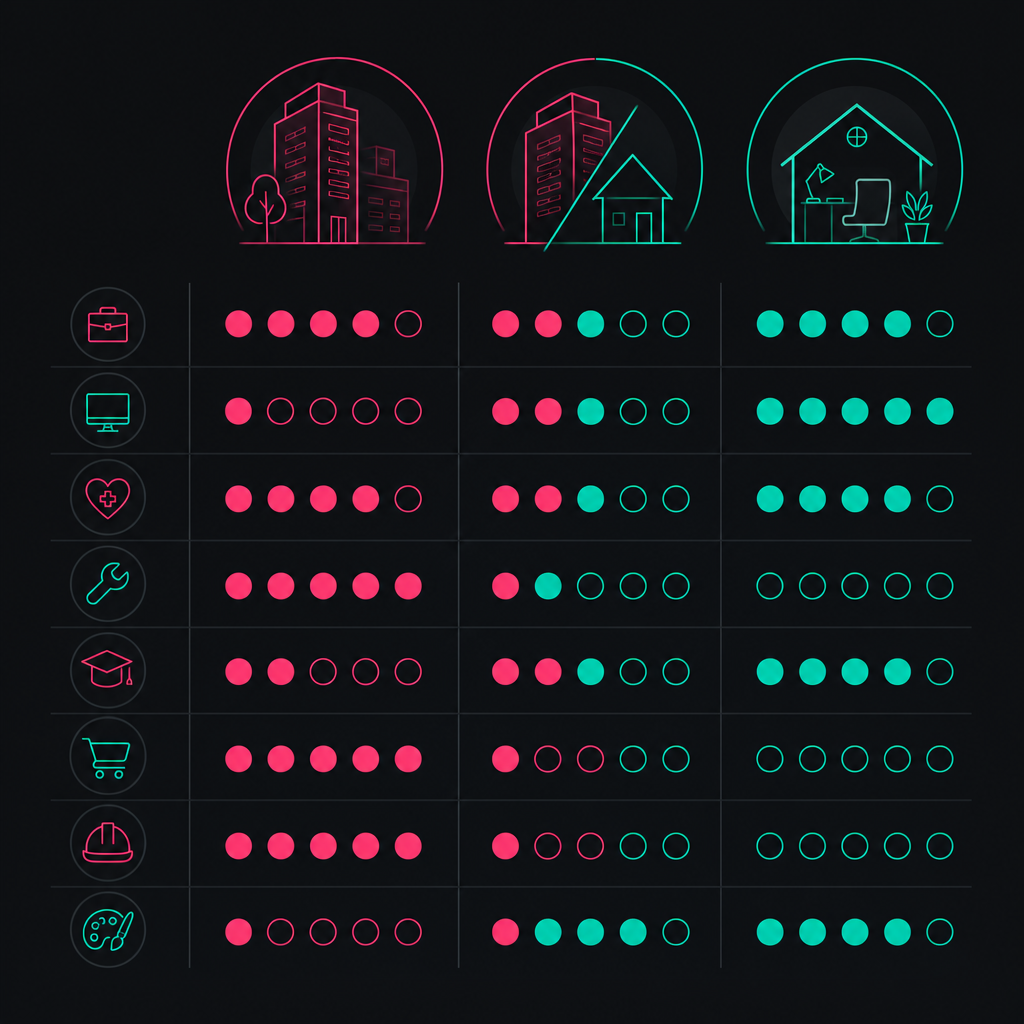
Remote and hybrid arrangements expanded the geographic reach of recruitment, particularly for work delivered through digital systems. They also changed candidate expectations. The data do not support the idea that every occupation can be remote, but they show that working from home remained much more common than it was before the pandemic.
- According to the Australian Bureau of Statistics (Working Arrangements), 37% of employed Australians usually worked from home in August 2023.
- According to the same ABS release, approximately 32% of employed Australians regularly worked from home before the COVID-19 pandemic. The post-pandemic level was therefore about 5 percentage points higher.
- According to the ABS, around 40% of employed people regularly worked from home in August 2021. The August 2023 result was below that pandemic-era level but remained above the earlier baseline.
- According to the Australian Bureau of Statistics, 60% of managers and professionals usually worked from home in August 2023. Occupational composition is therefore central to any remote-work benchmark.
- According to the same source, 49% of clerical and administrative workers usually worked from home in August 2023. This demonstrates that remote work extends beyond management, although it is not evenly available across all administrative roles.
| Remote-work benchmark | Share of employed people | Reference point | Source |
|---|---|---|---|
| Regularly working from home before the pandemic | Approximately 32% | Pre-pandemic comparison reported by ABS | ABS Working Arrangements |
| Regularly working from home | Around 40% | August 2021 | ABS Working Arrangements |
| Usually working from home | 37% | August 2023 | ABS Working Arrangements |
| Managers and professionals usually working from home | 60% | August 2023 | ABS Working Arrangements |
| Clerical and administrative workers usually working from home | 49% | August 2023 | ABS Working Arrangements |
The ABS question refers to people who usually or regularly work from home. It is not equivalent to a fully remote employment rate. A person attending an office for part of the week may be included, as may a self-employed person operating from home. Recruiters should not label the 37% result as the share of Australians holding fully remote jobs.
Remote-work feasibility also varies by occupation. Knowledge, professional and administrative work can often be delivered across locations, while health care, construction, hospitality, transport and many service roles require physical presence. An employer comparing its policy with a national average should first control for occupational mix.
Australia's right-to-disconnect provisions add another consideration to remote and flexible work design. According to the Fair Work Ombudsman (Right to disconnect), the provisions began applying to employees of non-small-business employers on 26 August 2024 and to small-business employees on 26 August 2025. Remote availability should therefore be documented rather than assumed to be continuous.
Talent Acquisition Challenges and Hiring Benchmarks
Talent acquisition performance is affected by labour supply, but it is also affected by the quality of the employer's process. A vacancy can remain open because suitable candidates are scarce, because remuneration is not competitive, or because decisions and approvals take too long. Public labour statistics cannot fully separate these causes at an individual employer level.
- According to the ABS (Job Vacancies, Australia), the approximately 344,000 vacancies recorded in November 2024 remained 51.3% above the February 2020 level. Employers were still competing across a larger vacancy pool than before the pandemic.
- According to Jobs and Skills Australia (Occupation Shortage List), the shortage share fell from 36% in 2023 to 33% in 2024. Recruitment conditions eased overall, although the change was not uniform across occupations.
- According to the ABS (Average Weekly Earnings), full-time adult average weekly ordinary-time earnings increased by 4.6% over the year to August 2024. Employers using older salary bands risk comparing offers with an outdated market.
- According to Jobs and Skills Australia (Internet Vacancy Index), the index measures newly lodged online advertisements and is designed to track changes in recruitment demand. It should be used with ABS vacancies because advertisements and unfilled positions measure different parts of the hiring cycle.
- According to Jobs and Skills Australia (Employment Projections), projected employment growth of 6.5% over the five years to May 2029 implies continued hiring demand from economic expansion, before replacement hiring caused by retirement or worker movement is considered.
Recruiters should separate time-to-fill from vacancy duration. Time-to-fill is normally an internal metric measured from an approved requisition to an accepted offer or commencement. Vacancy duration may be measured from advertising to removal, and definitions vary between systems. There is no single official Australian time-to-fill benchmark that can be applied safely to every industry.
The same caution applies to cost-per-hire and offer-acceptance benchmarks. Figures published by software vendors or individual recruitment firms may be useful within their samples, but they are not automatically representative of Australia. A defensible internal benchmark should specify which costs are included, how internal labour is valued, and whether executive, graduate and high-volume hiring are reported separately.
Process design becomes especially important in a tight occupation market. Employers can monitor the time between application, screening, interview, decision and written offer. Long approval gaps create avoidable candidate loss even when the underlying shortage cannot be fixed. The practical distinction is between a capacity gap and a capacity crisis. The latter often reflects unclear ownership and undocumented delivery steps as much as a shortage of applicants.
Workforce Supply, Training and Potential Responses
No single response can close every Australian skills gap. Training expands domestic capability but takes time. Migration can add experienced workers but is constrained by visa settings, processing, occupational recognition and settlement patterns. Flexible work can broaden access for some roles, while job redesign can remove unnecessary barriers.
- According to the Department of Home Affairs (Migration Program statistics), the permanent Migration Program delivered 190,000 places in 2023-24.
- According to the same Department of Home Affairs source, 137,100 of those places were delivered through the Skill stream.
- According to Home Affairs, 52,500 places were delivered through the Family stream and 400 through Special Eligibility in 2023-24. These streams should not be counted as direct employer-sponsored recruitment, even though some entrants may participate in the labour market.
- According to Jobs and Skills Australia (Employment Projections), employment was projected to grow by approximately 950,000 positions over the five years to May 2029. Workforce responses must therefore address both existing shortages and future growth.
- According to the Australian Bureau of Statistics (Working Arrangements), 37% of employed people usually worked from home in August 2023. Flexible location remains a potential way to widen candidate pools for suitable occupations.
| Permanent Migration Program stream | Places delivered in 2023-24 | Share of total calculated from published counts | Source |
|---|---|---|---|
| Skill | 137,100 | 72.2% | Department of Home Affairs |
| Family | 52,500 | 27.6% | Department of Home Affairs |
| Special Eligibility | 400 | 0.2% | Department of Home Affairs |
| Total | 190,000 | 100% | Department of Home Affairs |
Migration Program places are not equivalent to job placements. The Skill stream includes different visa categories, and not every person enters through a vacancy sponsored by a specific employer. Migration statistics should be treated as a workforce-supply indicator rather than a recruitment conversion benchmark.
Training responses need similar discipline. The National Centre for Vocational Education Research's employer survey collection tracks employers' use of apprenticeships, traineeships and other vocational training. Employers considering a training response should measure completion, competency, supervision capacity and the period before a learner can work independently.
Job redesign is another option. Selection criteria can be reviewed to distinguish mandatory licences or safety requirements from preferences that can be learned after commencement. Employers can also separate specialised work from repeatable support tasks. However, adding people without documented workflows, clear ownership and repeatable processes can move a bottleneck rather than remove it. Predictable delivery depends on both capable people and a defined operating system.
Australian Market Statistics

The Australian market combines high participation, relatively low unemployment, elevated vacancies and substantial differences between occupations. The following indicators provide a local benchmark for interpreting recruitment conditions in 2026.
- According to the ABS (Labour Force, Australia), the unemployment rate was 3.9% and participation was 67.0% in November 2024. These figures indicate limited economy-wide spare capacity at that point.
- According to the ABS (Job Vacancies, Australia), approximately 344,000 vacancies remained in November 2024, despite declines over both the quarter and the year.
- According to Jobs and Skills Australia (Occupation Shortage List), 33% of assessed occupations were in shortage in 2024. This is the clearest national benchmark for the extent of occupation scarcity.
- According to the ABS (Average Weekly Earnings), full-time adult average weekly ordinary-time earnings were $1,923.40 in August 2024. Remuneration planning should account for the reported 4.6% annual increase.
- According to the ABS (Working Arrangements), 37% of employed Australians usually worked from home in August 2023. This provides a national reference point for flexible-work policy, not a universal target.
- According to Home Affairs (Migration Program statistics), 137,100 Skill stream places were delivered in 2023-24. Skilled migration was therefore a material component of national workforce supply.
The Australian Competition and Consumer Commission's Scamwatch guidance is also relevant to recruitment operations, particularly where hiring takes place through messaging platforms or across borders. Employers and candidates should independently verify identities, entities, payment instructions and advertised positions. Recruitment controls need to cover data protection and fraud risk as well as candidate assessment.
IBISWorld Australia publishes commercial industry research through its Australian industry research portal. Its market reports may help organisations compare employment and business conditions within particular sectors, but subscription figures should be checked directly against the current report before publication.
Offshore staffing market share in Australia
No standard ABS, Jobs and Skills Australia or ACCC series reports a single offshore staffing market share for Australia. Public datasets use different concepts, including outsourcing, business-process services, overseas contractors, foreign affiliates and employees working remotely from another jurisdiction. These categories should not be merged into an invented market-share percentage.
A defensible offshore staffing analysis should define the numerator and denominator. For example, a study might examine overseas contractor expenditure as a share of external labour expenditure, or offshore workers as a share of a defined function's workforce. Those measures answer different questions and cannot be described interchangeably as national market share.
The absence of an official percentage is itself an important finding for researchers targeting the phrase "offshore staffing market share Australia". Any published estimate should identify the underlying sample, worker classification, countries included, reference period and treatment of outsourced service contracts.
Key Takeaways
-
Use occupation data, not only the unemployment rate. According to Jobs and Skills Australia, 33% of assessed occupations were in shortage in 2024 even though the ABS recorded unemployment at 3.9% in November 2024. A national unemployment figure cannot show whether the exact capabilities required for a vacancy are available.
-
Treat easing vacancies as a change in degree, not a return to old conditions. According to the ABS, vacancies fell 12.3% over the year to November 2024 but remained 51.3% above February 2020. Workforce plans should recognise both the recent easing and the elevated long-term baseline.
-
Refresh remuneration data before opening a role. According to the ABS, full-time adult average weekly ordinary-time earnings rose 4.6% over the year to August 2024. Historical salary bands may therefore understate candidate expectations, although occupation-specific evidence is still required.
-
Benchmark remote work by occupation. According to the ABS, 37% of employed Australians usually worked from home in August 2023, while the share was 60% among managers and professionals. A company-wide comparison can be misleading when the workforce contains occupations with different location requirements.
-
Plan for growth as well as current vacancies. Jobs and Skills Australia projected employment growth of approximately 950,000 positions over the five years to May 2029. Training, succession and recruitment capacity need to account for future expansion and replacement demand.
-
Do not treat migration places as direct hires. Home Affairs reported 137,100 Skill stream places within the 190,000-place Migration Program delivered in 2023-24. This increases potential labour supply, but visa grants and recruitment outcomes are different measures.
-
Measure the recruitment operating system. Candidate supply is only one part of hiring performance. Employers should document role approval, sourcing, screening, interviews, references, decision rights, offers and onboarding. Adding headcount without clear ownership and repeatable processes can increase coordination work rather than create reliable capacity.
-
Avoid unsupported offshore market-share claims. There is no single official Australian series that establishes offshore staffing market share. Researchers should publish a transparent definition and calculation rather than repeat an uncited percentage.
Methodology & Disclaimer
This report was prepared for publication in 2026 using publicly available releases that could be identified with confidence. Priority was given to the Australian Bureau of Statistics, Jobs and Skills Australia, the Department of Home Affairs, the Fair Work Ombudsman, the National Centre for Vocational Education Research, the Australian Competition and Consumer Commission and other recognised institutions.
The reference period is shown beside each figure because publication year and data year are not always the same. No attempt has been made to project missing 2026 observations or relabel earlier data as 2026 results. Percentages calculated from published counts are explicitly labelled as calculations. Commercial benchmarks and estimates were excluded where their definitions or public source material could not be verified.
Statistics sourced from publicly available research and industry reports. Verify individual figures before publishing. Releases may be revised, definitions may change and seasonally adjusted results can differ from original estimates. Report suspected citation or transcription errors through the Remotee contact page.
Sources
- Australian Bureau of Statistics, Labour Force, Australia.
- Australian Bureau of Statistics, Job Vacancies, Australia.
- Australian Bureau of Statistics, Average Weekly Earnings, Australia.
- Australian Bureau of Statistics, Working Arrangements.
- Jobs and Skills Australia, Occupation Shortage List.
- Jobs and Skills Australia, Employment Projections.
- Jobs and Skills Australia, Internet Vacancy Index.
- Department of Home Affairs, Migration Program statistics.
- National Centre for Vocational Education Research, Survey of Employers' Use and Views of the VET System.
- Fair Work Ombudsman, Right to disconnect.
- Australian Competition and Consumer Commission, Scamwatch.
- Australian Treasury, Working Future: The Australian Government's White Paper on Jobs and Opportunities.
- Reserve Bank of Australia, Statement on Monetary Policy, November 2024.
- IBISWorld Australia, Australian Industry Research.
FAQ_SCHEMA_JSON
FREQUENTLY ASKED QUESTIONS
Common questions
What percentage of Australian occupations are in shortage?
- Jobs and Skills Australia reported that 33% of assessed occupations were in shortage in 2024, down from 36% in 2023 but above 31% in 2022.
How many job vacancies are there in Australia?
- The Australian Bureau of Statistics reported approximately 344,000 job vacancies in November 2024. This was 51.3% above the February 2020 level.
What is Australia's unemployment rate?
- The Australian Bureau of Statistics recorded an unemployment rate of 3.9% in November 2024, alongside a labour-force participation rate of 67.0%.
How common is remote work in Australia?
- The Australian Bureau of Statistics reported that 37% of employed Australians usually worked from home in August 2023. The measure includes hybrid arrangements and should not be interpreted as a fully remote employment rate.
How does skilled migration support Australia's workforce?
- The Department of Home Affairs reported that 137,100 Skill stream places were delivered within Australia's 190,000-place permanent Migration Program in 2023-24. Migration places are workforce-supply indicators, not direct job-placement counts.
What is the offshore staffing market share in Australia?
- No standard ABS, Jobs and Skills Australia or ACCC dataset reports a single national offshore staffing market share. Estimates should define the workforce category, denominator, countries included and treatment of outsourced service contracts.

Jon Kelly
Founder, Remotee
Jon helps Australian businesses build compliance-led offshore teams that scale without the burnout. NDIS, accounting, mortgage broking, recruitment and digital marketing.
KEEP READING
Related posts
provider due-diligence checklist
Offshore Staffing Provider Due Diligence Checklist for Australian Businesses
An offshore staffing provider due-diligence checklist should verify the provider's delivery model, legal employing entity, payroll controls, recruitment process…
14 September 2026 · 18 min read
transparent provider pricing comparison
Offshore Staffing Pricing Transparency: How to Compare Provider Quotes Without Getting Caught Out
Transparent provider pricing comparison means evaluating offshore staffing quotes against total cost of engagement, not headline hourly rate. A genuine quote it…
13 September 2026 · 17 min read
managed staffing versus freelancer platforms
Managed Offshore Staffing vs Freelancer Platforms: Which Model Actually Delivers for Australian Businesses?
Managed offshore staffing suits ongoing, business-critical work because it wraps talent in documented workflows, compliance and a replacement guarantee. Freelan…
12 September 2026 · 15 min read
READY TO SCALE WITHOUT THE BURNOUT?
Build a compliance-led offshore team in 3–4 weeks.
Tell us about your current bottleneck and we'll show you what a Remotee placement would look like for your operation.
Or get our playbooks emailed to you instead.