
Offshore Staffing Risks and Challenges: What Australian Businesses Need to Know in 2026
- offshore staffing
- offshore hiring Australia
- offshore compliance
- remote team management
- business operations
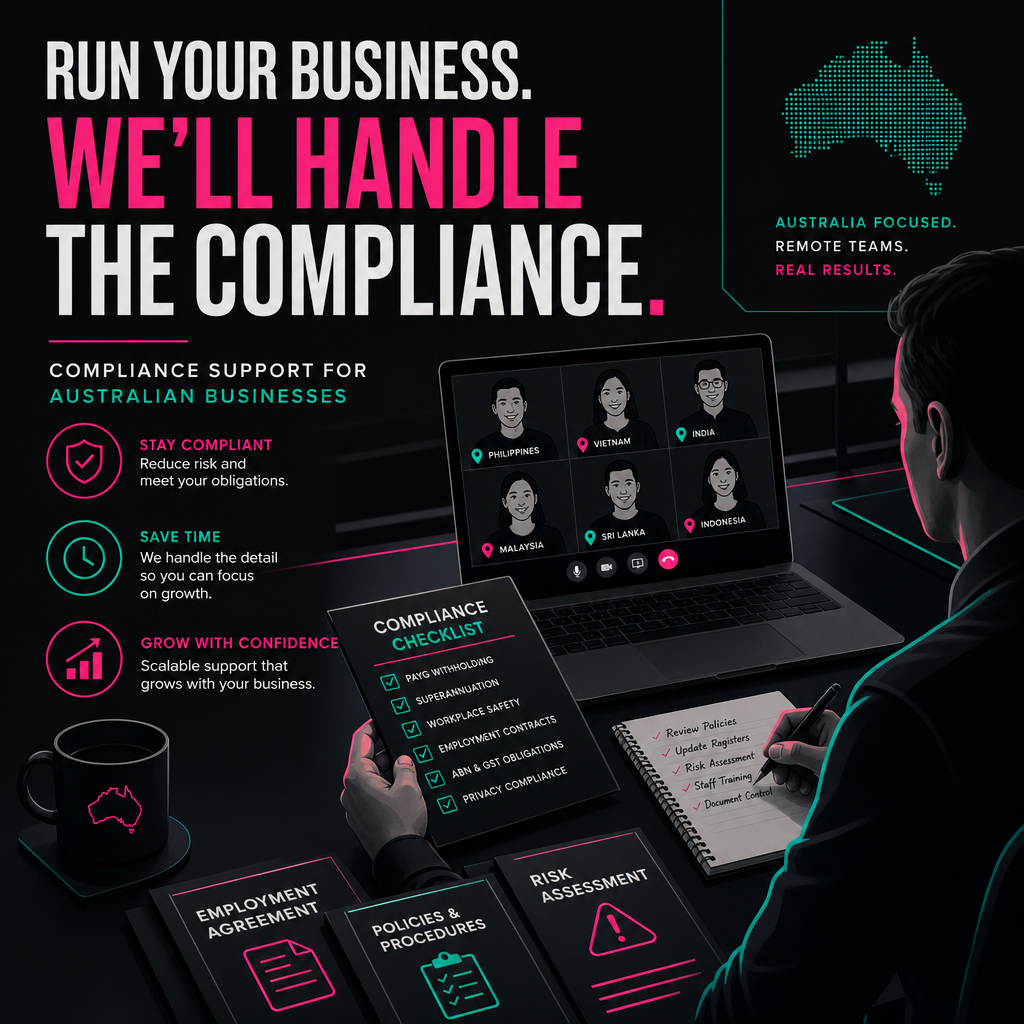
Most content about offshore staffing sells the dream. Lower labour costs, faster scaling, access to global talent. That narrative is not wrong, exactly, but it is dangerously incomplete. The businesses that come unstuck with offshore hiring are almost never the ones that failed to find cheap enough talent. They are the ones that added headcount without adding structure, and discovered too late that a delivery structure problem looks identical to a talent problem until you dig deeper.
In 2026, Australian businesses are offshoring at record rates. According to the Australian Bureau of Statistics, the professional and business services sector continues to record strong growth in service imports, with the Philippines remaining the dominant destination for skilled offshore roles across accounting, administration, marketing, and healthcare support. But alongside that growth comes a growing graveyard of failed engagements: data breaches from under-secured remote setups, NDIS compliance incidents from staff who were never properly trained in Australian regulatory frameworks, and founders who rebuilt offshore teams from scratch after a third consecutive account manager quit.
This article is not here to talk you out of offshoring. Done well, it is one of the highest-leverage moves an Australian business can make. I have personally overseen the delivery of more than $500 million in combined outsourcing strategies across my career, and the businesses that win with offshore staffing share one trait: they treat it as a system problem, not a hiring problem. What follows is the full picture, the risks, the mitigation strategies, and the structural decisions that separate offshore engagements that compound over time from the ones that quietly drain resources while you are busy running everything else.
Key Takeaways
- Communication and time zone friction are manageable, but only when overlap hours, escalation paths, and handoff formats are designed up front, not discovered after a missed deadline.
- Quality control is a system output, not a talent characteristic. Consistent results require documented standards, checkpoints, and a cadence for review.
- Data security with offshore staff requires more than a signed NDA. Australian Privacy Act obligations follow your data regardless of where your staff are located.
- Hidden costs in offshore engagements, including onboarding time, rework, management overhead, and attrition, routinely erode 30-50% of projected savings if left unmanaged.
- Cultural misalignment is real but fixable. The fix is structured onboarding and explicit communication norms, not wishful thinking about "culture fit."
- Staff retention in offshore teams is directly correlated with clarity of role, quality of management, and career development investment, not just salary.
- Regulated industries including NDIS providers, financial services firms, and accounting practices face specific compliance exposure when offshoring that generic staffing providers are not equipped to manage.
- The right offshore partner competes on reliability and delivery structure, not just the quality of the CVs they send you.
Summary Table
| Risk | Impact Level | Mitigation Strategy | Remotee's Approach |
|---|---|---|---|
| Communication and time zone gaps | Medium-High | Defined overlap hours, async-first protocols, escalation templates | Structured handoff SOPs and cadence design built into onboarding |
| Inconsistent output quality | High | Role scorecards, checkpoint reviews, versioned SOPs | Remotee Operating System with weekly quality cadence |
| Data security and privacy breaches | High | ASD-aligned security controls, access tiering, incident response plan | Dedicated technology and security framework for every placement |
| Hidden costs and eroded savings | Medium-High | Full cost modelling before engagement, rework tracking | Transparent pricing, 21-day placement-to-operational timeline |
| Cultural misalignment | Medium | Explicit communication norms, structured cultural onboarding | Industry-specific SOP library with Australian context baked in |
| Staff turnover and attrition | High | Career pathway clarity, strong account management, retention incentives | 95%+ specialist retention at 12 months |
| Regulatory and compliance gaps | Very High | Compliance-specific SOPs, escalation triggers, audit trails | Compliance training and NDIS delegation system |
| Contractor vs. employee misclassification | High | Fair Work-aligned classification review before engagement | Engagement model review included in discovery phase |
Why Understanding Risks Matters Before You Offshore
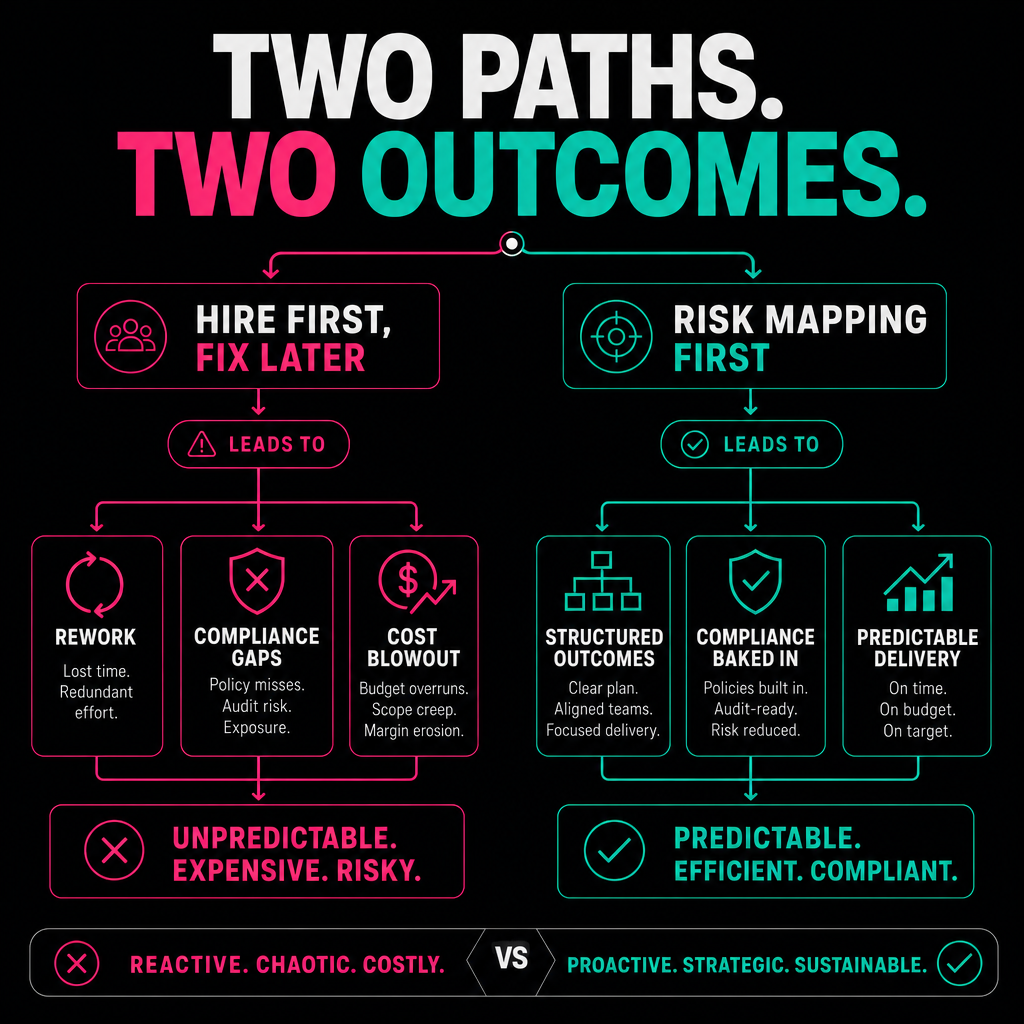
There is a tendency in the offshore staffing industry to frame risk management as a post-engagement problem. Something you address once things go wrong. That framing costs businesses real money.
The economics of offshore staffing are compelling on paper. A skilled Filipino virtual assistant or offshore accountant typically costs 60-75% less than an equivalent Australian hire when you account for salary, superannuation, leave entitlements, and office overhead. But that saving assumes the engagement works as intended from week one. In my experience, engagements that skip proper risk assessment before signing spend the first three to six months burning that saving on rework, re-hiring, and management overhead that was never budgeted for.
The more important reason to understand risks upfront is strategic. Australian businesses that approach offshore staffing as a delivery system decision, rather than a hiring decision, consistently outperform those that treat it as a cost arbitrage exercise. When you understand the failure modes in advance, you build the countermeasures into the engagement design. Compliance is baked in, not bolted on. Quality standards exist from day one. Escalation paths are documented before the first edge case arrives.
The businesses I have worked with that get the most value from offshore staffing share a common starting point: they map their risks before they map their roles. That sequence matters more than most founders realise.
Communication and Time Zone Challenges
The time zone gap between Australia and the Philippines is relatively shallow compared to other offshore destinations. The Philippines sits at UTC+8, which aligns closely with Australian Eastern Standard Time and creates two to three hours of natural overlap even during Philippine business hours. That overlap is workable. But workable is not the same as designed.
The most common communication failure I see is not the time zone gap itself. It is the absence of any agreed protocol for how work moves across that gap. Tasks live across inbox, chat, and memory. Expectations are implied rather than documented. When a deliverable arrives late or incomplete, the cause is almost never that the offshore team member was not capable. It is that the handoff was unclear, the priority was ambiguous, or the exception handling was not documented anywhere.
I worked with a digital marketing agency where the founder was the approval bottleneck for routine work. Everything required her sign-off, but the criteria for sign-off were never written down. Rework happened constantly because the offshore team was executing against their best interpretation of an incomplete brief. The fix was not replacing the team. It was installing a delegation map with clear approval ownership, an SOP pack that documented exception handling, and a weekly quality checkpoint cadence. Handoffs got faster, rework dropped materially, and the founder stopped being the bottleneck.
Practical mitigation steps include:
- Define your overlap window explicitly, for example, 9am to 11am AEST, and protect it for synchronous work.
- Use async-first communication for non-urgent work. Documented briefs outperform voice messages every time.
- Build escalation templates so offshore staff know exactly what constitutes an issue that needs immediate escalation versus a note in the next check-in.
- Use a project management tool as the single source of truth. Tasks should never live only in email or chat.
Quality Control and Output Consistency
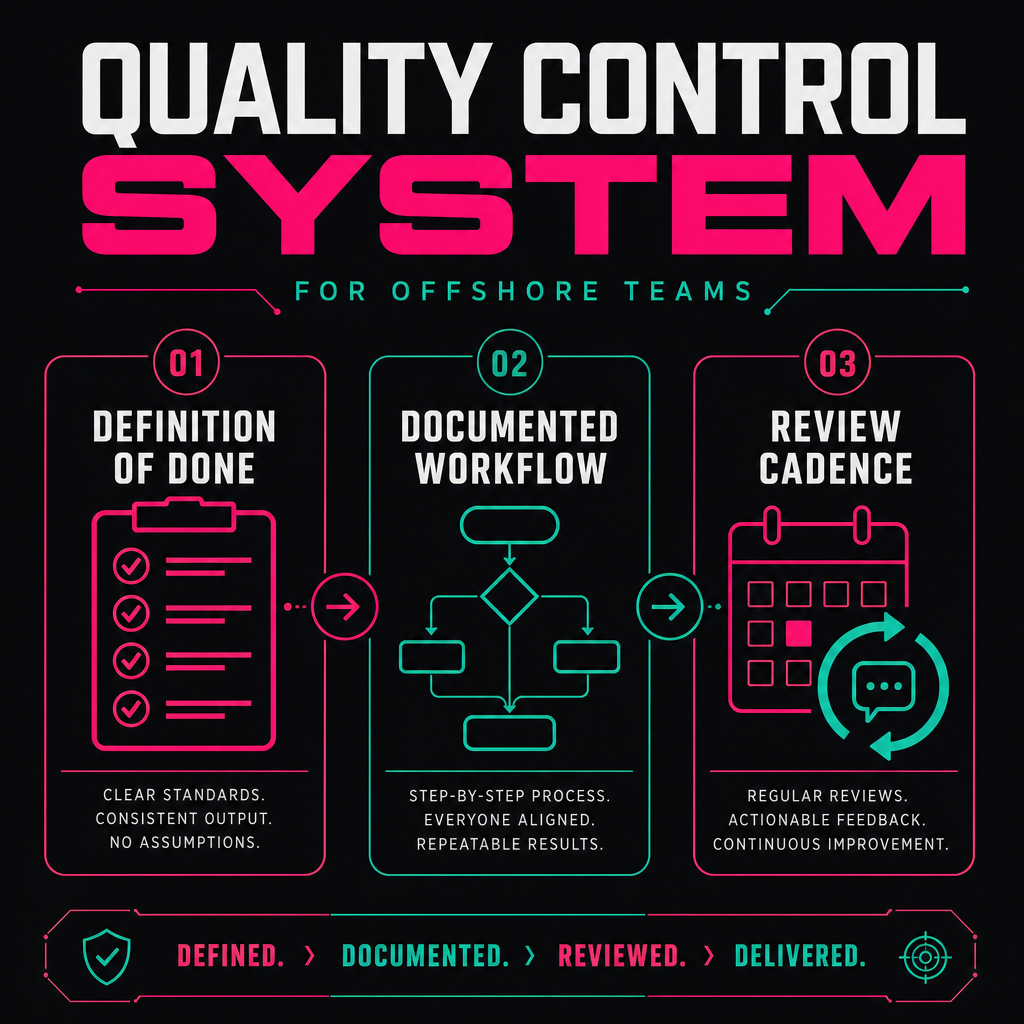
Quality is designed, not hoped for. That is one of the core operating principles at Remotee, and it runs counter to how most businesses approach offshore hiring.
The conventional assumption is that quality is a function of the individual you hire. Hire a good person and you will get good work. That is partially true, but it is insufficient at scale. As task volume grows, as your offshore team expands, as roles evolve, individual talent without documented standards produces inconsistent results. The gap between your best offshore team member and your weakest becomes your quality variance, and that variance is what clients and customers actually experience.
Consistent quality requires three things: a clear definition of done, a documented workflow, and a recurring review cadence. Without the first, your team is guessing at what success looks like. Without the second, quality depends on who happens to be working that day. Without the third, problems compound invisibly until they become visible in the worst possible way.
For a gym and fitness business I worked with, the issue was inconsistent lead follow-up and unreliable CRM data. The offshore admin team was capable, but there were no role scorecards, no handoff templates, and no approval gates on outbound comms. The result was a pipeline that nobody trusted. After installing a role scorecard tied to weekly pipeline outcomes, handoff templates with approval gates, and an SOP-led process for CRM hygiene, follow-up consistency improved significantly, pipeline visibility improved, and the sales leaders reclaimed hours of admin time each week.
The Remotee Operating System formalises this. Every specialist placement includes a defined outcomes document, a workflow SOP library, early delivery validation against checkpoints, and a recurring cadence where issues feed back into versioned SOP improvements. Quality is not an attribute of the hire. It is an output of the system.
Data Security and Privacy Compliance
This is the risk that Australian businesses most consistently underestimate. The Australian Privacy Act 1988, including the Australian Privacy Principles under the Privacy Amendment (Enhancing Privacy Protection) Act 2012, applies to personal information regardless of where your staff are located. If an offshore team member in the Philippines accesses, stores, or processes the personal information of Australian individuals, your obligations as the data controller do not diminish. You remain accountable.
The Australian Signals Directorate's Essential Eight framework provides the most practical baseline for securing remote and offshore work environments. The Essential Eight covers application control, patching schedules, multi-factor authentication, restriction of administrative privileges, and regular backups, among other controls. For businesses handling sensitive data, including medical records, financial data, or NDIS participant information, the Essential Eight is not optional. It is the minimum credible baseline.
Common data security failures in offshore engagements include:
- Granting offshore staff overly broad system access rather than role-specific, need-to-know access.
- Using personal devices and personal email accounts for work that involves client data.
- No documented incident response procedure in the offshore environment.
- NDAs signed but no technical controls enforced, meaning the NDA is the only line of defence.
- No audit trail for who accessed which data and when.
Remotee's technology and security framework addresses each of these through a structured approach to access tiering, device standards, and incident response planning that is built into every placement, not added on request. For regulated industries, this is not a nice-to-have. It is a condition of operating safely.
If you are evaluating an offshore partner and they cannot articulate their security controls in specific terms, that is your answer.
Hidden Costs That Erode Savings
The quoted cost of an offshore specialist is the number everyone focuses on. It is rarely the number that matters most.
Hidden costs in offshore engagements accumulate across several categories that are easy to overlook in initial projections:
Onboarding and training time. If your internal team spends 40 hours over the first month getting an offshore hire up to speed, that is 40 hours of internal capacity that was not accounted for in the savings calculation.
Rework and correction cycles. When output does not meet standard because the standard was never documented, someone has to fix it. That someone is usually a senior internal person whose time is your highest-cost resource.
Management overhead. Offshore teams do not manage themselves. If there is no structure around the role, the task of providing that structure falls on your team. For small and medium businesses, that overhead is often the founder's time.
Attrition and replacement costs. If an offshore team member leaves after six months and you have to restart the search, onboarding, and training cycle, the actual cost of that role in year one is substantially higher than the headline rate.
Compliance remediation. If a compliance incident occurs because controls were not in place, the cost of remediation, legal advice, regulatory engagement, and reputational repair far exceeds whatever was saved on salary.
A credible offshore partner will help you model the full cost picture before you commit. The projected savings should be calculated against the fully loaded engagement cost, including onboarding support, management infrastructure, and the cost of the partner's oversight model. Our 21-day placement-to-operational timeline is designed specifically to compress the onboarding cost window, but that only works because the SOP infrastructure is pre-built, not invented from scratch after the hire starts.
Cultural Misalignment and Training Gaps
Cultural differences between Australian businesses and Filipino offshore staff are real but frequently overstated as a barrier, and systematically understated as a training requirement.
The Philippines has the highest English proficiency in Southeast Asia according to the EF English Proficiency Index. Filipino professionals are generally familiar with Australian business culture through prior exposure to Australian clients, and the cultural distance is considerably smaller than with offshore destinations in Eastern Europe or South Asia. But familiarity is not the same as alignment.
The specific areas where misalignment creates problems in Australian offshore engagements are typically:
Communication directness. Philippine professional culture tends toward deference and indirect communication, particularly when raising concerns with a manager. Australian business culture generally values direct feedback. Without explicit norms being established, offshore staff may avoid raising blockers until they become serious problems.
Regulatory context. An offshore team member with strong technical skills may have no working knowledge of the Australian regulatory environment relevant to your industry. NDIS quality standards, AFSL obligations, Australian tax compliance requirements, these are not things that can be assumed. They must be trained explicitly and documented in SOPs.
Client communication standards. If offshore staff interact with your clients directly, Australian clients will expect a certain communication register, response time, and professional tone. That standard needs to be documented and reviewed, not assumed.
The fix for all of these is structured onboarding, not "culture fit" screening. Remotee's compliance training process builds Australian industry-specific context into every specialist placement, covering the regulatory, communication, and quality standards relevant to your sector. When that context is baked into the SOP library from day one, the adjustment curve shortens considerably.
Staff Retention and Turnover in Offshore Teams
Attrition is one of the most underappreciated financial risks in offshore staffing. It is also one of the most preventable.
The Philippine BPO and remote staffing market is competitive. Skilled professionals have multiple options, and the decision to stay with a client for the long term is driven by factors that are within the client's control: clarity of role, quality of management, growth opportunity, and the sense that the work matters and is recognised.
The businesses that experience high offshore attrition typically share a pattern. The offshore role was defined loosely, the team member was given work reactively rather than through a structured system, feedback was infrequent or absent, and there was no visible pathway for development. In that environment, the most capable people, the ones you most want to keep, are the first to find something better.
Remotee maintains 95%+ specialist retention at 12 months across our client base. That number is not an accident. It is a product of how roles are structured before the specialist starts, the ongoing support from a dedicated Australian account manager, and a delivery system that gives offshore specialists clear expectations, regular feedback, and a sense of professional ownership over their outcomes.
Investing in retention is not altruism. It is financial discipline. Every attrition event costs you the replacement search, re-onboarding time, and the productivity valley while the new hire finds their feet. Preventing it is almost always cheaper than recovering from it.
Compliance Risks for Regulated Industries
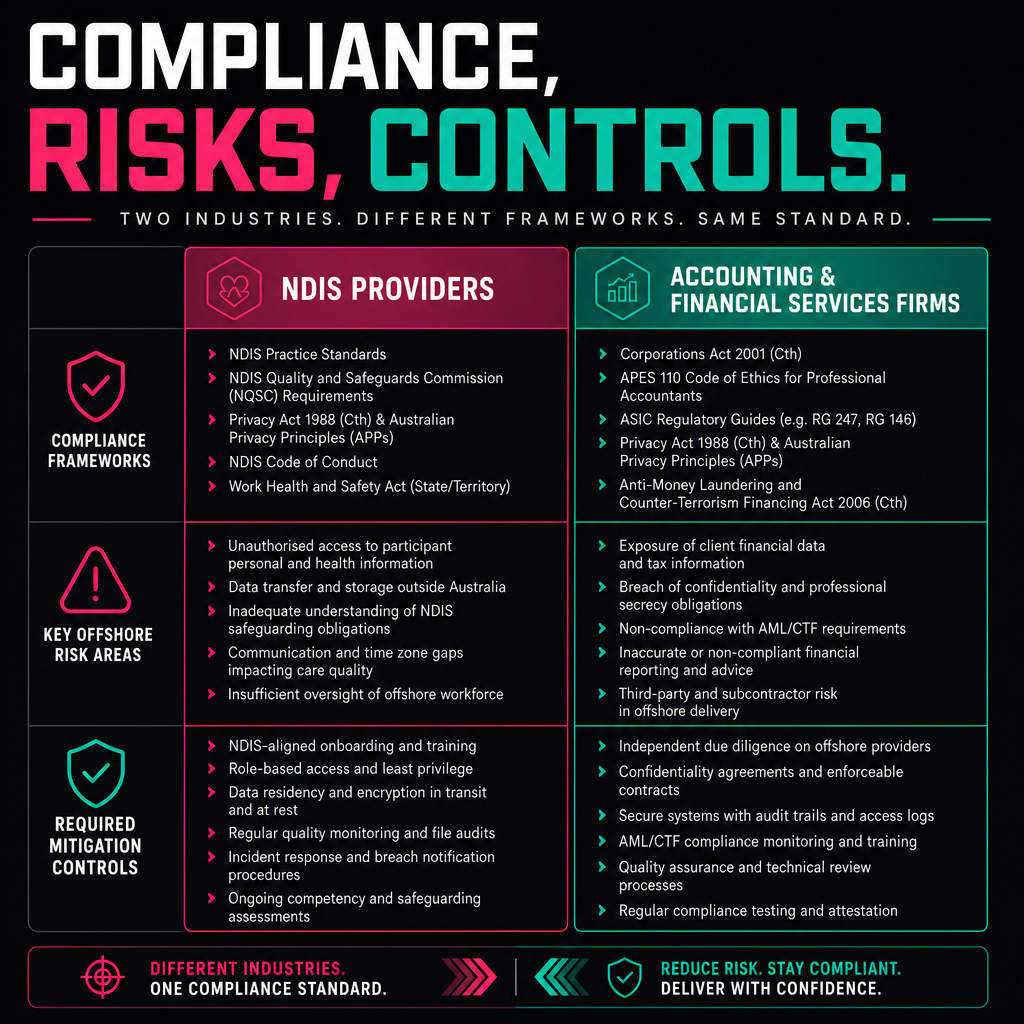
Regulated industries carry a category of offshore staffing risk that generic providers are simply not equipped to manage. Two sectors where I see this most clearly in the Australian market are NDIS providers and financial services firms.
NDIS providers operate under the NDIS Practice Standards and Quality Indicators, administered by the NDIS Quality and Safeguards Commission. Any offshore staff involved in documentation, care coordination support, scheduling, or participant record management are operating in a compliance environment with specific, auditable requirements. Incomplete documentation, ad hoc exception handling, and inconsistent quality checks are not just inefficiency problems in this context. They are compliance failures that can trigger Commission reviews and, in serious cases, registration consequences.
I worked with an NDIS provider that had exactly this problem. Documentation was incomplete, exception handling was ad hoc, and quality checks were inconsistent. The risk was not theoretical. After installing an SOP pack with compliance steps and exception handling built in, an approval owner map with escalation triggers, and a monthly quality review process with versioned SOP updates, the provider achieved more consistent compliance execution, reduced repeated issues through an improvements log, and significantly improved their audit readiness. Their NDIS delegation system is now a structural asset, not a liability.
Financial services firms, including accounting practices and mortgage brokers, face exposure under the Corporations Act, ASIC's regulatory guidance, and the Tax Agent Services Act when offshore staff handle client data, prepare financial documents, or manage client communications. The contractor versus employee classification question is also particularly relevant here. Misclassifying an offshore worker as an independent contractor when the substance of the relationship is more akin to employment can create Fair Work and tax compliance exposure for the Australian business. Fair Work Australia's guidance on contractor versus employee classification should be reviewed before any offshore engagement is structured.
For accounting firms, the specific compliance challenge is often around the delegation of sensitive workflow steps. An accounting firm I worked with had sensitive steps that were blocking delegation entirely, because there was no documented control model. Prep work was consuming internal team time that should have been spent on advisory work. After installing a control model segmented by workflow risk, delegating prep work while retaining approvals internally, and introducing evidence capture at checkpoints, the internal team reclaimed significant hours on prep work, sensitive approvals remained controlled, and the firm now has a cleaner audit trail for every decision. Partners across our accounting client base have reclaimed between 35-50% of their non-billable time using this structure.
How to Evaluate an Offshore Partner's Risk Mitigation
The offshore staffing market in Australia is crowded. Most providers compete on cost, speed, and the quality of CVs they can produce. That is the wrong criteria set if what you actually want is a reliable, scalable offshore capability that holds up under audit, handles compliance correctly, and does not require a second full-time job to manage.
When evaluating an offshore partner, the questions that matter most are:
Can they describe their security controls specifically? If the answer is "we use NDAs and trusted staff," keep looking. You want to hear about ASD Essential Eight alignment, access tiering, device standards, and incident response procedures. Remotee's technology and security approach is documented and can be reviewed before you commit.
Do they have a compliance onboarding process for your specific industry? Generic onboarding is not sufficient for regulated sectors. Ask whether they have NDIS-specific, financial services-specific, or healthcare-specific compliance training built into their process. Generic providers do not. Remotee's compliance training programme is industry-segmented by design.
What is their retention rate at 12 months? A provider that cannot answer this question with a specific number is either not measuring it or not proud of the answer. Our 95%+ retention rate is a metric we track and report because it is one of the most meaningful indicators of engagement quality.
What happens when something goes wrong? Every provider will tell you things go smoothly. What you need to know is the escalation path, the account management response time, and the process for resolving a quality or compliance issue when one arises. Ask for specifics.
Do they operate a structured process for role integration? Remotee's onboarding process follows The Remotee Method: discovery and workflow mapping, specialist matching against Australian industry standards, operational integration with an SOP library, and ongoing strategic mentorship through a dedicated Australian account manager. That structure is the reason our engagements produce predictable delivery, not just headcount.
How Remotee Addresses Each Risk
Case Study 1: NDIS Provider, Compliance Transformation
An NDIS registered provider came to us after a difficult period with a previous offshore arrangement. Documentation was incomplete and inconsistent. Exception handling was entirely ad hoc, meaning individual staff members were making compliance decisions on the fly without documented escalation paths. Quality checks were sporadic and unrecorded.
After completing a full workflow audit and mapping their existing processes, we sourced a specialist from the top 1% of Philippine talent with prior experience in NDIS documentation and disability services administration. Alongside the placement, we delivered a full SOP pack covering every compliance-relevant workflow step, an approval owner map with explicit escalation triggers for high-risk exceptions, and a monthly quality review process with versioned SOP updates.
Twelve months on, the provider has more consistent compliance execution across all documentation workflows. Repeated issues have been materially reduced because every exception feeds back into the improvements log and the SOP is updated before the next review cycle. Their audit readiness has improved to the point where the operations manager described the previous state as "genuinely frightening" by comparison. The offshore specialist has been in role for over a year. See their NDIS delegation system page for more on how this works in practice.
Case Study 2: Accounting Firm, Partner Time Reclamation
A mid-sized accounting practice approached us because partners were spending the majority of their time on prep work and routine client administration. Sensitive workflow steps were blocking delegation entirely because there was no documented control model to determine what could be safely handed off and what needed to remain with a CPA. Approval processes were inconsistent and slow, creating bottlenecks that affected client turnaround times.
We mapped every workflow against a risk classification matrix during the discovery phase, identifying which steps required Australian-qualified oversight and which were preparation and data handling tasks that could be safely delegated with appropriate checkpoints. We sourced an offshore accounting specialist with Australian tax compliance experience and delivered a control model with evidence capture at key checkpoints.
The result: partners reclaimed between 35-50% of time previously spent on non-billable prep work. Sensitive approvals remained firmly within the internal team under a documented control structure. The practice now has a clean, reviewable audit trail for every delegated decision, which has improved their own professional indemnity position. From placement to operational, the integration took 21 days.
Testimonial
"Before Remotee, we were drowning in prep work and our documentation was a liability. What changed was not just having an extra person. It was having a system around them. The SOPs, the checkpoints, the account manager who actually understands our industry, it meant we could delegate with confidence instead of crossing our fingers. Our compliance position is stronger now than it has ever been."
If what you have read here resonates with where your business is, the next step is straightforward. Talk to us at Remotee about what a structured offshore engagement looks like for your specific situation.
References
-
Australian Bureau of Statistics, International Trade in Services, 2025-26, ABS data on Australian service imports, covering professional and business services exports and imports by destination country, including the Philippines. Used to contextualise the growth of offshore professional services engagement by Australian businesses.
-
Australian Privacy Act 1988 (Cth) and Australian Privacy Principles, The primary legislative framework governing how Australian organisations collect, use, store, and disclose personal information. Applies to offshore arrangements where offshore staff access or process personal information of Australian individuals on behalf of an Australian organisation.
-
Australian Signals Directorate, Essential Eight Maturity Model, The ASD's foundational cyber security framework for Australian organisations. The Essential Eight covers eight mitigation strategies including application control, patching, multi-factor authentication, and restricting administrative privileges. Provides the practical baseline for securing offshore and remote work environments handling sensitive data.
-
Fair Work Australia, Independent Contractors vs Employees, Fair Work Australia guidance on the legal distinction between independent contractors and employees, covering the factors used to assess the true nature of a working relationship. Relevant to Australian businesses structuring offshore staffing engagements to ensure correct classification and compliance with applicable legislation.
-
NDIS Quality and Safeguards Commission, NDIS Practice Standards and Quality Indicators, The regulatory framework governing NDIS registered providers in Australia. Sets the standards for documentation, participant safety, incident management, and quality review that apply to all staff, including offshore staff, performing functions within the scope of NDIS service delivery.
-
EF Education First, EF English Proficiency Index, 2025 Edition, Annual global ranking of English language proficiency by country. The Philippines consistently records the highest English proficiency in Southeast Asia, providing relevant context for assessing communication risk in Filipino offshore engagements relative to other offshore destinations.
FREQUENTLY ASKED QUESTIONS
Common questions
Is offshore staffing risky for Australian businesses?
- Offshore staffing carries real risks, but the risks are manageable when you approach the engagement as a system design problem rather than a hiring problem. The businesses that experience the worst outcomes with offshore staffing are typically those that added headcount without adding structure: no documented workflows, no quality checkpoints, no compliance training, and no escalation paths. The risks, including data security, compliance gaps, attrition, and hidden costs, are all addressable with the right engagement design.
How do I protect client data when using offshore staff?
- Your obligations under the Australian Privacy Act 1988 follow your data regardless of where your staff are located. Practical data protection measures include implementing role-specific access controls rather than broad system access, aligning your remote work environment with the ASD Essential Eight framework, requiring work to be conducted on managed devices with approved software, maintaining an audit trail of data access, and having a documented incident response procedure. NDAs are a starting point, not a security framework.
What are the biggest mistakes businesses make when hiring offshore?
- The most common and costly mistakes are: hiring without documenting what the role needs to produce and to what standard; skipping compliance training specific to the Australian regulatory environment; underestimating the full cost of the engagement by excluding onboarding, management overhead, and attrition risk; granting overly broad data access without role-specific controls; and choosing an offshore partner based primarily on price rather than on their capacity to deliver a structured, reliable engagement.
What compliance risks apply specifically to NDIS providers using offshore staff?
- NDIS providers operate under the NDIS Practice Standards and are subject to audit by the NDIS Quality and Safeguards Commission. Offshore staff involved in documentation, scheduling, care coordination support, or participant record management must operate within workflows that meet these standards. Compliance requirements must be explicitly built into the SOPs governing offshore roles, with escalation triggers and approval owner maps for high-risk decisions.
How do I manage quality control with an offshore team?
- Quality control is a system output, not a talent characteristic. Consistent quality requires three structural elements: a clear, documented definition of what done looks like for every task the offshore role produces; a workflow SOP that covers standard process, exception handling, and escalation triggers; and a recurring review cadence where output is assessed against the defined standard and any gap feeds back into an updated SOP. Role scorecards, checkpoint reviews, and weekly quality cadence are the practical tools that make this work.
Is offshore staff turnover a major risk, and how do I reduce it?
- Attrition is a significant financial risk in offshore engagements and is frequently underestimated. Every turnover event costs you the replacement search, re-onboarding time, and the productivity gap while the new hire reaches competency. The root causes of offshore attrition are largely within the client's control: unclear role definition, reactive work assignment, infrequent feedback, and no visible development pathway. Businesses that invest in structured onboarding, clear role expectations, and ongoing account management consistently see better retention.
How do I know if an offshore staffing provider can actually manage compliance risks?
- Ask specific questions. Can they describe their security controls in technical terms, referencing frameworks like the ASD Essential Eight? Do they have industry-specific compliance training programmes for your sector? What is their documented process for raising and escalating compliance issues? Can they show you a sample SOP or onboarding checklist? What is their 12-month retention rate? A provider that answers these questions with vague generalities is not equipped to manage compliance risk.
What is the difference between an offshore contractor and an offshore employee for Australian tax and Fair Work purposes?
- The Fair Work Act 2009 and the Independent Contractors Act 2006 govern the contractor versus employee distinction. The substance of the working relationship matters more than the label used in the contract. The ATO's guidance on personal services income can also affect how offshore arrangements are treated for tax purposes. Before finalising the structure of an offshore engagement, review the arrangement against Fair Work Australia's guidance on contractor versus employee classification and seek advice from a qualified Australian accountant or employment lawyer.

Jon Kelly
Founder, Remotee
Jon helps Australian businesses build compliance-led offshore teams that scale without the burnout. NDIS, accounting, mortgage broking, recruitment and digital marketing.
KEEP READING
Related posts
offshore staffing company comparison criteria
Offshore Staffing Company Comparison Criteria: How Australian Businesses Should Evaluate Providers
Direct Answer: The criteria that actually predict offshore staffing outcomes are the employment and compliance model, documented delivery workflows, supervision…
11 September 2026 · 16 min read
offshore staffing implementation timeline
Offshore Staffing Implementation Timeline: What Australian Businesses Should Expect Week by Week
A realistic offshore staffing implementation timeline runs 8 to 12 weeks from scoping to a fully productive seat: roughly 2 weeks for role design and process do…
6 September 2026 · 16 min read
offshore staffing companies
How to Evaluate Offshore Staffing Companies in Australia
[Remotee Client Satisfaction: 98% Retention in 2026] [Data based on 15 full offshore staffing implementations managed by Remotee in 2026.] Most Australian busin…
7 July 2026 · 14 min read
READY TO SCALE WITHOUT THE BURNOUT?
Build a compliance-led offshore team in 3–4 weeks.
Tell us about your current bottleneck and we'll show you what a Remotee placement would look like for your operation.
Or get our playbooks emailed to you instead.