
How to Hire Offshore Staff in Australia: A Step-by-Step Guide for 2026
- offshore staffing
- hire offshore staff
- offshore hiring Australia
- Philippines staffing
- remote team Australia
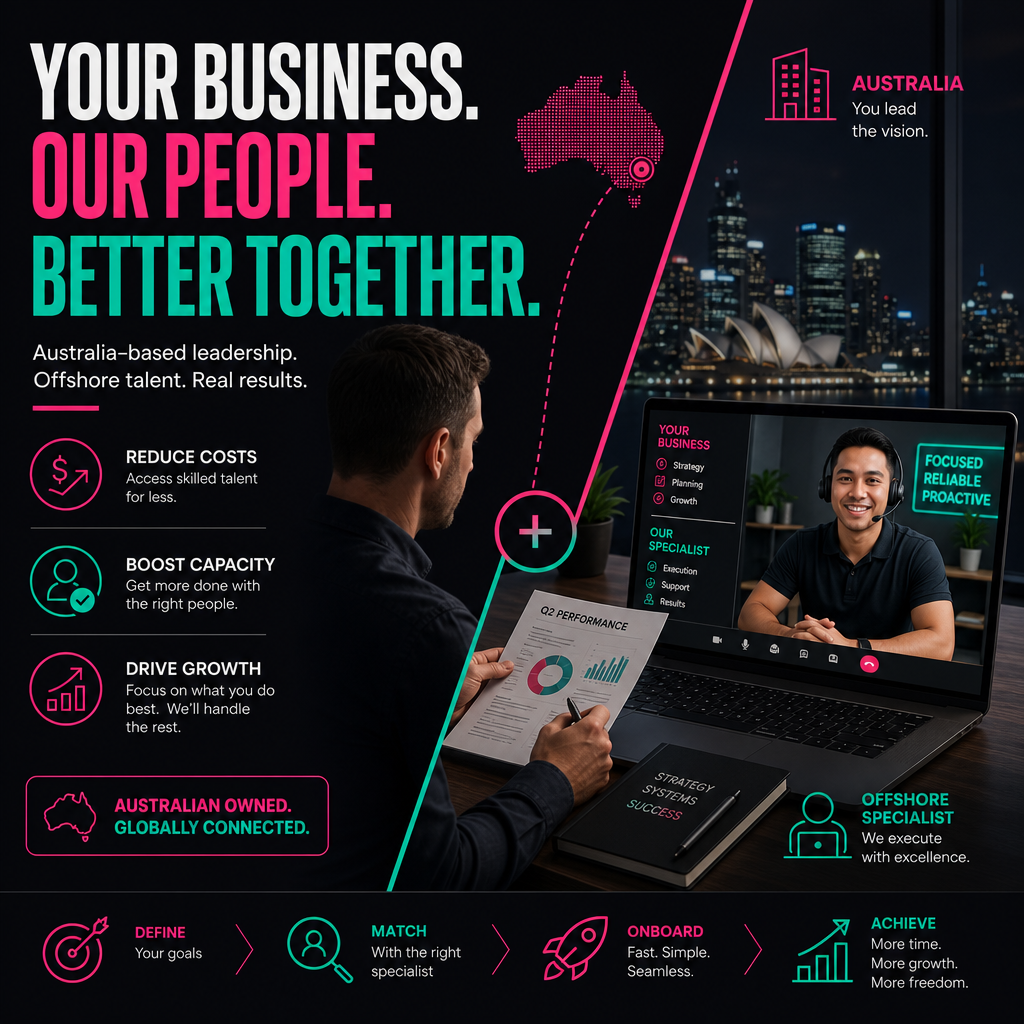
Hiring offshore is not a leap of faith. It is a decision with a clear process behind it, and the Australian businesses getting real results in 2026 are the ones treating it that way. They are not throwing resumes at a problem and hoping for the best. They are defining the role, building the delivery structure, and then adding the person. That sequence matters more than most providers will tell you.
The cost case is well established. An offshore specialist in the Philippines typically costs 60-70% less than an equivalent Australian hire when you factor in salary, superannuation, office overhead, and recruitment fees. But cost alone is not why serious operators are expanding offshore. They are doing it because the right offshore model adds a long-term capability layer to the business, not just a cheaper pair of hands. The difference between those two outcomes is almost entirely in how you set it up.
This guide walks through every stage of the offshore hiring process: deciding which roles to move first, defining the work and the outcomes, choosing your engagement model, running a real recruitment and vetting process, staying compliant under Australian and Philippine frameworks, setting up your tools and communication rhythm, and making the first 30 days count. If you follow this process, you will not be hoping it works. You will know why it does.
Key Takeaways
- Start with the role, not the resume. Define what done looks like before you start sourcing candidates.
- The direct-hire vs managed/leasing decision affects your compliance obligations, cost structure, and management load significantly. Understand the difference before committing.
- Philippine offshore hiring is legal, well-structured, and increasingly common for Australian businesses. The compliance risks come from doing it without proper employment contracts and payroll structures in place.
- Offshore staff need a delivery system around them, not just a job description. Without documented workflows, checkpoints, and a review cadence, even strong hires produce inconsistent results.
- The first 30 days determine whether the engagement succeeds. Invest in structured onboarding, not a sink-or-swim approach.
- Predictable delivery comes from systems, not supervision. Build the operating structure once and it compounds over time.
Summary: Steps, Timelines and Outcomes
| Step | Activity | Typical Timeline | Outcome |
|---|---|---|---|
| 1 | Decide which roles to offshore | Week 1 | A prioritised shortlist of roles with a clear business case |
| 2 | Define the role and KPIs | Week 1-2 | Role scorecard, outcomes defined, KPIs documented |
| 3 | Choose engagement model | Week 2 | Direct-hire or managed/leasing decision confirmed |
| 4 | Vet candidates or providers | Week 2-4 | Shortlist of 2-3 qualified candidates ready for interview |
| 5 | Legal, payroll and compliance | Week 3-4 | Employment contract executed, payroll structure in place |
| 6 | Tools, security and communication | Week 4 | Tech stack configured, access provisioned, comms rhythm set |
| 7 | Offer and onboarding (first 30 days) | Week 4-8 | Specialist operational, early deliverables reviewed against checkpoints |
Step 1: Decide Which Roles to Offshore First
The most common mistake I see Australian businesses make is starting with a provider search before they have decided what problem they are actually solving. They end up with a generalist hire doing tasks that were never clearly defined, and then they blame offshoring when the real problem was the absence of a plan.
Start with an honest audit of where your internal team is spending time. The question is not "what could someone offshore do?" The question is: "which tasks in this business are high effort, low impact work that should not be consuming senior time?"
In accounting firms, for example, our data shows that partners spend 35-50% of their time on work that could be delegated to a specialist at a fraction of the cost. That is not a talent problem. That is a delivery structure problem. And fixing it starts by naming the specific activities that are pulling senior people away from the work only they can do.
Roles that offshore well share a few characteristics:
- The work is repeatable and can be documented in a standard operating procedure
- The output is measurable (a report completed, a CRM updated, a campaign published, a document filed)
- The role does not require physical presence in Australia
- The work is currently consuming internal team capacity that could be redirected to higher-value activity
Roles that commonly offshore well for Australian businesses include: bookkeeping and accounts payable, mortgage processing and loan administration, digital marketing execution (social media, email, paid ads management), customer service and lead follow-up, data entry and CRM management, software development and QA, graphic design and content production, and NDIS documentation and compliance administration.
Roles that generally do not offshore well include: senior client relationship management where face-to-face presence drives revenue, highly regulated advisory work that requires an Australian licence, and roles that depend on real-time local knowledge (e.g. on-site operations, local government liaison).
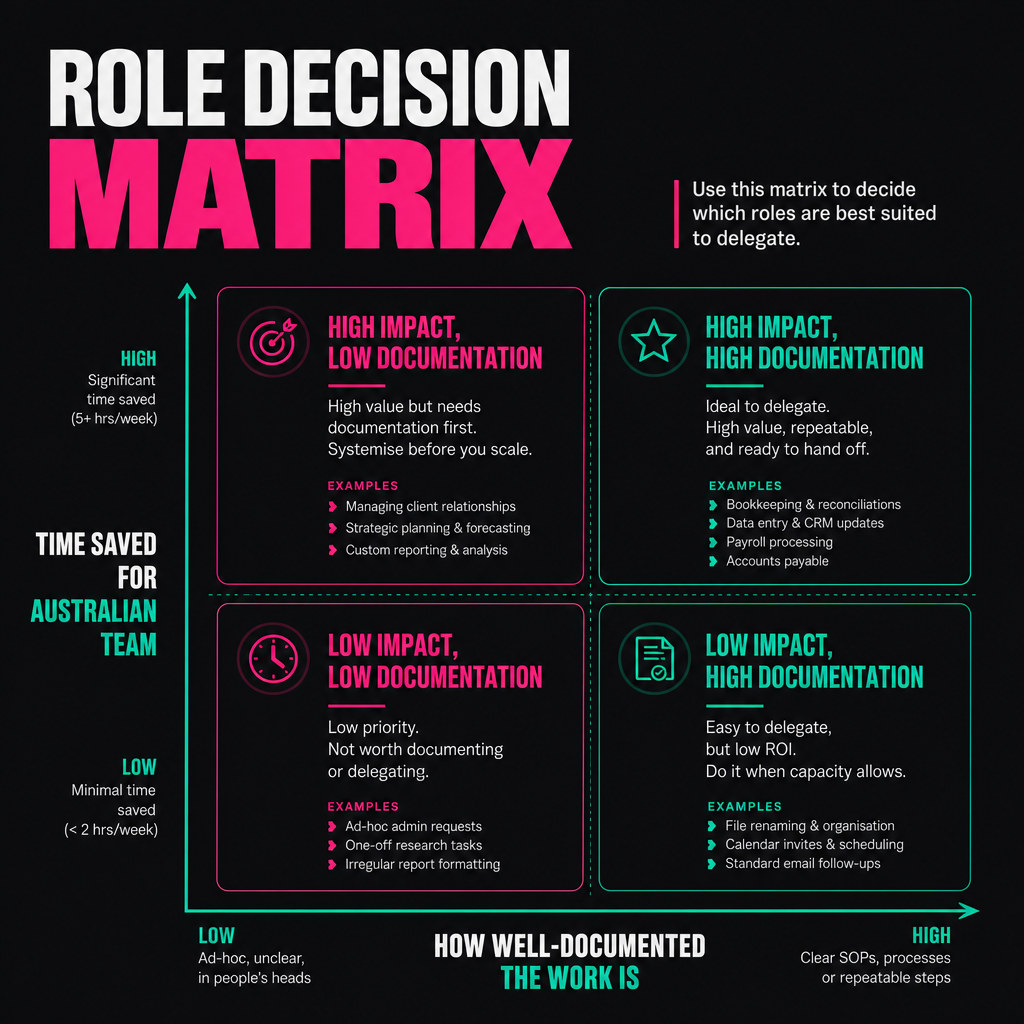
Once you have your shortlist, rank the roles by two factors: potential time saved for your Australian team, and how well-documented the work currently is. Start with the highest combination of both. That is your first offshore hire.
Step 2: Define the Role and KPIs Before You Source
I have never seen a vague job description produce a strong offshore hire. The offshore market in the Philippines is competitive and skilled, but candidates can only be assessed against what you have actually defined. If the brief is "general admin support," you will attract generalists who can do a bit of everything and excel at none of it.
A proper role definition for an offshore specialist includes four things:
1. The role scorecard. What are the 3-5 specific outcomes this person is accountable for each week? Not tasks. Outcomes. "CRM is updated within 24 hours of each client touchpoint" is an outcome. "Update the CRM" is a task. The scorecard is what you will use to measure performance in the first 90 days and beyond.
2. The workflow documentation. Before the hire starts, document the process they will follow. This does not need to be perfect on day one, but there needs to be a version. A one-page SOP for each core process is a minimum. This protects you when a hire leaves, and it forces clarity on what you actually need the person to do.
3. The tool stack. Which systems will the offshore specialist work in? CRM, project management, accounting software, communication platforms? List them and confirm you can provision access. If you have not done this, do it before you start interviewing.
4. The exception handling rules. What does this person do when something falls outside the normal process? Who do they escalate to? What is the turnaround expectation? Offshore hires that lack clear escalation paths default to either guessing (and making mistakes) or waiting (and missing deadlines). Neither is acceptable.
This upfront work is not optional. It is the difference between a specialist who delivers from week two and one who is still "getting up to speed" at month three.
Step 3: Choose Your Engagement Model
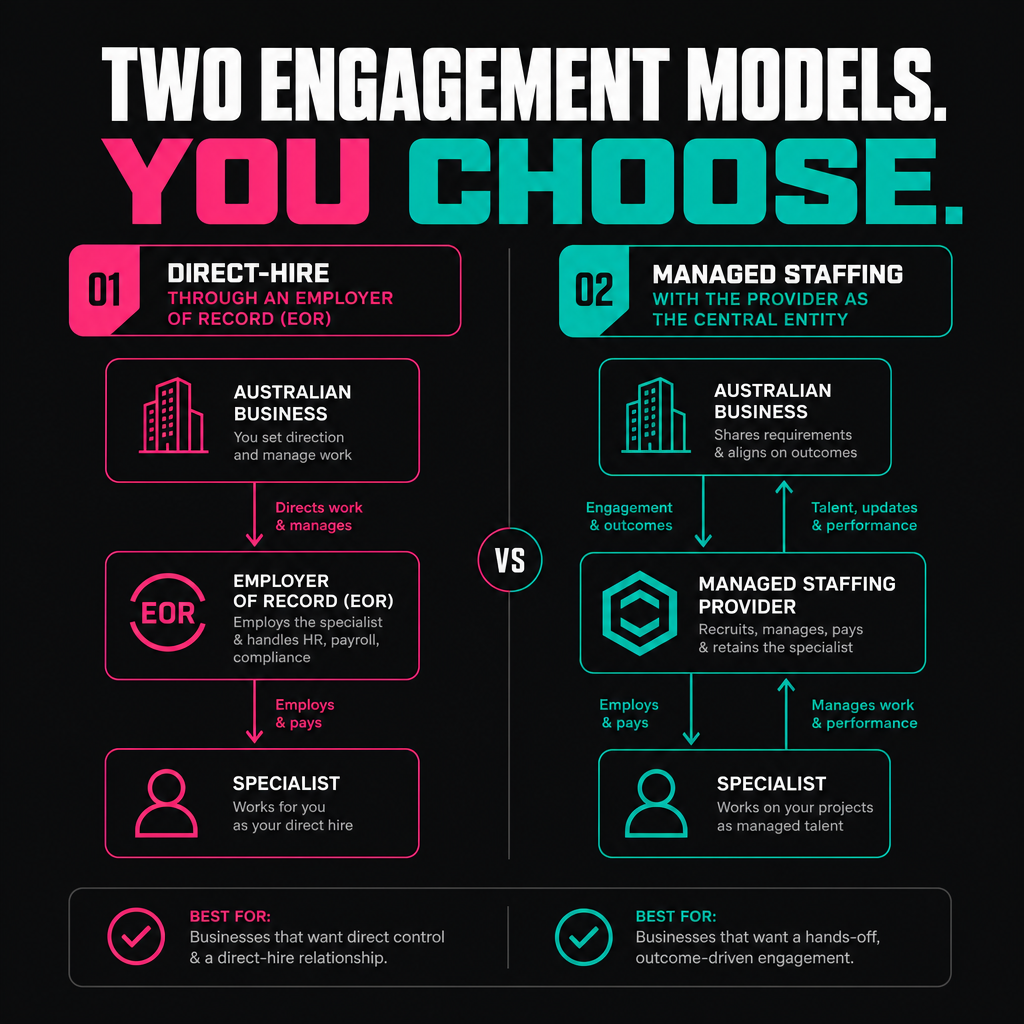
There are two primary ways to engage offshore staff as an Australian business: direct-hire (you employ the person yourself via a local Philippine entity or employer of record) or managed/leasing (a provider employs the specialist and supplies them to you under a commercial services agreement).
Understanding the difference matters because it affects your compliance obligations, cost structure, day-to-day management load, and flexibility to scale.
Direct-hire through an Employer of Record (EOR). Under this model, a third-party EOR (a company registered in the Philippines) becomes the legal employer of your offshore specialist. You direct the work; they handle payroll, statutory benefits under the Philippine Labor Code, and local compliance. This model suits businesses that want a direct working relationship with their specialist but do not want to set up their own Philippine entity. EORs charge a monthly fee on top of the specialist's salary, typically ranging from $200-$500 AUD per month depending on the provider and the role.
Managed staffing or staff leasing. Under this model, the staffing provider recruits and employs the specialist as their own employee and "leases" that person's time to you. The provider handles HR, payroll, benefits administration, and local compliance in the Philippines. You pay a single all-inclusive monthly fee and direct the work. This is the most common model used by Australian SMEs because it reduces administrative complexity significantly. The trade-off is that you have less direct visibility into the cost breakdown and the employment relationship sits with the provider.
For most Australian SMEs hiring their first offshore specialist, the managed staffing model is the right starting point. It reduces your compliance exposure, removes the need to understand Philippine employment law in depth, and gives you a single point of accountability for the hire. As you scale to a larger offshore team, direct employment through an EOR often becomes more cost-effective.
If cost comparison between offshore and local hiring is a live question for your business, the detailed numbers are in this offshore vs local hiring cost comparison for Australian businesses.
Step 4: Vet Candidates and Providers Properly
The Philippine talent market is genuinely strong. The country has a well-established outsourcing sector, high English proficiency, a strong culture of professional service delivery, and a significant pool of degree-qualified professionals with experience working for Australian, US, and UK businesses. But "the market is strong" does not mean every hire will be strong. Vetting matters.
If you are using a provider, vet the provider first.
Most staffing providers will tell you they have access to great talent. What you actually want to know is: how do they source? What does their screening and testing process look like? Do they do technical skills assessments relevant to your industry? What is their placement-to-operational timeline? What happens if the first hire does not work out?
Providers who compete only on cost or speed of placement are not the ones to use for roles that require real skill. The relevant question is: what delivery structure do they put around the placement once the specialist starts? If the answer is "we find you a great person and then you manage them," that is a headcount-only offer. It works fine for simple roles. It does not work well for specialist functions where consistency of output matters.
At Remotee, we source from the top 1% of Philippine talent using rigorous technical testing against Australian industry standards. Our placement-to-operational timeline for most specialist roles is 21 days, and our specialist retention at 12 months sits above 95%. Those numbers are not accidental. They come from getting the match right and then wrapping a delivery system around the role from day one.
If you are sourcing directly, run a structured interview process.
At minimum, your process should include: a written application with specific questions about their experience with your tool stack and industry, a skills test relevant to the role (not a generic one), a video interview covering both technical competence and communication style, and reference checks from previous employers or clients. For senior roles, a paid trial task before the offer is made is entirely reasonable and tells you more than an interview ever will.
For roles with access to sensitive business or client data (which is most specialist roles), you should also conduct a background check. Philippine-based background checking services are available through most managed staffing providers.
Step 5: Legal, Payroll and Compliance Considerations
This is the section where many businesses either over-complicate or dangerously under-think the compliance picture. Let me be direct about the key moving parts.
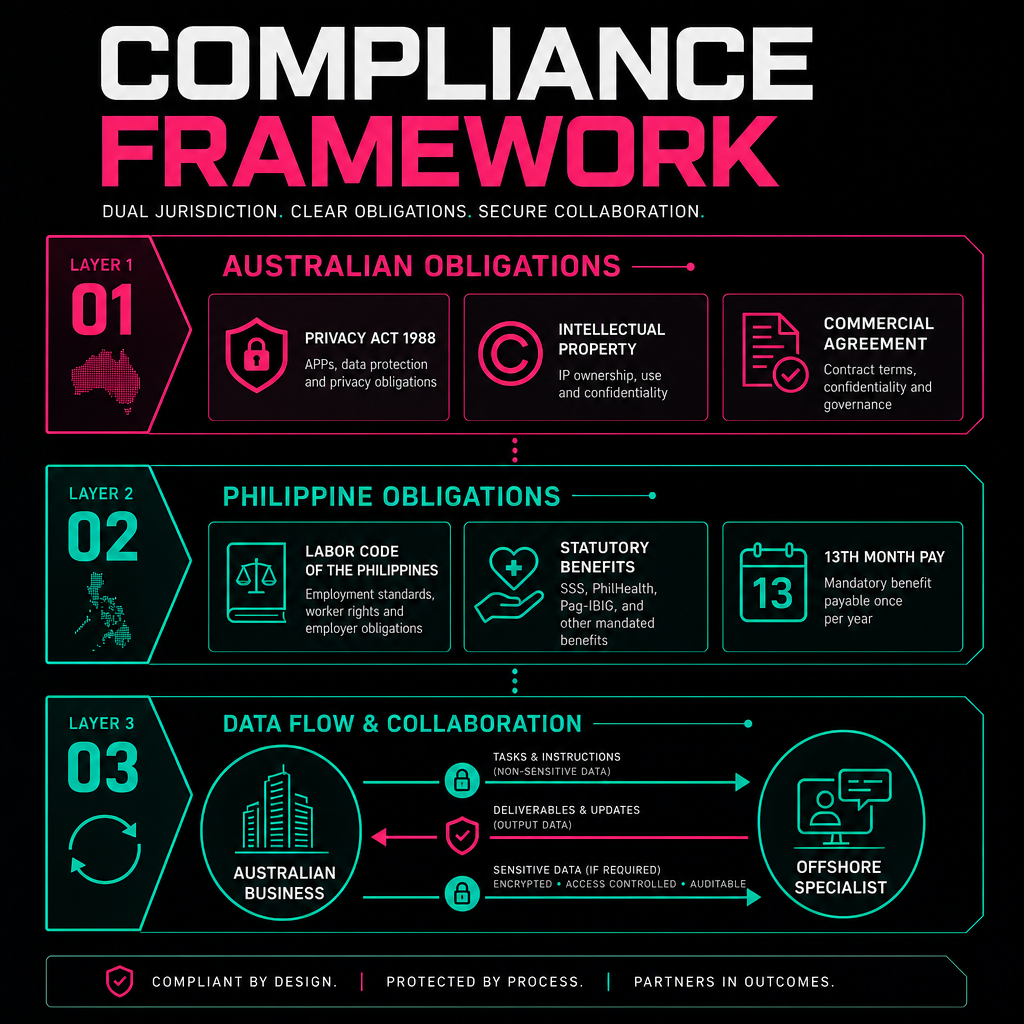
Australian obligations. If your offshore specialist is employed by a Philippine entity (whether your own or a provider's), Australian employment law does not apply to them directly. They are not employed in Australia, they are not covered by the Fair Work Act, and you do not pay Australian superannuation on their behalf. Your obligation as the Australian business is to ensure your commercial agreement with the provider (or EOR) is clear on: scope of services, data handling and privacy obligations (relevant to the Australian Privacy Act 1988 for any Australian client data the specialist accesses), intellectual property ownership, and termination terms.
Philippine obligations. The Philippines has a well-developed labour framework. The Labor Code of the Philippines governs minimum wages, mandatory benefits (SSS, PhilHealth, Pag-IBIG), 13th month pay, and termination procedures. If you are using a managed staffing provider or EOR, they handle all of this. If you are employing directly through your own Philippine entity, you need local legal advice. Do not try to navigate the Philippine Labor Code without it.
Data privacy. If your offshore specialist handles Australian client data, including names, contact details, financial records, or health information, you have obligations under the Australian Privacy Act 1988 and potentially the Privacy Amendment (Notifiable Data Breaches) scheme. You need a Data Processing Agreement (DPA) in place with any provider, and your specialist needs to understand the data handling rules that apply. This is compliance that needs to be baked in from day one, not retrofitted after an incident.
Tax. Payments to offshore staffing providers for services are generally deductible as business expenses for Australian tax purposes. Your accountant should confirm the treatment for your specific structure. There is no GST payable on offshore services from a non-Australian supplier (they are input-taxed exports from the supplier's perspective), but confirm this with your tax adviser for your specific arrangement.
For a full breakdown of how the process and compliance structure works at Remotee, see our process.
Step 6: Set Up Tools, Security and Communication
A specialist who cannot access the right systems on day one is a specialist who loses momentum before they have started. This is an operational detail that gets missed constantly, and it costs more in ramp-up time than the hour it would have taken to prepare.
Before your specialist starts, confirm:
Tool access. Which systems do they need? Create user accounts with appropriate permissions before their first day. For cloud-based tools (which most Australian SMEs use), this is straightforward. For on-premise systems, work with your IT provider to set up secure remote access.
Security baseline. At minimum: unique login credentials (no shared passwords), two-factor authentication on all relevant accounts, a VPN if required for your industry, and clarity on which files and data the specialist can and cannot access. If you are in a regulated industry (financial services, health, legal), document the access permissions you have granted. That documentation is part of your audit trail.
Communication setup. Establish the communication tools and norms before day one. Which platform is used for day-to-day communication? (Slack, Microsoft Teams, Google Chat.) How are tasks assigned and tracked? (ClickUp, Asana, Monday.com, Trello.) How often will you have a scheduled check-in, and who runs it? The time zone overlap between the Philippines and Eastern Australia (Philippines Standard Time is UTC+8, AEST is UTC+10) gives you 2-3 hours of direct working day overlap, which is enough for daily catch-ups. Many offshore specialists in the Philippines are also comfortable working adjusted hours to increase overlap if the role requires it.
Communication norms. Be explicit about response time expectations, preferred channels for different types of communication (urgent issues vs routine questions vs project updates), and how files are named and stored. These are not bureaucratic details. They are the difference between a smooth working relationship and a constant friction point.
Step 7: Make the Offer and Nail the First 30 Days
The first 30 days of any offshore engagement are disproportionately important. The habits and expectations established in week one tend to persist. A sink-or-swim onboarding produces a specialist who is guessing at what you want. A structured onboarding produces one who is delivering against defined outcomes by the end of the month.
The offer. If you are going through a managed staffing provider, the commercial terms will be in your agreement with them. Confirm: total monthly cost, notice periods on both sides, what happens if you need to replace the specialist, and how performance issues are handled. If you are direct-hiring via an EOR, confirm the employment contract terms with the EOR before signing off. Do not let a provider rush you past the contract details.
For current pricing on Remotee's managed staffing model, see our pricing page.
Days 1-7: Orientation. Introduce the specialist to the team. Walk them through the tools they will use. Provide the SOPs for their core processes. Do not expect them to produce full output in week one. Expect them to demonstrate that they understand the process and can ask the right questions.
Days 8-21: Supervised output. The specialist starts producing real work. You or your nominated team member reviews each deliverable against the quality checkpoint defined in your role documentation. Feedback at this stage is investment. The time you spend reviewing and correcting early work is directly reducing the time you will spend correcting later work.
Days 22-30: Cadence and accountability. By the end of month one, your specialist should have a weekly review rhythm in place. That review covers: what was completed against the scorecard, what issues or exceptions were encountered, and what process improvements should be made to the SOPs. If issues are logged and the SOPs are updated, quality improves over time by design rather than by chance. That is systems over heroics in practice.
The Remotee Operating System formalises this into four components applied from day one: define outcomes (what does done look like?), document the workflow (SOPs with exceptions and escalation triggers), train and validate against real early deliverables, and install a recurring review cadence where issues become versioned SOP improvements. It is the same structure regardless of the role or industry, because the underlying discipline of predictable delivery does not change.
Real Client Results: What This Looks Like in Practice
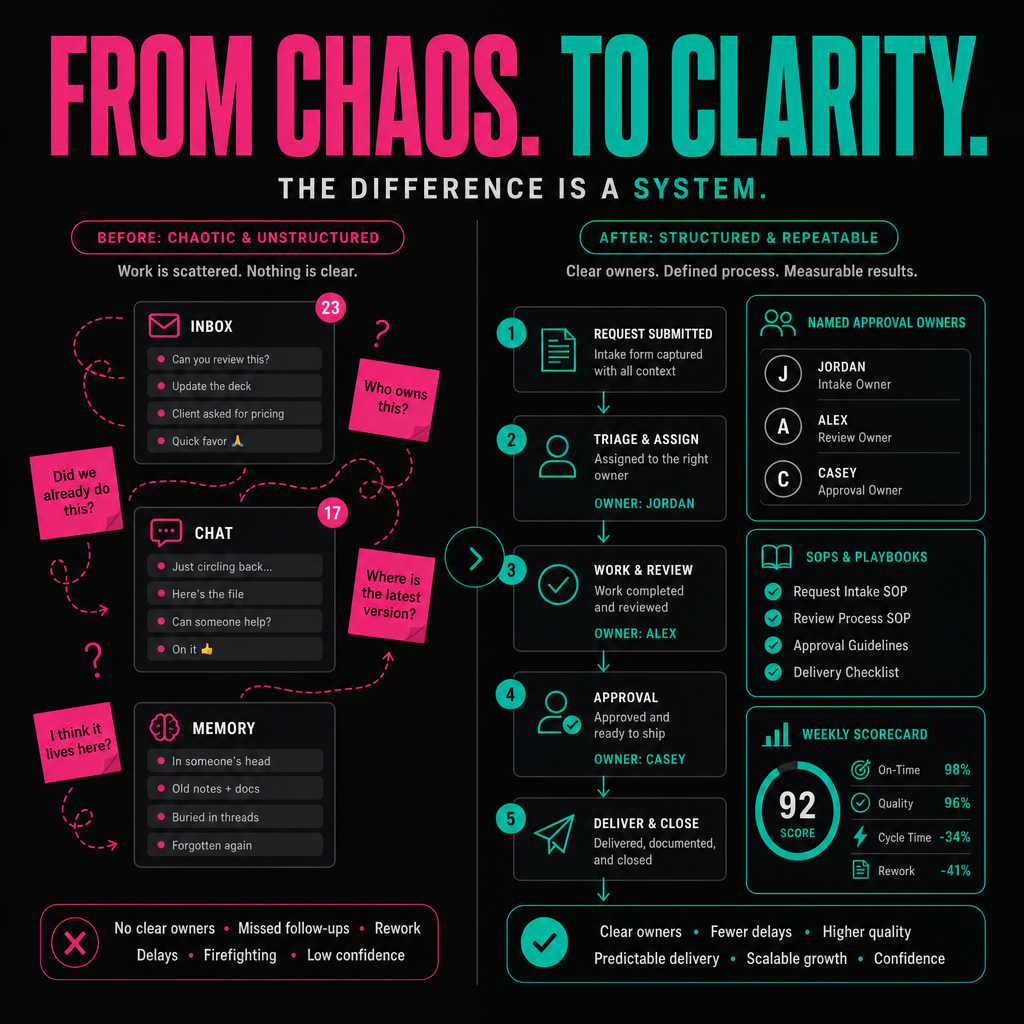
Digital marketing agency: breaking the approval bottleneck.
I worked with a digital marketing agency where the founder was the approval point for almost every piece of outgoing work. Tasks lived across the inbox, Slack, and the founder's memory. Rework was constant because expectations had never been written down. We installed a delegation map, defined clear approval ownership, built an SOP pack with exception handling rules, and introduced a weekly quality checkpoint with a scorecard. The result: handoffs happened faster because approvals had a named owner; rework dropped because expectations were documented before work started; and weekly outcomes became predictable because there was a scorecard tracking them. The offshore specialist was not the fix. The delivery structure was the fix. The specialist made the structure scalable.
Accounting firm: reclaiming partner time.
At an accounting firm where partners were spending the majority of their time on prep work and routine processing, we mapped the workflows by risk level and split the work accordingly. Prep work and routine processing were delegated to offshore specialists. Sensitive approvals and final sign-off stayed with the partners. We introduced evidence capture at each checkpoint so there was a clean audit trail for every decision. The outcome: partners reclaimed significant time that was previously consumed by prep and processing, sensitive work stayed appropriately controlled, and the audit trail was cleaner than it had been before the offshore model was introduced. Across our accounting clients, the reduction in non-billable partner time sits at 35-50%.
For more detail on outcomes across different industries, the case studies page covers multiple engagements with specific metrics.
Why Most Offshore Staffing Approaches Fall Short
Most providers in the offshore staffing market compete on three things: cost, speed of placement, and the quality of the resumes they can put in front of you. Those are real factors, but they are not the determinants of whether offshore hiring actually works for your business.
Talent quality alone does not produce consistent outcomes. I have seen businesses hire genuinely skilled specialists and still get inconsistent results at 90 days because there was no delivery structure in place. The specialist was capable. The environment was not. Without documented workflows, a review cadence, and clear accountability for outcomes, even strong hires default to working from their own interpretation of the role. That interpretation will sometimes be right and sometimes be wrong, and there is no mechanism to close the gap.
This is the core premise behind Remotee's approach. We do not compete on resumes. We compete on reliability. The Remotee Method pairs specialist talent with a compliance-ready operating system from day one, moving business owners from Doer to Strategist by ensuring the delivery structure is in place before the headcount is added. Compliance baked in, not bolted on, after something goes wrong.
The businesses we work with are not looking for a one-off fix. They are building a long-term capability layer that grows with them. That requires a different kind of provider relationship than "here is your hire, good luck."
If you are ready to have a direct conversation about what this looks like for your specific business and roles, contact the Remotee team and we will start with a workflow audit, not a sales pitch.
Offshore Staffing Compliance and Legal: What Australian Businesses Need to Know
To be direct: hiring offshore staff through a reputable provider is legal, structured, and increasingly standard for Australian SMEs. The ACCC has no prohibition on offshore hiring. The Australian Taxation Office has clear guidance on the deductibility of offshore service costs. The key legal obligations for Australian businesses are:
Australian Privacy Act 1988. If your offshore specialist accesses personal information about Australian individuals (which includes customer names, contact details, and financial records), you must have appropriate data handling agreements in place and take reasonable steps to ensure the overseas recipient handles the data in a way consistent with the Australian Privacy Principles. This is not optional and it is not complex to implement. A well-drafted Data Processing Agreement covers the material obligations.
Intellectual property. Your commercial agreement with the provider should clearly state that all work product produced by the specialist is owned by your business. Do not leave this ambiguous. Most reputable providers include this as standard, but read the contract.
Fair Work Act. The Fair Work Act does not apply to employees based offshore and employed by a foreign entity. Your offshore specialists are not entitled to Australian minimum wage, leave entitlements, or superannuation. Their employment conditions are governed by the laws of their country of employment (the Philippines, in most cases).
Philippine Labor Code. Managed staffing providers handle compliance with the Philippine Labor Code on your behalf. This includes minimum wage requirements (which vary by region in the Philippines), mandatory government contributions (SSS, PhilHealth, Pag-IBIG), 13th month pay, and termination procedures. If you are employing directly, get local legal advice. The cost is worth it.
Roles You Can Hire Offshore: A Practical Breakdown
The range of roles that Australian businesses are successfully hiring offshore has expanded significantly. Here is a practical breakdown by function:
Finance and accounting: bookkeeping, accounts payable and receivable, payroll processing, tax preparation support, financial reporting, BAS preparation support, and management accounts preparation.
Mortgage and finance broking: loan processing, file preparation, CRM management, compliance documentation, client update communications, and pipeline reporting. Across Remotee's mortgage broking clients, time-to-settle has reduced by 30% after implementing structured offshore loan processing support with defined handoff templates and update cadences.
Digital marketing: social media management and scheduling, content creation and copywriting, email marketing execution, paid advertising management (Google, Meta), SEO reporting and optimisation, graphic design, and analytics reporting.
Healthcare and NDIS: documentation support, case file management, compliance administration, scheduling support, and reporting. One NDIS provider I worked with had incomplete documentation across client files and ad hoc exception handling that was creating compliance exposure. We installed an SOP pack with compliance steps and exceptions built in, an approval owner map with escalation triggers, and a monthly quality review with versioned SOP updates. The result was more consistent compliance execution, fewer repeated issues, and a process that was reviewable and auditable when required.
Technology and software development: software engineers, QA testers, DevOps engineers, UI/UX designers, data analysts, and IT support.
Customer service and sales support: inbound and outbound customer service, lead qualification, appointment setting, and CRM management and reporting.
References
- Australian Privacy Act 1988 (Cth), Office of the Australian Information Commissioner. Available at: https://www.oaic.gov.au/privacy/the-privacy-act
- Philippine Labor Code (Presidential Decree No. 442), as amended. Chan Robles Virtual Law Library. Available at: https://www.chanrobles.com/legal4labor.htm
- Australian Bureau of Statistics, "Characteristics of Employment," ABS, Canberra. Available at: https://www.abs.gov.au/statistics/labour/earnings-and-work-hours/characteristics-employment
- ACCC, "Business and the law," Australian Competition and Consumer Commission. Available at: https://www.accc.gov.au/business
- Australian Taxation Office, "Foreign income and tax offsets," ATO. Available at: https://www.ato.gov.au/individuals-and-families/income-deductions-offsets-and-records
FREQUENTLY ASKED QUESTIONS
Common questions
How much does it cost to hire offshore staff in Australia?
- For managed staffing through a provider like Remotee, total monthly costs for specialist roles typically range from $1,800 to $3,500 AUD per month all-inclusive, covering the specialist's salary, employer contributions, provider fees, and HR support. This compares with an equivalent Australian hire costing $5,000 to $9,000+ AUD per month including salary, superannuation, and on-costs. The savings range from 50% to 70% depending on the role.
How long does it take to hire an offshore specialist?
- For a well-defined role with a clear brief, the typical timeline from engagement to an operational specialist is 3-5 weeks. Remotee's placement-to-operational timeline for specialist roles is 21 days. The biggest variable is how quickly the Australian business can complete the role definition and provide access to required tools and systems.
Is hiring offshore staff legal for Australian businesses?
- Yes. Hiring offshore staff through a properly structured provider or employer of record arrangement is legal. Offshore specialists are employed under the laws of their country (most commonly the Philippines). Australian businesses must comply with the Australian Privacy Act 1988 if the specialist handles personal data about Australian individuals, but this is straightforward to implement with a proper data handling agreement.
What is the difference between direct-hire and managed offshore staffing?
- With direct-hire through an employer of record, a third-party Philippine entity is the legal employer of your specialist and you pay a fee for that service on top of the specialist's salary. With managed staffing, the provider recruits, employs, and HR-manages the specialist as their own employee and supplies that person's services to you under a commercial agreement. Most Australian SMEs start with managed staffing because it reduces administrative complexity and compliance exposure.
Can I hire offshore staff on a part-time basis?
- Yes, though full-time engagements are more common and typically more cost-effective. Part-time offshore arrangements (usually a minimum of 20 hours per week) are available through most managed staffing providers. For roles where you genuinely only need 20 hours of specialist support per week, a part-time arrangement is a reasonable starting point with the option to scale to full-time as the workload grows.
Can I scale my offshore team as my business grows?
- Yes. Adding a second or third offshore specialist in the same function is significantly faster and cheaper than growing a local team. The delivery structures built for the first hire, including SOPs, workflows, and review cadences, are reusable and make each subsequent hire faster to integrate. Most Remotee clients who start with one specialist add a second within 12 months.
What happens if an offshore hire does not work out?
- With managed staffing, the provider handles the employment relationship, so you are not exposed to the same termination risks as with a direct employee. Your commercial agreement should specify notice periods (typically 4 weeks) and what the replacement process looks like if performance is not meeting expectations. Remotee's 95%+ specialist retention at 12 months reflects both the quality of the match and the delivery structure installed from day one.
Do offshore staff work Australian business hours?
- The Philippines is in the UTC+8 time zone, which gives Australian Eastern Standard Time businesses 2 hours of direct working day overlap. Most Philippine specialists are experienced working with Australian businesses and are comfortable with adjusted start or finish times to increase overlap. For largely asynchronous roles, the time zone difference is rarely a meaningful issue.

Jon Kelly
Founder, Remotee
Jon helps Australian businesses build compliance-led offshore teams that scale without the burnout. NDIS, accounting, mortgage broking, recruitment and digital marketing.
KEEP READING
Related posts
offshore staffing companies
Top Offshore Staffing Companies in Australia Compared (2026)
Most "best offshore staffing companies" lists are thin affiliate content dressed up as research. They rank providers by who paid for placement, not by who actua…
17 June 2026 · 23 min read
offshore staffing risks
Offshore Staffing Risks and Challenges: What Australian Businesses Need to Know in 2026
Most content about offshore staffing sells the dream. Lower labour costs, faster scaling, access to global talent. That narrative is not wrong, exactly, but it…
27 May 2026 · 27 min read
transparent provider pricing comparison
Offshore Staffing Pricing Transparency: How to Compare Provider Quotes Without Getting Caught Out
Transparent provider pricing comparison means evaluating offshore staffing quotes against total cost of engagement, not headline hourly rate. A genuine quote it…
13 September 2026 · 17 min read
READY TO SCALE WITHOUT THE BURNOUT?
Build a compliance-led offshore team in 3–4 weeks.
Tell us about your current bottleneck and we'll show you what a Remotee placement would look like for your operation.
Or get our playbooks emailed to you instead.