
Offshore IT Staffing Services for Australian Businesses: How to Build a Remote Tech Team in 2026
- offshore IT staffing
- offshore developers Australia
- remote tech team
- offshore software developers
- IT outsourcing Australia
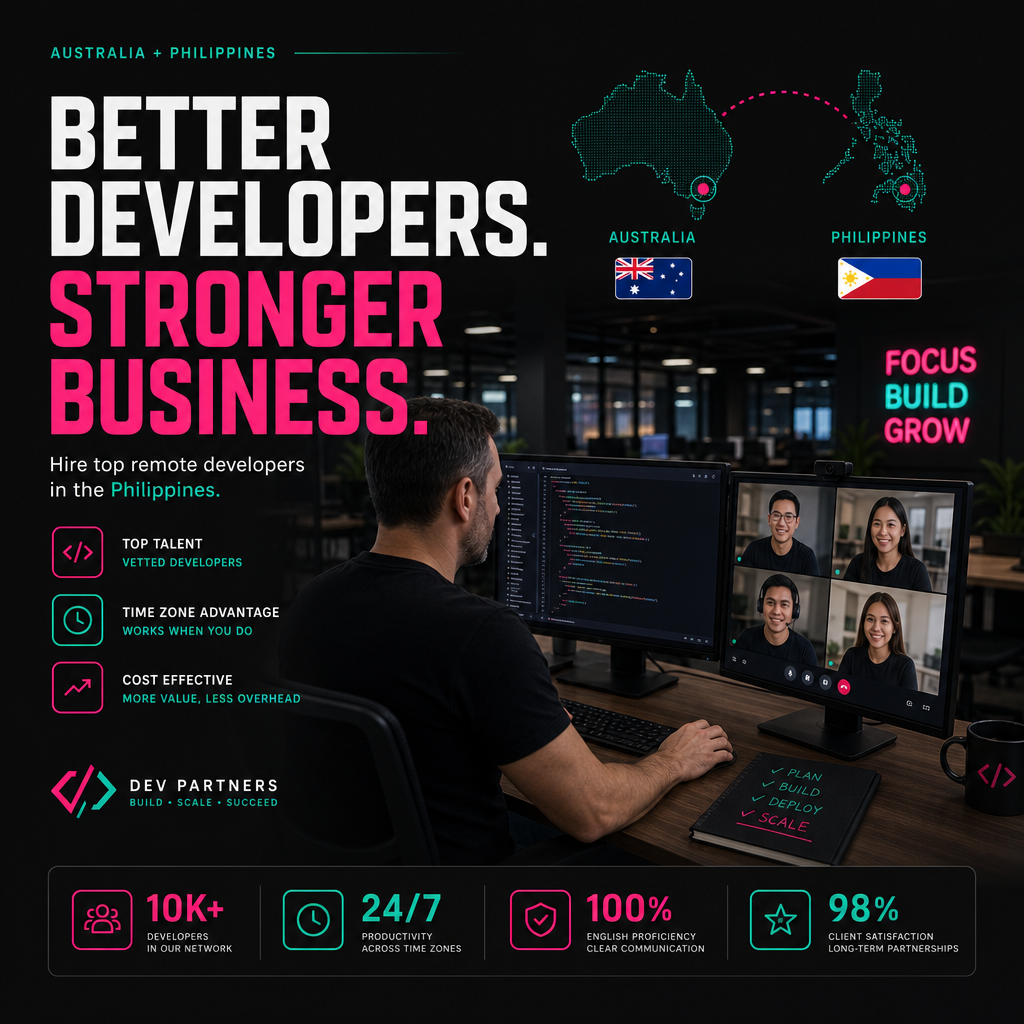
Australia has a structural technology skills shortage that is not going away. The ACS Digital Pulse report identifies a shortfall of over 60,000 ICT workers nationally, and Jobs and Skills Australia lists software engineering, cloud architecture, and cybersecurity among the most critically understaffed occupations in the country. At the same time, median salaries for mid-level software developers in Australian capital cities now sit between $110,000 and $140,000 per year according to current Seek salary data, with senior engineers and DevOps specialists pushing well above that. For most small and mid-sized Australian businesses, building a full in-house tech team at those rates is simply not viable.
Offshore IT staffing services give Australian businesses access to qualified, full-time technology professionals without the local salary overhead or the recruitment delays that come with a tight domestic market. Done poorly, offshore hiring creates new problems: inconsistent output, communication gaps, and work that never quite meets the standard you imagined. Done with the right delivery structure behind it, it becomes a genuine long-term capability layer that your business can rely on and scale.
This guide covers everything you need to make an informed decision about offshore IT staffing in 2026. What roles you can hire, what they cost compared to Australian equivalents, how data security and IP protection work in practice, what compliance looks like, and how to onboard a remote tech team so it actually performs from day one.
Key Takeaways
- Australia faces a shortage of more than 60,000 ICT workers, making offshore IT staffing a practical, not just a cost, decision.
- Offshore IT roles through a managed model typically cost 50-70% less than equivalent Australian salaries, with no compromise on technical capability.
- A managed offshore staffing model pairs talent with documented workflows, SOPs, and accountability checkpoints, not just a resume.
- Data security and IP protection are manageable with the right contractual and technical controls in place before the first day.
- The biggest risk in offshore IT staffing is not talent quality. It is the absence of a delivery structure around the role.
- Ramp-up to a fully operational offshore IT specialist typically takes 21 days when onboarding is structured correctly.
Summary Table: Offshore IT Roles and Indicative Monthly Cost
| Role | Indicative AU Salary (Monthly) | Offshore Monthly Cost (AUD) | Estimated Saving |
|---|---|---|---|
| Software Developer (mid) | $9,200 - $11,700 | $3,500 - $5,000 | 50-65% |
| Senior Software Developer | $12,500 - $15,000 | $5,000 - $7,000 | 50-55% |
| QA / Test Engineer | $7,500 - $10,000 | $2,800 - $4,500 | 50-65% |
| DevOps Engineer | $11,000 - $14,200 | $4,500 - $6,500 | 50-60% |
| IT Helpdesk / Support (L1-L2) | $5,500 - $7,500 | $2,000 - $3,500 | 50-60% |
| Systems Administrator | $8,500 - $11,000 | $3,200 - $4,800 | 50-60% |
| Data Engineer | $11,500 - $15,000 | $4,800 - $6,800 | 50-55% |
| IT Project Coordinator | $7,500 - $9,500 | $2,800 - $4,000 | 55-65% |
Offshore costs are indicative for Philippines-based specialists through a managed model. AU salary ranges sourced from Seek salary data, 2026. Figures are approximate and vary by experience level, tools, and role complexity.
What Offshore IT Staffing Services Actually Are
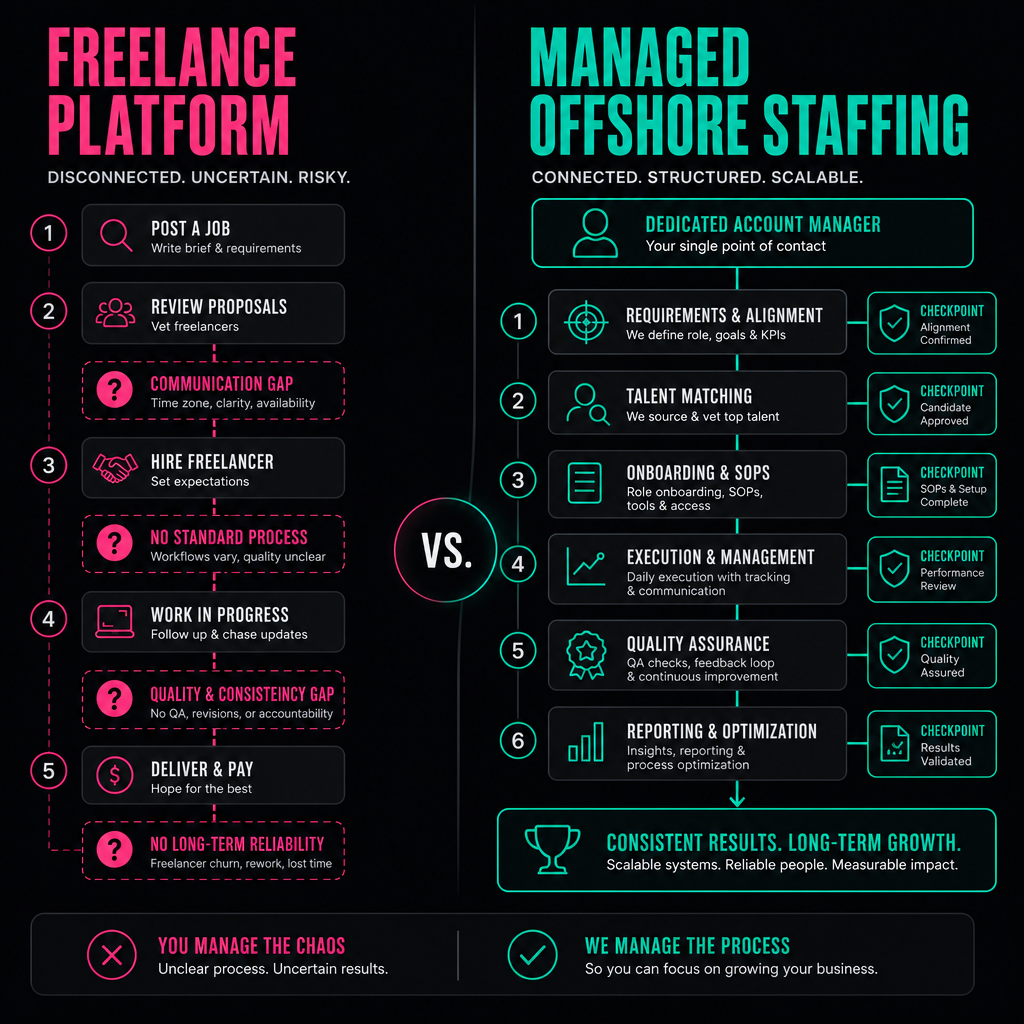
Offshore IT staffing is the practice of hiring qualified technology professionals based in another country to work as dedicated, full-time (or part-time) members of your team. They are not freelancers. They are not shared resources you borrow from a project pool. A properly structured offshore IT staff arrangement means the person works exclusively for your business, on your systems, to your standards, within a defined role and set of outputs.
The distinction matters because a lot of Australian business owners have had poor experiences with freelance platforms or low-cost outsourcing marketplaces where the accountability structure is essentially absent. You post a brief, someone delivers something, it is not quite right, and you spend more time managing the back-and-forth than you saved. That is not offshore IT staffing done well. That is delegation without a system.
A managed offshore IT staffing model, which is what Remotee delivers, wraps the specialist in a delivery structure: documented workflows, role scorecards, quality checkpoints, and an Australian account manager who ensures the output stays consistent as your business grows. Predictable delivery, not just headcount. The talent is only part of the equation.
The Philippine IT Talent Market in 2026
The Philippines is the primary source market for offshore IT staffing serving Australian businesses, and for good reason. English is an official language, the education system produces a significant volume of engineering and computer science graduates each year, and the time zone overlap with Australian eastern states (AEST is two to three hours ahead of Philippine Standard Time) makes real-time collaboration workable without asking your offshore team to work at unreasonable hours.
The talent pool is deep, but it is not uniform. The difference between the top 10% and the median candidate is meaningful, particularly for roles requiring systems thinking, security awareness, or complex problem-solving. At Remotee, we headhunt from the top 1% of Philippine talent, running rigorous technical testing against Australian industry standards before a specialist is presented to a client. The volume of candidates we assess to make a single placement is high. That screening cost is built into the model because a bad placement costs everyone more in the long run.
Roles You Can Hire Through Offshore IT Staffing
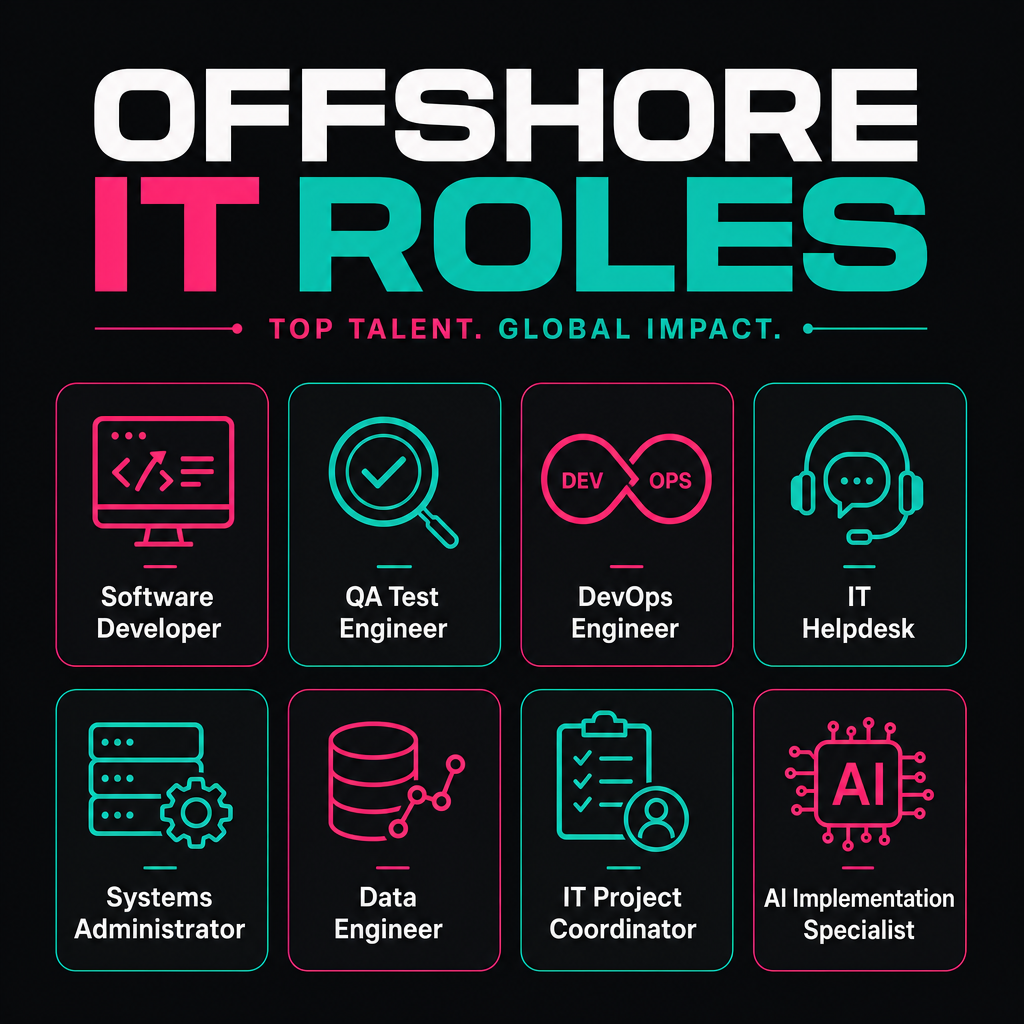
Software Developers
This is the most commonly requested offshore IT role for Australian businesses. Full-stack developers, front-end specialists, back-end engineers, mobile developers (iOS and Android), and API integration developers are all well-represented in the Philippine talent market. Technology stacks commonly covered include React, Node.js, Python, PHP, Laravel, .NET, Java, Swift, and Kotlin.
For Australian businesses building or maintaining web applications, SaaS products, internal tools, or customer-facing platforms, an offshore software developer working as a dedicated team member produces output that is indistinguishable from a local hire when the role is set up correctly with clear specifications, version control discipline, and code review processes.
QA and Test Engineers
Quality assurance is one of the highest-return roles to offshore. It is detail-oriented, process-driven, and well-suited to a documented workflow. QA engineers can handle manual testing, automated testing (Selenium, Cypress, Playwright), regression suites, API testing, and defect reporting. For software businesses shipping code regularly, having a dedicated offshore QA resource dramatically reduces the cost of bugs reaching production.
DevOps Engineers
Cloud infrastructure management, CI/CD pipeline maintenance, containerisation (Docker, Kubernetes), monitoring, and incident response are all within scope for a senior offshore DevOps engineer. This is a role where the skills gap in Australia is acute and salaries reflect it. An experienced DevOps engineer in Sydney commands $130,000 or more. The offshore equivalent, with comparable AWS, Azure, or GCP credentials, costs a fraction of that.
IT Helpdesk and Support
Level 1 and Level 2 helpdesk is one of the most straightforward roles to offshore. Ticket management, password resets, software troubleshooting, hardware diagnostics, and user onboarding tasks follow repeatable processes that document cleanly into SOPs. With a structured escalation map, your offshore helpdesk team handles routine requests while sensitive escalations are routed correctly every time.
Systems Administrators
Offshore systems administrators manage server environments, user access, backup processes, patch management, and network monitoring. For businesses running Microsoft 365, Google Workspace, or hybrid cloud environments, a dedicated offshore sysadmin provides coverage that would otherwise require a full-time local hire at significant cost.
Data Engineers
As Australian businesses accumulate more data from their CRM, ERP, e-commerce, and marketing platforms, the demand for data engineering support has grown sharply. Offshore data engineers handle ETL pipeline development, data warehouse management (BigQuery, Redshift, Snowflake), dashboard creation (Power BI, Looker, Tableau), and reporting automation. This is a role where the return on investment is highly measurable.
IT Project Coordinators
Not every IT need is purely technical. IT project coordinators manage sprint planning, vendor communication, documentation, and stakeholder updates. Offshore coordinators with experience in Jira, Confluence, Asana, or Monday.com can take a significant administrative load off your senior technical staff, freeing them to focus on architecture and delivery.
Cost Comparison: Offshore IT Staff vs Australian Salaries
The numbers are stark. A mid-level software developer in Melbourne or Sydney costs between $110,000 and $140,000 in base salary before you factor in superannuation (11.5% in 2026), employer payroll tax, leave entitlements, equipment, and office space. Total employment cost for a single developer in an Australian capital city can reach $160,000 to $180,000 annually.
An equivalent offshore software developer through a managed model typically costs between $42,000 and $60,000 AUD per year all-inclusive. That includes the specialist's salary, employer contributions in the Philippines, equipment, HR management, and the delivery infrastructure Remotee wraps around the role. The saving is 50-65% on a like-for-like basis.
For a business running a tech team of four, that difference can fund an entire additional specialist or be reinvested into product development, marketing, or sales infrastructure. Over 24 months, the compounding effect of that cost difference is substantial.
But cost alone is the wrong lens. The question is not just "how much cheaper is offshore?" It is "what output can I reliably get for what total investment?" A cheaper hire who produces inconsistent work, requires constant supervision, or leaves after six months is not a saving. It is a loss. This is where a managed model earns its value, and it is why specialist retention at 12 months across Remotee's client base sits above 95%.
You can review transparent pricing and engagement structures at Remotee's pricing page.
Data Security, IP Protection, and Compliance
This is the question I hear most often from Australian business owners considering offshore IT staffing for the first time. It is also the question that deserves the most honest answer.
Offshore IT staff access your systems, your codebase, your client data, and in some cases your financial or operational infrastructure. The risk is real. But it is manageable, and the controls are not complicated. What they require is deliberate setup before the first day, not a hope that things will be fine.
At the contractual level, every Remotee specialist signs a comprehensive non-disclosure agreement and an intellectual property assignment agreement before engagement begins. IP created during the engagement belongs to your business. Full stop.
At the technical level, access should be provisioned on a least-privilege basis. Your offshore IT staff member should have access to what they need to do their job, not administrator-level access to everything by default. Role-based access control, multi-factor authentication, endpoint management software, and VPN requirements are standard. Screen recording or activity monitoring tools can be deployed where the role or regulatory context warrants it.
For Australian businesses operating under the Privacy Act 1988 or handling sensitive data categories, the data handling obligations apply regardless of where your staff member is located. The compliance responsibility sits with your business. A properly structured offshore staffing arrangement documents the data access, processing activities, and security controls in a way that is audit-ready from day one.
Remoree's full technology security framework, including the specific controls applied to every engagement, is detailed at our technology security page.
How the Remotee Model Works: Systems Over Heroics
Most offshore staffing providers give you a resume and a start date. You figure out the rest. That works for some businesses and produces problems for most, because the issue is rarely the quality of the person. The issue is the absence of a delivery structure around them.
I have seen this pattern repeatedly. A business hires an offshore developer, the first two weeks go well, and then the output becomes inconsistent. Tickets are closed but the work has to be reworked. Communication slips into reactive mode. The founder starts checking in more often, which defeats the point. The offshore hire did not fail. The system failed, because there was no system.
The Remotee Method is built around four phases:
Phase 1: Discovery and Mapping. We audit your existing workflows and map your complete software ecosystem to build an operational blueprint before we source anyone. We know what the role needs to produce before we define who should fill it.
Phase 2: The Specialist Match. We headhunt from the top 1% of Philippine talent, running technical assessments benchmarked against Australian industry standards. A single placement may involve screening 30 to 50 candidates.
Phase 3: Operational Integration. The specialist joins your team alongside a library of industry-specific SOPs with compliance baked in, not bolted on. Every exception, escalation trigger, and tool rule is documented before the first task goes live.
Phase 4: Strategic Mentorship. An Australian account manager works with you on an ongoing basis to move your engagement from reactive headcount to a genuine capability layer. The goal is to move you from Doer to Strategist, not to keep you managing the offshore process yourself.
The Remotee Operating System that runs across every client engagement defines outcomes before work starts, documents workflows with exception handling, trains against real deliverables with checkpoint reviews, and installs a recurring accountability cadence. Issues surface as SOP improvements, not repeated mistakes.
Real Outcomes: What This Looks Like in Practice
Case Study 1: Digital Marketing Agency
I worked with a digital marketing agency where the founder was the approval bottleneck for almost every piece of routine work. Tasks lived in the inbox, in Slack threads, and in the founder's memory. When work came back wrong, which happened frequently, no one could identify where the brief had broken down. There was no trail.
We installed a delegation map and approval ownership structure that took routine sign-offs out of the founder's hands entirely. We built an SOP pack with exception handling for the three most common failure points. We introduced a quality checkpoint checklist and a weekly scorecard cadence.
Within six weeks, handoffs were faster because approvals had a named owner. Rework dropped sharply because the checkpoints caught issues before delivery. The founder described the shift as going from feeling like a full-time reviewer to actually running the agency. That is what systems over heroics looks like.
Case Study 2: NDIS Provider
An NDIS provider came to us with incomplete documentation, ad hoc exception handling, and quality checks that happened inconsistently or not at all. In a compliance-sensitive environment, that is not just an operational problem. It is a regulatory risk.
We installed an SOP pack with compliance steps and documented exception handling. We built an approval owner map with escalation triggers for anything outside normal parameters. We introduced a monthly quality review process with a versioned improvements log so the same issue never recurred without a documented response.
Compliance execution became consistent. The frequency of repeated issues dropped significantly. Audit reviewability improved because there was a documented trail for every decision. For businesses in regulated industries, this is where the Remotee model pays a compliance dividend that goes well beyond cost savings.
Testimonial
"We were sceptical about offshore IT staffing after a bad experience with a freelance platform. What Remotee delivered was completely different. From week one, the developer knew what was expected, had access to documented workflows, and produced output we could actually use. Twelve months in, he is one of the most reliable people on our team."
Founder, Australian SaaS business (name withheld)
For more detailed outcomes across industries, see the Remotee case studies page.
Time Zones, Communication, and Managing a Remote IT Team
Time zone difference between Australia and the Philippines is two to three hours, depending on daylight saving in your state. This is a workable gap for real-time collaboration. A Philippine-based specialist starting at 8am local time is online by 10am or 11am AEST, leaving a full afternoon of overlap for stand-ups, code reviews, or support queries.
For roles requiring less real-time interaction, such as data engineering, automated testing, or back-end development, the time difference becomes an operational advantage. Work submitted at the end of the Australian business day is processed overnight and ready for review the next morning. The feedback loop accelerates rather than slows.
Effective remote IT team management comes down to three non-negotiable practices:
-
Asynchronous-first communication. Use tools like Loom, Confluence, or Notion to document context rather than requiring live calls for every handoff. Your offshore team member should be able to start a task with full context, not waiting for someone to be available to explain it.
-
Structured daily or weekly check-ins. A 15-minute stand-up with a consistent agenda (what is done, what is in progress, what is blocked) keeps delivery visible without creating a surveillance culture.
-
Shared task management. Jira, Linear, Asana, or Monday.com creates a single source of truth for what is being worked on, what is waiting, and what is complete. Accountability is visible to everyone.
AI Implementation and Offshore IT Staffing
One area where offshore IT staffing is delivering significant value in 2026 is AI implementation support. Australian businesses are integrating AI tools into their workflows, products, and operations at an accelerating rate, but the internal capacity to implement, test, and maintain AI features is limited. Offshore developers and data engineers with experience in LLM integration, prompt engineering, and AI-assisted automation are increasingly in demand.
Remoree offers dedicated AI implementation support through offshore specialists who work alongside your existing team to build, test, and operationalise AI features in a structured, documented way, so the capability is embedded in your systems, not dependent on a single person's knowledge.
How to Get Started with Offshore IT Staffing
The process of engaging offshore IT staffing services through Remotee follows a structured path designed to minimise risk and accelerate time to productive output.
Step 1: Role scoping. Define the role in terms of outputs, not just job description. What does done look like? What tools are involved? What decisions can this person make independently, and what requires escalation?
Step 2: Workflow audit. Before we source a specialist, we map the existing processes the role will operate within. If those processes are not documented, we build the documentation as part of onboarding. Quality is designed, not assumed.
Step 3: Talent search and assessment. We screen candidates against your technical requirements and our own benchmarks. You review a shortlist of pre-vetted specialists, typically two to three candidates, and make the final selection.
Step 4: Onboarding and SOP deployment. The specialist begins with a structured onboarding programme tied to real deliverables. Early output is reviewed against checkpoints, and the SOP library is refined based on what we learn.
Step 5: Cadence and accountability. Weekly scorecard reviews, a named Australian account manager, and a versioned SOP improvement process keep the engagement on track as your business evolves.
Placement to operational typically takes 21 days. That is not a best-case figure. That is the consistent outcome when onboarding is built around a system rather than improvised.
To start a conversation about your specific IT staffing requirements, contact Remotee here.
References
-
ACS Digital Pulse 2025-2026 (Australian Computer Society): Annual report on the state of the Australian technology workforce, including ICT worker shortfall estimates, skills gap analysis, and workforce growth projections by specialisation.
-
Jobs and Skills Australia, Skills Priority List 2026: Official Australian Government publication identifying occupations in national shortage. ICT roles including software engineers, cloud architects, and cybersecurity specialists are listed as critically understaffed.
-
Seek Salary Insights, Technology and IT Sector, 2026: Aggregated salary data drawn from job advertisements and employer submissions across Australian capital cities, covering software development, DevOps, data engineering, IT support, and systems administration roles.
-
Office of the Australian Information Commissioner (OAIC), Privacy Act 1988 Compliance Guidance: Guidance on the obligations of Australian businesses when handling personal data, including in offshore or cross-border processing arrangements.
-
Australian Bureau of Statistics (ABS), Labour Force Data 2026: Monthly and annual data on employment conditions, vacancy rates, and workforce participation across industries including professional and technical services.
FREQUENTLY ASKED QUESTIONS
Common questions
Is offshore IT staffing secure for Australian businesses?
- Yes, when the right controls are in place before engagement begins. Every Remotee specialist signs NDA and IP assignment agreements. Access is provisioned on a least-privilege basis with MFA enforced. For businesses handling personal data under the Privacy Act 1988, the data processing activities are documented to support compliance obligations.
Who owns the code and IP created by an offshore developer?
- Your business does. IP assignment is a contractual condition of every Remotee engagement. Any code, documentation, or intellectual property created by the offshore specialist during the engagement belongs to you from the moment it is created.
How does the time zone difference work in practice?
- The Philippines is two to three hours behind Australian eastern states. Most clients find this is a workable overlap for daily stand-ups and real-time collaboration. For asynchronous roles such as data engineering or automated testing, the time difference often improves turnaround because work progresses while your Australian team is offline.
How long does it take to onboard an offshore IT specialist?
- Placement to fully operational typically takes 21 days through the Remotee model. This includes role scoping, candidate screening, selection, and a structured onboarding programme tied to real deliverables with checkpoint reviews.
What happens if the offshore specialist does not work out?
- Remotee manages the replacement process. Specialist retention at 12 months sits above 95% across our client base, which reflects the quality of the matching and onboarding process. In the event of a mismatch, we manage the transition without leaving your business without coverage.
Can I hire a part-time offshore IT specialist or does it have to be full-time?
- Both arrangements are available. Full-time dedicated specialists are the most common engagement, but part-time arrangements are structured for roles where a business needs consistent support without a full-time commitment. The same delivery structure applies regardless of hours.
What IT roles can I actually hire through offshore staffing?
- The most commonly placed roles include software developers (full-stack, front-end, back-end, mobile), QA and test engineers, DevOps engineers, IT helpdesk and Level 1-2 support, systems administrators, data engineers, and IT project coordinators.
How does offshore IT staffing comply with Australian employment law?
- Offshore IT specialists are employed in their home country under local employment law. They are not Australian employees and Australian employment law does not apply directly to the offshore engagement. The contractual relationship is between your business and the staffing provider. Remotee manages all Philippine-side employment obligations.

Jon Kelly
Founder, Remotee
Jon helps Australian businesses build compliance-led offshore teams that scale without the burnout. NDIS, accounting, mortgage broking, recruitment and digital marketing.
KEEP READING
Related posts
offshore teams for startups
How to Scale Australian Startups Using Offshore Teams
Australian startups rarely fail because founders lack ambition. They fail when cash, execution capacity and market timing stop lining up. Hiring locally for eve…
13 July 2026 · 22 min read
offshore staffing companies
Offshore Staffing Compliance and Data Security for Australian Businesses
| Metric | Statistic | | --- | --- | | Australian Privacy Act Penalties | Up to $50 million | | Compliance Rate with Specialist Offshore Staffing | 100% | | Red…
30 June 2026 · 19 min read
provider due-diligence checklist
Offshore Staffing Provider Due Diligence Checklist for Australian Businesses
An offshore staffing provider due-diligence checklist should verify the provider's delivery model, legal employing entity, payroll controls, recruitment process…
14 September 2026 · 18 min read
READY TO SCALE WITHOUT THE BURNOUT?
Build a compliance-led offshore team in 3–4 weeks.
Tell us about your current bottleneck and we'll show you what a Remotee placement would look like for your operation.
Or get our playbooks emailed to you instead.