
Building a Resilient Tech Team: Hiring Dedicated Offshore IT Staff
- offshore it staffing
- offshore tech recruitment
- software development
- tech talent shortage
- australian tech companies
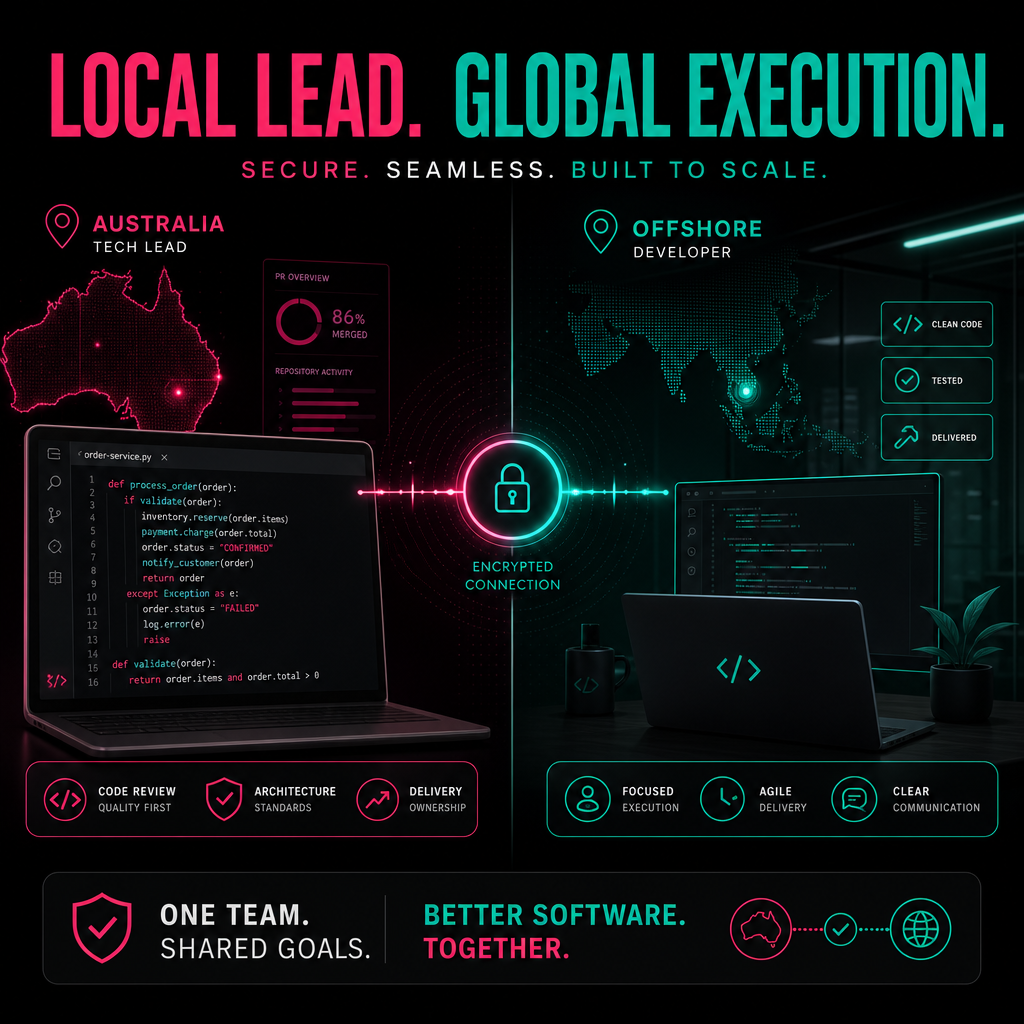
Australian technology companies are hitting a brick wall. The local talent shortage is real, and the cost of senior engineers is suffocating margins. You know you need to scale your engineering output, but hiring locally means burning through capital and waiting 6 months for the right candidate to accept an offer.
This is where offshore IT staffing changes the math. By tapping into markets like the Philippines, you can access highly skilled developers, QA testers, and DevOps engineers at a fraction of the local cost. But cheaper headcount is only half the battle. If you plug a new offshore staff member into a broken delivery structure, you just create a different kind of chaos.
At 3P Digital, I see this constantly. Businesses try to solve a systemic delivery problem by throwing cheaper bodies at it. The real problem is rarely talent. The difference between a capacity gap and a capacity crisis is usually a delivery structure problem, not a talent problem. In this guide, we will break down exactly how to implement offshore IT staffing safely, securely, and profitably.
Key Takeaways
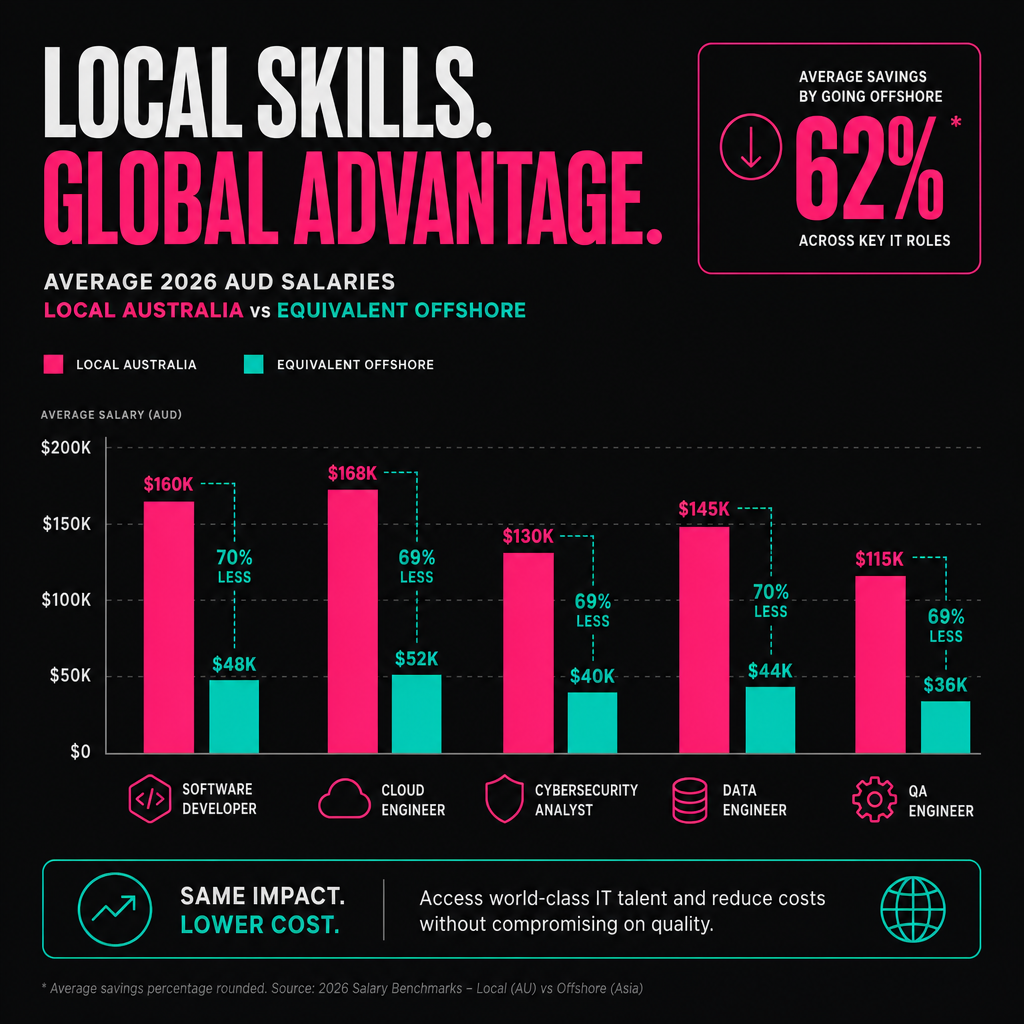
- Cost efficiency: Offshore IT staff in the Philippines typically cost 50-70% less than their Australian counterparts, delivering immediate operational savings.
- Talent availability: Australia's tech talent shortage is worsening. Offshore tech recruitment provides immediate access to a deep, skilled global talent pool.
- Delivery over headcount: Adding offshore developers without documented workflows just creates remote chaos. You need a reliable delivery system.
- Data security is non-negotiable: Proper IP protection, secure development environments, and endpoint management are mandatory when outsourcing development.
- Predictable velocity: A correctly integrated offshore team increases code deployment frequency and shortens time-to-market for new features.
Summary Table: Common Offshore IT Roles and Cost Comparisons
| Role | Average AUD Salary (Local) | Average AUD Salary (Offshore) | Estimated Savings | Core Function |
|---|---|---|---|---|
| Full-Stack Developer | $130,000 - $160,000 | $45,000 - $65,000 | 55-65% | Front-end and back-end application logic |
| QA Engineer | $90,000 - $110,000 | $30,000 - $45,000 | 60-70% | Automated testing, bug tracking, release validation |
| DevOps Engineer | $140,000 - $180,000 | $50,000 - $75,000 | 60% | Infrastructure, CI/CD pipelines, cloud security |
| Technical Support (L2) | $75,000 - $90,000 | $25,000 - $35,000 | 65% | Resolving complex technical user issues |
Note: Local salaries based on 2026 market averages. Offshore salaries reflect total employment costs including agency fees and local taxes.
The Reality of the Australian Tech Talent Squeeze
Finding experienced, capable tech talent locally is painful. The Australian Bureau of Statistics (ABS) consistently highlights the difficulties businesses face in recruiting highly skilled workers, particularly in the tech and IT sectors. According to the ABS, the proportion of businesses reporting difficulty finding suitable staff has remained at record highs over the last few years, directly impacting operational capacity and growth.
If you are a CTO or a technical founder, you already know this. You post a job for a mid-level React developer, and you get a trickle of applicants who lack the core competencies required to ship production code. You either compromise on quality, or you inflate your salary offers to poach from competitors. Neither option builds a resilient engineering team.
Offshore tech recruitment bypasses this bottleneck entirely. The Philippines produces hundreds of thousands of STEM graduates annually. Manila and Cebu have mature tech ecosystems populated with developers experienced in working for Australian, US, and UK enterprises. The talent exists. The challenge is accessing it through a framework that protects your intellectual property and ensures productive output.
What is Offshore IT Staffing?
Offshore IT staffing is not traditional outsourcing. When you outsource a project, you hand a brief to an external agency and hope they deliver the agreed scope. Offshore IT staffing services are different. You are hiring dedicated, full-time staff who work exclusively for your business.
These offshore staff members adopt your tech stack, use your development workflows, attend your daily stand-ups, and report directly to your engineering managers. The only difference between a local developer and your offshore developer is their physical postcode.
The Remotee Delivery Model
Most offshore providers compete on resumes and low hourly rates. We compete on reliability. If you add headcount without adding a system, you create operational drag.
This principle applies just as strongly to engineering as it does to back-office functions. I learned this the hard way with a recruitment agency we worked with. The founders were buried in operational execution, specifically payroll and accounting, rather than focusing on new business development. Hiring in-house resources to manage this was a poor commercial return on investment. We executed a full discovery and implementation of a managed payroll system within two weeks. The result was a structured system where our team managed all compliance, tax, and timesheet queries.
The lesson is universal. Whether you are installing a payroll function or integrating a team of offshore QA testers, predictable delivery is what matters. If you want to explore specific operational structures, review our offshore staffing solutions.
Core IT Roles to Source Offshore
To build a resilient tech team, you need to map your capability gaps. Offshore markets excel in several critical technical disciplines.
Full-Stack and Back-End Developers
Full-stack developers are the backbone of any software team. In the Philippines, you can find highly capable engineers proficient in modern stacks like React, Node.js, Python, and .NET. These developers are accustomed to working in agile environments and can take ownership of complex features from database design through to user interface logic.
QA Engineers and Automated Testing
Quality assurance is often treated as an afterthought until technical debt cripples a product. Dedicated offshore QA engineers build automated testing pipelines using tools like Cypress, Selenium, and Postman. By offloading regression testing and QA cycles to an offshore staff member, your local senior engineers can focus on core architecture and feature delivery.
DevOps and Cloud Infrastructure
DevOps engineers manage the critical path of code deployment. Hiring offshore DevOps talent allows you to maintain robust CI/CD pipelines, manage AWS or Azure environments, and monitor system health 24/7. Because these roles are process-driven and rely heavily on infrastructure-as-code, they are perfectly suited to remote integration.
Case Studies: Scaling Tech Teams Predictably
Theory is useless without execution. Here are two real examples of how structured offshore IT staffing changed the trajectory of Australian tech teams.
Case Study 1: SaaS Startup Scaling Engineering Output
The Problem: An Australian B2B SaaS startup had a strong product-market fit but a feature backlog that was angering key enterprise clients. Their local engineering team consisted of three senior developers. CTO estimated it would take eight months to hire two more mid-level engineers locally. Budget constraints made local hiring at $140,000 AUD per developer nearly impossible without raising another funding round.
The Intervention: We deployed a structured offshore IT staffing strategy. We sourced two full-stack developers and one QA engineer from our talent pool in Manila. Crucially, we did not just hand them Jira tickets. We spent the first three weeks documenting the deployment workflow, setting up code review protocols, and establishing secure access environments.
The Outcome: The total cost for the three offshore staff members was less than the cost of hiring one local developer. Within four months, the offshore team was shipping production code weekly. Feature delivery velocity increased by 130%. The startup avoided diluting equity through another funding round and retained 100% of their local team for architectural leadership.
Case Study 2: Enterprise Legacy System Migration
The Problem: A logistics company needed to migrate a legacy on-premise inventory system to a modern cloud-based microservices architecture. Their internal IT team was entirely consumed by day-to-day operational support. The migration project was stalled, and the business was bleeding money on server maintenance and downtime.
The Intervention: We integrated an offshore pod consisting of two back-end developers and one DevOps engineer. The internal IT lead acted as the product owner. We established strict delivery milestones focused on data integrity and zero-downtime cutover.
The Outcome: The migration was completed in 7 months. The total project cost was 60% lower than engaging a traditional Australian software development agency. The internal team maintained full operational control, while the offshore staff handled the heavy lifting of data mapping, API development, and pipeline automation.
IP Protection and Source Code Security
Security is the number one concern for technical leaders evaluating offshore IT staffing. Handing over access to your proprietary source code, customer databases, and cloud infrastructure is inherently risky. You cannot rely on a handshake or a standard employment contract.
Protecting your intellectual property requires physical, technical, and administrative controls. When you partner with a provider, you need granular visibility into their security architecture. We operate on the principle that compliance is not optional.
Secure Development Environments
Your offshore staff should never store source code locally. We enforce a thin-client model where developers connect to a secure Virtual Desktop Infrastructure (VDI). The development environment, IDEs, and source code reside on locked-down servers. The offshore developer can write, compile, and test code, but they cannot copy files to a local USB drive, use personal email, or upload code to unauthorized repositories.
Endpoint Management and Network Security
Every device used by your offshore staff must be provisioned and managed by the agency. This means standardised operating systems, automatic security patching, and mandatory endpoint detection and response (EDR) software. Devices must be locked to specific IP addresses and operate over dedicated, encrypted VPN connections.
This mirrors the strict controls required in back-office operations. We apply the same logic to payroll, where sensitive financial and personal data requires absolute security. STP, super, leave, PAYG and reporting must be handled by people who live in payroll, under strict compliance frameworks. The same rigour applies to software development. Unmanaged devices on public Wi-Fi are a massive liability. Controlled environments are the only acceptable standard.
Data Sovereignty and Access Controls
All cloud infrastructure access must route through Australian data centres where applicable. Access to production environments, database administration tools, and customer data must follow the principle of least privilege. Offshore staff should only have access to the exact systems required to complete their specific tasks.
Common Pitfalls in Offshore Tech Recruitment
Building an offshore tech team is not a magic bullet. If you approach it poorly, you will burn time and money. Here are the common ways businesses fail.
Failing to Document Processes
I see this failure mode constantly. A business hires a talented offshore developer, points them to a messy, undocumented codebase, and expects them to figure it out. The developer struggles, the local team gets frustrated, and the engagement fails.
Talent cannot fix a broken system. You must document your branching strategy, your deployment process, and your testing expectations. If you want to move from being a Doer to a Strategist, you need documented workflows. We recently helped a hospitality recruitment company that was drowning in operational chaos. They had multiple people managing payroll inefficiently. Our expert team completed a discovery phase, installed a customised system, and moved them to a fortnightly cycle. We eliminated the chaos. The same approach is mandatory for software delivery. Document the system before you scale the team.
Focusing on Cost Over Capability
Do not hire the cheapest developer you can find. If you pay bargain-basement rates, you will get junior developers who write spaghetti code that your senior engineers have to rewrite later. Focus on value and capability. A mid-level offshore developer who writes clean, maintainable code is exponentially more valuable than a cheap developer who generates technical debt.
Ignoring Cultural and Timezone Integration
Successful offshore staffing requires deliberate integration. While the Philippines offers a significant timezone overlap with Australia, you still need to schedule overlapping hours for daily stand-ups and sprint planning. Treat your offshore staff as core team members. Include them in team messages, reward good performance, and ensure they understand the business context behind the code they are writing.
How to Integrate Offshore IT Staff Successfully
Execution is everything. To get predictable delivery from your offshore team, you must install the right operational frameworks from day one.
Implement Agile Methodologies
Use standard agile frameworks like Scrum or Kanban. Two-week sprints with clearly defined tickets, acceptance criteria, and pull request requirements are essential. Your offshore developers need to know exactly what success looks like for every task they pick up.
Enforce Strict Code Review Protocols
No code gets merged without approval from a senior local engineer. Code reviews ensure quality, maintain architectural standards, and provide a continuous feedback loop for your offshore staff. This process trains your offshore team to align with your engineering standards rapidly.
Provide Clear Ownership
Every piece of code, infrastructure component, or testing suite needs a clear owner. Ambiguity kills productivity. When you assign clear ownership, your offshore staff take pride in their work and hold themselves accountable for the outcomes. This is how you build a resilient team.
The Bottom Line on Offshore IT Staffing
The tech talent shortage in Australia is not going to resolve itself. If your business relies on building software, maintaining infrastructure, or delivering digital products, you need a scalable strategy to access talent. Offshore IT staffing provides a clear, measurable path to reducing operational costs while increasing engineering velocity.
However, cheaper headcount is not a strategy. Predictable delivery, not just headcount, is what moves a business forward. You need secure environments, documented workflows, and a relentless focus on quality. By installing the right delivery system around your offshore staff, you can build a tech team that outpaces your local competitors without blowing up your budget.
If you are ready to scale your engineering output securely, review our delivery models or contact our team to discuss your specific technical requirements.
References
- Australian Bureau of Statistics (ABS). (2026). Business Indicators, Business Innovation and Technology.
- Department of Industry, Science and Resources. (2026). Australia's Tech Workforce Dynamics and Shortage Reports.
- Australian Cyber Security Centre (ACSC). (2026). Essential Eight Mitigation Strategies and Secure Remote Access Guidelines.
FREQUENTLY ASKED QUESTIONS
Common questions
How do you protect our source code when working with offshore developers?
- Source code protection is enforced through technical controls, not just legal contracts. We use secure Virtual Desktop Infrastructure (VDI) so developers cannot download or transfer code locally. Devices are locked down, USB ports are disabled, and developers access code repositories through managed, audited environments.
Will the offshore staff work in my timezone?
- Yes. The Philippines operates in a timezone that closely aligns with the Australian eastern states. Offshore IT staff typically adjust their working hours to ensure a 3-4 hour overlap with your local team for stand-ups, meetings, and collaborative problem solving.
What happens if the offshore developer is not performing?
- Because you are hiring dedicated staff, performance management works exactly like a local hire. You provide feedback and set performance plans. If a replacement is necessary, we manage the offboarding and recruitment of a new candidate to ensure you get the right fit.
Are there hidden costs with offshore IT staffing services?
- When working with a transparent provider, no. The monthly fee should encompass the staff salary, local taxes, hardware provision, office infrastructure, and agency management fees. You should not be paying separate fees for office space.
Can we scale the offshore team up or down quickly?
- Yes, scaling is a primary advantage. We maintain a pipeline of pre-vetted tech talent. We can deploy additional developers or QA engineers rapidly according to your contractual terms, provided reasonable notice is given for staffing logistics.
How does offshore IT staffing compare to hiring IT contractors locally?
- Local IT contractors in Australia charge premium rates and move between contracts rapidly. Offshore staff are dedicated, full-time employees who integrate deeply into your team, retain institutional knowledge, and cost a fraction of a local contractor's daily rate.

Jon Kelly
Founder, Remotee
Jon helps Australian businesses build compliance-led offshore teams that scale without the burnout. NDIS, accounting, mortgage broking, recruitment and digital marketing.
KEEP READING
Related posts
provider due-diligence checklist
Offshore Staffing Provider Due Diligence Checklist for Australian Businesses
An offshore staffing provider due-diligence checklist should verify the provider's delivery model, legal employing entity, payroll controls, recruitment process…
14 September 2026 · 18 min read
transparent provider pricing comparison
Offshore Staffing Pricing Transparency: How to Compare Provider Quotes Without Getting Caught Out
Transparent provider pricing comparison means evaluating offshore staffing quotes against total cost of engagement, not headline hourly rate. A genuine quote it…
13 September 2026 · 17 min read
managed staffing versus freelancer platforms
Managed Offshore Staffing vs Freelancer Platforms: Which Model Actually Delivers for Australian Businesses?
Managed offshore staffing suits ongoing, business-critical work because it wraps talent in documented workflows, compliance and a replacement guarantee. Freelan…
12 September 2026 · 15 min read
READY TO SCALE WITHOUT THE BURNOUT?
Build a compliance-led offshore team in 3–4 weeks.
Tell us about your current bottleneck and we'll show you what a Remotee placement would look like for your operation.
Or get our playbooks emailed to you instead.