
Offshore Staffing for NDIS Providers: How Australian Agencies Are Cutting Admin Costs Without Compromising Compliance in 2026
- NDIS staffing
- offshore staffing
- NDIS compliance
- NDIS admin
- disability services
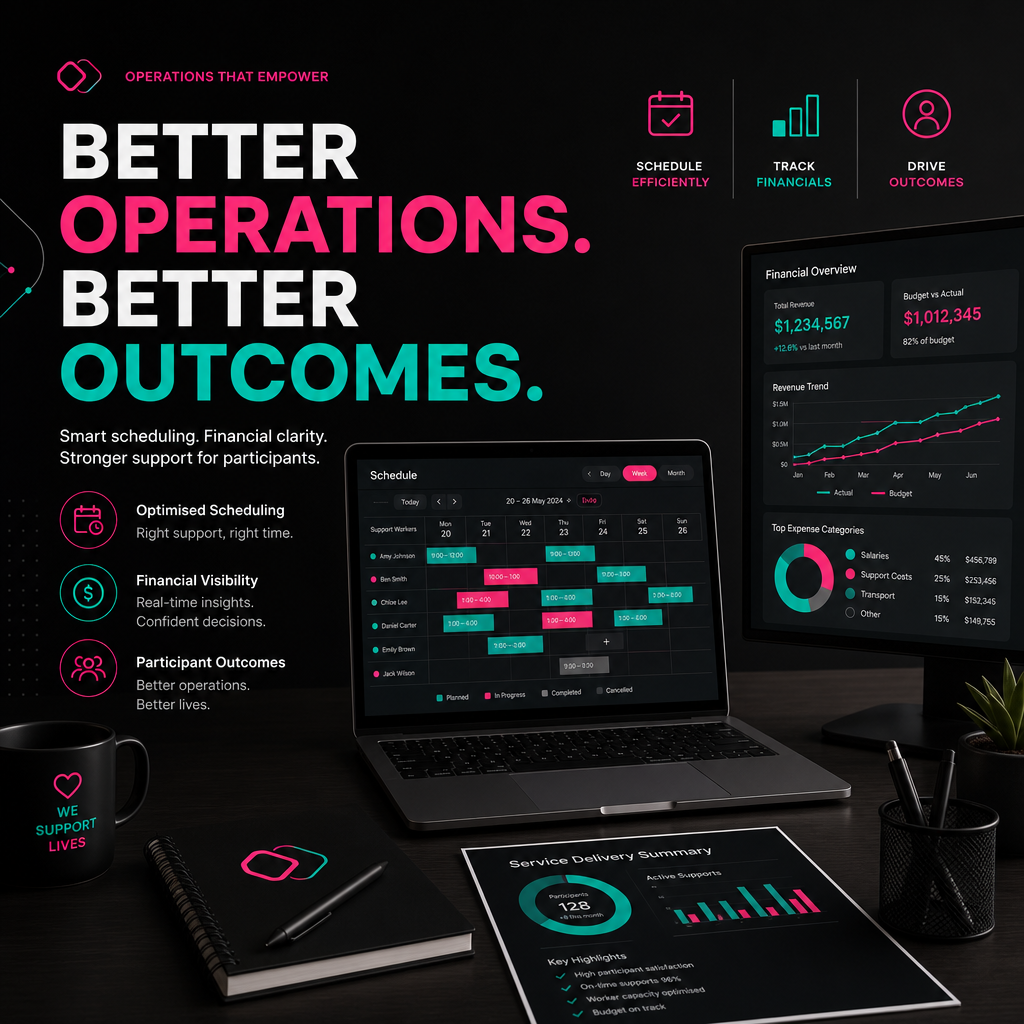
Margin pressure inside the NDIS sector has never been more acute. The 2026 pricing reforms have tightened unit rates, compliance obligations have grown heavier, and participant expectations have moved in only one direction. Most NDIS providers are running lean already. The question is no longer whether to find efficiencies. The question is where those efficiencies can be found without putting compliance, participant safety, or registration at risk.
Offshore staffing is the answer a growing number of Australian NDIS providers are arriving at. Not offshore care delivery. Not outsourced case management. Offshore admin, back-office, and operational support: the functions that consume hours of internal time every week but do not require physical presence in Australia to be executed well. Done correctly, it is one of the most effective ways to reduce cost per participant while keeping your compliance posture exactly where the NDIS Quality and Safeguards Commission expects it.
Done incorrectly, it creates exactly the audit exposure and service inconsistency you were trying to avoid. This article covers both sides. Which roles can be safely offshored, which cannot, what the compliance guardrails look like in practice, what it actually costs compared to hiring locally, and where the common mistakes happen. If you are a registered NDIS provider looking for a realistic, detailed picture of how offshore staffing works in this sector in 2026, this is the resource.
Key Takeaways
- NDIS admin, bookkeeping, rostering coordination, and claims processing are all functions that can be safely handled by offshore specialists without compromising participant outcomes or audit readiness.
- Compliance is a delivery structure problem, not just a talent problem. Offshore teams need documented SOPs, escalation triggers, and quality checkpoints to remain audit-ready.
- Onshore NDIS admin roles typically cost $65,000 to $85,000 AUD per year in salary alone. Comparable offshore specialists through Remotee cost $24,000 to $36,000 AUD, with compliance training and delivery systems included.
- Data security and participant privacy are manageable with the right controls: role-based access, encrypted platforms, and documented data handling procedures.
- The roles that must stay onshore are those requiring direct participant contact, clinical judgement, or statutory decision-making authority.
- Providers who offshore successfully pair talent with a delivery system. Those who offshore without one create a different kind of operational problem.
Summary Table: Onshore vs Offshore Costs for Common NDIS Back-Office Roles
| Role | Onshore Annual Cost (AUD) | Offshore Annual Cost via Remotee (AUD) | Annual Saving (AUD) |
|---|---|---|---|
| NDIS Admin Coordinator | $65,000 - $75,000 | $24,000 - $28,000 | $37,000 - $51,000 |
| Bookkeeper / Finance Officer | $70,000 - $85,000 | $26,000 - $32,000 | $38,000 - $59,000 |
| Rostering Coordinator | $60,000 - $72,000 | $22,000 - $28,000 | $32,000 - $50,000 |
| Claims Processing Officer | $62,000 - $74,000 | $24,000 - $30,000 | $32,000 - $50,000 |
| NDIS Data Entry / Reporting | $58,000 - $68,000 | $20,000 - $26,000 | $32,000 - $48,000 |
| Executive / Operations Assistant | $65,000 - $78,000 | $24,000 - $30,000 | $35,000 - $54,000 |
Cost estimates are indicative for 2026. Onshore figures include superannuation, leave entitlements, and oncosts. Offshore figures reflect Remotee all-inclusive engagement fees.
Why NDIS Providers Are Exploring Offshore Staffing in 2026
The NDIS has never been a high-margin sector for providers. But the 2026 pricing environment has pushed the pressure to a point where many operators are being forced to make structural decisions about how they run their businesses. The NDIS Price Guide for 2025-2026 held support rates broadly flat in real terms while the cost of delivering services continued to rise. Award wage increases under the Social, Community, Home Care and Disability Services (SCHADS) Award have added meaningful cost to frontline delivery. And the administrative burden of compliance has grown, not shrunk, with each reform cycle.
For a mid-sized registered provider running 80 to 200 active participants, the back-office cost base is significant. You typically need someone managing plans and service agreements, someone coordinating rosters, someone processing NDIS claims through the myplace provider portal, someone handling bookkeeping and payroll, and someone managing documentation and audit files. In many providers, two or three of those functions sit with the same person, creating a bottleneck and a single point of failure.
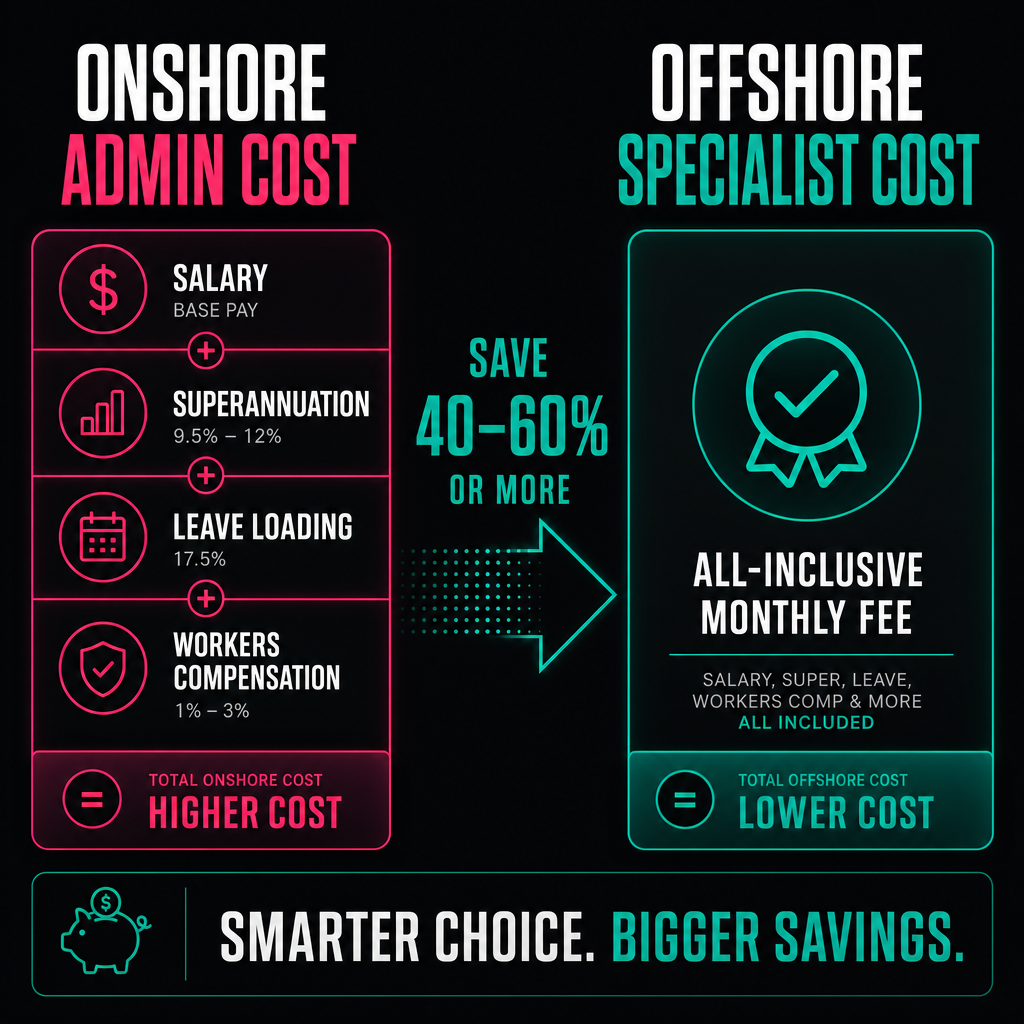
The arithmetic of offshoring is straightforward. A full-time NDIS admin coordinator based in Sydney or Melbourne costs somewhere between $65,000 and $75,000 in base salary, before you add superannuation, leave loading, workers compensation, and any oncosts. The equivalent role, filled by a specialist sourced from the Philippines through Remotee's NDIS staffing programme, costs $24,000 to $28,000 all-inclusive per year. For a two-person admin team, that is a saving of $70,000 to $100,000 annually, which is real money in a sector where margins are under sustained pressure.
But the providers getting value from offshore staffing are not just making a cost trade. They are making a structural decision about how their business operates. The ones who offshore without thinking through delivery structure, documentation, and compliance oversight are the ones who end up with inconsistent outputs, frustrated staff, and audit risk. That distinction matters enormously in an NDIS context, and it is what this article is really about.
For a detailed breakdown of how the 2026 NDIS reforms are reshaping provider economics, see Remotee's NDIS reform 2026 resource.
Which NDIS Admin Roles Can Be Offshored (and Which Cannot)
This is the question every NDIS provider asks first, and it is the right question to start with. Not every role is suitable for offshore delivery. The ones that are suitable share a common characteristic: they involve information processing, documentation, scheduling, or financial administration that can be executed remotely with the right access, tools, and training.
Roles That Are Well Suited to Offshore Delivery
NDIS Claims Processing. Processing claims through the NDIS myplace provider portal is a rules-based, document-intensive task. An experienced offshore specialist can be trained on your specific service types, support categories, and claims workflow. With the right SOP library and a quality checkpoint before bulk submission, this function can run offshore without any reduction in accuracy. In fact, dedicated offshore claims staff often produce fewer errors than overloaded onshore admin staff who are juggling five other tasks.
Rostering Coordination. Scheduling support workers across participant needs, availability windows, and compliance requirements is one of the most time-consuming admin functions in any NDIS business. An offshore rostering coordinator working in your scheduling platform (Brevity, Careview, AlayaCare, or similar) can handle shift creation, change requests, cancellation management, and communication with workers. The participant-facing interaction stays with your local team. The back-end coordination moves offshore. One of our NDIS provider clients moved to this model after a period where their operations manager was spending more than 20 hours per week on rostering alone. After installing an offshore rostering coordinator with a documented handoff protocol and a weekly quality review, that time dropped below five hours. The operations manager could focus on participant relationships and growth.
NDIS Bookkeeping and Finance. Reconciling NDIS payments, managing accounts payable, processing payroll, and producing management reports are all functions an offshore bookkeeping specialist can handle. The key is that invoice approval and payment authority stay with your nominated onshore owner. The prep work moves offshore. This is exactly the control model we apply across our accounting and finance clients: delegate the preparation, retain the approval. See Remotee's bookkeeping and finance solutions for how this is structured.
Service Agreement and Plan Administration. Preparing service agreements, updating participant plans in your CRM or practice management platform, tracking plan expiries, and managing correspondence related to plan reviews are all tasks an offshore admin specialist can handle effectively.
Reporting and Data Entry. Compliance reporting, incident log maintenance, progress note formatting, and KPI dashboards are low-complexity, high-volume tasks that consume significant internal time. Offshore specialists are well placed to own this work.
Executive and Operations Support. Diary management, inbox triage, document preparation, and internal communications coordination are standard virtual assistant functions that translate cleanly to offshore delivery in an NDIS context.
Roles That Must Stay Onshore
The following functions should not be offshored, for legal, ethical, or regulatory reasons.
Direct participant support and care delivery. Any role involving physical presence with a participant must be delivered by a locally based, registered support worker. This is non-negotiable.
Behaviour support practice. Behaviour support practitioners must be registered with the NDIS Commission and operate under Australian law. This role cannot be delegated offshore under any structure.
Statutory complaints handling. Any function that involves making formal determinations about participant complaints, safeguarding matters, or restrictive practice authorisations must be handled by an authorised onshore officer.
Clinical governance decisions. Anything requiring professional clinical judgement, including nursing assessments, allied health recommendations, or risk classifications, must stay onshore.
The pattern is clear: process and documentation go offshore, professional judgement and statutory authority stay onshore.
Compliance and Data Security Considerations for NDIS Offshore Teams
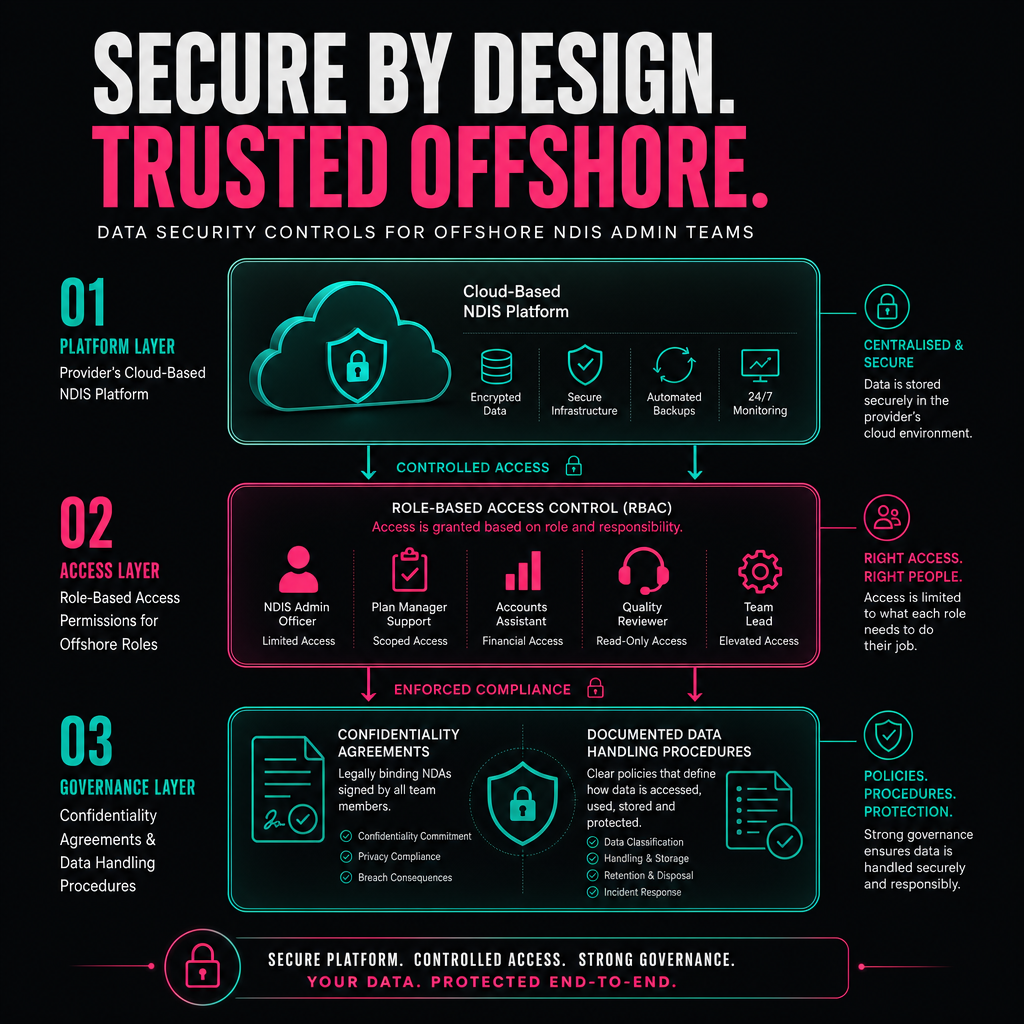
This is where many providers hesitate, and the hesitation is reasonable. NDIS participants are among the most vulnerable people in Australia. The NDIS Quality and Safeguards Commission sets high expectations for how participant data is handled. The Privacy Act 1988 (Cth) applies to any organisation handling personal information about participants, regardless of where that information is processed.
Here is how compliant offshore staffing structures handle this.
Data Handling and Access Controls
Offshore team members should access participant data only through systems controlled by your organisation. This means your NDIS management platform (Brevity, Careview, or equivalent), your accounting software, and your document management system. Access should be role-based: each offshore specialist has access only to the data their role requires. A rostering coordinator does not need access to financial records. A bookkeeper does not need access to support notes.
All access should be through your systems, not through copies of data held locally by the offshore team. This keeps data sovereignty with your organisation. Using cloud-based platforms with Australian data residency (where available) is the cleanest approach. Multi-factor authentication should be standard.
Documented Data Handling Procedures
Your offshore team members should operate under a documented data handling procedure that specifies what data they can access, how it is processed, how it is stored or not stored, and how breaches are escalated. This document is part of your compliance file and should be reviewed regularly. At Remotee, this is built into the SOP library delivered as part of every NDIS engagement. Compliance is baked in, not bolted on.
Contracts and Confidentiality
Offshore specialists working with NDIS providers should sign confidentiality agreements that explicitly cover participant data. Remotee's engagement structure includes this as standard. Your own organisation should also maintain a data processing register that records the functions performed by offshore staff and the controls in place.
Audit Readiness
The NDIS Commission does not prohibit providers from using offshore admin support. What it requires is that providers can demonstrate governance over their operations. That means being able to show, during an audit, that offshore staff are operating within a documented, controlled process with appropriate oversight. This is entirely achievable. Remotee's compliance training programme, available through our compliance training resource, ensures offshore specialists understand NDIS-specific requirements before they begin work.
How to Structure Delegation and Quality Checkpoints
Most NDIS providers who have had a bad experience with outsourcing made the same mistake: they handed over a role without handing over a system. They assumed that a capable person would figure out what good looked like. That assumption is what creates inconsistency, rework, and eventually compliance exposure.
The structure that works is straightforward but requires upfront investment.
Define What Done Looks Like
Before an offshore specialist touches any NDIS workflow, there needs to be a clear, written definition of what a completed task looks like. For claims processing, that means which fields must be complete, what supporting documentation must be attached, what the error rate threshold is, and what happens when a claim is rejected. For rostering, that means what a confirmed shift record looks like, what the escalation path is for an unfilled shift, and how change requests are communicated to workers.
This is the first principle of the Remotee Operating System: define outcomes and done. Clarity at the front removes ambiguity that compounds downstream.
Document the Workflow
Every function your offshore team performs should have a written SOP that covers the standard process, common exceptions, tool rules for your specific platforms, and escalation triggers. SOPs do not need to be long. They need to be accurate and current. Remotee provides an NDIS-specific SOP library as part of every engagement, which providers customise to their own processes. You can review the delegation and SOP structure in detail at Remotee's NDIS delegation system page.
Install a Quality Checkpoint Rhythm
Quality is designed, not assumed. For NDIS back-office functions, a weekly quality checkpoint covering output volume, error rates, and exception items is typically sufficient. Monthly, those checkpoints should feed into an SOP review. If the same issue appears twice, the SOP is updated. Versioned SOP updates are themselves a compliance artefact: they demonstrate that your organisation identifies and addresses process gaps systematically.
I worked directly through this problem with an NDIS provider who was seeing inconsistent documentation quality and ad hoc exception handling across their admin team. After installing an SOP pack with compliance steps and exception paths, an approval owner map with escalation triggers, and a monthly quality review with versioned SOP updates, the pattern shifted. Repeated issues dropped sharply because the improvements log made every exception a learning event rather than a forgotten incident. Reviewability improved. The operations manager described it as going from systems over heroics to actually having systems.
Cost Comparison: Onshore NDIS Admin Staff vs Remotee Offshore Teams
The summary table above gives a snapshot. This section goes deeper.
When Australian NDIS providers calculate the cost of an onshore admin hire, they typically start with base salary and stop there. The real cost includes superannuation (11.5% in 2026), leave loading, workers compensation insurance, any payroll tax liability (which kicks in at various thresholds depending on state), recruitment costs (typically $5,000 to $15,000 per hire), and the productivity loss during a 3 to 6 month ramp-up period.
For a $70,000 base salary hire, the full employment cost sits closer to $85,000 to $95,000 per year once all oncosts are included. That is before office space, equipment, or software licences.
Remotee's offshore engagement fees are all-inclusive. There is no superannuation obligation, no leave loading liability, and no workers compensation exposure for the provider. The specialist is employed through Remotee's Philippines entity under compliant local employment law. The provider pays one monthly fee. Current pricing is available at remotee.com.au/pricing.
The operational saving on a single offshore admin role is typically $37,000 to $55,000 per year. For a provider employing two offshore specialists, that is $70,000 to $110,000 in annual savings: enough to fund another frontline support worker, invest in technology, or simply improve margin.
Across Remotee's NDIS provider clients, the consistent finding is that non-billable internal time drops by 35% to 50% within the first 90 days of an offshore engagement, as the offshore specialist absorbs the high-effort, low-impact administrative work that was consuming the onshore team's capacity.
Case Study 1: Reducing Admin Overhead in a Mid-Sized NDIS Provider
A registered NDIS provider in Queensland was operating with a team of 12 support workers and a single operations manager carrying the full administrative load. That load included rostering, claims processing, service agreement preparation, and participant correspondence. The operations manager was working 50-plus hours per week and the provider was losing service agreements because follow-up was inconsistent.
We came in through our discovery phase and mapped the full administrative workflow against the operations manager's time. The finding was that 65% of her weekly hours were consumed by tasks that required no Australian qualification, no direct participant contact, and no statutory authority. They were process tasks: data entry, schedule building, claims submission, and document preparation.
We placed an offshore NDIS admin specialist and a part-time offshore rostering coordinator, both sourced from the top 1% of Philippine talent through Remotee's specialist match process. Both were onboarded with a customised SOP library covering the provider's specific platforms and workflows. A delegation map was built that clarified exactly which decisions required the operations manager's approval and which could be executed autonomously by the offshore team.
Within 60 days, the operations manager's weekly hours dropped to 38. Claim processing time decreased by four days per cycle. Three service agreements that had been sitting incomplete for more than two weeks were finalised and signed within the first month. The annual saving on the two offshore roles compared to equivalent onshore hires was $82,000. The provider used that saving to bring on an additional frontline support worker.
Case Study 2: Offshore Bookkeeping and Rostering Support
A disability services provider in South Australia was managing bookkeeping internally using the founder's partner, who had accounting experience but no capacity to dedicate more than 10 hours per week to the function. NDIS payment reconciliations were running three to four weeks behind. Payroll had errors. The provider had received a minor finding in their most recent NDIS audit related to financial record keeping.
Through Remotee's bookkeeping and finance solution, we placed a dedicated offshore bookkeeping specialist with NDIS payment reconciliation experience. We installed a control model that kept invoice approval and payment authority with the founder but delegated all preparation, reconciliation, data entry, and reporting to the offshore specialist. Evidence capture was built into the workflow: every approval had a timestamped record, which formed part of the audit trail.
Within the first month, reconciliations were current. Payroll error rate dropped to zero across the following quarter. When the provider's next NDIS audit occurred, their financial records were described by the auditor as thorough and well-maintained. The offshore specialist cost $28,000 per year all-inclusive. The equivalent onshore bookkeeper with NDIS experience would have cost $72,000 to $80,000. The annual saving was $44,000 to $52,000.
Real Client Experience
"Before Remotee, I was spending my Sunday nights doing admin that should have been done on Thursday. Now I have an offshore team member who owns the claims process end to end. I review the exceptions. Everything else runs without me. Our compliance file is cleaner than it has ever been and I have not had a late claim in four months."
Registered NDIS provider, Victoria (name withheld on request)
If you want to understand how this could work for your organisation, reach out to our team for a no-obligation conversation.
Common Mistakes NDIS Providers Make When Offshoring
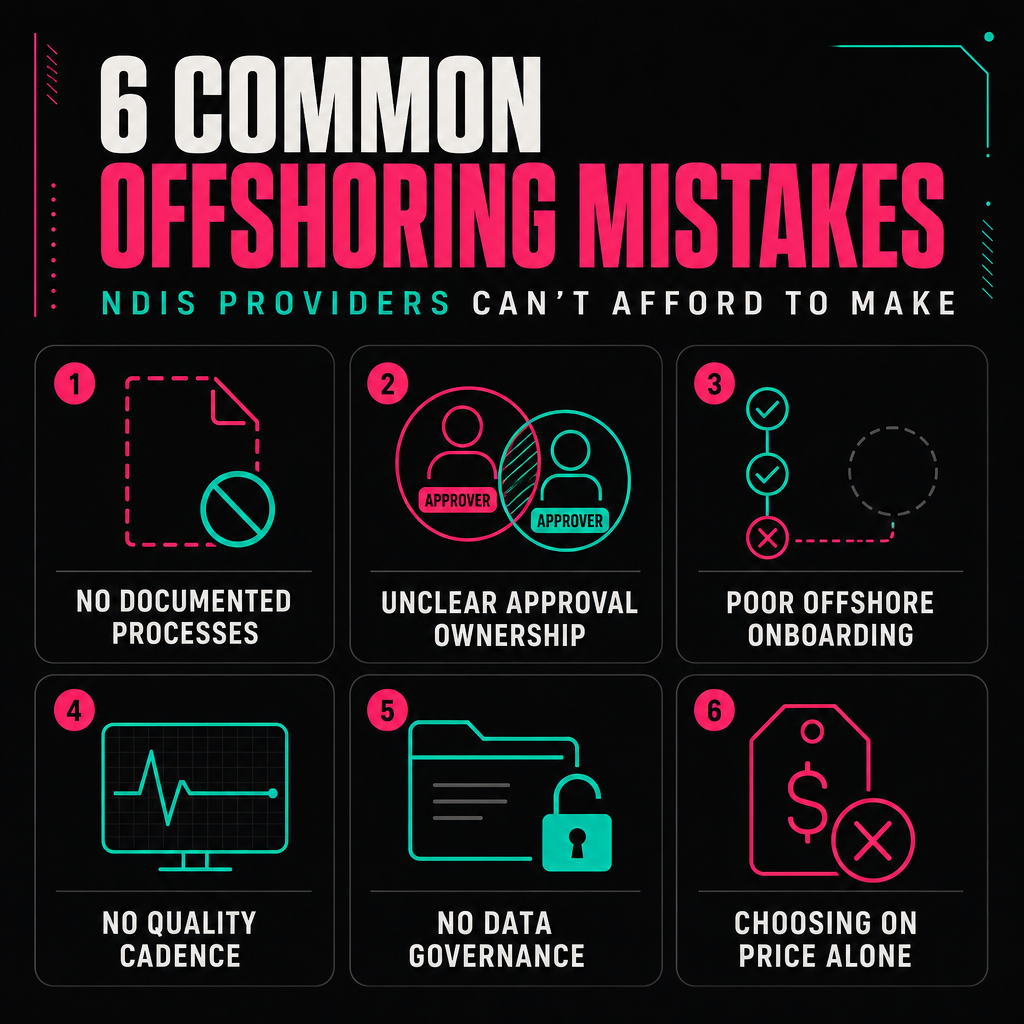
Offshoring is not a plug-and-play solution. The providers who get it wrong make predictable mistakes. Understanding them in advance saves significant pain.
Mistake 1: Offshoring Without Documented Processes
This is the most common failure. A provider hires an offshore admin specialist, sends them a login to the NDIS portal and their rostering system, and expects them to figure it out. Without documented SOPs, the specialist relies on memory, guesswork, and ad hoc instructions. Output becomes inconsistent. The provider assumes the offshore model does not work. The real problem was never the talent. It was the absence of a delivery structure.
Mistake 2: No Clear Approval Ownership
In NDIS operations, not every task carries equal risk. Approving a claim for submission carries more risk than building a draft roster. If the approval ownership is not mapped clearly, offshore staff will either escalate everything (creating a bottleneck for the onshore team) or approve things they should not (creating compliance exposure). The solution is a delegation map: a single document that defines which actions the offshore specialist can execute autonomously and which require onshore sign-off. Remotee builds this during Phase 1 of every NDIS engagement.
Mistake 3: Treating Offshore Onboarding Like a Local Hire
Local hires can ask a colleague a question. They can read the room. They can pick up context informally. Offshore specialists cannot do any of those things. Onboarding for offshore roles needs to be structured, documented, and tied to real output review. The first four weeks of an offshore engagement should include output reviews against checkpoints, not just orientation activities.
Mistake 4: No Quality Cadence After the First Month
Many providers invest in setup but then let the offshore engagement run on autopilot. Without a recurring quality checkpoint, small process deviations compound into material errors over time. A monthly quality review does not need to be long. It needs to be consistent. If it identifies an issue, the SOP is updated. That cycle is what keeps offshore delivery audit-ready over the long term.
Mistake 5: Offshoring Without Considering Data Governance First
Placing an offshore specialist without first reviewing your data access controls, confidentiality agreements, and participant privacy obligations creates legal exposure. The Privacy Act applies regardless of where data is processed. Get your data governance in order before your offshore specialist starts day one.
Mistake 6: Choosing on Price Alone
The cheapest offshore option is almost never the best value option in an NDIS context. Low-cost staffing platforms that match freelancers to roles without providing compliance training, delivery structure, or ongoing support create short-term savings and long-term operational problems. NDIS providers need offshore partners who understand the sector's regulatory environment, not just staffing platforms that source low-cost labour. Predictable delivery, not just headcount, is what actually reduces risk.
How Remotee Structures NDIS Offshore Engagements
For NDIS providers specifically, Remotee applies The Remotee Method: a four-phase engagement structure designed to move providers from Doer to Strategist by installing a compliance-ready operating system around offshore specialist roles.
Phase 1 Discovery and Mapping audits your existing workflows and maps your complete software ecosystem. For an NDIS provider, this includes your NDIS portal access, your rostering platform, your bookkeeping software, and your document management processes. The output is an operational blueprint that defines which functions are ready to offshore today and which need process documentation before they can be delegated.
Phase 2 The Specialist Match identifies and places a specialist from the top 1% of Philippine talent, with technical testing against NDIS-specific requirements. We do not send you a shortlist and ask you to interview. We match and recommend based on the blueprint built in Phase 1.
Phase 3 Operational Integration delivers the specialist alongside a library of NDIS-specific SOPs with compliance baked in. Your specialist starts with a working process, not a blank page. Training is tied to real outputs, and early deliverables are reviewed against checkpoints before the specialist operates autonomously.
Phase 4 Strategic Mentorship provides ongoing support from a dedicated Australian account manager. As your offshore specialist grows into the role, the account manager helps you identify the next layer of delegation, continuously moving your onshore team away from high-effort, low-impact work and toward strategic decisions.
The typical placement-to-operational timeline for an NDIS admin specialist through Remotee is 21 days. Specialist retention at 12 months is above 95%, which matters in a sector where consistency of process knowledge is directly linked to compliance outcomes.
If you are ready to explore whether offshore staffing is the right move for your NDIS operation, contact our team for a free workflow audit.
References
-
NDIS Quality and Safeguards Commission: Practice Standards and Quality Indicators. The governing framework for registered NDIS providers, outlining the quality and safety standards providers must meet. Available through the NDIS Commission website. Relevant to understanding what governance obligations apply to provider operations, including those involving offshore support staff.
-
National Disability Insurance Scheme Act 2013 (Cth). The primary legislation establishing the NDIS framework in Australia. Defines provider obligations, participant rights, and the regulatory role of the NDIS Commission. Available through the Federal Register of Legislation.
-
Privacy Act 1988 (Cth) and the Australian Privacy Principles. The federal legislation governing how organisations handle personal information. Applies to NDIS providers handling participant data regardless of where that data is processed. Available through the Office of the Australian Information Commissioner (OAIC).
-
Fair Work Act 2009 (Cth) and the SCHADS Award (Social, Community, Home Care and Disability Services Industry Award 2010). The Fair Work Commission's social services award governs employment conditions for most NDIS frontline staff in Australia. Relevant for understanding Australian onshore employment cost benchmarks referenced in the salary comparison tables.
-
NDIS Pricing Arrangements and Price Limits 2025-2026. Published by the National Disability Insurance Agency (NDIA). The annual pricing document setting support category rate limits for registered providers. Referenced in the context of 2026 margin pressure on NDIS providers.
-
Australian Bureau of Statistics: Labour Costs Survey and Wage Price Index. ABS data on labour cost trends in Australia, relevant to benchmarking the full employment cost of onshore admin roles in the disability services sector.
FREQUENTLY ASKED QUESTIONS
Common questions
Is it legal for NDIS providers to use offshore admin staff?
- Yes. There is no NDIS legislation or NDIS Commission guideline that prohibits registered providers from using offshore administrative support. The NDIS Quality and Safeguards Practice Standards and the NDIS Act 2013 set requirements for the quality and safety of participant supports, not for the geographic location of back-office staff. What providers must demonstrate is that they maintain governance and control over all functions that affect participant outcomes, and that participant data is handled in accordance with the Privacy Act 1988 (Cth). Both requirements are entirely compatible with a well-structured offshore engagement.
How is participant data protected when using offshore staff?
- Participant data protection is managed through a combination of technical and procedural controls. Offshore specialists access data only through your organisation's systems, with role-based access permissions that limit each person to the data their function requires. Data is not copied or stored locally by offshore team members. Confidentiality agreements are signed as part of every Remotee engagement. Documented data handling procedures form part of the compliance file. These controls satisfy the requirements of the Privacy Act 1988 (Cth) and are consistent with NDIS Commission expectations for governance over provider operations.
Will offshore staffing affect my NDIS audit outcomes?
- Not if the engagement is structured correctly. NDIS audits assess whether a provider can demonstrate governance, process consistency, and quality oversight. A well-documented offshore engagement, with SOPs, approval ownership maps, quality checkpoints, and evidence capture, typically produces a cleaner audit trail than an underdocumented onshore operation. Remotee's compliance training programme and SOP library are designed specifically to support audit-ready compliance.
How long does it take to get an offshore NDIS admin specialist operational?
- Through Remotee, the typical placement-to-operational timeline is 21 days. This covers the discovery and mapping phase, specialist matching, SOP customisation, and early delivery review. The specialist is not handed over until they have been trained on your specific platforms, processes, and compliance requirements, and their early outputs have been reviewed against quality checkpoints.
Which NDIS admin roles are most suitable for offshore staffing?
- The functions best suited to offshore delivery are those involving information processing, documentation, scheduling coordination, and financial administration. Specifically: NDIS claims processing, rostering coordination, bookkeeping and payment reconciliation, service agreement and plan administration, reporting and data entry, and executive and operations support. Roles involving direct participant contact, clinical judgement, behaviour support practice, or statutory decision-making authority must remain onshore.
How much can an NDIS provider realistically save by offshoring admin roles?
- Based on current 2026 salary benchmarks and Remotee's engagement fees, the saving on a single offshore admin role compared to an equivalent onshore hire is typically $37,000 to $55,000 AUD per year. For a two-person offshore admin team, annual savings are commonly $70,000 to $110,000. These figures reflect the difference in all-inclusive offshore fees versus the full onshore employment cost including salary, superannuation, leave loading, workers compensation, and oncosts. Across Remotee's NDIS provider clients, non-billable internal time drops by 35% to 50% within the first 90 days.
What does Remotee's onboarding process look like for NDIS providers specifically?
- Remotee's NDIS onboarding follows The Remotee Method. Phase 1 maps your existing workflows and software ecosystem to produce an operational blueprint. Phase 2 matches a specialist from the top 1% of Philippine talent to your specific requirements. Phase 3 delivers the specialist alongside an NDIS-specific SOP library, with training tied to real output review. Phase 4 provides ongoing support from an Australian account manager. Throughout the engagement, compliance training ensures your offshore specialist understands NDIS sector requirements.

Jon Kelly
Founder, Remotee
Jon helps Australian businesses build compliance-led offshore teams that scale without the burnout. NDIS, accounting, mortgage broking, recruitment and digital marketing.
KEEP READING
Related posts
transparent provider pricing comparison
Offshore Staffing Pricing Transparency: How to Compare Provider Quotes Without Getting Caught Out
Transparent provider pricing comparison means evaluating offshore staffing quotes against total cost of engagement, not headline hourly rate. A genuine quote it…
13 September 2026 · 17 min read
managed staffing versus freelancer platforms
Managed Offshore Staffing vs Freelancer Platforms: Which Model Actually Delivers for Australian Businesses?
Managed offshore staffing suits ongoing, business-critical work because it wraps talent in documented workflows, compliance and a replacement guarantee. Freelan…
12 September 2026 · 15 min read
offshore staffing company comparison criteria
Offshore Staffing Company Comparison Criteria: How Australian Businesses Should Evaluate Providers
Direct Answer: The criteria that actually predict offshore staffing outcomes are the employment and compliance model, documented delivery workflows, supervision…
11 September 2026 · 16 min read
READY TO SCALE WITHOUT THE BURNOUT?
Build a compliance-led offshore team in 3–4 weeks.
Tell us about your current bottleneck and we'll show you what a Remotee placement would look like for your operation.
Or get our playbooks emailed to you instead.