
Offshore Staffing for Australian SMEs: Scale Smarter Without the Overhead in 2026
- offshore staffing
- SME outsourcing
- offshore team
- small business australia
- remote staffing
Australian SMEs account for 97% of all businesses and employ nearly half the private sector workforce, according to the Australian Bureau of Statistics. Yet most of them are competing for talent in the same market as enterprises that have HR departments, employer branding budgets, and the ability to absorb superannuation guarantee obligations, payroll tax thresholds, and leave liabilities without blinking. The playing field has never been level, and right now, with the superannuation guarantee sitting at 11.5% and the national minimum wage at $24.10 per hour as of 2026, the cost of adding a full-time local employee to a lean operation is significant.
Offshore staffing changes that equation. Not by cutting corners, and not by replacing your core team. It changes it by giving SMEs access to skilled, full-time specialists at a fraction of the local all-in cost, paired with a delivery structure that ensures the work actually gets done to a consistent standard. That last part matters more than most providers will tell you. Headcount without structure is how scaling creates chaos. I have seen it repeatedly: a small business adds an offshore hire, the owner stays the bottleneck, tasks live across inboxes and chat threads, and six months later the hire feels like a liability rather than an asset.
This guide is for Australian business owners who want a clear, honest picture of offshore staffing in 2026: what it costs, which roles to start with, how to manage a small remote team without a dedicated HR function, and how to know whether your business is actually ready. I will also share two real examples from our client work at Remotee, with specific outcomes, so you can benchmark against your own situation.
Key Takeaways
- Australian SMEs can access full-time offshore specialists from the Philippines at 60-75% less than equivalent local all-in employment costs, without PAYG withholding, superannuation, or payroll tax obligations.
- The first roles to offshore are admin, bookkeeping support, customer service, and lead generation. These are high-volume, process-driven roles where clear SOPs produce consistent output.
- Offshore staffing only delivers predictable results when paired with documented workflows, clear ownership, and a review cadence. Talent quality alone is not enough.
- Managing a small offshore team does not require an HR department. It requires a role scorecard, a weekly check-in rhythm, and SOP coverage for every repeatable task.
- IP and compliance caveats are manageable for small operators with the right contracts and data handling protocols in place before Day 1.
- Signs your SME is ready: you have repeatable work, you can describe what done looks like, and the owner is spending more than 30% of their week on tasks someone else could execute.
Summary Table: Offshore Staffing vs. Local Hire for an Australian SME (2026)
| Factor | Local Full-Time Employee | Offshore Specialist (Philippines) |
|---|---|---|
| Base salary (admin/bookkeeping equivalent) | $55,000-$70,000 AUD per year | $18,000-$28,000 AUD per year |
| Superannuation guarantee (11.5%) | $6,325-$8,050 | Not applicable |
| Payroll tax (where applicable) | Varies by state, 4.75-6.85% | Not applicable |
| Annual leave / sick leave liability | Yes | Managed by employer of record |
| Recruitment timeline | 4-10 weeks average | 10-21 days with Remotee |
| Redundancy exposure | Yes | No (via EOR model) |
| Onboarding / training overhead | High (internal) | Reduced with SOP library |
| Scalability | Slow, high fixed cost | Flexible, lower incremental cost |
| Compliance risk | Managed internally | Managed via provider structure |
Why SMEs Specifically Benefit from Offshore Staffing
Large enterprises offshore because they have the internal infrastructure to manage it. Procurement teams, legal, IT security, workforce planning. SMEs have historically assumed offshore staffing is an enterprise play. It is not, and the economics in 2026 make that clearer than ever.
The Cash Flow Argument
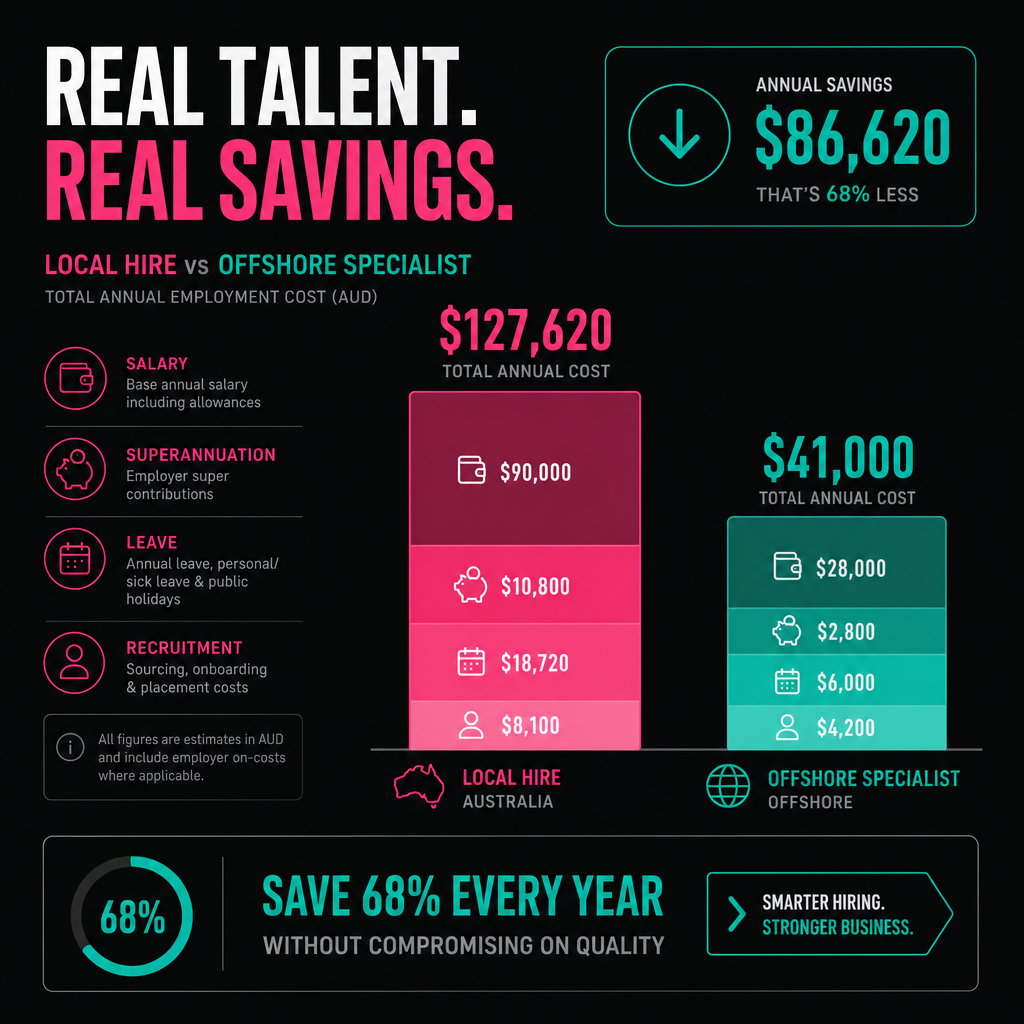
For a small business, cash flow is existential. A $70,000 base salary employee costs closer to $85,000 AUD all-in when you add superannuation at 11.5%, account for annual leave accrual (four weeks under the National Employment Standards), and factor in recruitment fees typically ranging from 10-15% of first-year salary. That is before workers compensation insurance, any tools or equipment, and the real cost most owners forget: the time spent managing underperformance or replacing a hire that does not work out.
An equivalent offshore specialist, say a full-time bookkeeping support role or a customer service operator in the Philippines, runs at roughly $18,000-$28,000 AUD per year through a managed offshore provider. The employer of record structure means no PAYG withholding obligations on your end, no super guarantee exposure, and no payroll tax threshold creep. For an SME running on margins of 10-20%, that difference in fixed cost is the difference between hiring and not hiring at all.
No Fixed PAYG and Super Overhead
Under the Australian Tax Office's rules, the superannuation guarantee applies to employees and, in some cases, contractors who are substantially dependent on a single payer. When you engage an offshore specialist through a compliant employer of record arrangement, those obligations sit with the offshore employer, not with you. This is not a loophole. It is the structure the model is built on, and it is why the net cost comparison between local and offshore is so stark.
For an SME owner who is currently the employer, payroll manager, and operator all in one, removing the obligation to administer PAYG, super, and leave for additional headcount is a material reduction in complexity.
Flexible Scaling Without Fixed Commitment
One of the genuine advantages of offshore staffing for small businesses is the ability to scale up and down with less friction than local employment law allows. If your business has seasonal demand, project-based workloads, or is growing into a new service line and not yet sure of the long-term volume, committing to a local permanent hire carries significant risk.
Offshore staffing through a managed provider gives you more flexibility. You can start with one specialist, validate the model, and add a second role once you have the workflow structure in place. Most SME clients at Remotee start with a single hire, get the operating system right, and are at two or three specialists within 12 months, with each new role coming online faster because the SOP framework is already built.
The First Roles SMEs Should Offshore
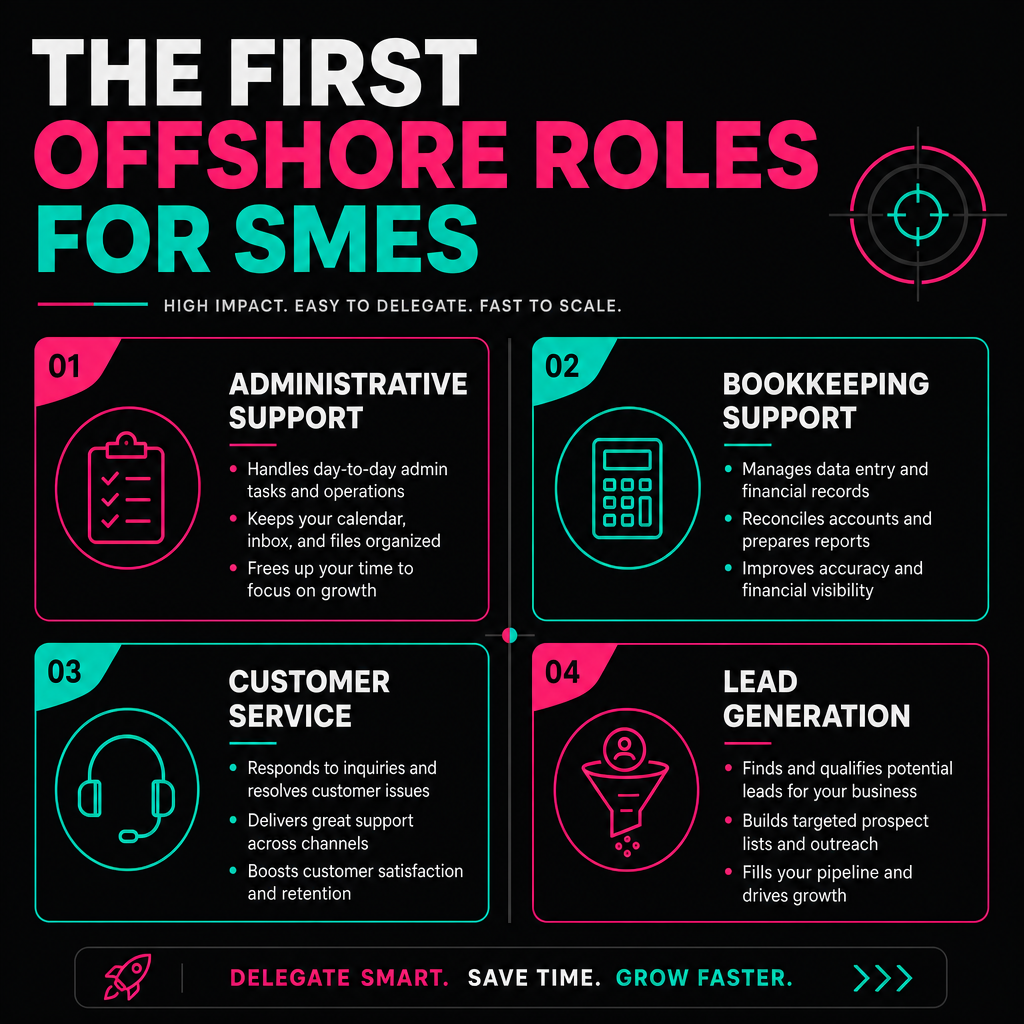
Not every role is suitable for offshoring from day one. The best starting point is roles that are high-volume, process-driven, and currently eating the owner's time without requiring their unique expertise or local physical presence.
Administrative Support
Calendar management, inbox triage, document preparation, data entry, travel booking, supplier communication. These are tasks that require reliability and attention to detail, not local market knowledge. They are also the tasks most SME owners are still doing themselves at 7pm on a Tuesday.
A skilled offshore admin specialist in the Philippines will typically have a diploma or degree-level education, strong written English, and experience with the tools your business already uses: Google Workspace, Microsoft 365, project management platforms like Asana or Monday.com. The critical factor is not the hire. It is whether you have documented what you need done and what done looks like. Without that, even an excellent admin hire will underdeliver, because they are guessing at your priorities.
This is exactly what I saw with a digital marketing agency I worked with. The founder was the approval bottleneck for routine work. Tasks lived across inbox, chat, and memory. Rework was constant because expectations were unclear. We installed a delegation map, an approval ownership structure, and an SOP pack with exception handling and a weekly quality checkpoint. The result: faster handoffs, reduced rework, and predictable weekly outcomes tracked by scorecard. The offshore admin hire did not change. The delivery structure did.
Bookkeeping Support
For SMEs using Xero or MYOB, an offshore bookkeeping support specialist can handle bank reconciliations, accounts payable and receivable processing, payroll data preparation, and BAS preparation support. Note the word "support": the specialist handles the prep and data work; a registered BAS agent or your accountant retains sign-off on anything lodged with the ATO.
This is the model I recommend for accounting firm clients too. In constrained accounting practices, partner time is genuinely scarce. Roughly 60% of that partner time is spent on tasks that could be handled by a capable specialist at a fraction of the cost. The fix is not hiring another accountant. It is installing the right support structure around existing capacity. Offshore bookkeeping support typically comes online within 21 days at Remotee, and the specialists we place retain at 12 months at a 95%+ rate.
Customer Service and Client Communication
For businesses with a high volume of inbound enquiries, ticket management, appointment booking, or routine client communication, an offshore customer service specialist is one of the most cost-effective hires available. Philippine-based specialists are widely regarded for their communication skills and service orientation, and the talent pool for English-language customer service roles is deep.
The key is building the escalation framework before the specialist starts. What can they handle autonomously? What requires a local decision? What is the response time standard? These are not complicated questions, but they need documented answers. Without them, you will find yourself back in the inbox managing the specialist rather than being freed from it.
I worked with a gym and fitness business that had inconsistent lead follow-up, incomplete CRM data, and late reporting. We installed a role scorecard for weekly pipeline outcomes, handoff templates and approval gates, and an SOP-led process for CRM hygiene and follow-ups. Follow-up consistency improved markedly, pipeline visibility improved for the sales leaders, and admin overhead dropped. The offshore specialist was capable from the start. The system made that capability visible and reliable.
Lead Generation and CRM Management
Lead generation support, including LinkedIn outreach, prospect list building, CRM data hygiene, and follow-up sequencing, is a strong fit for offshore staffing. These are repetitive, structured tasks with clear success metrics: number of qualified leads contacted, CRM records updated, follow-up tasks completed on time.
For small businesses that know they need a more consistent pipeline but cannot justify a full-time local BDM, an offshore lead gen specialist can handle the top-of-funnel work while the owner or a local relationship manager handles the close. This is a legitimate division of labour, and it works well when the CRM workflow and outreach templates are documented and owned.
The Realistic Cost Picture for Australian SMEs
Let me be direct about what offshore staffing actually costs in 2026, because the range is wide and the variables matter.
For a full-time offshore specialist in the Philippines, you are typically looking at:
- Entry-level admin or data support: $1,200-$1,600 AUD per month
- Experienced admin, customer service, or lead gen specialist: $1,600-$2,200 AUD per month
- Bookkeeping support or specialist-level roles: $2,000-$2,800 AUD per month
- Senior or technical specialists (finance, compliance, digital marketing): $2,800-$3,800 AUD per month
These figures are all-in from the client's perspective through a managed provider like Remotee, meaning the employer of record costs, management fees, and HR administration are included. You are not separately managing employment contracts, local HR compliance in the Philippines, or payroll.
You can view Remotee's current pricing structure to benchmark against your specific role requirements.
For context, the Fair Work Commission's 2026 national minimum wage of $24.10 per hour translates to roughly $48,200 AUD per year for a 38-hour week, before superannuation ($5,543), leave liabilities, and any recruitment costs. The total cost of a minimum-wage local hire is comfortably above $55,000 AUD per year. An equivalent offshore specialist sits at $19,200-$26,400 AUD per year all-in. The gap is real and it compounds as you add roles.
One important caveat: do not try to offshore your way out of a structural problem. If your business cannot describe what a role is supposed to produce each week, adding a cheap offshore hire will not fix that. It will just make the confusion cheaper and more visible.
Managing a Small Offshore Team Without an HR Department
Most SME owners hear "offshore team" and immediately wonder how they are supposed to manage people in a different timezone without a dedicated HR or operations function. The honest answer is: it is simpler than you think, but only if you set it up correctly from the start.
The Role Scorecard
Every offshore role needs a role scorecard before the specialist starts. This is a one-page document that defines: the purpose of the role, the five to seven key outputs expected each week or month, the tools the specialist uses, who they report to, and what escalation looks like. It is not a job description. It is a performance contract written in plain language.
The scorecard does three things. It tells the specialist exactly what success looks like. It gives you a framework for your weekly check-in. And it removes the ambiguity that causes most offshore relationships to break down, where the owner expects one thing, the specialist delivers another, and neither party can point to an agreed standard.
Weekly Cadence, Not Constant Oversight
One of the most common mistakes SME owners make when they first hire offshore is over-managing. Daily check-ins, constant messages, requests for updates. This is exhausting for both parties and a sign that the SOP coverage is insufficient, not that the specialist needs more supervision.
The goal is a weekly rhythm: a scorecard review, a brief async or video check-in, a look at the previous week's output against the agreed metrics, and a clear set of priorities for the coming week. If your weekly check-in is consistently under 30 minutes, your system is working. If it runs over an hour, you have a documentation or expectation gap to address.
At Remotee, this cadence is built into the engagement from day one through Phase 4 of the Remotee Method, which we call Strategic Mentorship. An Australian account manager works with you to transition from being the person who does everything to the person who directs and reviews. That shift, from Doer to Strategist, is what makes offshore staffing genuinely valuable rather than just slightly cheaper labour.
SOP Coverage for Every Repeatable Task
If a task is done more than once, it needs a Standard Operating Procedure. This sounds bureaucratic until you realise that an SOP is just a clear, step-by-step description of how to do something, including what to do when things go wrong. A two-page SOP for how to process an accounts payable invoice in Xero is not overhead. It is insurance.
The SOPs do not need to be lengthy. They need to cover: the trigger (what starts the task), the steps (in order), the tools used, the quality check (what does done look like), and the escalation path (who to notify if the exception does not fit a known case). At Remotee, we deliver an industry-specific SOP library with every specialist placement, with compliance steps baked in from the start rather than bolted on later.
Timezone and Communication Norms
The Philippines is in the same timezone band as the eastern states of Australia (Philippine Standard Time is UTC+8, compared to AEST at UTC+10). The overlap is genuinely workable. Most Remotee clients opt for a core overlap window of 9am-5pm AEST, with specialists starting slightly earlier in Manila to align. This is not a significant operational challenge for the roles most SMEs are offshoring.
For tools, the standard stack of Slack or Microsoft Teams, Loom for async video updates, and your existing project management platform is sufficient. No specialist software required.
Compliance and IP Caveats for Small Operators
This is the section most content on offshore staffing glosses over. I am not going to do that, because getting this wrong creates real risk for your business.
Data Privacy and the Privacy Act
Australian businesses are subject to the Privacy Act 1988, which governs how personal information is collected, stored, and disclosed. If your offshore specialist handles customer data, employee data, or financial records, you have obligations under the Australian Privacy Principles regardless of where the work is done. The OAIC (Office of the Australian Information Commissioner) is clear that sending personal information overseas does not remove your obligations as the Australian entity.
Practically, this means: data handling must be covered in your offshore engagement contract, access to sensitive systems should be role-scoped (minimum necessary access), and you should have a clear data breach response protocol that includes your offshore team.
For most SME roles (admin, customer service, bookkeeping support), this is not a blocker. It is a documentation and contract task, not a structural impediment.
Intellectual Property
Any work product created by your offshore specialist should be explicitly assigned to your business in the services agreement. This is standard in a well-drafted offshore staffing contract. If your provider does not include IP assignment clauses as a matter of course, that is a gap worth addressing before work begins.
For SMEs in creative or technology-adjacent industries, where output includes written content, code, or design assets, this is particularly important. Confirm with your provider that the contract explicitly addresses work-for-hire and IP ownership in a way consistent with Australian commercial practice.
ATO and Fair Work Considerations
Offshore specialists engaged through a compliant employer of record arrangement are employed by the offshore entity, not by your Australian business. This means no PAYG withholding, no super guarantee obligation, and no Fair Work Act coverage for those individuals. Your Australian employment law obligations apply to your local employees only.
If you are engaging offshore specialists as direct contractors rather than through a managed EOR model, take advice from an employment lawyer or your accountant before proceeding. The ATO's sham contracting provisions and the ACCC's guidelines on independent contractor arrangements are relevant here, particularly if the arrangement has the hallmarks of an employment relationship.
You can explore Remotee's staffing solutions for more detail on how the engagement model is structured.
Two Real Case Studies from the Remotee Client Base
Case Study 1: Mortgage Broking Business, Queensland
A Queensland-based mortgage broking business came to us with a consistent client communication problem. Updates were being missed. Client requests were not captured reliably. The team felt reactive, and the principal was spending a significant part of each week chasing status updates internally rather than dealing with clients and lenders.
We placed a full-time offshore client services specialist and wrapped the role in an intake template system, prioritisation rules, a communication cadence for updates and follow-ups, and outbound comms quality checkpoints. Within 90 days, client updates were consistent, missed requests dropped sharply, and the delivery rhythm shifted from reactive to structured.
The outcome that mattered most to the principal: time-to-settle reduced by 30%. Not because the specialist was faster at lender processing (that is outside anyone's control), but because the internal workflow was no longer the bottleneck. Every step from client request to lender submission was documented, owned, and tracked.
The all-in cost of the offshore specialist was $2,200 AUD per month. A local equivalent, even a junior administrator, would have cost more than double that before super and leave.
Case Study 2: Accounting Firm, New South Wales
A Sydney-based accounting firm with three partners was losing partner time to prep work. Reconciliations, workpaper preparation, ATO correspondence drafting. Tasks that required accuracy and attention to detail but not partner-level judgement. The firm was also inconsistent on approvals: some prep work went straight to partners for review, some got caught in a queue, and the audit trail for decisions was thin.
We placed two offshore accounting support specialists and installed a control model by workflow risk. Prep work was delegated to the specialists. Approvals for anything lodged with the ATO stayed with the partners. Evidence capture at checkpoints created an audit-ready trail for every file. The SOP library covered every repeatable task, with compliance steps baked in.
The outcome: internal partner time recovered by approximately 40% on non-billable prep work, which falls squarely in the 35-50% range we see consistently across our accounting client base. The audit trail improved. The specialists were operational within 21 days of placement. Both retained at 12 months.
For more detail on client outcomes like these, see the Remotee case studies page.
Client Testimonial
"Before Remotee, I was the person doing everything and approving everything. Now I have a specialist who owns the prep work, a clear process for what goes to me and what does not, and a weekly review that keeps it all on track. The cost saving was meaningful, but the real value is getting my time back on things that actually grow the business."
Principal, Accounting Firm, New South Wales (Remotee client)
Signs Your SME Is Ready for Offshore Staffing
Not every SME should offshore immediately. Here is how to know whether your business is genuinely ready.
You have repeatable work. If you can describe a task clearly enough to train someone on it, it can be offshored. If every task requires significant contextual judgement or relationship history that lives only in your head, you have an SOP gap to close first.
You can describe what done looks like. This is the single most important readiness indicator. If I asked you right now what a good week's output from a bookkeeping support role looks like, could you give me a specific answer? If not, start there.
The owner is doing executor work more than 30% of the time. If more than a third of your week is spent on tasks that someone else could execute given the right documentation, you are the bottleneck in your own business. That is a solvable problem.
You have basic technology infrastructure. Cloud-based accounting software, email, a communication tool, a shared file system. You do not need anything exotic. But the work needs to live somewhere accessible and structured.
You are growing but cannot justify a full local hire yet. This is the sweet spot for offshore staffing. Revenue is growing, demand exists, but the risk of a $80,000 AUD all-in local hire feels premature. An offshore specialist at $24,000-$30,000 AUD all-in lets you add real capacity without betting the business on it.
If you are uncertain, walk through how the Remotee process works before making any commitments. The right provider will tell you honestly if you are not yet ready, rather than placing a hire into a structure that will not support it.
How the Remotee Method Works for SMEs
For SMEs that want more than a resume and a seat licence, the Remotee Method is built specifically for businesses with repeatable operations who want a long-term capability layer, not a one-off fix.
Phase 1: Discovery and Mapping. We audit your existing workflows and map your software ecosystem to produce an operational blueprint. This is where most SME owners discover that their biggest problem is not a talent shortage. It is a delivery structure problem.
Phase 2: The Specialist Match. We headhunt from the top 1% of Philippine talent, with rigorous technical testing against Australian industry standards. We are not recruiting from a generic job board. The talent pool we draw from is deep, experienced with Australian business practice, and tested before they ever meet you.
Phase 3: Operational Integration. The specialist arrives with an industry-specific SOP library, not a blank slate. Compliance is baked in from the start. The first two weeks are structured around early deliverables reviewed against checkpoints, so you know within the first fortnight whether the setup is working.
Phase 4: Strategic Mentorship. An Australian account manager works with you on an ongoing basis. Not just to manage the relationship, but to actively move you from Doer to Strategist. As the SOP library grows and the specialist becomes more autonomous, your role shifts to reviewing outcomes and setting direction rather than executing tasks.
This is what "predictable delivery, not just headcount" means in practice. The difference between an offshore hire that works and one that does not is almost always the delivery structure, not the quality of the individual.
The SME Competitive Advantage in 2026
Australian SMEs that adopt offshore staffing well in 2026 are not just saving money. They are building an operational advantage. Local talent is expensive, increasingly scarce in specialist roles, and protected by employment conditions that create real fixed-cost risk for small operators. Offshore staffing through a managed provider removes those constraints without removing quality.
The businesses I see getting the most value from this model share a common characteristic: they treat their offshore specialist as part of the team, not as a vendor. The SOP library is maintained and updated. The weekly cadence is respected. The scorecard is reviewed and evolved as the role matures. That is systems over heroics in practice.
For every SME owner who is currently the person doing the bookkeeping, managing the inbox, chasing leads, and handling client communication while also trying to grow the business: the capacity exists to change that without taking on the overhead of a local hire. The question is whether you are willing to invest the upfront time to document the work before you delegate it.
If you are ready to find out what your business looks like with a capable specialist and the right delivery structure around them, contact the Remotee team here and we will walk through your situation honestly.
References
-
Australian Bureau of Statistics, Australian Industry 2025-2026, ABS data on the proportion of SMEs as a share of Australian businesses and their contribution to private sector employment. The ABS defines SMEs as businesses with fewer than 200 employees.
-
Fair Work Commission, National Minimum Wage Order 2026, The Fair Work Commission sets the national minimum wage annually. The 2026 rate referenced in this article ($24.10 per hour) reflects the Commission's determination effective July 2026. Fair Work also governs the National Employment Standards, including annual leave entitlements.
-
Australian Taxation Office, Super Guarantee Rate Schedule, The ATO publishes the superannuation guarantee rate schedule, which increased to 11.5% in 2026 as part of the legislated progression to 12% by 2025. Employers must contribute this rate on top of ordinary time earnings for eligible employees.
-
Office of the Australian Information Commissioner, Australian Privacy Principles Guidelines, The OAIC publishes guidance on the application of the Privacy Act 1988, including obligations when personal information is sent or accessed overseas. Relevant for any Australian business engaging offshore staff who handle customer or employee data.
-
Xero, State of Small Business Report (Australia, 2026), Xero's annual research on Australian SME financial health, cash flow pressure, and operational challenges. Provides relevant context on wage cost pressure and the proportion of SME owners spending time on administrative tasks.
-
Australian Competition and Consumer Commission, Independent Contractors Guide, The ACCC and ATO both publish guidance relevant to distinguishing genuine contractor arrangements from employment relationships, which is relevant for SMEs considering direct offshore contractor engagements rather than managed EOR models.
FREQUENTLY ASKED QUESTIONS
Common questions
How much does offshore staffing cost for a small Australian business?
- For a full-time offshore specialist in the Philippines through a managed provider, expect to pay between $1,200 and $3,800 AUD per month depending on the role and seniority level. Admin and customer service roles typically sit at $1,400-$2,200 per month. Bookkeeping support and specialist roles range from $2,000-$2,800 per month. These figures are all-in through a managed provider, covering the employer of record structure, HR administration, and management support. Compare this to a local minimum-wage hire at over $55,000 AUD per year all-in before leave liabilities.
What is the minimum team size to make offshore staffing worthwhile for an SME?
- One. You do not need multiple hires to justify the model. The majority of SMEs at Remotee start with a single offshore specialist, validate the delivery structure, and scale from there. The economics work at a team of one if the role is well-defined and the workflow is documented.
How long does it take to get an offshore specialist up and running?
- With the Remotee Method, placement-to-operational typically takes 21 days. This includes the Discovery and Mapping phase, the specialist match, and the SOP library delivery. Some roles, particularly admin and customer service, can be onboarded faster. Senior or specialist roles may take slightly longer.
What are the compliance risks for Australian SMEs using offshore staff?
- The main compliance areas to address are: data privacy obligations under the Privacy Act 1988 and Australian Privacy Principles, IP assignment in the services agreement, and ATO sham contracting rules if you are engaging directly rather than through an employer of record. A well-structured managed provider arrangement addresses all three through the contract and operating framework.
Which roles are most suitable for a small business to offshore first?
- The best starting roles for SMEs are high-volume, process-driven, and currently consuming the owner's time without requiring their unique expertise. In order of readiness for most SMEs: administrative support, bookkeeping support, customer service and client communication, and lead generation and CRM management.
Do I need an HR department to manage an offshore team?
- No. Managing a small offshore team requires a role scorecard, a weekly review cadence, and SOP coverage for every repeatable task. With a managed provider, the employer of record structure handles payroll, local HR compliance, and employment administration in the Philippines. Most SME owners find this takes three to five hours per week once the system is established.
Can an offshore specialist handle Australian-specific tasks like Xero, MYOB, or BAS support?
- Yes. Philippine-based specialists with experience in Australian accounting software are widely available. Xero and MYOB are both common in the Philippines due to the volume of Australian clients served by the offshore sector. For BAS preparation support, the specialist handles prep and data work; lodgement sign-off must remain with a registered BAS agent or your accountant.
How do I know if my SME is ready to start with offshore staffing?
- You are ready if: you have repeatable work you can describe clearly, you can specify what a good week's output looks like for the role, and the owner is spending more than 30% of their time on tasks someone else could execute with the right documentation. If you cannot yet describe the role clearly, start by documenting your current workflows before placing a hire.

Jon Kelly
Founder, Remotee
Jon helps Australian businesses build compliance-led offshore teams that scale without the burnout. NDIS, accounting, mortgage broking, recruitment and digital marketing.
KEEP READING
Related posts
offshore staffing statistics australia
Offshore Staffing Statistics for Australia: 2026 Report
- The Australian business process outsourcing (BPO) market is projected to exceed $7.9 billion AUD in 2026, up from approximately $5.4 billion in 2022. - Austra…
9 June 2026 · 22 min read
transparent provider pricing comparison
Offshore Staffing Pricing Transparency: How to Compare Provider Quotes Without Getting Caught Out
Transparent provider pricing comparison means evaluating offshore staffing quotes against total cost of engagement, not headline hourly rate. A genuine quote it…
13 September 2026 · 17 min read
managed staffing versus freelancer platforms
Managed Offshore Staffing vs Freelancer Platforms: Which Model Actually Delivers for Australian Businesses?
Managed offshore staffing suits ongoing, business-critical work because it wraps talent in documented workflows, compliance and a replacement guarantee. Freelan…
12 September 2026 · 15 min read
READY TO SCALE WITHOUT THE BURNOUT?
Build a compliance-led offshore team in 3–4 weeks.
Tell us about your current bottleneck and we'll show you what a Remotee placement would look like for your operation.
Or get our playbooks emailed to you instead.