
Offshore Staffing for Accounting Firms in Australia: How to Scale Capacity Without Sacrificing Quality in 2026
- offshore staffing
- accounting firms
- bookkeeping outsourcing
- remote accounting team
- offshore accountant Australia
Australian accounting firms are running out of road. CPA Australia's workforce data consistently flags persistent shortages of qualified accountants across the country, and the ABS labour market figures confirm the broader picture: professional services vacancies remain elevated while the pipeline of new entrants has not kept pace with demand. The result is a familiar pattern inside most small to mid-sized practices. Partners are spending 40-60% of their time on work that should sit three levels below them. Deadlines are getting tighter. Margins are eroding. And the answer most firms reach for, another local hire, costs $75,000-$95,000 AUD per year before superannuation, leave, and recruitment fees.
Here is the reality that the leading practices in 2026 have already acted on: offshore staffing for accounting firms is not a cost-cutting gimmick. When it is set up correctly, it is a capacity strategy that frees your senior team to do the work only they can do. Client advisory. Complex tax. Business development. Relationship management. The prep work, reconciliations, data entry, BAS lodgements, and payroll processing that consume your team's best hours? Those can be handled offshore, at a fraction of the cost, without sacrificing quality, provided you build the right system around the hire.
This guide covers exactly how the top Australian accounting firms are doing it in 2026. Which roles to offshore, which to keep onshore, what it actually costs, how to stay compliant with ATO obligations, and how to structure a delivery system that produces consistent, reviewable output. No fluff. Just the operational playbook.
Key Takeaways
- Roles suited for offshoring include bookkeeping, BAS preparation, payroll processing, data entry, reconciliations, and management reporting preparation.
- Client advisory, complex tax strategy, and ATO dispute management should remain onshore with your qualified senior staff.
- Realistic cost savings from offshore accounting staff sit at 60-70% per role compared to an equivalent local hire.
- Quality and compliance depend on documented SOPs, checkpoint reviews, and a clear supervision structure, not on the geography of the hire.
- The fastest-performing firms pair offshore talent with a delivery operating system, not just a job description.
- Remotee's accounting specialists are operational within 21 days and carry a 95%+ retention rate at 12 months.
Summary Table: Onshore vs Offshore Role Suitability Matrix
| Role | Offshore Suitable? | Complexity Level | Estimated Offshore Cost (AUD/yr) | Estimated Onshore Cost (AUD/yr) | Saving |
|---|---|---|---|---|---|
| Bookkeeping and reconciliations | Yes | Low | $18,000-$25,000 | $60,000-$70,000 | ~65% |
| BAS preparation | Yes | Medium | $22,000-$30,000 | $65,000-$80,000 | ~62% |
| Payroll processing | Yes | Medium | $22,000-$30,000 | $65,000-$75,000 | ~60% |
| Management reporting prep | Yes | Medium | $25,000-$35,000 | $70,000-$85,000 | ~60% |
| Data entry and file management | Yes | Low | $15,000-$20,000 | $50,000-$60,000 | ~67% |
| Tax return preparation (individual) | Partial | Medium-High | $28,000-$38,000 | $75,000-$90,000 | ~58% |
| Complex tax strategy and structuring | No | High | N/A | $100,000-$150,000+ | N/A |
| Client advisory and CFO services | No | High | N/A | $120,000-$180,000+ | N/A |
| ATO audit and dispute management | No | High | N/A | $100,000-$160,000+ | N/A |
Why Australian Accounting Firms Are Turning to Offshore Staff in 2026
The staffing problem inside Australian accounting practices is not new, but the urgency has sharpened. CPA Australia's 2024 Member Employment and Remuneration Survey flagged that demand for qualified accountants continues to outpace supply in every state. The ABS reports that the broader professional services sector has maintained vacancy rates well above pre-2020 levels, and salary expectations have risen accordingly. A graduate hire in 2026 in Sydney or Melbourne commands $65,000-$75,000 before super. An experienced bookkeeper with three or more years of practice experience is closer to $70,000-$80,000. A qualified CPA with five years under the belt is rarely available for under $95,000 in a capital city market.
At those cost levels, most small and mid-sized accounting firms face a genuine constraint. They cannot afford the headcount to handle peak lodgement periods without either burning out the existing team or turning away work. Neither option is sustainable.
The second driver is the shift in what clients actually expect. Business owners in 2026 want proactive advice, not reactive compliance. They want their accountant to flag a tax planning opportunity before EOFY, not call them in April. But partners and senior managers cannot deliver proactive advisory when they are buried in reconciliations and BAS prep. That is the real cost of under-resourcing: not just the dollar figure on a salary, but the advisory capacity that never gets deployed because the team is stuck on high effort, low impact work.
Offshore staffing for accounting firms addresses both constraints simultaneously. The right offshore hire, paired with the right system, handles the volume compliance work accurately and on time. The local team gets capacity back. And the practice can grow its advisory revenue without adding proportional cost to its payroll.
This is not a future trend. Across Remotee's accounting firm client base in 2026, we are seeing partners reclaim 35-50% of their non-billable time within the first quarter of integrating an offshore specialist. That is the difference between a firm that is reactive and one that is growing.
Which Accounting Roles Can Be Safely Offshored
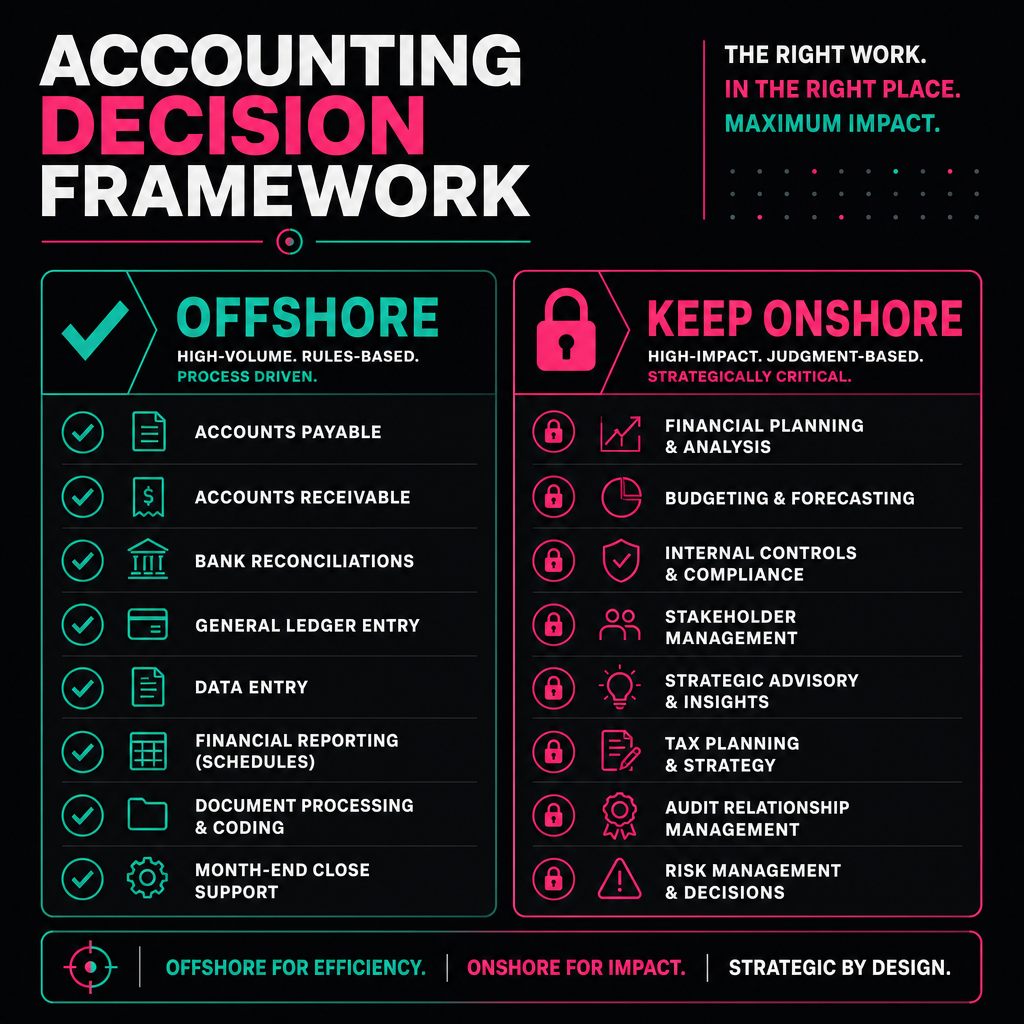
The single most common mistake I see when accounting firms consider offshoring is treating it as binary. Either everything goes offshore or nothing does. The reality is that a well-structured offshore model is selective. You offshore the roles where the work is repeatable, documentable, and reviewable. You keep onshore the roles where judgement, relationship, and regulatory accountability are non-negotiable.
Roles that offshore well:
Bookkeeping and bank reconciliations. This is the clearest fit. The work follows a defined process, the software (Xero, MYOB, QuickBooks) is cloud-based and accessible globally, and the outputs are verifiable against source documents. An offshore bookkeeper in the Philippines working inside your practice management system produces work that your senior accountant reviews and approves. The geography of where the reconciliation was run is irrelevant to the quality of the output.
BAS preparation. Preparing a Business Activity Statement is a structured, process-driven task. The rules are codified in ATO guidance. An offshore accountant with Australian tax training can prepare BAS returns accurately, flag anomalies for senior review, and ensure the lodgement-ready file is complete before it reaches your onshore reviewer. Critically, the lodgement itself and the final sign-off remain with your registered tax agent in Australia. The offshore team handles the preparation; the Australian team handles the authorisation.
Payroll processing. Cloud payroll software (Employment Hero, KeyPay, Xero Payroll) has made payroll processing genuinely location-independent. Your offshore payroll specialist processes pay runs, manages leave balances, handles STP reporting preparation, and flags anomalies. Approval and submission remain with the onshore team. The ATO's guidance on Single Touch Payroll does not restrict where the processing work happens, only who is responsible for the lodgement.
Data entry and file management. Scanning, coding, filing, document management, client onboarding data entry. These tasks consume hours of time that could be spent on advisory. Offshore specialists handle them faster, at a fraction of the cost, and to a documented standard.
Management reporting preparation. Compiling monthly reports, building dashboards in Xero or MYOB, preparing the data that your accountants turn into insights. The interpretation stays onshore. The preparation goes offshore.
Roles to keep onshore:
Client advisory, complex tax structuring, ATO audit and dispute management, business valuation, estate planning, and any communication with clients that involves professional judgement. These roles require your registered professionals, your client relationships, and your professional indemnity insurance to be front and centre. They should not be offshored.
For a full breakdown of which accounting roles Remotee can place specialists into, visit Remotee's accounting staffing solutions page.
The Real Cost of an Offshore Accountant vs a Local Hire
Let me put numbers on this directly. A mid-level bookkeeper with three to five years of experience hired locally in a capital city in 2026 will cost your firm approximately $70,000-$80,000 in base salary, plus 11.5% superannuation, plus leave loading, plus workers' compensation, plus recruitment fees (typically 10-15% of first-year salary if using an agency). All-in cost: $95,000-$115,000 per year, per person.
The equivalent offshore bookkeeper, sourced through Remotee from the Philippines, costs $18,000-$25,000 AUD per year in remuneration, with total engagement fees that bring the all-in cost to roughly $28,000-$38,000 per year. That is a saving of 60-70% per role, which aligns with what we consistently see across our accounting firm placements.
For a firm currently running three bookkeeping and compliance staff locally, shifting those roles offshore represents a saving of $170,000-$230,000 AUD per year, while maintaining or improving throughput. That is not a marginal efficiency gain. That is a structural change to your cost base.
But here is the part most providers do not tell you: the saving is only real if the offshore hire produces consistent, accurate output. A cheap offshore hire who produces work that requires significant rework, or who leaves after six months, does not deliver a 60% saving. They deliver a headache. This is why Remotee's model pairs the specialist with a delivery system from day one, so that the cost saving is durable, not just an initial headline.
For transparent pricing on Remotee's accounting firm packages, see the Remotee pricing page.
How to Maintain Quality and Compliance with Offshore Accounting Staff
This is the section most offshoring articles skip. They talk about cost savings and talent quality, then leave you to figure out the compliance and quality framework yourself. That gap is exactly where most offshore arrangements fall apart.
Let me be direct about what the ATO actually says. The ATO's guidance on outsourcing and offshoring makes clear that a registered tax agent retains responsibility for all tax services delivered to clients, regardless of who performs the underlying work. This means your Australian registered tax agent must supervise, review, and authorise all lodgements. The offshore team can prepare, compile, and flag, but the accountable person is always onshore and registered.
Data security and privacy obligations. Under the Privacy Act 1988, if your firm sends client financial data offshore, you are responsible for ensuring that data is handled in accordance with Australian Privacy Principles. This requires a written data processing agreement with your offshore provider, documented data handling protocols, and evidence that the offshore team operates within a secure, compliant environment. Remotee's specialists work within client-controlled cloud environments (Xero, MYOB, etc.) rather than downloading data to local devices, and all engagements are structured with data handling agreements in place.
Supervision frameworks. The ATO's Tax Practitioners Board (TPB) requires that offshore work performed as part of a registered agent's services is properly supervised. In practical terms, this means defining who reviews what, at what stage, with what sign-off authority. A clear supervision matrix is not optional. It is the compliance backbone of your offshore arrangement.
Software access and audit trails. Cloud-based accounting software creates a natural audit trail. Every entry, every reconciliation, every change is logged against a user. This is actually better for compliance than a local arrangement where someone might make a manual adjustment without a system record. Configure your software so offshore users have role-appropriate permissions, and your senior reviewers have full visibility of every action taken.
For firms wanting a structured starting point, Remotee offers a capacity assessment that maps your current workflow risk levels before we recommend a delegation structure.
Setting Up SOPs and Review Workflows
The number one reason offshore arrangements fail is not the quality of the offshore hire. It is the absence of documented workflows on the Australian side.
I have seen this directly. Working with an accounting firm where sensitive process steps were blocking delegation, I found that prep work was consuming internal senior team time not because the work was complex, but because no one had ever written down exactly how it should be done. There was no SOP. There was no defined checkpoint. There was no documented exception handling. Every task relied on someone's memory and institutional knowledge. That is not a talent problem. That is a delivery structure problem.
The intervention was straightforward: install a control model that categorised workflow tasks by risk level, delegate preparation tasks with documented SOPs and exception handling rules, and introduce evidence capture at defined checkpoints so the review process had something concrete to review. The outcome was that the internal team reclaimed significant time on prep work, sensitive approvals stayed with the onshore accountants, and there was a cleaner audit trail for every decision made.
The Remotee Operating System formalises this approach across every engagement. It covers four elements:
-
Define outcomes and done. Before any offshore task begins, document what a completed, correct output looks like. Not a vague instruction, but a scannable checklist that tells the specialist exactly what success looks like for each task type.
-
Document the workflow. SOPs with step-by-step instructions, tool rules (which fields to populate, which codes to use, which exceptions to flag), and escalation triggers for anything outside the standard scope. Work does not live in someone's inbox or memory.
-
Train and validate early delivery. The first 30 days of any offshore arrangement are the most important. Early deliverables are reviewed against checkpoints, not just accepted or rejected. Feedback is specific and tied to the SOP so the specialist knows exactly what to adjust.
-
Install cadence and accountability. A weekly review rhythm where the offshore team's output is assessed against the defined scorecard. Issues are logged and become versioned SOP improvements, not repeated conversations.
When this system is in place, quality is designed into the workflow. It is not dependent on who happens to be paying attention that week. That is what we mean by compliance baked in, not bolted on.
Learn more about how this works in practice on the Remotee process page.
Two Case Studies: Offshore Accounting Teams in Action
Case Study 1: Mid-Sized Melbourne Practice, 12 Partners
A Melbourne-based accounting firm with 12 partners and approximately 850 client files was approaching the end of financial year in a familiar state: the compliance team was at capacity, BAS lodgements were running behind, and two senior managers were spending 60% of their time on work that should have been handled by junior staff. The firm had tried hiring locally twice in the previous 18 months. Both hires left within 12 months.
Remoter placed two offshore accounting specialists: one focused on bookkeeping and BAS preparation, one on payroll processing and management reporting. Both were operational within 21 days of engagement. In the first quarter post-placement, the firm reported a 42% reduction in non-billable partner hours. BAS lodgement volumes processed on time lifted from 71% to 96%. The two offshore specialists have been in place for 14 months. Total annual saving versus equivalent local hires: approximately $118,000 AUD.
The critical factor was not the talent alone. It was the SOP library Remotee delivered alongside the placement, which documented every recurring task type and built review checkpoints into the workflow from week one.
Case Study 2: Regional Queensland Firm, 3 Partners
A three-partner firm in regional Queensland was unable to compete with capital city salary packages to attract local talent. The firm was turning away new clients because it had no capacity to onboard them. The founding partner was personally handling bookkeeping for 40+ clients because there was no one else to do it.
Remoter placed one offshore bookkeeper and one offshore accounts administration specialist. The bookkeeper took on 38 client files within the first 90 days. The administration specialist handled onboarding documentation, file management, and client communication preparation. The founding partner moved from spending 22 hours per week on bookkeeping to spending fewer than 4. The firm onboarded 14 new clients in the following 6 months. Revenue increased by 28% year on year. The offshore team cost approximately $52,000 AUD per year all-in, compared to a projected local cost of $155,000 for the equivalent two roles.
"I went from being the person doing everything to being the person reviewing and advising. That shift happened faster than I expected, and the quality of work coming through was better than I had with some of my local hires because the process was actually documented this time.", Founding Partner, Queensland accounting firm (name withheld)
Common Mistakes Accounting Firms Make When Offshoring
Not every offshore arrangement works. Here are the most common failure points I see, and how to avoid them.
Hiring offshore without documenting the work first. If you cannot write down how a task should be done, you cannot delegate it successfully, offshore or onshore. The SOP has to come before the hire, not after.
Choosing the cheapest option without assessing the delivery structure. A $12,000 AUD per year offshore bookkeeper sourced through a generic freelance platform with no SOP support, no account management, and no quality framework is not a 70% saving. It is a liability. The saving is only real if the output is consistent and the arrangement is sustainable.
Offshoring roles that require registered agent sign-off without maintaining the right supervision structure. BAS lodgements cannot be submitted by an unregistered person. Tax returns cannot be signed by someone who is not a registered tax agent. These rules apply regardless of where the prep work happens. Blur this line and you are exposed to TPB sanctions.
Treating the offshore specialist as a vendor, not a team member. The firms that get the best results integrate their offshore specialists into the team: regular video check-ins, access to the same tools as local staff, inclusion in team communication channels, clear escalation paths. Isolation produces inconsistency.
Skipping the capacity assessment. Adding offshore headcount without understanding which workflows are actually bottlenecking your team means you might solve the wrong problem. Remotee's capacity assessment maps your current state before we make any placement recommendation.
How Remotee Supports Accounting Firms Specifically
Remoter is not a general staffing platform. It is a specialist capability layer built for Australian businesses that need compliance-ready systems around their remote roles, not just access to a CV pool.
For accounting firms specifically, Remotee delivers through what we call The Remotee Method:
Phase 1: Discovery and Mapping. We audit your existing workflows and map your complete software ecosystem (Xero, MYOB, QuickBooks, Practice Ignition, Karbon, etc.) to build an operational blueprint. We identify which tasks are safe to delegate, which need a checkpoint structure, and which should stay onshore.
Phase 2: The Specialist Match. We headhunt from the top 1% of Philippine talent, with rigorous technical testing against Australian accounting standards. Every accounting specialist we place has demonstrated competency in Australian tax concepts, GST and BAS frameworks, and the specific software stack your firm uses.
Phase 3: Operational Integration. The specialist is delivered alongside a library of industry-specific SOPs with compliance baked in. Your firm does not start from scratch. The documentation, the checkpoints, and the exception-handling rules are part of the package.
Phase 4: Strategic Mentorship. An Australian account manager works with your firm on an ongoing basis to move you from Doer to Strategist. As volume grows and workflows evolve, the SOP library is versioned and updated. This is a long-term capability layer, not a one-off placement.
For accounting practices specifically, Remotee also offers a dedicated bookkeeping and finance solutions page that outlines the specific task categories covered and the compliance frameworks built into every engagement.
If you are ready to map your current capacity gaps and identify which roles make sense to offshore, the starting point is a conversation. Contact the Remotee team here.
References
-
CPA Australia Member Employment and Remuneration Survey (2024), Annual survey of CPA Australia members covering employment conditions, salary benchmarks, and workforce demand across the Australian accounting profession. Reports persistent shortages of qualified accountants in key practice areas and rising salary expectations across capital city markets.
-
Australian Bureau of Statistics (ABS), Labour Account Australia (2026), Quarterly ABS publication tracking job vacancies, employment levels, and workforce demand by industry sector. Professional services sector data confirms sustained above-average vacancy rates in accounting and financial services roles.
-
Tax Practitioners Board (TPB), Code of Professional Conduct and Outsourcing Guidance, The TPB's published guidance on the obligations of registered tax agents when outsourcing or offshoring tax-related work. Confirms that registered agents retain responsibility for all work lodged under their registration, including work prepared by offshore teams.
-
Office of the Australian Information Commissioner (OAIC), Australian Privacy Principles Guidelines, OAIC guidance on the obligations of Australian entities when personal information is disclosed to overseas recipients, including the requirements under Australian Privacy Principle 8 for cross-border data disclosure.
-
Philippine Regulatory Commission (PRC), CPA Licensure Examination Results, Published results of the Philippine CPA Board Examinations demonstrating the rigorous standard of the Filipino accounting qualification, including consistently low pass rates that attest to the quality of certified practitioners.
FREQUENTLY ASKED QUESTIONS
Common questions
Is offshoring accounting work legal under ATO rules?
- Yes, offshoring accounting work is legal. The ATO and the Tax Practitioners Board (TPB) allow offshore teams to perform preparation, data entry, reconciliations, and compliance work, provided the final lodgement and sign-off is performed by a registered tax agent in Australia. The registered agent retains full responsibility for the quality and accuracy of the work lodged. Your offshore team handles preparation; your Australian registered professional handles authorisation and submission.
What qualifications do offshore accountants from the Philippines hold?
- Filipino CPAs complete a four-year Bachelor of Science in Accountancy and must pass the Philippine CPA Board Examination, which consistently has a pass rate below 30%. For Australian practices, Remotee also tests offshore candidates on Australian-specific concepts including GST, BAS, STP, and the Australian income tax framework to ensure practical competency before placement.
How do you manage time zone differences between Australia and the Philippines?
- The Philippines is UTC+8, which means it is 2-3 hours behind Sydney and Melbourne (AEDT) and 0-1 hours behind Perth (AWST). Most accounting firms structure their offshore team's hours so the overlap covers the core review and communication window. For asynchronous tasks like reconciliations and data processing, time zone overlap matters less than a clear handoff process.
Which accounting software do offshore specialists work with?
- Remotee's accounting specialists are tested and experienced across all major Australian accounting platforms including Xero, MYOB, QuickBooks Online, Reckon, Practice Ignition, Karbon, and HandiSoft. Because these platforms are cloud-based, access is straightforward and your platform's audit trail captures every action the offshore specialist takes.
How does data security work when offshore staff access client financial data?
- Data security is governed by the Privacy Act 1988 and the Australian Privacy Principles. Remotee engagements include a data processing agreement documenting how client data is handled. Offshore specialists work within your cloud-based accounting software so data stays within your controlled platform environment. Role-based access controls limit access to relevant client files only, and all access is logged within the platform's audit trail.
Is there a trial period before committing to a long-term offshore arrangement?
- Remotee structures engagements to include an initial onboarding and validation phase, typically the first 30 days, during which early deliverables are reviewed against defined checkpoints. This structured integration period gives both parties clear visibility of performance before the longer-term arrangement is confirmed. Remotee's 95%+ specialist retention rate at 12 months reflects the quality of this process.
How long does it take to have an offshore accounting specialist operational?
- Remotee's placement-to-operational timeline for accounting specialists is 21 days. This covers the discovery and mapping phase, candidate headhunting and technical assessment, onboarding, and delivery of the initial SOP library. Within three weeks of engagement, your offshore specialist is working within your systems on live tasks with the review and checkpoint structure already in place.
What happens if the offshore specialist leaves?
- Because the SOP library, workflow documentation, and checkpoint structure all live with your firm rather than with the individual specialist, a change in personnel does not mean starting from scratch. A replacement specialist can be onboarded faster and to the same standard using the documented system. Remotee's 95%+ retention rate at 12 months means this scenario is rare, but the system is designed to be resilient regardless.

Jon Kelly
Founder, Remotee
Jon helps Australian businesses build compliance-led offshore teams that scale without the burnout. NDIS, accounting, mortgage broking, recruitment and digital marketing.
KEEP READING
Related posts
transparent provider pricing comparison
Offshore Staffing Pricing Transparency: How to Compare Provider Quotes Without Getting Caught Out
Transparent provider pricing comparison means evaluating offshore staffing quotes against total cost of engagement, not headline hourly rate. A genuine quote it…
13 September 2026 · 17 min read
managed staffing versus freelancer platforms
Managed Offshore Staffing vs Freelancer Platforms: Which Model Actually Delivers for Australian Businesses?
Managed offshore staffing suits ongoing, business-critical work because it wraps talent in documented workflows, compliance and a replacement guarantee. Freelan…
12 September 2026 · 15 min read
offshore staffing company comparison criteria
Offshore Staffing Company Comparison Criteria: How Australian Businesses Should Evaluate Providers
Direct Answer: The criteria that actually predict offshore staffing outcomes are the employment and compliance model, documented delivery workflows, supervision…
11 September 2026 · 16 min read
READY TO SCALE WITHOUT THE BURNOUT?
Build a compliance-led offshore team in 3–4 weeks.
Tell us about your current bottleneck and we'll show you what a Remotee placement would look like for your operation.
Or get our playbooks emailed to you instead.