
Managed Outsourcing Services in Australia: How to Build a Fully Managed Offshore Team in 2026
- managed outsourcing
- offshore teams
- outsourcing australia
- managed staffing
- business operations
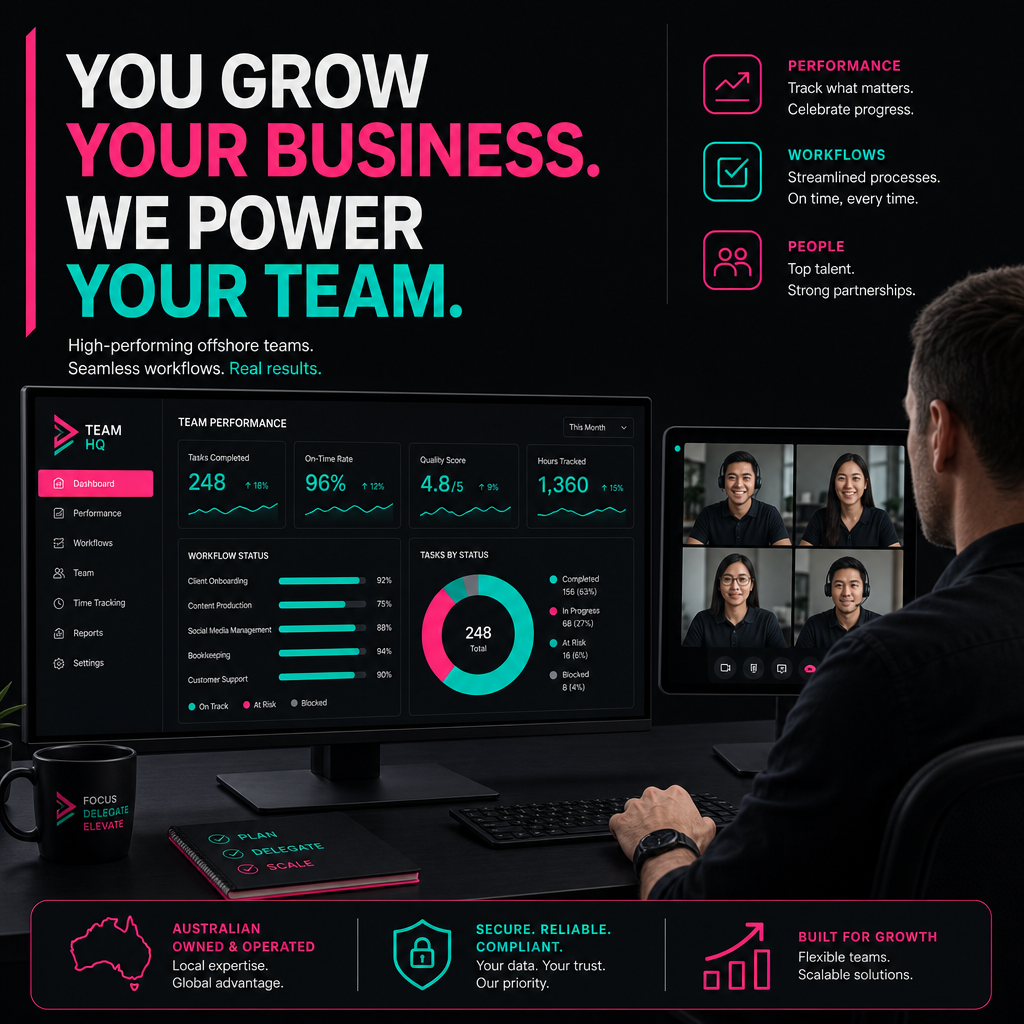
Australian businesses are no longer asking whether to outsource. They are asking whether their outsourcing arrangement actually works. The shift happening right now across accounting firms, marketing agencies, mortgage brokers, and NDIS providers is not from local hiring to offshore hiring. It is from ad hoc offshore contractor arrangements to fully managed outsourcing services that handle recruitment, onboarding, compliance, training, and performance management end-to-end.
The difference matters more than most business owners realise. Adding a contractor from an offshore platform is easy. Getting consistent, reviewable, audit-ready output from that contractor six months later is a different challenge entirely. Most businesses discover this the hard way: a promising hire who delivers inconsistently, a workflow that exists only in someone's head, and a founder who is still the approval bottleneck for work they were supposed to delegate.
This guide covers what managed outsourcing services actually are in 2026, how they differ from staff augmentation and traditional BPO, which business functions are best suited to this model, how to evaluate providers in the Australian market, and what genuine compliance and data security looks like when you are building an offshore team. If you are a business owner ready to move from Doer to Strategist, the answer is not more headcount. It is a delivery structure built around the right people.
Key Takeaways
- Managed outsourcing is distinct from staff augmentation and traditional BPO: it pairs specialist talent with a documented operating system, not just a resume.
- The functions best suited to fully managed offshore delivery include finance and bookkeeping, administration, customer service, and digital marketing.
- Selecting the right managed outsourcing provider in Australia requires evaluating their delivery framework, not just their talent pool or price point.
- Compliance and data security are not optional add-ons: they must be baked into the operating model from day one.
- Remotee clients consistently see 35-50% reductions in non-billable time and operational readiness within 21 days of placement.
- The problem is almost always a delivery structure problem, not a talent problem.
Summary Table: Managed Outsourcing vs Staff Augmentation vs Traditional BPO
| Feature | Staff Augmentation | Traditional BPO | Managed Outsourcing (Remotee) |
|---|---|---|---|
| Who manages the worker | You | The BPO | You are supported by a delivery partner |
| SOP and workflow ownership | Yours to build | BPO's generic templates | Co-built, industry-specific, versioned |
| Compliance responsibility | Yours | Shared or vague | Baked into onboarding and delivery |
| Talent selection rigour | Variable | Volume-based | Top 1% sourced and tested to AU standards |
| Account management | None or reactive | Account manager (reactive) | Dedicated AU account manager (proactive) |
| Time to operational productivity | 4-12 weeks | 4-16 weeks | 21 days |
| 12-month retention rate | Variable | Variable | 95%+ |
| Best for | Short-term capacity gaps | High-volume transactional work | Long-term capability layer |
What Are Managed Outsourcing Services?
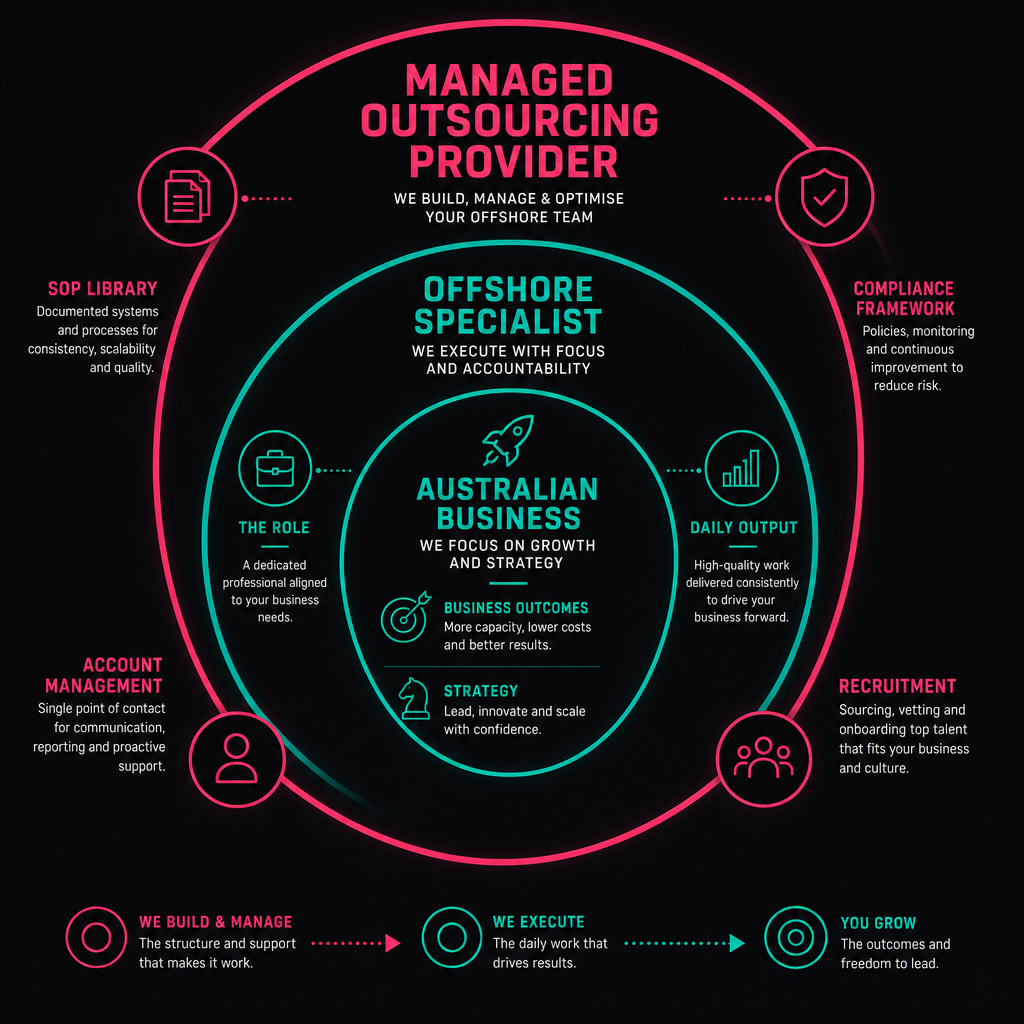
Managed outsourcing services sit in a specific part of the market. They are not a job board. They are not a freelancer platform. And they are not a call centre operator who takes over your customer service queue and replaces your brand voice with a script.
A managed outsourcing provider recruits, onboards, trains, and performance-manages specialist offshore staff on behalf of an Australian business. The business gets the output. The provider maintains the delivery infrastructure. In the best arrangements, that infrastructure includes documented standard operating procedures (SOPs), a compliance framework, regular performance cadence, and a dedicated account manager who understands the Australian regulatory and business context.
In 2026, the model is growing for three concrete reasons. First, the Australian labour market remains tight in skilled professional roles. ABS data shows persistent vacancy rates across accounting, administration, and digital roles that are not resolving through local hiring alone. Second, the maturity of remote work infrastructure, built rapidly between 2020 and 2023, now makes offshore specialist teams genuinely viable in ways they were not a decade ago. Third, and most importantly, Australian business owners have accumulated enough experience with unmanaged offshore contractors to know what goes wrong: unclear expectations, inconsistent output, compliance gaps, and founders who are still doing the work they hired someone else to do.
Managed outsourcing solves that third problem. The keyword is "managed." Talent quality matters, but quality alone is not enough. The real issue is the absence of documented workflows, clear ownership, and repeatable processes. That is a delivery structure problem, and no amount of talent solves a delivery structure problem on its own.
Managed Outsourcing vs Staff Augmentation vs Traditional BPO
These three models are frequently conflated, and the confusion costs Australian businesses money and time. Here is how they actually differ.
Staff Augmentation
Staff augmentation means adding a worker to your existing team to fill a capacity gap. You manage them directly. You own the onboarding. You own the SOPs, or more likely, you do not have SOPs and the new person learns by watching and asking questions. The worker fills a seat. What they produce depends entirely on how well you have structured the role.
For short-term technical projects, augmentation can work. For ongoing operational roles in a business without documented processes, it almost always creates more management overhead than it relieves. I have worked with a digital marketing agency where the founder was the approval bottleneck for every piece of routine work. Tasks lived across inbox, Slack, and memory. When they added a contractor through an augmentation model, the rework rate went up because expectations were still unclear. The headcount increased. The chaos increased with it.
Traditional BPO
Traditional business process outsourcing transfers a function entirely to an external provider. The BPO owns the team, the process, and the output. You receive a report or a deliverable. This model works at volume for highly transactional functions: inbound call handling, data entry at scale, basic claims processing.
The problem for most Australian SMEs and mid-market businesses is that traditional BPO is built for volume, not for nuance. When the ACCC tightens disclosure requirements, or the ATO updates its BAS lodgement rules, or your specific industry has a compliance obligation that the BPO's generic process does not account for, you discover quickly that your outsourced function is running on someone else's template, not yours.
Managed Outsourcing
Managed outsourcing sits between these two models and solves the problems of both. The specialist is sourced for you, but they become part of your operation. The delivery framework, the SOPs, the compliance checkpoints, and the performance cadence are built around your specific workflows and industry context, not a generic template.
The critical distinction is ownership of outcomes. In staff augmentation, you own everything and the provider gives you a body. In traditional BPO, the provider owns everything and you receive output. In managed outsourcing done properly, there is a shared operating model: you own the business outcomes, the provider maintains the delivery infrastructure that makes those outcomes repeatable.
This is why managed outsourcing services are the fastest-growing model among Australian professional services firms, marketing agencies, and compliance-heavy industries right now. It delivers the cost efficiency of offshore talent without the management overhead of building the delivery system yourself.
Which Business Functions Can Be Fully Managed Offshore?
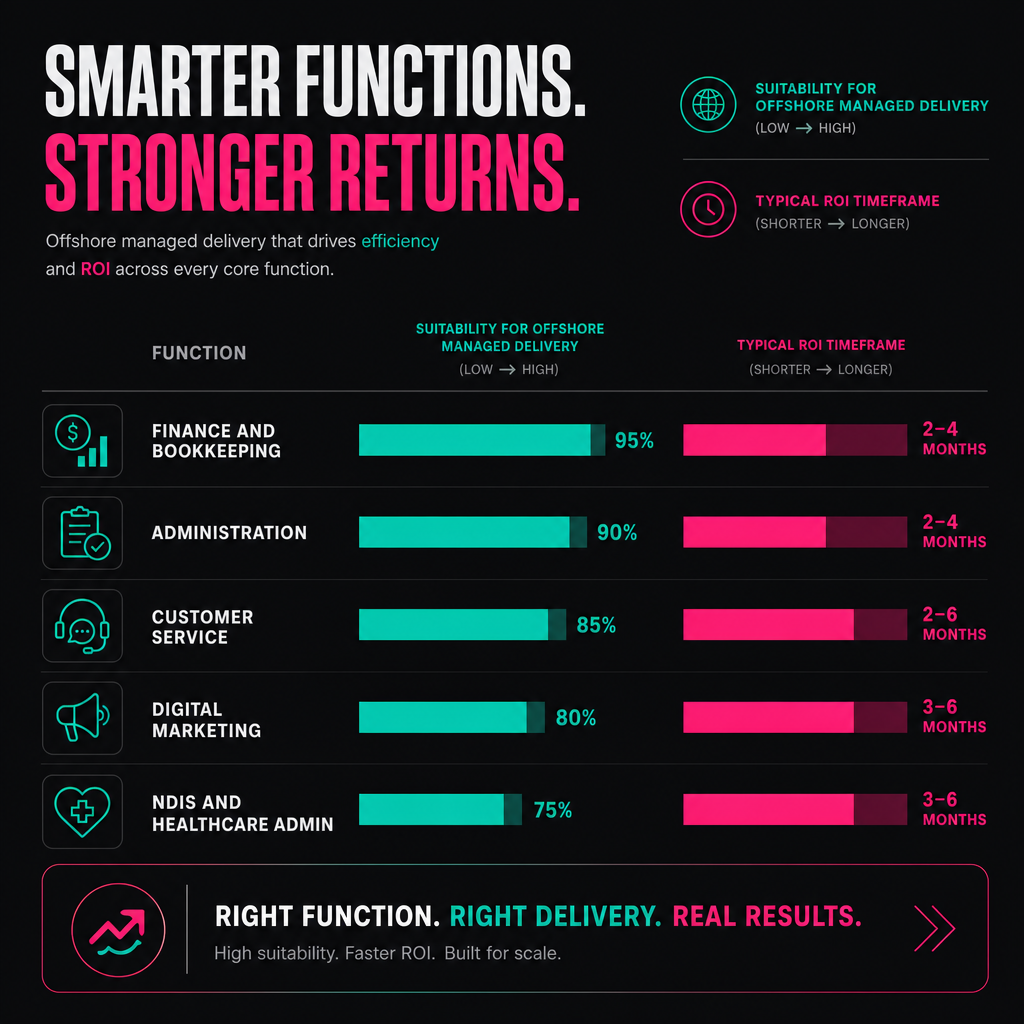
Not every function is equally suited to managed offshore delivery. The sweet spot is work that is process-driven, repeatable, and documentable, but requires genuine expertise rather than just task completion.
Finance, Bookkeeping, and Accounting Support
This is the highest-volume use case in the Australian market. Offshore accounting specialists handle bookkeeping, bank reconciliations, BAS preparation, accounts payable and receivable, payroll processing, and management reporting. The compliance requirements are well-defined (ATO, ASIC, relevant state bodies), which means SOPs can be built with precision.
Across Remotee's accounting firm clients, partners are reclaiming 35-50% of their time previously spent on non-billable prep work. That is not a marketing claim. It is the outcome of installing a control model by workflow risk: delegating the preparation steps while keeping final approvals and sensitive sign-offs internally. The accounting firm I worked with that had the most dramatic result had been blocking delegation at every sensitive step, not because they needed to, but because no one had mapped which steps actually required a licensed professional to own them. Once we separated prep from approval, and introduced evidence capture at checkpoints, the internal team reclaimed hours every week and the audit trail became cleaner, not murkier.
Administration and Operations Support
Virtual executive assistants, operations coordinators, project administrators, and data management specialists all perform effectively in a managed offshore model. The function requires reliable process documentation and a clear communication cadence, which a good managed outsourcing provider installs as part of onboarding.
For a gym and fitness business with inconsistent lead follow-up and unreliable CRM data, we installed a role scorecard for weekly pipeline outcomes, handoff templates with approval gates, and an SOP-led process for CRM hygiene. The result was higher follow-up consistency, improved pipeline visibility, and significantly less admin overhead for the sales leaders. The talent was not the missing ingredient. The delivery structure was.
Customer Service and Client Communications
Onshore Australian businesses frequently resist offshoring customer service because they fear brand voice inconsistency. That concern is valid when the offshore team operates without a managed framework. When they operate with a documented communication style guide, escalation triggers, approval flows, and regular quality reviews, the concern evaporates.
For a mortgage broking business where client updates were inconsistent and requests were getting missed, we installed intake templates, prioritisation rules, a cadence for updates and follow-ups, and checkpoints for outbound comms quality. Client updates became consistent. Missed requests dropped. And the delivery rhythm shifted from reactive to predictable. That business saw a 30% reduction in time-to-settle as a direct consequence of the communication structure, not the headcount change.
Digital Marketing Execution
Content creation, social media scheduling, SEO implementation, paid media support, graphic design, and email marketing are all functions being delivered effectively through managed offshore teams in 2026. Australian digital agencies are using this model to scale delivery capacity without scaling their Australian payroll proportionally.
The key is separating strategy from execution. Strategy stays onshore. Execution, under a well-documented brief and quality checkpoint structure, is delivered offshore. When the quality checkpoint structure is missing, you get rework, missed briefs, and a frustrated account manager who is reviewing and rewriting everything themselves. That is not outsourcing. That is delegation without infrastructure.
NDIS and Healthcare Administration
Compliance-heavy industries like NDIS provision require extra rigour in the managed outsourcing model. Documentation must be complete, exception handling must be explicit, and quality checks must be regular and versioned. An NDIS provider I worked with had incomplete documentation, ad hoc exception handling, and inconsistent quality checks. We installed an SOP pack with compliance steps and exception protocols, an approval owner map with escalation triggers, and a monthly quality review with versioned SOP updates. The outcome was more consistent compliance execution, fewer repeated issues due to an improvements log, and far better reviewability across the operation.
This is what "compliance baked in, not bolted on" looks like in practice.
How to Evaluate Managed Outsourcing Providers in Australia
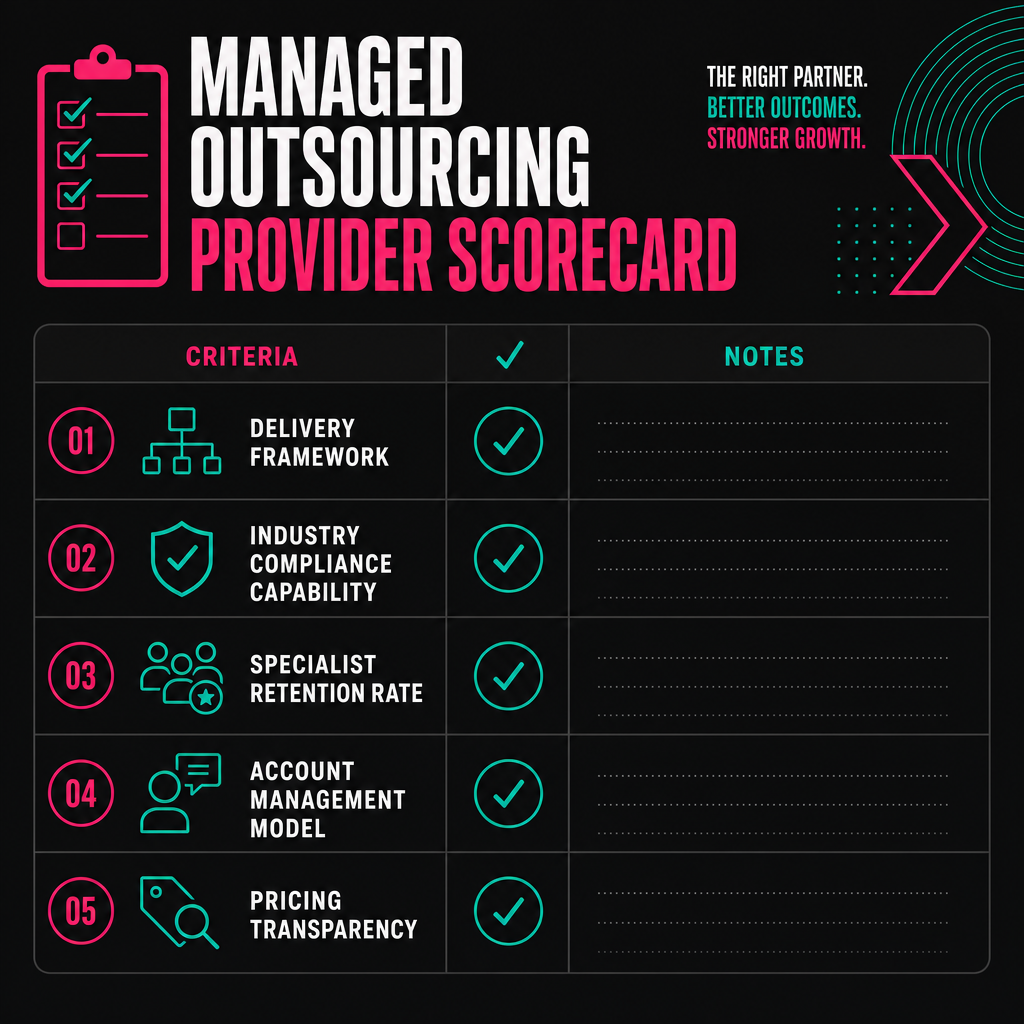
The Australian managed outsourcing market has grown significantly, and not all providers are equal. Here is how to cut through the noise.
Evaluate the Delivery Framework, Not Just the Talent Pool
Every provider will tell you they source high-quality candidates. That is table stakes. The question to ask is: what happens after placement? How is the role structured? Who owns the SOPs? What does the onboarding process look like? How is performance measured and reviewed? If the answers are vague, the provider is competing on resumes. That is staff augmentation with an offshore flavour, not managed outsourcing.
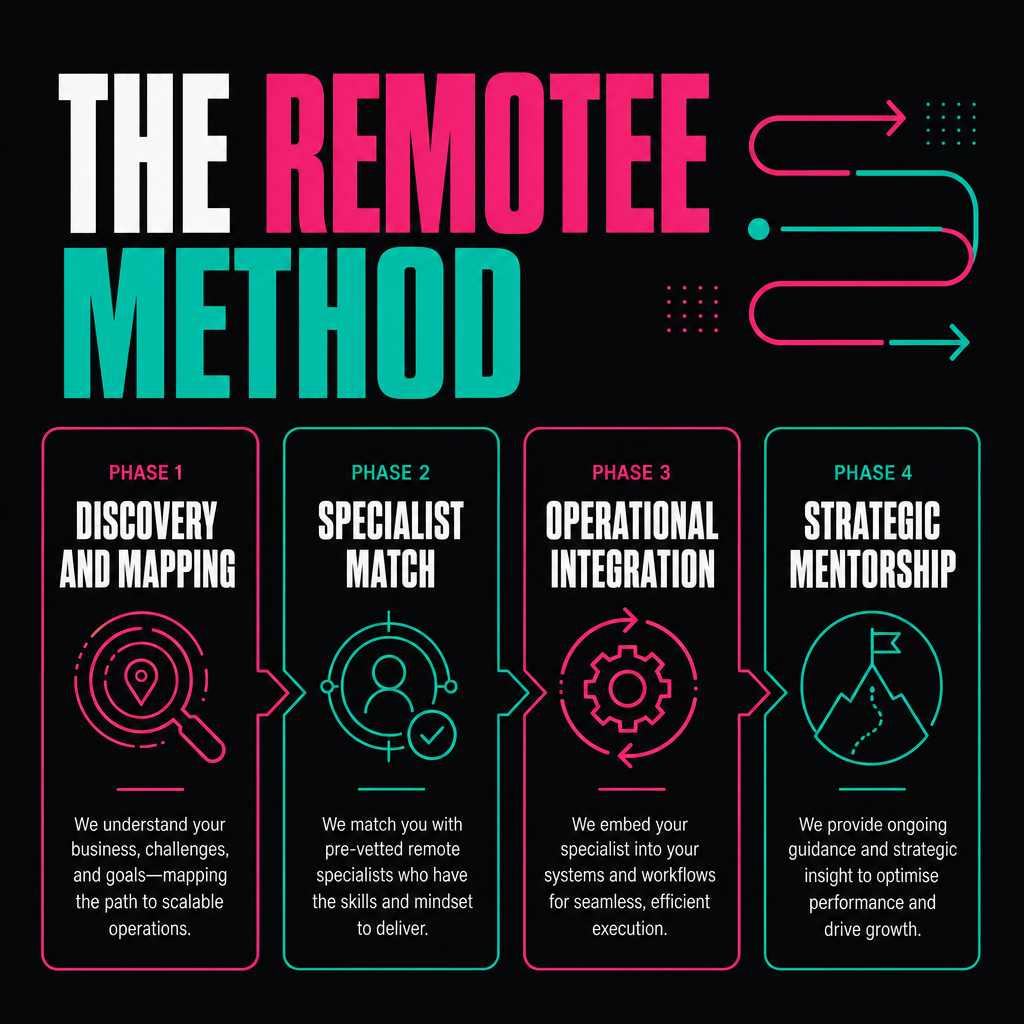
Look for providers who can describe their operating model in specific terms. At Remotee, our process moves through four phases: Discovery and Mapping, Specialist Match, Operational Integration, and Strategic Mentorship. Each phase has defined outputs. The client knows what they are getting and when.
Assess Industry-Specific Compliance Capability
A managed outsourcing provider serving Australian businesses must understand Australian compliance obligations. That means familiarity with ATO requirements, ASIC reporting obligations where relevant, the Privacy Act 1988 and Australian Privacy Principles, industry-specific regulators (NDIS Quality and Safeguards Commission, APRA for financial services), and the Fair Work Act where employment-adjacent relationships need structuring.
Providers who cannot speak to these specifics are building generic SOPs and hoping they translate. They usually do not.
Check Retention Data, Not Just Placement Speed
Recruitment speed is easy to optimise. You lower your quality bar. The metric that actually matters is 12-month specialist retention. Remotee's 12-month retention rate sits above 95%. Industry average for offshore roles across Australian engagements is considerably lower. High turnover in an offshore specialist role means repeated onboarding costs, repeated knowledge loss, and compounding disruption to your operations.
Understand the Account Management Model
Who is your contact when something goes wrong? Is it a ticketing system, an offshore account manager, or a dedicated Australian account manager who understands your business context? The difference in responsiveness and strategic value is significant. For complex, compliance-sensitive functions, a dedicated Australian account manager is not a luxury. It is the mechanism through which your outsourced operation stays aligned with your business as it grows.
Review Pricing Transparency
Managed outsourcing is not the cheapest model. It is more expensive than hiring a contractor on a freelancer platform. What you are paying for is the delivery infrastructure: the SOPs, the compliance framework, the account management, the quality reviews, and the recruitment rigour. If a provider is priced at the bottom of the market, ask what they have removed to get there. You can review Remotee's pricing structure to understand what a transparent, delivery-first model looks like.
The Compliance and Data Security Layer
This is the section most managed outsourcing guides skip or cover superficially. It is also the section that should determine whether a business chooses a provider or walks away.
Australian Privacy Principles and Cross-Border Data Flows
Under the Privacy Act 1988, Australian businesses that disclose personal information to overseas recipients retain accountability for how that information is handled. This is not a grey area. If your offshore specialist has access to client records, financial data, or health information, your business has obligations around how that data is stored, transmitted, and protected.
A managed outsourcing provider should be able to demonstrate: secure access protocols (VPN, two-factor authentication, role-based access controls), data residency clarity (where data is stored and under what jurisdiction), contractual clauses that extend your privacy obligations to the offshore arrangement, and incident response procedures.
Providers who treat this as an afterthought are exposing your business to OAIC enforcement action and reputational damage. Compliance-ready systems are not optional. They are the foundation.
Industry-Specific Compliance Obligations
For accounting firms, this means client data handled in accordance with TPB guidelines. For NDIS providers, it means adherence to the NDIS Practice Standards. For financial services businesses, APRA and ASIC expectations around third-party risk management apply. For health businesses, the My Health Records Act and relevant state health privacy legislation come into play.
The right managed outsourcing provider does not just say "we are compliant." They show you the SOP library entries that operationalise compliance for your specific industry, and they update those entries when the regulatory landscape changes. That is what audit-ready compliance looks like in practice.
Intellectual Property and Confidentiality
Every offshore specialist engagement should be wrapped in a confidentiality deed and a clear IP assignment clause. Work product created by your offshore specialist should belong unambiguously to your business. This needs to be documented at the start of the engagement, not negotiated after a dispute arises.
Case Studies: Real ROI from Managed Outsourcing in Australia
Case Study 1: Accounting Firm Reclaims Partner Capacity
A mid-sized accounting firm with four partners was spending the majority of their billable time reviewing and reworking preparation tasks that should have been completed before hitting their desk. The constraint was not the number of partners. It was the absence of a delegable preparation workflow.
We ran a Discovery and Mapping engagement, identified every workflow step that required a CPA-level professional versus those that required competent preparation, and built an SOP library around the preparation layer. A Remotee accounting specialist was placed within 21 days. Within 90 days, the firm had reclaimed 40% of combined partner time on non-billable prep work. That freed capacity was redeployed into advisory engagements that generated significantly higher revenue per hour. The audit trail for every lodgement improved, not because the partners were more careful, but because the evidence capture process was now systematic.
The firm's managing partner described it plainly: the person we hired is good. The system around them is what made the difference.
Case Study 2: Mortgage Broking Business Accelerates Settlement Pipeline
A boutique mortgage broking operation was losing clients at the post-approval stage due to inconsistent communication. Clients were not receiving timely updates. Requests were falling through the gaps between broker and admin. The settlement pipeline felt reactive rather than managed.
We installed a Remotee client communications specialist alongside a managed delivery framework: intake templates, a weekly update cadence, prioritisation rules for urgent requests, and quality checkpoints for all outbound client communications. Within the first quarter, the business recorded a 30% reduction in average time-to-settle, driven primarily by fewer communication delays and missed handoffs. Client referral rates increased. The lead broker's comment: I have gone from chasing updates to reviewing dashboards.
What These Case Studies Have in Common
Neither result came from sourcing a better candidate. Both results came from installing a delivery structure around a capable specialist. The talent was necessary. The system was the differentiator. That is the Remotee thesis in practice: predictable delivery, not just headcount. You can see more outcomes like these in our case studies.
How Remotee Delivers Managed Outsourcing
Remoter is built for established Australian businesses with repeatable operations who want compliance-ready systems and a long-term capability layer. The model is not designed for businesses that want a quick hire and are comfortable managing the rest themselves. It is designed for business owners who want to stop being the delivery system and start being the decision-maker.
The Remotee Method
Phase 1: Discovery and Mapping. We audit your existing workflows and map your complete software ecosystem. The output is an operational blueprint: a clear picture of what you do, how you do it, where the gaps are, and which roles can be delegated offshore with the right support structure in place.
Phase 2: The Specialist Match. We headhunt from the top 1% of Philippine talent. Every candidate is technically tested against Australian industry standards. We are not running a recruitment platform where you filter resumes. We are selecting the right person for your specific operation.
Phase 3: Operational Integration. The specialist is delivered alongside a library of industry-specific SOPs with compliance baked in. Onboarding is tied to real outputs, not just orientation. Early deliverables are reviewed against checkpoints. The specialist is productive within 21 days, not 12 weeks.
Phase 4: Strategic Mentorship. Your dedicated Australian account manager works with you on an ongoing basis to move you from Doer to Strategist. Issues become versioned SOP improvements. The system gets stronger over time, not just maintained.
For businesses exploring custom team configurations, our custom teams solution covers multi-role offshore team builds with the same delivery infrastructure applied at scale.
The Remotee Operating System
Every client engagement runs on The Remotee Operating System. This is not a project management tool. It is a structured delivery methodology applied to every role:
- Define outcomes and done: before any work begins, success is documented in scannable, measurable terms. No ambiguity about what "good" looks like.
- Document the workflow: SOPs with exceptions, tool rules, and escalation triggers so work never relies on memory or heroics.
- Train and validate early delivery: training is tied to real outputs, not theory. Early work is reviewed against checkpoints before it becomes self-managed.
- Install cadence and accountability: a recurring review rhythm where performance is visible, issues are addressed in real time, and improvements are written back into the SOP library.
For businesses exploring how AI tools can be layered into this operating system, our AI implementation support solution integrates automation into the managed delivery framework without creating new compliance risks.
Why Reliability Beats Cost and Speed
Most outsourcing providers compete on cost, speed, or the quality of resumes they can supply. These are the wrong metrics for businesses that need consistent output over 12, 24, or 36 months. Remotee competes on reliability. The talent is paired with a delivery system so outcomes are predictable, reviewable, and easier to manage long-term.
Systems over heroics. That is the operating principle. A business that depends on one excellent person to hold everything together is one resignation away from a crisis. A business with documented workflows, clear ownership, and a versioned SOP library is resilient regardless of who fills the role.
If you are ready to build a fully managed offshore team with the delivery infrastructure to make it work, speak with the Remotee team and we will map the right solution for your business.
References
-
Australian Bureau of Statistics, Labour Force and Job Vacancy data, 2026, ABS publishes quarterly data on job vacancy rates across Australian industries, including administration, finance, and professional services. Used to substantiate ongoing labour market tightness in skilled roles.
-
Office of the Australian Information Commissioner (OAIC), Australian Privacy Principles Guidelines, The OAIC's official guidelines on the Privacy Act 1988 and the Australian Privacy Principles, including APP 8 covering cross-border disclosure of personal information. Used to substantiate compliance obligations for Australian businesses engaging offshore workers.
-
NDIS Quality and Safeguards Commission, NDIS Practice Standards, The official practice standards for NDIS registered providers, covering documentation, quality management, and incident reporting obligations. Used to substantiate compliance requirements for NDIS providers using offshore administrative support.
-
Australian Taxation Office, Tax Practitioner Board Guidelines on Outsourcing, TPB guidance for registered tax agents and BAS agents on their obligations when using offshore support staff, including supervision and responsibility requirements. Used to substantiate compliance framework requirements for accounting firm outsourcing engagements.
-
Deloitte Access Economics, Future of Work in Australia 2026, Research report examining workforce trends, remote work adoption, and offshore delivery models among Australian SMEs and mid-market businesses. Used to contextualise growth in managed outsourcing models.
-
ASIC, Regulatory Guide 259: Risk Management Systems of Responsible Entities, ASIC guidance on third-party and outsourcing risk management for financial services licence holders. Relevant to financial services businesses building managed offshore teams.
FREQUENTLY ASKED QUESTIONS
Common questions
What is the difference between managed outsourcing and staff augmentation?
- Staff augmentation adds a worker to your team and leaves you responsible for managing, onboarding, and directing that person. Managed outsourcing provides the specialist plus the delivery framework: the SOPs, compliance structure, performance cadence, and account management. The outcome is consistent, reviewable output rather than capacity that you still have to manage yourself.
How long does it take to get a managed offshore specialist operational with Remotee?
- Remotee's placement-to-operational timeline is 21 days from confirmed placement. This includes the Discovery and Mapping phase, specialist selection and testing, SOP build-out, and the initial onboarding and early delivery validation period.
What business functions work best with fully managed outsourcing?
- The functions with the strongest ROI in managed offshore models are accounting and bookkeeping support, administration and operations coordination, customer service and client communications, digital marketing execution, and compliance-adjacent administrative roles in industries like NDIS provision and financial services. The common thread is that these functions are process-driven, repeatable, and documentable.
How does Remotee handle Australian compliance and data security for offshore teams?
- Compliance is baked into the operating model from day one, not added as an afterthought. This includes secure access protocols (VPN, two-factor authentication, role-based access controls), data handling SOPs aligned to the Australian Privacy Principles under the Privacy Act 1988, industry-specific compliance steps for regulated industries, confidentiality deeds, and IP assignment clauses for all specialists. Your dedicated Australian account manager keeps the compliance framework current as regulations change.
What is the 12-month retention rate for Remotee specialists?
- Remotee's 12-month specialist retention rate is above 95%. This is significantly higher than industry average for offshore roles in the Australian market and reflects both the rigour of the specialist selection process and the quality of the ongoing managed support environment.
How does managed outsourcing differ from a traditional BPO arrangement?
- Traditional BPO transfers a function to an external provider who runs it on their own generic processes and templates. Managed outsourcing builds the delivery infrastructure around your specific workflows, your compliance obligations, and your industry context. You retain ownership of the business outcomes. The managed outsourcing provider maintains the delivery system that makes those outcomes repeatable. The specialist integrates into your operation rather than sitting inside a separate provider's process factory.
What does managed outsourcing cost compared to local hiring in Australia?
- Managed outsourcing with a provider like Remotee typically costs 40-60% less than the equivalent fully-loaded local hire in Australia (salary, superannuation, leave entitlements, office costs, recruitment fees, and management overhead). For accounting and professional services functions, the ROI calculation also includes the value of partner and senior staff time reclaimed from non-billable work, which across Remotee's client base has averaged a 35-50% reduction.
Is managed outsourcing suitable for businesses that do not yet have documented processes?
- Yes, and this is actually where managed outsourcing delivers the most value. Businesses without documented processes benefit from the Discovery and Mapping phase, which builds that documentation as the foundation of the engagement. The common mistake is waiting until your processes are fully documented before engaging a managed outsourcing partner. The provider's job is to help you build that capability layer, not to inherit one that already exists.

Jon Kelly
Founder, Remotee
Jon helps Australian businesses build compliance-led offshore teams that scale without the burnout. NDIS, accounting, mortgage broking, recruitment and digital marketing.
KEEP READING
Related posts
managed staffing versus freelancer platforms
Managed Offshore Staffing vs Freelancer Platforms: Which Model Actually Delivers for Australian Businesses?
Managed offshore staffing suits ongoing, business-critical work because it wraps talent in documented workflows, compliance and a replacement guarantee. Freelan…
12 September 2026 · 15 min read
offshore staffing company comparison criteria
Offshore Staffing Company Comparison Criteria: How Australian Businesses Should Evaluate Providers
Direct Answer: The criteria that actually predict offshore staffing outcomes are the employment and compliance model, documented delivery workflows, supervision…
11 September 2026 · 16 min read
offshore staffing implementation timeline
Offshore Staffing Implementation Timeline: What Australian Businesses Should Expect Week by Week
A realistic offshore staffing implementation timeline runs 8 to 12 weeks from scoping to a fully productive seat: roughly 2 weeks for role design and process do…
6 September 2026 · 16 min read
READY TO SCALE WITHOUT THE BURNOUT?
Build a compliance-led offshore team in 3–4 weeks.
Tell us about your current bottleneck and we'll show you what a Remotee placement would look like for your operation.
Or get our playbooks emailed to you instead.